It’s October. You’re checking your employee benefits before open enrollment, and your health FSA still has $900 in it.
You remember someone at work saying you need to use the money before the end of the year.
So you start wondering whether you should book appointments, order new glasses, or find something eligible to buy before December 31.
But before spending anything, there’s a much more useful question:
Does your FSA actually require you to use that entire $900 by the end of your plan year?
The answer depends on your employer’s plan. Some health FSAs allow a limited amount to carry into the next year. Others give you extra time to incur medical expenses. Some provide neither.
And there’s a second deadline that can be just as important: the date by which you must submit reimbursement claims for expenses you’ve already incurred.
Those two dates aren’t necessarily the same.
If you confuse them, you could rush to spend money unnecessarily—or miss the deadline to claim money for medical care you’ve already received.
First, Find Out Which Kind of FSA Deadline You Have
Under IRS rules, an employer-sponsored health FSA generally follows the “use it or lose it” principle.
Unused funds are forfeited unless the employer’s plan includes a permitted extension.
For a regular health FSA, the plan can offer a grace period, a carryover, or neither. It cannot offer both extensions for the same applicable plan year.
Here’s what that means for someone with money left near year-end.
| Your plan provides | What happens to unused money | What you need to check |
|---|---|---|
| Grace period | You can use the previous year’s eligible balance for care incurred during extra time, up to 2½ months after the plan year ends | Your plan’s actual grace-period end date |
| Carryover | Up to the plan’s permitted limit moves into the next plan year; excess funds are forfeited | The dollar limit and any re-enrollment conditions |
| Neither | Unused money is forfeited when the plan year ends | Your plan-year end date |
The IRS establishes the outer limits. Your employer’s plan determines which option you actually have.
For plan years beginning in 2026, the IRS maximum permitted health FSA carryover is $680. An employer can choose a smaller amount or no carryover at all.
That $680 is the maximum amount that may move from a plan year beginning in 2026 into the following plan year, not an automatic benefit for every FSA holder.
The IRS explains the general rules in Publication 969, while Revenue Procedure 2025-32 provides the 2026 inflation-adjusted limit.
What Would Happen to That $900?
Let’s return to the hypothetical employee with $900 remaining.
Assume the employer uses a calendar-year health FSA ending December 31, 2026, and that $900 is the final unused amount after all applicable claims are accounted for.
Three employees could have the same $900 balance and face very different outcomes.
Employee A: The plan has a carryover
Suppose the employer permits the full $680 carryover allowed for a plan year beginning in 2026.
Then:
- $680 can move into the next plan year.
- $220 is forfeited.
That’s because $900 minus $680 equals $220.
But if the employer allows only a $500 carryover, the result changes: $500 moves forward and $400 is forfeited.
The plan’s actual limit—not simply the IRS maximum—is what matters.
Some plans also condition a carryover on enrolling in the health FSA for the next year. Check whether yours does before open enrollment closes.
Employee B: The plan has a grace period
Now suppose the employer offers the full permitted grace period instead of a carryover.
For a plan year ending December 31, 2026, the full grace period would extend through March 15, 2027.
Eligible medical care received during that period could be reimbursed from the unused 2026 balance.
The employee isn’t automatically carrying $900 into a new plan year. They’re receiving extra time to incur eligible expenses against the old balance.
And if some money remains after the grace period, it is forfeited.
A shorter employer-provided grace period would mean an earlier deadline.
Employee C: The plan has neither
This employee’s $900 is at risk of forfeiture when the plan year ends.
There is no carryover and no additional period to incur expenses using that year’s balance.
However, that doesn’t mean all reimbursement paperwork must necessarily be submitted on December 31.
The plan may still allow time afterward to file claims for qualifying expenses incurred before the plan year ended.
That distinction is where the second deadline comes in.
You Can Have Time to Submit a Claim Without Having More Time to Spend
This is the part I’d want every FSA holder to understand before the end of the year.
Your spend-by deadline and your submit-by deadline answer two different questions.
The spend-by date determines when an eligible medical expense must be incurred to count against the relevant FSA balance.
The submit-by date determines how long you have to file the reimbursement claim for that expense.
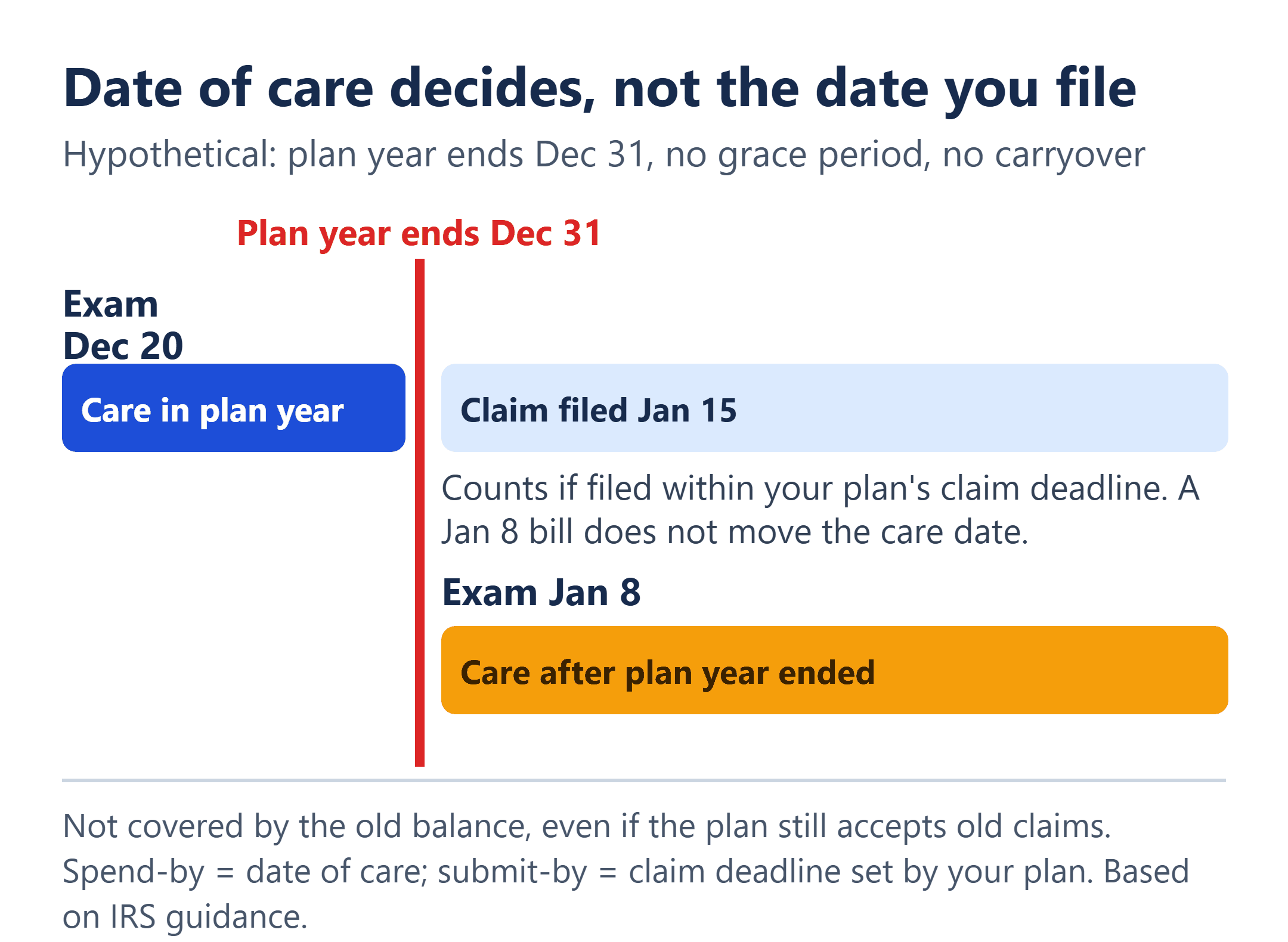
Consider this hypothetical situation:
Your employer’s health FSA plan year ends December 31, and the plan has neither a grace period nor a carryover.
You have an eligible eye exam on December 20.
The provider doesn’t send the bill until January 8, and you submit the claim on January 15.
Could the claim still qualify?
Potentially yes, if the medical expense was incurred while you were covered and you submit it within your plan’s claim-filing deadline.
The date of care matters. The fact that the bill arrived in January doesn’t automatically turn the December appointment into a January expense.
Now change the situation.
Suppose the eye exam actually takes place January 8, after the December 31 plan year ends.
Without a grace period or applicable carried-over funds, that January care generally cannot be reimbursed from the previous year’s forfeited balance merely because the plan is still accepting old claims.
That’s what the run-out period does—and doesn’t—allow.
What is a run-out period?
A run-out period is additional time to submit reimbursement claims for expenses incurred during the applicable coverage period.
It is not automatically additional time to incur new expenses.
Your employer’s plan sets the claim-submission deadline. There isn’t one universal IRS-mandated run-out length that applies to every health FSA.
So if a coworker tells you, “Our FSA deadline is in March,” that isn’t enough information.
March could refer to the end of a grace period, a claim-submission deadline, or something else in the plan.
You need to know which.
Before Buying Anything, Check for Medical Expenses You’ve Already Paid
There’s another way to approach a leftover FSA balance that doesn’t begin with shopping.
Look at the medical expenses you’ve already incurred during the coverage period.
Maybe you paid a copay with your regular credit card. Maybe you bought prescription glasses but never submitted the receipt. Maybe a dental office sent a bill and you forgot to request reimbursement.
Those are examples worth checking against your plan’s eligible-expense rules.
The money may already have a legitimate reimbursement use without you scheduling a new appointment or buying something you don’t need.
If one of those bills is a hospital bill that’s more than your FSA balance can cover, check whether you can still apply for hospital financial assistance after the bill has arrived before deciding how to pay the rest.
Here’s the order I’d follow.
First, review expenses already incurred. Look through medical, dental, and vision records for expenses that haven’t been reimbursed.
Second, confirm eligibility. IRS Publication 502 describes medical expenses generally, but your FSA plan and administrator determine the applicable reimbursement requirements.
Third, collect the required documentation. A reimbursement claim generally needs independent substantiation showing the expense and amount, such as an itemized provider statement. A credit card total by itself may not be sufficient.
If that itemized statement is far higher than a good faith estimate you received before the care, how to check the $400 test for each provider and file a dispute explains what to compare first.
Finally, submit before your plan’s claim deadline. Don’t wait until the last day if you can avoid it.
And remember: your employer generally cannot simply pay the leftover FSA balance back to you as cash because you didn’t use it.
Where to Find Your Real Deadlines
You don’t need to memorize the entire IRS rulebook.
You need five pieces of information about your own plan:
- Plan-year start and end dates. Not every employer uses January 1 through December 31.
- Extension type. Grace period, carryover, or neither.
- Carryover conditions, if applicable. The dollar limit and whether you must re-enroll.
- Claim-submission deadline. The last date your administrator accepts claims for the applicable plan year.
- Account type. Confirm you’re looking at a health FSA, not a dependent care FSA or HSA, which follow different rules.
Look in your Summary Plan Description, benefits enrollment materials, or FSA administrator information.
If the dates aren’t clear, ask HR or the administrator.
A useful message would be:
“I have unused money in my health FSA. Can you confirm whether our plan has a carryover, a grace period, or neither? I also need the last date an expense can be incurred for this plan year and the final deadline for submitting reimbursement claims. If there’s a carryover, do I need to re-enroll to keep it?”
That question is much more useful than simply asking, “When does my FSA expire?”
It separates the rules that actually determine what happens to your balance.
Leaving Your Job? Your FSA Has a Different Clock
Year-end isn’t the only time FSA money can be lost.
Imagine you’re leaving your employer in November, but the company’s health FSA plan year doesn’t end until December.
You might assume you can continue using the account through the end of the year because you’ve already contributed through payroll.
That isn’t necessarily true.
Your health FSA coverage generally ends when your plan says participation ends. That date may differ from the plan-year end.
Eligible expenses incurred while you were still covered can generally be submitted afterward, as long as you meet the applicable claim-filing deadline.
But expenses incurred after coverage ends generally aren’t reimbursable unless coverage is continued under an applicable arrangement.
Some health FSAs are subject to COBRA continuation requirements. If continuation is offered and you elect it, the coverage and payment rules depend on the plan and your COBRA election materials.
There’s also an easily overlooked distinction while you’re actively covered: a health FSA generally makes the full annual elected reimbursement amount available during the coverage period, minus amounts already reimbursed, even if you haven’t contributed that entire amount through payroll yet.
That doesn’t mean you should assume unused funds will remain available after employment ends.
Before your last day, ask HR for your FSA coverage end date, the claim-submission deadline for expenses incurred while covered, and whether FSA COBRA continuation is available.
Those answers matter more than the balance displayed in your account alone.
The Question to Answer Before December Arrives
When someone says, “Don’t forget to spend your FSA,” the advice isn’t necessarily wrong.
It’s incomplete.
For one employee, the right action may be submitting receipts for care already received.
For another, it may be confirming that $680—or a smaller plan-approved amount—can carry from a plan year beginning in 2026 into the next one.
For someone with a grace period, there may be extra time to incur eligible expenses.
And for someone leaving a job, the relevant deadline might arrive well before the end of the calendar year.
Don’t treat the balance shown in your FSA account as money you automatically have until December 31—or as money you’re automatically going to lose that day.
Find your plan’s design. Identify the last date expenses can count. Then find the separate date by which claims must be submitted.
Once you know those two dates, you can make a much better decision about what to claim, what you still need, and what could genuinely be forfeited.
Sources and scope: IRS Publication 969, IRS Revenue Procedure 2025-32, IRS Publication 502, and IRS guidance on health FSA grace periods, carryovers, and reimbursement timing. Reviewed October 16, 2026. The $680 carryover ceiling applies to plan years beginning in 2026; an employer may permit less or none. This article covers employer-sponsored health FSAs, not dependent care FSAs or HSAs. Your employer’s plan documents control your actual deadlines, eligibility, and continuation options.