Picture a hypothetical pest control owner with three trucks and one tech in each. GorillaDesk’s pricing page shows Basic at $49 a month, so the owner does the obvious math: $49 × 3 = $147.
The page’s own route slider says $149 for three routes on Basic. Close enough. But add a fourth truck and Basic goes to $179, not $196, because after the third route each extra one adds $30 instead of $50. Pro doesn’t get that break. It keeps adding $50 a route, so the gap between the two plans starts to widen right as you grow.
GorillaDesk is priced per route, meaning a technician’s schedule, not per user. Office staff, admins and mobile devices are free on every plan. One route costs $49 a month on Basic and $99 on Pro; three routes cost $149 and $199. Annual billing is 11 months’ price for the year, charged up front, with no refunds. Texting isn’t in any plan price: it’s $5 a month plus prepaid credits.
The prices below are GorillaDesk’s published US list prices as of October 2026, taken from its pricing page, Terms of Service and Help Center. They aren’t from a GorillaDesk account or a real invoice, and every business in this post is an illustration.
How many routes will GorillaDesk bill you for?
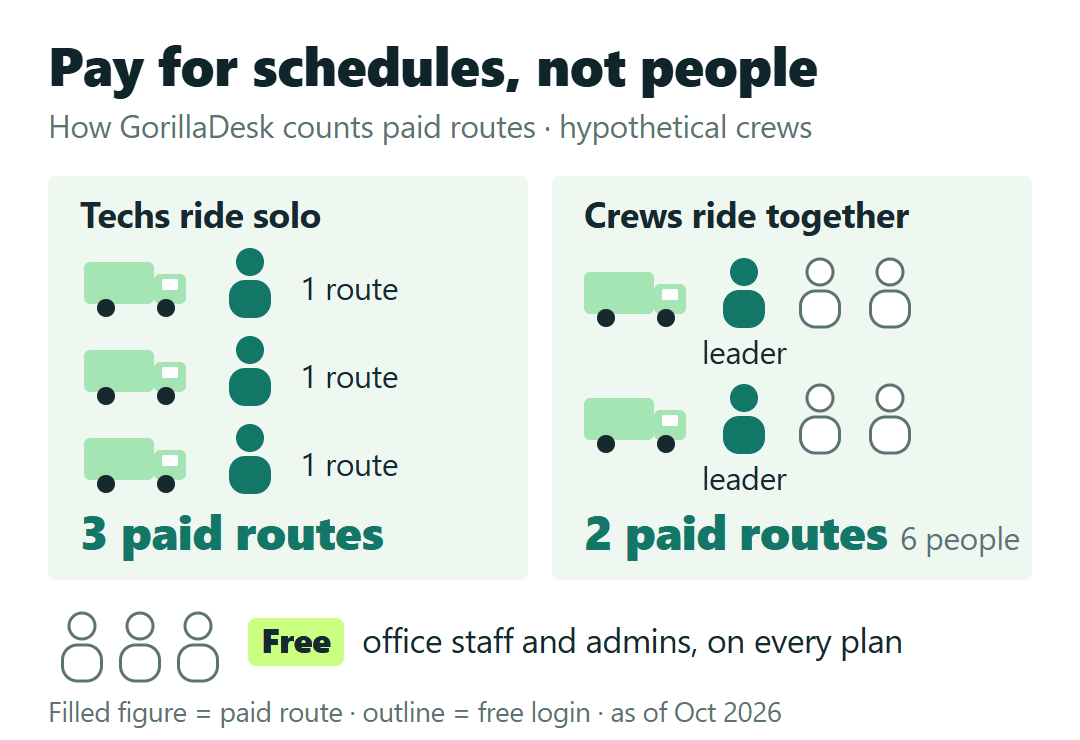
GorillaDesk’s pricing page asks one question: how many routes do you have? A route is a schedule, and only users assigned to a schedule need a paid seat. Everyone else, from the office manager to whoever answers the phone, gets a free login.
How you count schedules depends on how your techs work:
- Riding solo: each technician who runs their own stops needs their own schedule.
- Riding together: you assign schedules to crew leaders or supervisors only, not to every person on the truck.
Take a hypothetical lawn care company with two trucks and three people on each. That’s six people in the field but only two schedules, one per crew leader. At two routes, Basic is $99 a month and Pro is $149, and the other four crew members and the office add nothing to the bill.
The counting is the same whether the routes are pest, lawn or pool. If you run pool routes and are also pricing pool-specific software, our Skimmer vs. Pool Brain pricing breakdown works through billing per pool versus per tech, which is worth having next to this number.
What GorillaDesk costs at 1 to 5 routes
Here’s the ladder for a small route business, read from GorillaDesk’s pricing page. Each cell shows the monthly price, then the annual price billed up front.
| Routes | Basic | Pro | Growth | Pro over Basic, per month |
|---|---|---|---|---|
| 1 | $49 / $539 | $99 / $1,089 | $149 / $1,639 | $50 |
| 2 | $99 / $1,089 | $149 / $1,639 | $249 / $2,739 | $50 |
| 3 | $149 / $1,639 | $199 / $2,189 | $299 / $3,289 | $50 |
| 4 | $179 / $1,969 | $249 / $2,739 | $349 / $3,839 | $70 |
| 5 | $209 / $2,299 | $299 / $3,289 | $499 / $5,489 | $90 |
| 10 | $359 / $3,949 | $549 / $6,039 | $749 / $8,239 | $190 |
Growth figures are the ones on the pricing page’s Growth card. If you’re considering Growth, confirm the price on the checkout screen before you pay.
Two things in that table matter more than the headline $49.
The steps aren’t flat. On Basic, routes two and three each add $50, and every route after that adds $30. Pro adds $50 for every route. Growth’s fifth route adds $150 ($349 → $499).
So the Pro premium grows with your fleet. It’s $50 a month at one to three routes, $70 at four, $90 at five and $190 at ten. Going from four routes to five costs $30 more on Basic ($179 → $209) but $50 more on Pro ($249 → $299).
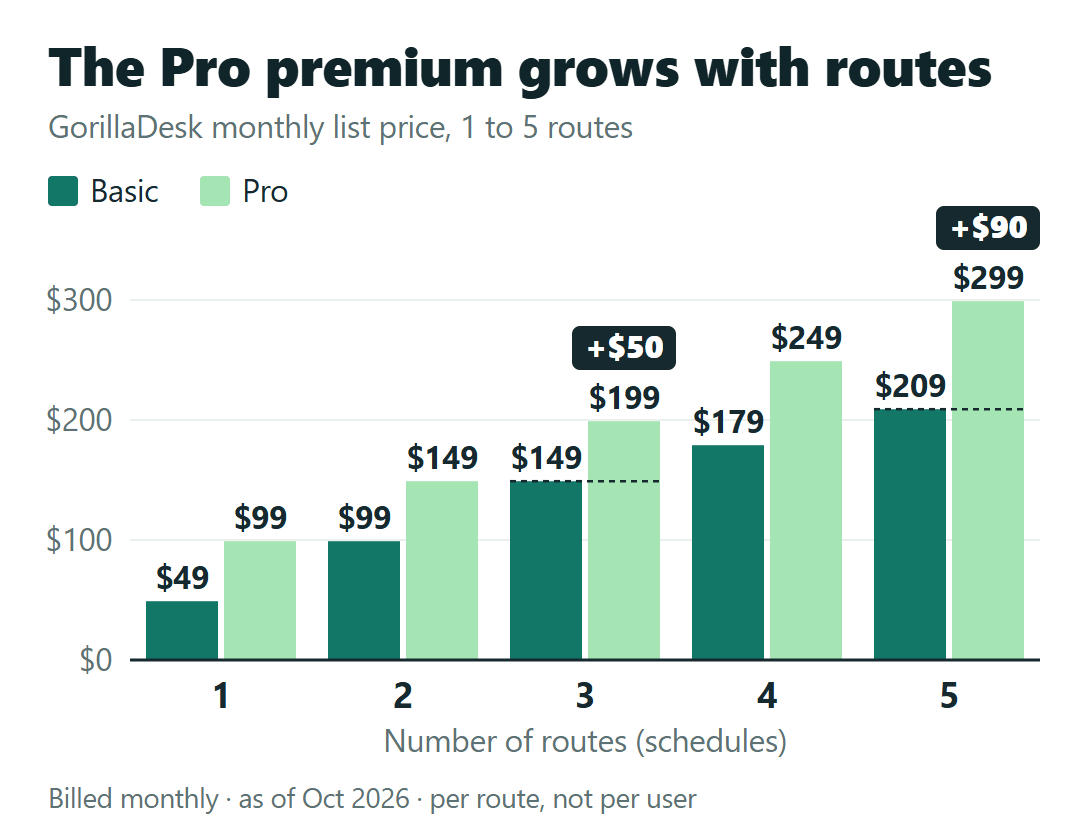
Don’t price your account by multiplying $49 by your truck count. Find your row.
Basic or Pro: what the extra $50 to $90 a month buys at 1 to 5 routes
Basic already covers the daily route work: scheduling, invoicing and estimates, payments through your own Square or Stripe account, automated email and SMS reminders, and material (chemical) tracking and reporting. It also puts your stops in the best order, up to 25 stops at a time.
The rows that separate the two plans for a small route company:
| What you need | Basic | Pro |
|---|---|---|
| Route optimization | Up to 25 stops at a time | Drive Matrix real-time street routing |
| QuickBooks Online sync | Not included | Included |
| GPS tracking of your team’s location and history | Not included | Included |
| Online booking and a customer portal | Not included | Included |
| Barcode tracking for traps, bait stations and equipment | Not included | Included |
| Recurring subscription billing through Stripe or Square | Not included | Included |
Pro also adds review generation, documents with e-signatures and time clocking. The full feature list is on GorillaDesk’s pricing page.
My practical reading: the question isn’t whether Pro has more, it’s whether any one of those rows is something you’d use every week. If you service traps and bait stations, barcoding is the row to look at. If your days regularly run past 25 stops, routing is. If none of the Pro rows fits how you work, Basic does the job and the difference stays with you.
If QuickBooks Online sync is the main reason you’d move to Pro, make sure QuickBooks Online is the bookkeeping you’ll actually keep paying for. Our QuickBooks Online vs. Wave comparison for small contractors covers when paying for bookkeeping starts to make sense.
Texting is a separate bill on every plan
Automated SMS reminders are on every plan, but GorillaDesk won’t send a single text until you turn on the SMS add-on. That’s $5 a month for a local texting number, plus prepaid credit packs:
- $50 for 1,000 credits (5 cents each)
- $100 for 2,500 credits (4 cents each)
- $200 for 8,000 credits (2.5 cents each)
One credit covers one outgoing message of up to 160 plain-text characters, and a single emoji drops that limit to 70. Incoming texts are free. A call to your SMS number forwards to your business line for 4 credits.
Credits never expire, but packs auto-renew when 50 credits remain, and they’re non-refundable.
Example: three routes on Pro, with reminder texts
Take a hypothetical three-tech pest company, each tech running a truck alone, on Pro at $199 a month. Say it sends 300 one-segment reminder texts a month on the $50 / 1,000 pack: 300 × $0.05 = $15 in credits, plus the $5 number, is $20 a month. That brings the monthly total to about $219.
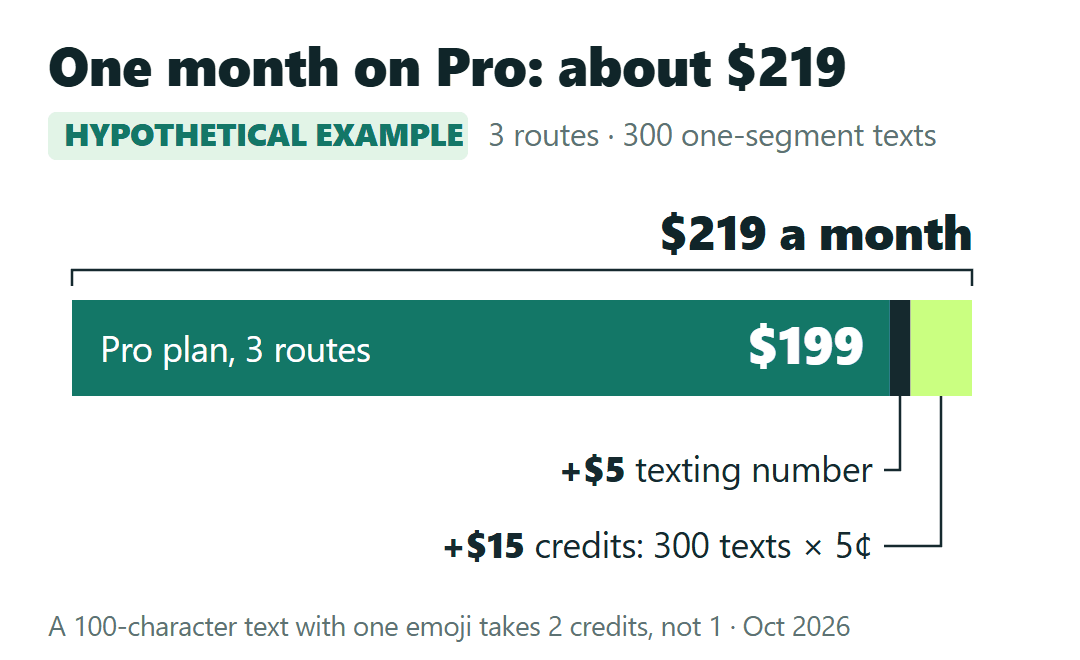
The cash doesn’t leave evenly: in practice you’d pay $50 for a pack about every three months, plus $5 each month. And if those same reminders ran about 100 characters with one emoji, each would take 2 credits, so 600 credits, or $30 plus $5 = $35 a month.
For your own number: $5 + (outgoing texts per month × credits per text × the per-credit price of your pack).
Monthly or annual: one free month against money you can’t get back
Annual billing is 11 times the monthly price for the same route count, charged for the whole year at the start. In plain terms, you get one month free.
For a hypothetical one-truck operator on Basic, that’s $539 up front instead of 12 × $49 = $588, a $49 saving. For the three-route Pro company above, it’s $2,189 instead of 12 × $199 = $2,388, a $199 saving.
What you give up is room to change your mind:
- No refunds once a subscription period starts. If you cancel, you keep access until the end of the period you paid for.
- Upgrades happen any time; downgrades wait. A downgrade takes effect at the end of the current billing cycle, which on an annual plan means the end of the year.
- Adding a route on an annual plan goes through GorillaDesk’s Customer Success team, not the pricing slider.
Monthly plans are month-to-month, with no contract and no setup fee, and you can cancel any time without a penalty. There’s also a 14-day free trial with no credit card required.
Seasonal lawn and pest businesses can also freeze the account in the off-season with their data kept, but GorillaDesk’s pages don’t say what a freeze costs. Ask before you count on it. If you go annual, these are the two questions I’d put to Customer Success first:
If I add a route partway through an annual plan, how is it billed for the rest of the term? What does freezing my account cost in the off-season, and how does a freeze work on an annual plan?
Switching from another system? GorillaDesk’s free import brings over contacts, service and billing addresses, notes and a starting balance, but not past service or billing history, so keep an export of your old records.
What to settle before the 14-day trial ends
Two weeks is enough to get the number right. I’d work through it in this order:
- Count schedules the way GorillaDesk does: one per solo tech, one per crew leader, none for the office.
- Find that row in the price table, instead of multiplying $49 by your trucks.
- Go down the Basic-vs-Pro rows and mark only the ones you’d use every week. If none qualifies, start on Basic; you can upgrade at any time.
- Add texting at your own reminder volume.
- Stay monthly until the plan and the route count have settled. Annual saves one month, but it’s paid up front and doesn’t come back.
Get the route count right first. Every other number on the bill follows from it.
Sources: GorillaDesk Pricing · GorillaDesk Terms of Service · GorillaDesk Help Center: SMS Text Messages · GorillaDesk Route Planning (free trial terms)