

You’re on the HealthCare.gov sign-in page with the Marketplace’s letter about 2027 open beside you. It names the plan you’re matched with for next year, and if you don’t act by Dec. 15, that’s the plan you’ll be automatically re-enrolled in.
Say it’s the plan you have now. Closing the tab is tempting, and HealthCare.gov does re-enroll Marketplace customers who don’t act: in the same plan, or, if an insurer stops offering yours, in a different plan from the same company or a comparable one from another company. The same page warns that “in some cases, you won’t be automatically re-enrolled,” so it’s the letter, not an assumption, that tells you which case you’re in.
What auto-renewal carries over is your coverage, not your price. Your 2027 monthly bill is your plan’s 2027 premium minus a premium tax credit, and that credit is worked out from another plan’s price (the second-lowest-cost silver plan available to your household, called the benchmark) and your expected 2027 income. Either one can move while your own plan’s price stands still.
For coverage that starts Jan. 1, the date is Dec. 15: enroll in or change plans by then. HealthCare.gov’s Open Enrollment runs Nov. 1, 2026 through Jan. 15, 2027, and a change made Dec. 16 through Jan. 15 starts Feb. 1. If your state runs its own Marketplace, its dates and steps may differ, so check your state’s site.
The One Number That Decides Whether Auto-Renewal Works for You: Your 2027 Net Premium
The IRS puts the credit in one sentence: it’s “generally equal to the premium for the second lowest cost silver plan available through the Marketplace that applies to the members of your coverage family, minus a certain percentage of your household income.” It also can’t be more than the premium for the plan you actually enroll in.
Put those steps together and your net premium is your own plan’s price minus the credit, and the credit is the benchmark’s price minus your income share. That’s why “my plan’s price didn’t change, so my bill won’t” doesn’t hold. If the benchmark gets cheaper, your credit shrinks and your bill goes up even with a flat rate on your own plan.
I wouldn’t count on a familiar plan name in the letter meaning a familiar bill in January. The part of the letters about changes in your cost savings is the part to read twice.
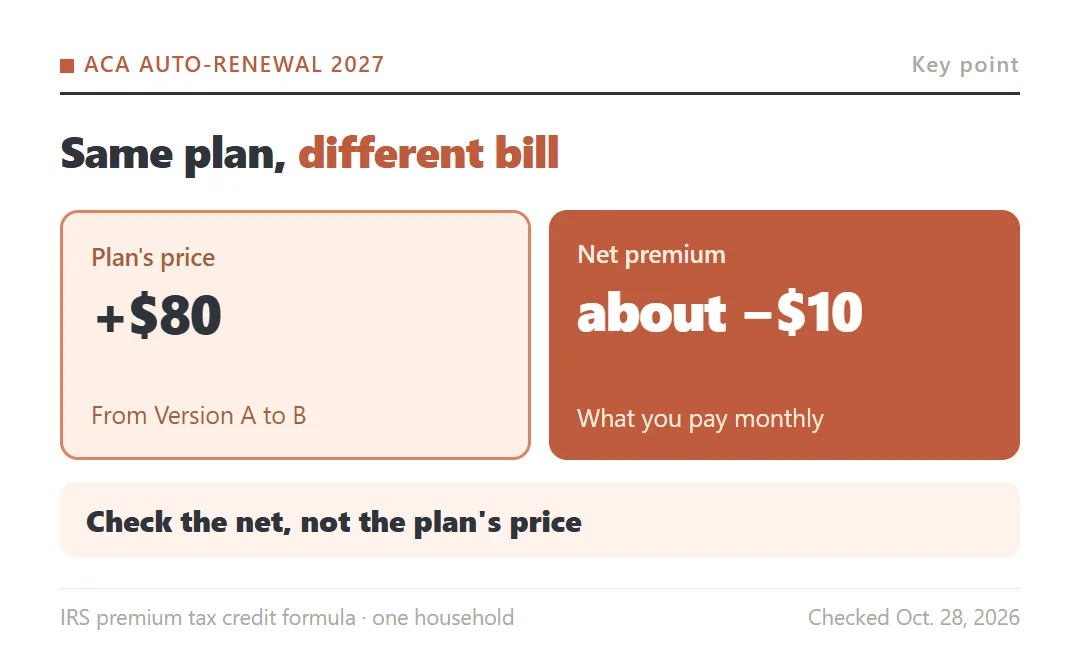
Here’s how that plays out for one household. A single person estimates 2027 income at $40,000, about 250.6% of the 2026 poverty guideline of $15,960 for one person. At the 2027 percentages, the income share works out to about 8.68%, roughly $3,472 a year or $289 a month. Assume these plan prices:
Monthly net premium · single person, $40,000 income
Net premium = your plan's premium − ( benchmark − income share )
Version A$550 − ( $600 − $289 )= about $239 a month
| Version | Own plan · benchmark, monthly | Credit → net, monthly |
|---|---|---|
| B: both prices rise | $630 · $690 | about $401 → about $229 |
| C: a cheaper silver plan becomes the benchmark | $700 · $580 | about $291 → about $409 |
Same person, same income, three different 2027 bills. No single percentage tells you whether to stay or switch; the answer is in your own matched plan’s premium and the savings the Marketplace shows for you.
Your Own Numbers: Two Letters and a Login
By Nov. 1 you should get two letters, one from your insurance company and one from the Marketplace. Together they tell you whether your current plan is available for 2027, which plan you’re matched with and will be re-enrolled in if you don’t act by Dec. 15, any changes in your coverage and cost savings, and whether the Marketplace needs documents from you.
Then log in to your Marketplace account. That’s where you update your application and compare the plan you were matched with against the others you can choose. For the matched plan, write down its 2027 monthly premium, the savings you’re shown and what’s left for you to pay each month.
Those savings are only as good as the income on your application. HealthCare.gov says Marketplace savings are based on “your expected estimated income for the year you’re applying for coverage, not on past years.” Leave an old figure in place and you could qualify for more savings than you’re getting, or for less, and then have to pay back the difference when you file your federal taxes.
My letter says I’m matched with [plan name] for 2027. What monthly premium and what premium tax credit apply to that plan for me, and what 2027 income and household size is the credit based on?
2027’s Income Share Is a Little Higher Than 2026’s
The percentage of income you’re expected to put toward the benchmark is set by the IRS each year. The two ends of the range:
| Household income | 2026 | 2027 |
|---|---|---|
| Under 133% of the poverty line | 2.10% | 2.15% |
| Between 300% and 400% | 9.96% | 10.22% |
Within each income band the percentage rises gradually, which is where the 8.68% above comes from.
A second household: a single person with $50,000 of income, about 313% of the 2026 poverty line, sits in the top band under either year’s table.
Monthly income share toward the benchmark · single person, $50,000 income
Rounded · about $11 a month more, holding everything else equal, including the benchmark's price
Real prices will move too, so that difference is only the income-share piece.
The $63,840 Line, and a Repayment With No Cap
The credit is for household income from 100% to 400% of the federal poverty line. The rule that removed the upper limit applied only to tax years 2021 through 2025. For 2027 savings the 2026 poverty guidelines are used, so 400% is $63,840 for one person and $132,000 for a family of four in the 48 contiguous states and Washington, D.C.; the amounts are higher in Alaska and Hawaii. Above 400%, there’s no credit at all.
The second change shows up at tax time. For tax years after 2025, if the advance credit you received is more than the credit you’re allowed once your actual income is known, there is no repayment cap: the whole difference comes out of your refund or is added to what you owe.
Keep three amounts apart here. The credit lowers each monthly bill in advance, the premium is what you pay yourself, and a repayment, if there is one, lands on your federal tax return. Take the $40,000 household from Version A: about $311 a month in advance credit, while it pays about $239 a month itself. If its actual 2027 income turns out to be $65,000, above the $63,840 line for one person, it repays the whole advance credit on its 2027 return.
Version A household's 2027 credit · actual income above the 400% line
The whole difference is repaid on the 2027 return · rounded
What to Do Between Nov. 1 and Jan. 15
Once the letters arrive, the work fits in one sitting:
- Read both letters and note which plan you’re matched with.
- Update your 2027 income estimate and household information on your application.
- Compare the matched plan’s monthly net premium with the other plans you can choose, using the savings shown after your update.
- Enroll in or change plans by Dec. 15 for coverage starting Jan. 1. If you don’t act, you may be re-enrolled in the matched plan.

Missing Dec. 15 doesn’t lock you in for the year. If you were automatically re-enrolled and that coverage has started, you can still change plans until Jan. 15; a plan picked Dec. 16 through Jan. 15 starts Feb. 1.
If you’re leaving the Marketplace for 2027, for example because a new job offers coverage, the steps are different. By Dec. 15, log in, select your current-year application, not the one for next year, and use the stop coverage button on the “My Plans & Programs” page. If you’ve already been automatically enrolled and don’t want 2027 coverage, log in by Dec. 31 to stop it from starting.
Due to a law change, starting Jan. 1, 2027 only people with certain immigration statuses can qualify for savings on Marketplace plans. If that could apply to anyone on your application, see HealthCare.gov’s page on coverage for lawfully present immigrants.
Sources, checked Oct. 28, 2026: HealthCare.gov’s pages on automatic re-enrollment, keeping or changing your plan and Open Enrollment dates; the IRS premium tax credit questions and answers for the credit formula, the 400% limit and repayment; IRS Rev. Proc. 2026-26 and Rev. Proc. 2025-25 for the 2027 and 2026 percentages; and HealthCare.gov’s federal poverty level table.
Before Your January Premium Bill: What Dec. 15 Settles
Auto-renewal keeps you covered. It doesn’t update your income, and it doesn’t tell you what the benchmark plan did. Those two numbers, along with your own plan’s price, decide what January costs, and Dec. 15 is the last day to act on them for a Jan. 1 start.
Open both letters, put in a fresh 2027 income estimate and compare the matched plan’s net with the others before you decide to stay put. Doing nothing is allowed, and HealthCare.gov words it carefully: if you don’t act by December 15, “you may be automatically re-enrolled for January 1 coverage—but you should update your information.”
Photos and icons in this post are illustrations made for explanation; they do not show real places, products or people.