
Medicare’s own fact sheet on the Part D late enrollment penalty fits the whole rule on one line: “1% x national base beneficiary premium x number of full months without Part D or creditable coverage.” The result “is rounded to the nearest $0.10 and added to your monthly Part D premium.”
For 2027, CMS set that national base beneficiary premium at $41.33. So every full month you went without Part D or other creditable drug coverage after your enrollment window adds about $0.41 a month to your 2027 premium, before rounding. It’s 1% of the national figure, not 1% of your own plan’s premium.
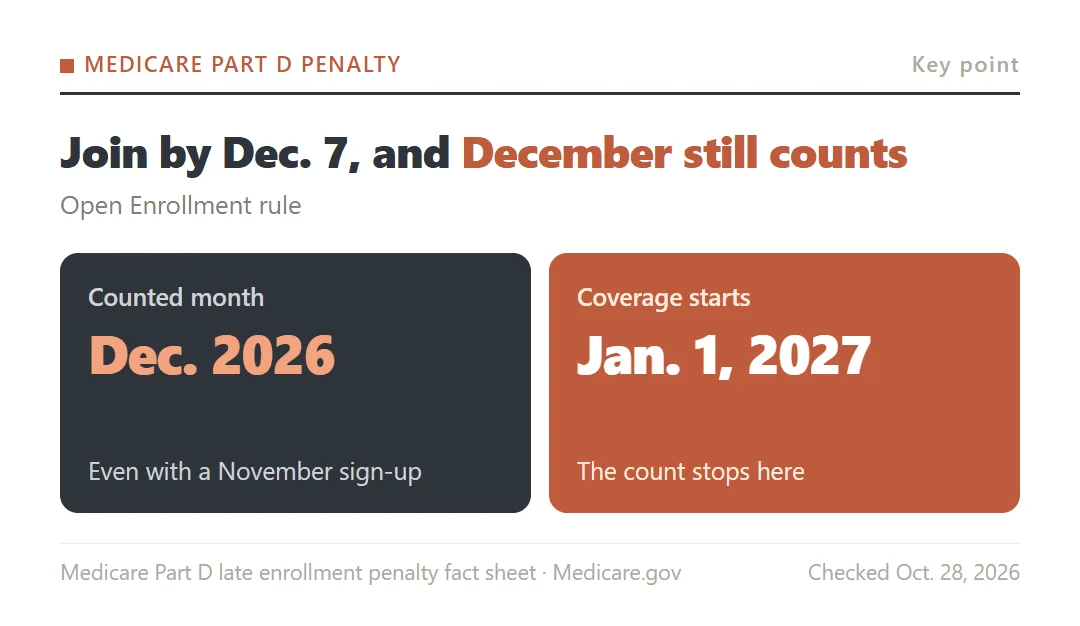
The phrase that catches people is “full months.” If you join a drug plan during Open Enrollment, your coverage starts Jan. 1, 2027, so December 2026 counts as an uncovered month even if you signed up in November. Only a gap of 63 days or more in a row counts at all.
Once it’s set, the penalty is generally added for as long as you have Medicare drug coverage, even if you switch plans or pick one with a $0 premium, and the dollar amount is re-priced every year. If you qualify for Extra Help, you’re not charged a penalty while you’re getting it.
The Day You Sign Up vs. the Day Coverage Starts: Why December Still Counts
The count starts after your Initial Enrollment Period ended, or after your last creditable drug coverage ended if you had some. It runs through the month before your new drug coverage begins. The day you fill out the enrollment form isn’t part of the formula.
Open Enrollment runs Oct. 15 through Dec. 7, 2026, and the plan must get your request by Dec. 7. A plan chosen in that window starts Jan. 1, 2027, whether you enroll in the first week or the last, so October, November and December 2026 are all still uncovered months if you had no creditable coverage.
Medicare’s fact sheet walks through exactly this with a beneficiary it calls Ray. He left his drug plan effective Aug. 1, 2024, joined a new Part D plan during the fall 2025 Open Enrollment Period, and his coverage began Jan. 1, 2026. Medicare counted 17 months: Aug. 1, 2024 through Dec. 31, 2025. The months between his sign-up and his start date were inside the count.
The 63-day line works differently from how it’s often described. It isn’t a two-month allowance that gets subtracted from your total. A break shorter than 63 days in a row adds nothing; a break of 63 days or more counts every full uncovered month in it.
Take a household whose creditable employer drug coverage ended Oct. 31, 2026, with Part D starting Jan. 1, 2027. That’s Nov. 1 through Dec. 31, a 61-day gap, so no penalty. If the same coverage had ended Sept. 30, 2026, the gap is 92 days, Oct. 1 through Dec. 31, and all three months count: 0.03 × $41.33 = $1.24, rounded to $1.20 a month in 2027.
How many months would count, and what would that add in 2027?
Enter the last day of your creditable drug coverage (or of your Initial Enrollment Period if you never had any) and the date your Part D starts. The defaults are the Sept. 30 example above.
If your result doesn't match your bill or notice, check the exact figure on Medicare's late enrollment penalty fact sheet. Rules as of 2026-10-28
Show the breakdown and basis
—
Counted months = full calendar months with no coverage between the two dates, only if the break lasted 63 days or more in a row. Penalty = 1% of the 2027 base premium ($41.33) times counted months, rounded to the nearest $0.10. One continuous break only; your plan's letter is the count you're billed.
Values are calculated in your browser and are not saved or sent anywhere.
Three Dates That Set Your Own Count
Your number depends on dates only you, or your old plan, can look up. Before you estimate anything, find these three:
- When your Initial Enrollment Period ended. That’s the enrollment window you had when you first got Medicare. If you never joined a drug plan, your count starts after it.
- When your last creditable drug coverage ended, if you had any. Creditable means drug coverage “expected to pay, on average, at least as much as” Medicare drug coverage. Medicare’s examples include coverage from a current or former employer or union, TRICARE, the Indian Health Service and Tribal or Urban Indian programs, among other plans. Your plan must tell you in writing whether its coverage is creditable, and employer and union plans send that notice before Oct. 15 each year.
- Any months you had Extra Help. You’re not charged a late enrollment penalty while you’re getting Extra Help, and uncovered months from before you qualified aren’t counted toward a penalty. If you later go 63 days or more without coverage and no longer qualify, a penalty can apply again.
If the creditable-coverage notice is missing from your files, ask the employer, union or plan that sent it. It’s the document that does the most work later.
Please send me a copy of the notice of creditable prescription drug coverage for my plan, and confirm in writing the last date my drug coverage was in effect.
Once you join, the plan runs its own check. It reviews Medicare’s systems for a break of 63 days or more and, if it finds one, sends a notice with a form asking about your prior drug coverage. Complete and return that form by the deadline listed on it, or call the plan, with proof of any creditable coverage it didn’t know about.
After that, the plan tells you whether you owe a penalty and what your premium will be. That letter is the first place your own number appears in writing, and its date matters later.
These are the standard rules for people who got Medicare at 65 or later. If you’re on Medicare because of a disability, ask the plan or 1-800-MEDICARE how your count works, and see Medicare’s Part D late enrollment penalty fact sheet.
Your 2027 Penalty, Worked Out for Four Households
Multiply your counted months by 1% of $41.33, then round to the nearest 10 cents. Each household below assumes Part D coverage starting Jan. 1, 2027.
Household A never joined a drug plan. Its Initial Enrollment Period ended June 30, 2026, with no drug coverage since. July through December 2026 is 6 months: 0.06 × $41.33 = $2.48, rounded to $2.50 a month, or $30.00 over 2027.
Household B retired off employer coverage. Its creditable employer drug coverage ended April 30, 2025, and nothing replaced it. May 2025 through December 2026 is 20 months: 0.20 × $41.33 = $8.27, rounded to $8.30 a month, or $99.60 over 2027.
Household C had a short gap. It’s the household from the section above: employer coverage ending Oct. 31, 2026 leaves a 61-day gap and no penalty, while an end date of Sept. 30, 2026 leaves 92 days, three counted months and $1.20 a month.
Household D qualifies for Extra Help. It has the same dates as Household A, but gets Extra Help. It isn’t charged a penalty while the Extra Help continues, and the uncovered months from before it qualified aren’t counted.
| Household | Full months counted | 2027 penalty per month |
|---|---|---|
| A: never joined | 6 | $2.50 |
| B: employer coverage ended | 20 | $8.30 |
| C: 61-day gap | 0 | $0 |
| C: 92-day gap | 3 | $1.20 |
| D: Extra Help | Not counted | $0 while on Extra Help |
What these numbers can’t tell you is whether joining now or waiting longer “pays off.” That comparison depends on your plan’s premium, your drug costs and how many years you’ll have Part D, and those aren’t the same for any two readers. The part that holds for everyone in 2027 is the marginal piece: each additional uncovered full month adds about $0.41 a month, for as long as you have Medicare drug coverage.
Same Percentage, Bigger Bill: Why the Amount Moves Every Year
Your penalty percentage stays with you, but the dollar amount follows the national base premium, which changes each year. Ray’s 17% came to $6.63, rounded to $6.60 a month, in 2026, when the base was $38.99. At the 2027 base of $41.33, the same 17% is $7.03, rounded to $7.00 a month, without anything changing in his record.
Switching plans doesn’t reset it, and neither does a plan with a $0 monthly premium. Medicare.gov’s penalty page says late enrollment penalties are “not a one-time late fee” and that for most people they’re a lifetime penalty. The 2028 base hasn’t been set, so any lifetime total you see elsewhere rests on a number nobody has yet.
When the Plan’s Count Doesn’t Match Your Dates
If the penalty letter arrives and the months look wrong, you can ask for a reconsideration using the form the plan includes with the notice. Send it to the address or fax number listed within 60 days of the date on the letter, which is not the same as 60 days from the day you open it.
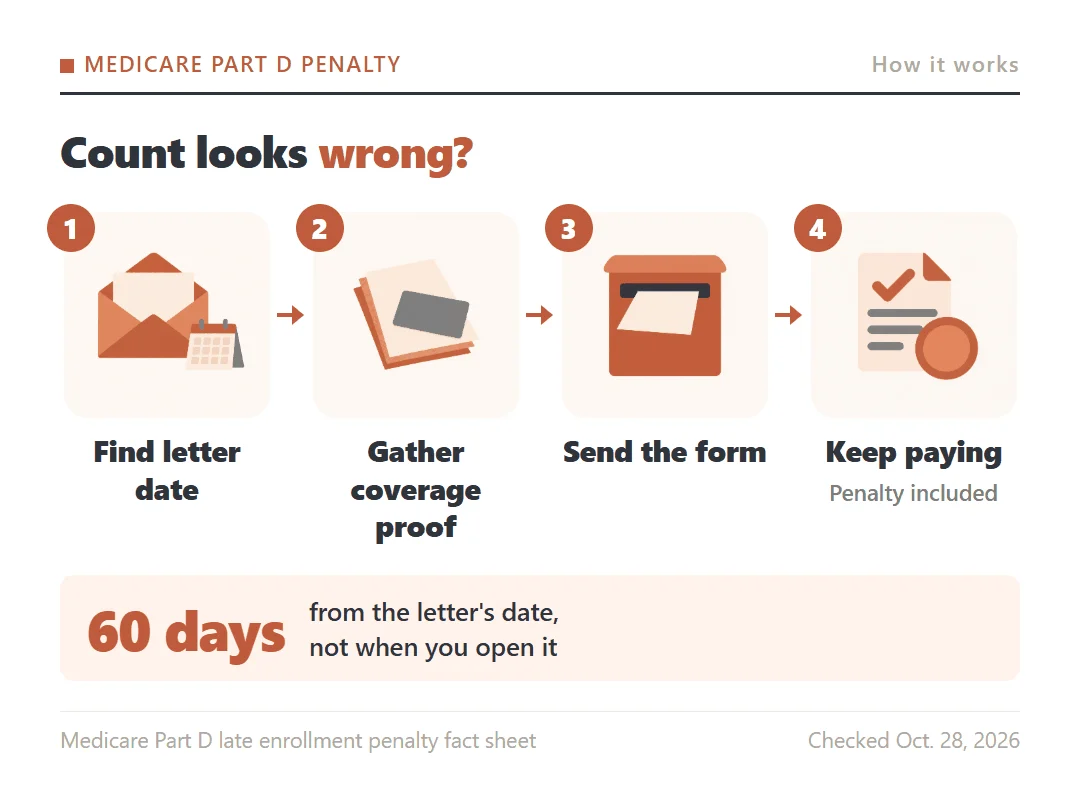
Send proof that supports your case, such as a copy of your notice of creditable prescription drug coverage from an employer or union plan, or a copy of your old prescription drug card. If you miss the 60 days, you’ll have to explain why your form is late.
My late enrollment penalty notice is dated [date]. Which months did you count, and what start and end dates did you use? My Initial Enrollment Period ended in [month, year], and my creditable drug coverage from [employer or plan] ended on [date]. Where do I send the reconsideration form and my proof?
Keep paying while you wait. By law the penalty is part of your premium, so you still pay it after you’ve asked for a reconsideration, and a plan can disenroll you for unpaid premiums, penalty included. Medicare’s contractor generally decides within 90 days, though it may take an additional 14.
If Medicare finds the penalty was wrong, the plan removes or adjusts it, tells you your correct premium and explains whether you’ll get a refund of the penalty amounts you paid during the review. One limit: if you’re already paying a penalty, joining a different plan generally won’t give you a new reason to ask for reconsideration.
Sources, checked Oct. 28, 2026: Medicare’s “The Part D Late Enrollment Penalty” fact sheet (July 2026) for the formula, the Ray example, Extra Help and reconsideration; Medicare.gov’s late enrollment penalty page; the CMS 2027 Part D bid fact sheet for the $41.33 base; and Medicare.gov’s joining-a-plan page for Open Enrollment dates.
What Changes on January 1, 2027
On Jan. 1 the count stops. The coverage you chose by Dec. 7 begins, December 2026 becomes the last month that can be counted, and your monthly premium starts carrying whatever penalty the plan calculated. The plan’s letter tells you that number, and the date printed on it starts your 60-day clock.
I’d rather spend an evening tracking down a creditable-coverage notice before Dec. 7 than spend 60 days disputing months after the letter shows up. The penalty is small per month, but it rides along for as long as you have drug coverage, so the useful work is getting your three dates right, not guessing at a break-even.
If you’re also sorting out year-end health money before January, our guide to the two FSA use-it-or-lose-it deadlines covers the other account that runs on a calendar this season.
Pull your three dates this week and get your enrollment in by Dec. 7. When the plan’s letter comes, its month count will either match your dates or it won’t; if it doesn’t, put the 60-day deadline on your calendar that day and send your proof. Either way, every uncovered month through Dec. 31, 2026 is already part of the count once you choose a Jan. 1 start, so the work left is proving the months that shouldn’t be there.
Photos and icons in this post are illustrations made for explanation; they do not show real places, products or people.