

Two pieces of paper about the same knee scope can disagree by $1,500. Say the anesthesiologist’s bill asks for $1,680, while the health plan’s Explanation of Benefits (EOB) lists $180 as the patient’s share.
The rest of the setup: the surgery was at an in-network surgery center, the anesthesiologist was out of network, the deductible was already met, and the plan applied 20% coinsurance to a $900 amount. It paid $720 of the $2,400 charge.
With private health insurance, $180 is what’s owed. Under the federal No Surprises Act, in effect since Jan. 1, 2022, an out-of-network provider in this spot can’t bill you more than your in-network cost-sharing: the copay, coinsurance and deductible you’d pay if the doctor were in your network. The other $1,500 is the part to push back on.
That cap covers three kinds of bills: emergency care, non-emergency care from an out-of-network provider at an in-network hospital, hospital outpatient department or ambulatory surgical center, and air ambulance. Anesthesia, radiology, lab and ER doctors at an in-network facility can’t have you sign that protection away. The common bill it doesn’t reach is a ground ambulance.
The ER, an In-Network Hospital or Surgery Center, an Air Ambulance
Those are the three situations CMS lists on its Know your medical bill rights page. The protection applies to job-based plans and Marketplace or other individual plans, including employer plans that are self-funded.
Emergency care counts at a hospital ER or an independent freestanding ER, and your plan has to cover it without prior authorization. Whether it was an emergency is judged on your symptoms, not just the final diagnosis code.
| The bill | Capped at in-network cost-sharing? | What to know |
|---|---|---|
| Emergency room, hospital or freestanding | Yes | Follow-up care in the same visit is included in most cases |
| Out-of-network doctor or lab at an in-network hospital, outpatient department or surgery center | Yes | Anesthesia, radiology, pathology and lab can’t ask you to waive it |
| Air ambulance | Yes | Same cap as the ER |
| Ground ambulance | No, unless your state adds a rule | Can still charge out-of-network rates |
| Out-of-network facility you chose for planned care, or a doctor’s office or urgent care outside those facilities | No | Outside the three situations |
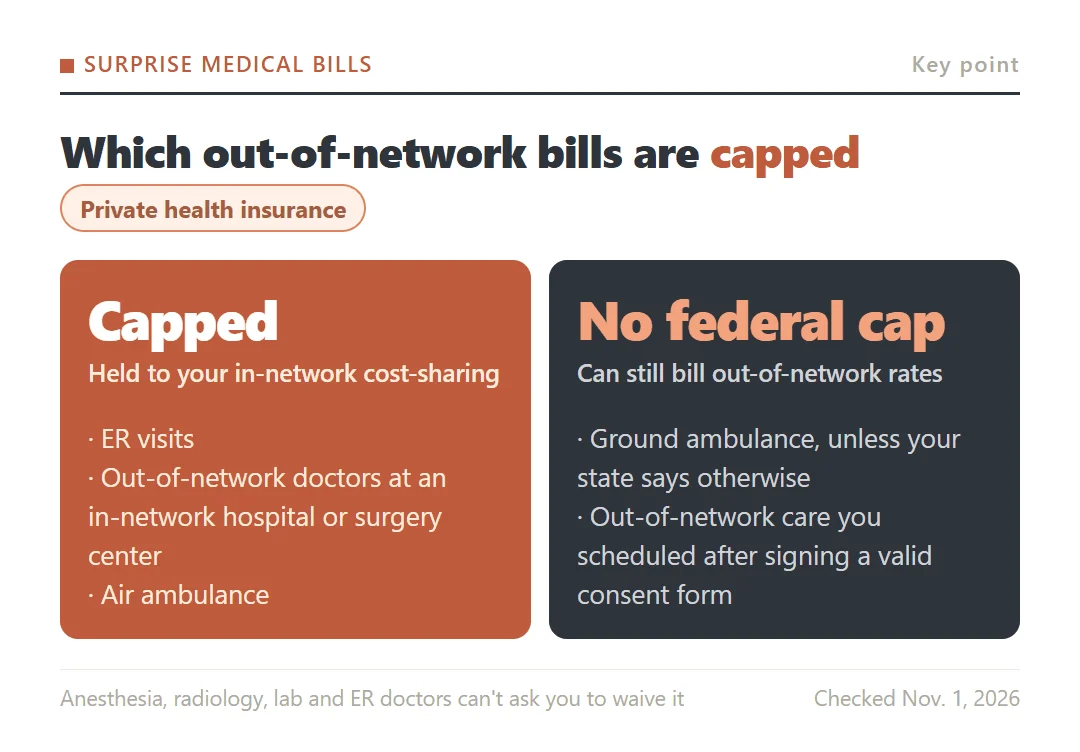
The card splits out-of-network bills into the ones held to your in-network share and the ones that can still be billed at out-of-network rates.
One emergency can produce both answers. In a second case, a ground ambulance takes someone to the ER of an out-of-network hospital.
| The amount | ER bill | Ground ambulance bill |
|---|---|---|
| Charged | $3,800 | $1,600 |
| Paid by the plan | $2,900 | $560 |
| Billed to the patient | $900 | $1,040 |
| On the EOB as the patient’s share | $300 (the plan’s ER copay) | $140 |
| Part to dispute under the federal rule | $600 | None; check state law |
The ER bill is held to the copay. Because the ambulance was a ground ride, the federal rule doesn’t stop the company from billing the full balance. Your state’s rules might, so that bill is the one to check against state law. A helicopter or plane ride would have been capped like the ER.
Medicare, Medicaid, VA, TRICARE and Indian Health Service coverage already have their own protections against some out-of-network bills. Short-term, health care sharing ministry, fixed indemnity and dental-only or vision-only plans aren’t covered by these billing protections.
No insurance, or paying on your own? A different federal rule applies, built on the Good Faith Estimate, and the next step is disputing a bill that comes in $400 or more over your Good Faith Estimate.
“But I Signed the Forms Before Surgery”
A stack of pre-op paperwork is the usual reason people assume a surprise bill must be legitimate. For the doctors who send most of these bills, a signature changes nothing.
At an in-network facility, these providers can never use a consent form to bill you out-of-network rates: emergency medicine, anesthesiology, pathology, radiology and neonatology; assistant surgeons, hospitalists and intensivists; and diagnostic services, including radiology and lab work. The same holds when no in-network provider was available for that service there, and for care that came from an unforeseen, urgent need during the procedure.
I find that list the most useful part of the rule. These are the doctors a patient rarely gets to choose, which is exactly why their bills are the ones that surprise people.
A form can matter for planned care from a provider outside that list, such as an out-of-network surgeon you picked for an operation at an in-network hospital. Even then, the notice and consent have to reach you at least 72 hours before a scheduled service. Care booked less than 72 hours out needs the notice on the day it’s booked, and same-day care at least 3 hours before.
You can also revoke a consent in writing before the care. A form handed over in pre-op for a surgery booked weeks earlier doesn’t meet the 72-hour clock.
In another case, a $6,000 surgery with an out-of-network surgeon at an in-network hospital, with consent signed five days before, can be billed under the plan’s out-of-network terms. The anesthesiologist on that same case still can’t bill above in-network cost-sharing.
In the ER, a consent form only comes into play for follow-up care once you’re stable enough to travel and able to consent.
Finding the Amount You Actually Owe
On a protected bill, the number that counts is the patient responsibility on your plan’s EOB, the amount it says you may owe. That’s your in-network cost-sharing, and it counts toward your in-network deductible and out-of-pocket maximum.
The arithmetic is one subtraction. It applies only to a protected bill with no valid consent form, which is what the two sections above sort out.
Amount to dispute on a protected bill
Balance billed to you − EOB patient responsibility = amount to dispute
Knee scope, deductible met$1,680 − $180= $1,500
Same scope, deductible not met$2,400 − $900= $1,500
How much you owe moves with your deductible. Back in the knee-scope example, suppose the deductible hadn’t been met: the plan pays nothing, the EOB shows the plan’s whole figure as yours, and the anesthesiologist bills the full charge.
The amount owed rises, and it still counts toward the in-network deductible. The gap to dispute stays the same only because the example holds the charge and the plan’s figure fixed.
Since your plan design and deductible status set the number, there’s no single dollar line that fits every household. Enter your own bill and EOB here.
Do you owe this out-of-network bill?
Pick your coverage, where the care happened and who billed you, then enter the bill and your EOB amount.
If your result doesn't match your bill or notice, check the exact figure on CMS: Know your medical bill rights. Rules as of 2026-11-01
Show the breakdown and basis
On a protected bill with no valid consent: amount to push back on = balance billed to you minus the EOB patient responsibility. Pathology, neonatology, assistant surgeons, hospitalists and intensivists count as the first 'who' option. Private health insurance, care since 2022.
Values are calculated in your browser and are not saved or sent anywhere.
The tool assumes private health insurance and care received in 2022 or later. Ground ambulance and state rules vary.
Who Do You Call First, and What Do You Say?
Hold off on paying the gap while it’s open. If the EOB hasn’t arrived yet, wait for it before you pay anything on an out-of-network bill from one of the three situations.
- The provider’s billing office. Ask them to correct the bill to your in-network cost-sharing, the amount your EOB says you owe.
- Your health plan. Ask it to confirm the claim was processed under the surprise-billing protections.
- The No Surprises Help Desk, 1-800-985-3059. If the bill still isn’t fixed, call or submit a complaint online with the bill and EOB ready.
Something like this works for the billing office, with your own details filled in:
This bill is for [anesthesia / radiology / lab work] at [facility], an in-network [hospital / surgery center], on [date]. Under the No Surprises Act, I can be billed only my in-network cost-sharing, which my EOB lists as $[amount]. Please correct the balance and send an updated statement.
For the plan, one line is enough: “Can you confirm this claim was processed under the No Surprises Act’s surprise-billing protections?”
CMS says the Help Desk will get in touch within 60 days if it needs more information, and it can refer a complaint to a federal or state enforcement agency. Already paid more than the EOB amount? Ask the provider for the overpayment back, and include it in any complaint.
Some states add protection on top of the federal rule; your state’s insurance department can tell you what applies. On a protected bill, the provider’s statement is only the provider’s number until the plan’s EOB backs it up. Has the EOB for that exact date of service shown up yet?
Photos and icons in this post are illustrations made for explanation; they do not show real places, products or people.