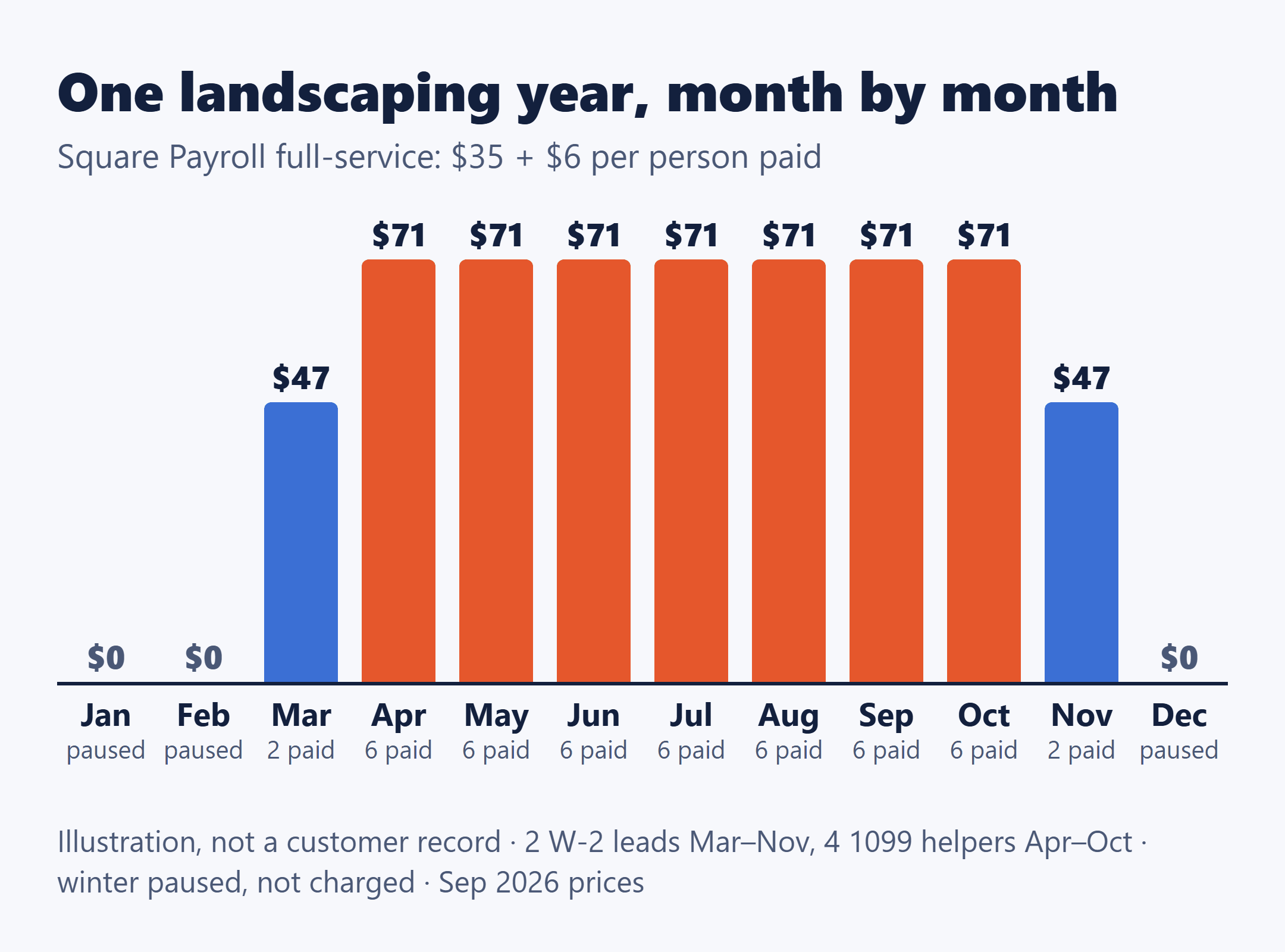
Picture one landscaping company’s payroll year. This is an illustration, not a customer record. Two W-2 crew leads are paid from March through November. Four 1099 helpers join them from April through October. From December through February, nobody is paid.
On Square Payroll’s full-service account, at the published $35 a month plus $6 per person paid, that year produces three different monthly bills. April through October, six people are paid: $35 + $6 × 6 = $71. In March and November only the two leads are paid: $35 + $6 × 2 = $47. Over the winter the owner pauses the subscription, and Square says you aren’t charged while it’s paused.
The helpers don’t cost anything in the months they aren’t paid, and paying weekly instead of monthly wouldn’t change any of those numbers.
Square Payroll publishes two prices: $35 a month plus $6 per person paid on the full-service account, or $6 per person paid with no base fee on an account set up to pay only 1099 contractors. Which one you’re on follows how the account is set up, not which price is lower. On full-service, contractors carry the $6 too, and the $6 is counted on the people you actually pay that month, not on everyone on your roster. For a quiet season, you can pause the subscription for up to nine months.
Everything here comes from Square’s own payroll pricing, product and support pages, checked October 17, 2026. These are published US prices, not figures from running payroll in an account. They also aren’t an all-in cost: workers’ compensation, health insurance, 401(k) and paid amendment services are separately priced add-ons, and Square doesn’t print their prices on the pricing page.
Your account setup picks the price, not the month’s pay mix
Set the two prices side by side and contractor-only looks like the cheaper plan. It isn’t a plan you choose at checkout. It’s the price for an account set up to pay only 1099 contractors.
- Full-service, $35 + $6 per person paid. This is the account set up for W-2 payroll. Square offers it to employers paying “any combination of W-2 employees and contractors,” starting “as low as $41 per month,” which is $35 plus $6 for one person paid.
- Contractor-only, $6 per person paid. Square’s support article says subscription fees don’t apply to an account set up for paying only 1099 contractors, which is why there’s no $35 on this side.
The same article covers the case people get wrong: if your account is set up for W-2 payroll and you’re now paying just 1099 contractors, you contact Square support to update the status of your subscription. A month with no W-2 paychecks doesn’t change the account on its own.
My practical reading: treat contractor-only as an account status, not a discount. Whether someone on your crew is a W-2 employee or a 1099 contractor is decided by IRS and state rules, not by Square or by price. If that’s an open question for anyone, settle it with your accountant and the IRS guidance on contractor or employee status before you price anything.
The $6 counts people paid, so the bill follows the season
Square’s wording is “per person paid,” and it appears that way on its payroll pricing, overview and features pages. Two things follow for a mixed, seasonal crew.
Contractors count on full-service
Go back to the landscaping illustration. In a peak month with two W-2 leads and four 1099 helpers all paid, the full-service bill is $35 + $6 × 6 = $71. If you’d budgeted only for the two employees, $35 + $6 × 2 = $47, you’d be $24 a month short. On full-service, every person paid carries the $6.
People on the roster who aren’t paid don’t count
In March, the same crew pays only the two leads, and the bill drops to $47. The four helpers still on the books don’t add $6 each, because they weren’t paid that month.
What doesn’t drop is the $35. Square doesn’t publish that the base fee disappears in a month with no pay run. The published way to stop it is the pause, covered below, and it’s something you have to go and do.
How often you pay doesn’t move the bill either. Both accounts include unlimited pay runs per month at no extra cost, with no long-term contract, so a weekly payroll costs the same per person as a monthly one.
What the $35 pays for, and what the $6 account still gets
The base fee is for payroll taxes. On full-service, Square automates federal and state payroll tax payments and filings at no additional charge, and multistate payroll is included: for each state or tax jurisdiction where you run payroll, Square remits the payments and files on your behalf. Square lists no separate per-state charge in its own pricing. What a state requires of you to register as an employer there is a separate matter this post doesn’t cover.
Contractor-only still gets 1099-NECs filed. Square generates, prepares and files Form 1099-NEC, and contractors can download their own copy from their online accounts. A business that pays only contractors doesn’t need the $35 account for that. Paying for it anyway would cost $35 × 12 months = $420 a year.
One small charge sits outside both prices. If you opt in to mailing paper copies of W-2s and 1099s, Square charges an annual fee of $3 per mailed form. Digital delivery is included on both accounts.
Slow season: pause the account, don’t close it
Square Payroll can be paused for up to nine months, and you’re not charged during the pause. It resumes automatically when you send a pay run or when the nine months are up, so in the illustration the March pay run for the two leads restarts the subscription.
Two conditions come with it. Square keeps filing taxes on your behalf while the account is paused. And employees shouldn’t be paid outside Square Payroll during that time.
Don’t mix up pausing with closing. Square says you can close a Square Payroll account at any time, but closing it is irreversible. If you plan to run payroll again next season, pause is the step to take.
A contractor-only account has no base fee to pause. In a month when it pays nobody, there’s no person paid for the $6 to count.
Put your own head count into the formula
The rates are fixed. The only input that comes from you is the number of people you actually pay in the month you’re pricing.
Full-service: $35 + ($6 × people you pay that month, employees and contractors together)
Contractor-only: $6 × contractors you pay that month
| People paid that month | Full-service | Contractor-only account |
|---|---|---|
| 1 | $41 | $6 |
| 3 | $53 | $18 |
| 5 | $65 | $30 |
| 10 | $95 | $60 |
Read the two columns as two different accounts, not two options for the same business. Your column was settled by how the account is set up.
None of these figures include the separately priced add-ons (workers’ compensation, health insurance, 401(k), paid amendment services), the opt-in $3 per mailed form, sales tax, or anything charged by other Square products. There’s no head count at which one account becomes the better deal, because a business can’t freely swap between them.
Settle the account type first, then run your busiest and quietest months
Do it in that order. Any W-2 employee on the payroll means the account set up for W-2 payroll and the $35 base, with every person paid at $6. A business paying only 1099 contractors, on an account set up that way, is looking at $6 per contractor paid with no base fee.
Then count the people you’d actually pay in your busiest month and in your quietest one, and put both counts through the formula. That’s the range your subscription moves in over a year, before add-ons. If the quiet months have nobody on payroll at all, put a reminder on the calendar to pause, not close.
Payroll is one bill, and getting paid is another. If customers pay you by invoice through Square, Square vs. Stripe invoice fees on $300, $1,200 and $3,000 jobs works through what that side costs. If you’re also deciding where the books live, QuickBooks Online vs. Wave for small contractors covers when paying for bookkeeping starts to make sense.
Prices were as published in September 2026; check today’s numbers before you subscribe. Official pages: Square Payroll pricing · Square Payroll for contractors · Square Help: manage subscriptions