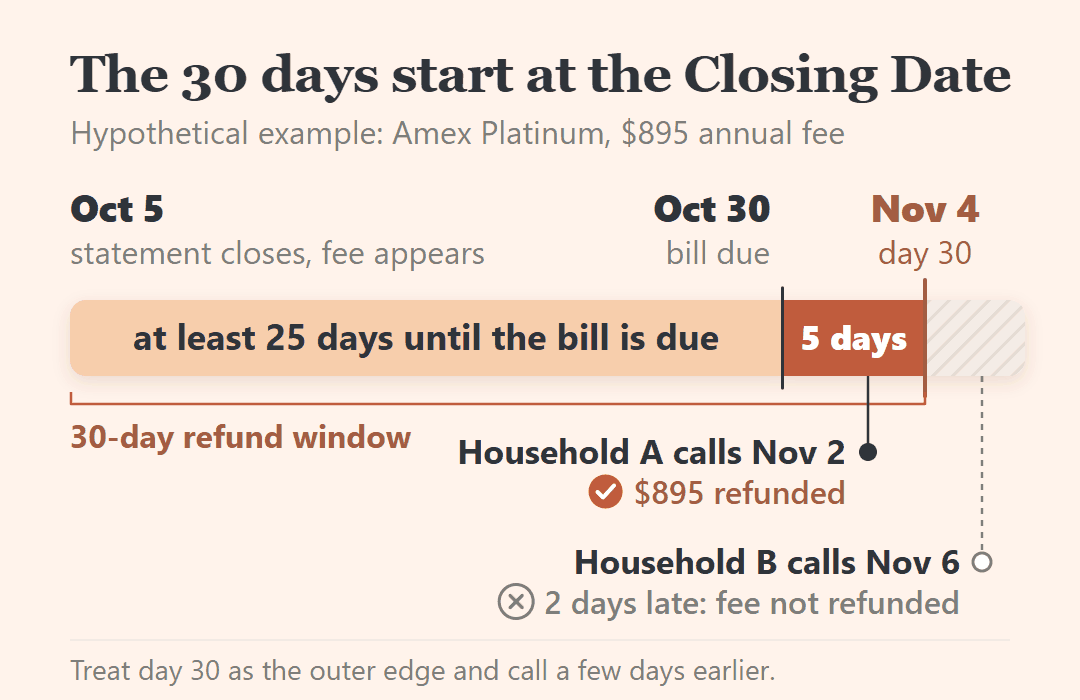
Here’s a hypothetical example, built from American Express’s current card agreement rather than anyone’s real account. Two households each carry an Amex Platinum Card with the $895 annual fee listed in Amex’s June 30, 2026 agreement, and in both cases the fee shows up on a statement that closes on October 5, 2026.
Household A calls on November 2 to close the card, and the $895 comes back. Household B waits for the October 30 payment due date, pays the bill, thinks it over for a few more days and calls on November 6. Under the same agreement, B’s fee is no longer refundable.
Both took about a month to decide. Only one of them was counting from the date Amex actually uses.
On an Amex card, the refund window is 30 days after the Closing Date of the statement that shows the fee, not 30 days after the payment due date or the day you spotted the charge. Amex puts the due date at least 25 days past that Closing Date, so if you wait for the bill to come due, you have about five days left at most.
Other banks set their own deadlines, and no federal rule gives every cardholder “30 days after the fee posts.” What federal rules do require is a renewal notice, sent before the fee is billed, that tells you how and when to cancel to avoid the fee. Your real date is in that notice and on your statement.
Which Date on Your Statement Starts the 30 Days
Amex’s Platinum, Gold, Blue Cash Preferred and Delta SkyMiles Gold agreements, all dated June 30, 2026, use the same sentence. Amex “will refund this fee if you notify us that you are voluntarily closing your Account within 30 days after the Closing Date of the billing statement on which that fee appears.” After those 30 days, the agreement says, the annual fee is non-refundable.
So the statement that matters is the one where the annual fee first appears, and the date that matters is that statement’s Closing Date. Here’s how the two hypothetical households play out with the same card and the same dates.
Household A: closed the card on November 2
A Closing Date of October 5 plus 30 days puts the deadline at November 4. A calls on November 2, inside the window, so under the agreement the $895 fee is refunded.
Household B: paid on October 30, closed the card on November 6
Same October 5 Closing Date, same November 4 deadline. Assume B’s payment is due October 30, the earliest date Amex’s 25-day minimum allows, so by the time B pays, 25 of the 30 days are already gone. The call on November 6 lands two days after the window closed.
To run your own numbers, pull up the statement that shows the fee and find two dates on it: the Closing Date and the Payment Due Date.
Your Amex deadline = the Closing Date + 30 days. The days left once the bill is due = 30 minus the number of days between the Closing Date and the due date. With Amex’s 25-day minimum that’s five at most, and a later due date leaves fewer.
Two cautions before you mark the calendar. The agreement doesn’t say whether day 30 itself still counts, so treat it as the outer edge and call a few days earlier. And if your billing address is in Massachusetts when you close the account, Amex’s agreement says this 30-day policy doesn’t apply to you, so ask Amex what does.
The agreement lets you close the account by calling or writing. The version for your exact card is in Amex’s cardmember agreements library.
Getting the Fee Back Doesn’t Save Your Points
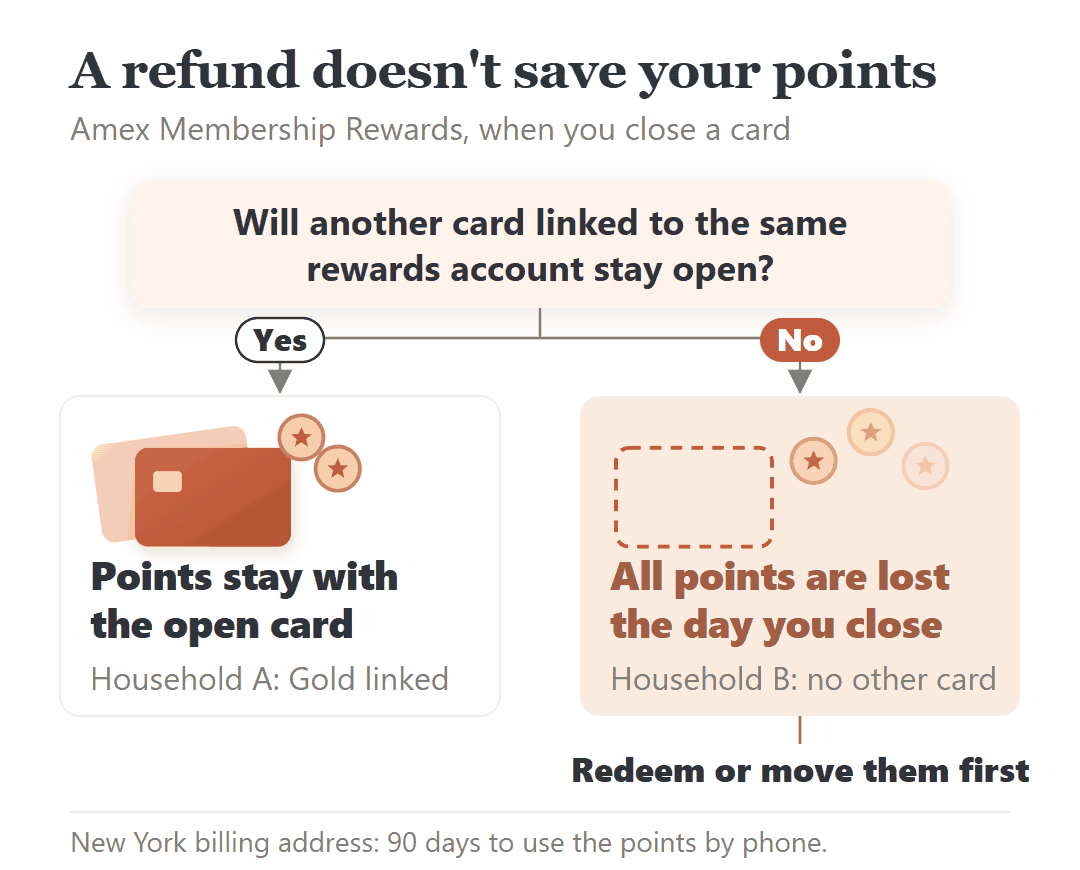
The refund and your rewards balance are separate money. Closing the card can cost you the second even when you get the first on time.
Amex’s Membership Rewards terms, last updated September 2026, say you “will immediately lose all of the points” in your rewards account if you cancel your last linked card. If another linked card stays open, the points stay with it. A cardholder with a New York billing address gets 90 days to use the points by calling the number on the back of the card.
That’s the second way the two households split. Household A also has a Gold Card linked to the same rewards account, so the points survive the Platinum closing. Household B has no other linked card, so if B closes the Platinum anyway after missing the deadline, the fee stays paid and every point disappears that day.
Chase handles it differently. It says to move your points to another open Chase card before closing, because “otherwise, you will lose the unused points in your closed account.” For any other card, read that program’s rewards terms before you call.
If the card you’re closing is the last one holding those points, redeem or move them first. Then make the call.
If Your Card Isn’t an Amex, Go by Your Renewal Notice
For consumer credit and charge cards, the federal rule in 12 CFR 1026.9(e) requires the issuer to send a renewal notice before the statement that first charges the annual fee. That notice has to come at least 30 days or one billing cycle before that statement, whichever is shorter, and it has to say how and when you can cancel to avoid paying the fee.
You also get at least 30 days or one billing cycle, whichever is shorter, from the notice to decide. If you cancel in time and the fee has already been billed, the issuer must reverse it promptly.
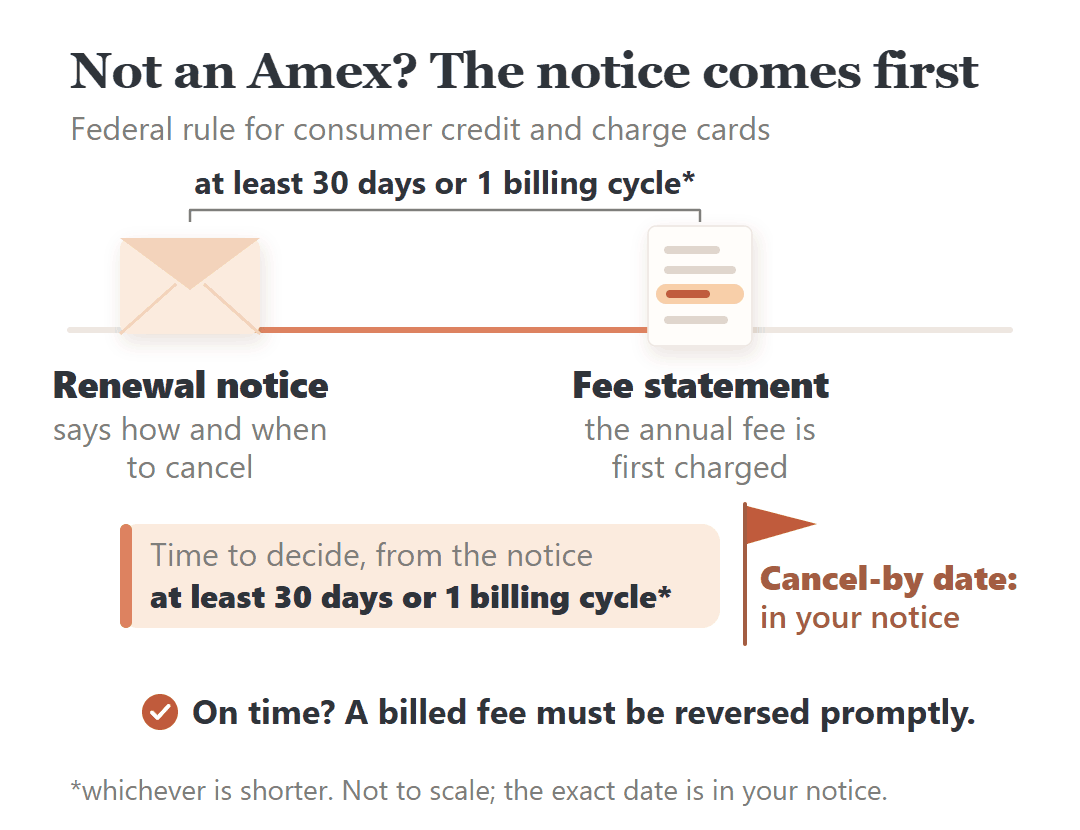
Within those limits, each issuer picks its own deadline, which is why your notice matters more than any rule of thumb. Chase’s cardmember agreement, for example, says your monthly billing statement “will tell you how to cancel your account and avoid future annual fees.”
You’ll see specific windows for other banks quoted online. Those numbers are mostly cardholder reports rather than card-agreement text, so the date in your own notice or agreement is the one to go by. If the bank offers to switch you to a no-fee card instead of closing, ask whether the annual fee comes back before you say yes.
Can’t find the notice? Check the statement before the one with the fee, plus any letters or account messages from your issuer around that time. If the date still isn’t clear, call and ask before you decide anything.
Whichever bank it is, this is the question I’d put to the agent before saying “go ahead and close it”:
“The annual fee is on my statement that closed on [date]. If I close the account today, will the full fee be reversed, and what’s the last day I could close it and still get the fee back? And what happens to the points on this card once it’s closed?”
Three Things to Do While the Statement Is Still Fresh
- Open the statement that shows the annual fee. Write down its Closing Date and any cancel-by date in your renewal notice. On Amex, add 30 days, then circle a day a few days earlier.
- Settle the points before anything else. If this is the last card linked to your rewards account, redeem or move the points first.
- Call before the deadline, not on it. Ask the agent to confirm the fee will be reversed, then check your next statement to see that it came off.
The fee is the easy part to spot. The date that decides whether you get it back sits on the same statement, and it started running before your bill was even due.
Sources: American Express Platinum Card agreement and the Gold, Blue Cash Preferred and Delta SkyMiles Gold agreements dated June 30, 2026; Amex Membership Rewards terms (September 2026); Chase Cardmember Agreement and Chase’s page on points expiration; 12 CFR 1026.9(e) and its official interpretation on eCFR. All read October 16, 2026.
This is about the yearly renewal fee on a personal card. First-year fees, business cards and fees for additional cards on your account can work differently, and issuers can change their agreements, so check the terms for your own card.