

Two District households look identical on paper. Each is a family of three in a single-family rowhouse, each has $22,000 in combined annual income, and each faces the same winter of heating bills. One heats with natural gas; the other heats with electricity.
On DOEE’s FY27 LIHEAP Benefit Matrix, the gas household’s one-time benefit is $1,415. The electric household’s is $354. Same income, same size, same program; the heating fuel put them in different cells.
That is how DC’s Low Income Home Energy Assistance Program works for 2026-27 (fiscal year 2027, Oct. 1, 2026 to Sept. 30, 2027). The regular benefit is a one-time payment between $250 and $1,800, sent to your utility or fuel vendor, not to you, and the exact amount comes from four inputs: your income line, household size, home type and main heating fuel.
As of Oct. 28, 2026, applications are open. DOEE has taken FY27 applications online since Oct. 20, 2026; in-person appointments start Nov. 17, and calls to schedule them start Nov. 10. If an older page or search snippet says DC LIHEAP is closed, check its date.
One thing doesn’t change while you wait: this isn’t a monthly payment, so keep paying your bill.
First Check the Income Limit, Then Find Your Row
“Do I get LIHEAP?” is really two questions. Whether you qualify depends on household size and combined income; how much you get depends on the matrix. Answer them in that order.
A household is everyone living together, and the limit applies to everyone’s income combined. These are DOEE’s FY27 limits:
| People in the household | Combined annual income limit |
|---|---|
| 1 | $63,024 |
| 2 | $82,416 |
| 3 | $101,808 |
| 4 | $121,200 |
| 5 | $140,592 |
| 6 | $159,984 |
For each person beyond six, the matrix adds three percentage points to 132% and applies that percentage to the four-person limit. If anyone in the household gets SNAP, TANF or SSI, DOEE treats the household as income-eligible, though that doesn’t change the benefit amount.
Here’s the mismatch that trips people up. One person can earn up to $63,024 and still qualify, but the matrix’s highest income line is $30,000. Clearing the limit tells you you’re in; it doesn’t tell you the amount.
For the amount, open DOEE’s FY27 LIHEAP Benefit Matrix and pick four things:
- Home type. Single-family (SF) or multifamily (MF). Apartments count as multifamily.
- Income line. The lines are $0, $5,000, $10,000, $15,000, $20,000, $25,000 and $30,000. Use the one just below your combined annual income; anyone at $30,000 or more, up to the limit, uses the $30,000 line.
- Household size. Rows go up to four people. Households of five or more use the four-person line.
- Main heating fuel. Gas, electric, oil, or heat included in rent (HIR).
The number in that cell is your FY27 regular benefit. A few values are fixed: heat included in rent pays $250 at every income and size, sent to your electric or gas company; oil heat pays $1,500 at every income and size, or you can have DOEE send the smaller gas or electric amount listed in your row to that vendor instead; and the gas column tops out at $1,800.
Are you under DC's FY27 income limit, and which matrix row is yours?
Pick your household size and enter everyone's combined annual income.
If your result doesn't match your bill or notice, check the exact figure on DOEE's FY27 LIHEAP Benefit Matrix. Rules as of 2026-10-28
Show the breakdown and basis
—
Limit = DOEE's FY27 limit for your household size. Households of 7 or more: DOEE adds 3 percentage points per extra member to 132% and applies it to the 4-person limit; check the matrix. Income line = the $5,000 line at or just below your income, $30,000 at most. Households of 5 or more use the 4-person row.
Values are calculated in your browser and are not saved or sent anywhere.
Same Income, Different Fuel, Different Check
Back to the two rowhouses. Both land on the SF, three-person, $20,000 line, since $20,000 is the line just below $22,000. Change only the fuel and the same family reads a different column:
Family of three · SF rowhouse · $20,000 line · FY27 matrix
One example cell; your amount comes from your own row
The oil and heat-included-in-rent amounts don’t change with income or household size, which is why the fuel column deserves as careful a look as the income line.
A few more households, each read straight off the FY27 matrix:
| Household | Matrix line used | FY27 benefit |
|---|---|---|
| A: lives alone in an apartment, gas heat, $14,000 a year | MF, $10,000, 1 person | $1,108 |
| B: same as A, but $15,500 a year | MF, $15,000, 1 person | $658 |
| E: five people in an apartment, gas heat, $11,000 a year | MF, $10,000, 4-person line | $1,800 |
| D: renter with heat included in rent, any size or income under the limit | HIR column | $250 |
A and B show how the income lines work. An extra $1,500 a year moves that one-person apartment from the $10,000 line to the $15,000 line, and the gas amount drops by $450. That’s how the table is built, not a reason to report income any differently.
The top of the table depends on fuel and home type too. On the $30,000 line, every apartment gas and electric row and every single-family electric row sits at the $250 minimum and oil stays at $1,500, while single-family gas rows read:
Single-family gas heat · $30,000 income line · FY27 matrix
No single income level gives everyone the same amount; your own row does.
I’m wary of estimating your amount from a neighbor’s award or an older year’s benefit table. The FY27 matrix, dated Sept. 29, 2026, is the one that sets this winter’s amounts. DC’s matrix applies only in DC; if you’re helping a relative in Pennsylvania, our guide to Pennsylvania LIHEAP’s 2026-27 cash and crisis grants covers that state’s program separately.
Already Disconnected? Crisis Help Comes After the Regular Benefit
DC’s LIHEAP has a second, separate crisis benefit, and a household can receive it in the same fiscal year as the regular one. DOEE’s criteria are narrow, though. All of these have to be true:
- Your regular benefit has already been applied to your account.
- You still owe $250 or more after it.
- Your gas or electric service has already been disconnected, or your oil or other delivered fuel is at 5% or less of the tank.
For a gas or electric emergency, bring Pepco or Washington Gas documentation showing that service has been disconnected; DOEE’s page names disconnection, not a notice, as the trigger. Emergency walk-ins aren’t accepted.
The crisis amount isn’t on the matrix. DOEE sets it at what’s needed to resolve the shutoff, and the current crisis rules are on the DOEE LIHEAP page.
How to Apply, and What to Have Ready
Apply only through DOEE, the agency that runs LIHEAP in DC, not through your utility or a third party. Apply every year as well, since DOEE doesn’t automatically enroll last winter’s households.
Have these ready before you start:
- Unexpired government photo ID for the applicant
- Social Security cards for everyone in the household
- Proof of current income for every household member
- Recent Pepco, Washington Gas and DC Water bills
- A disconnection notice or utility letter, if you have one
The energy bill has to show that you’re responsible for the cost. A bill in a management company’s or a business’s name won’t work.
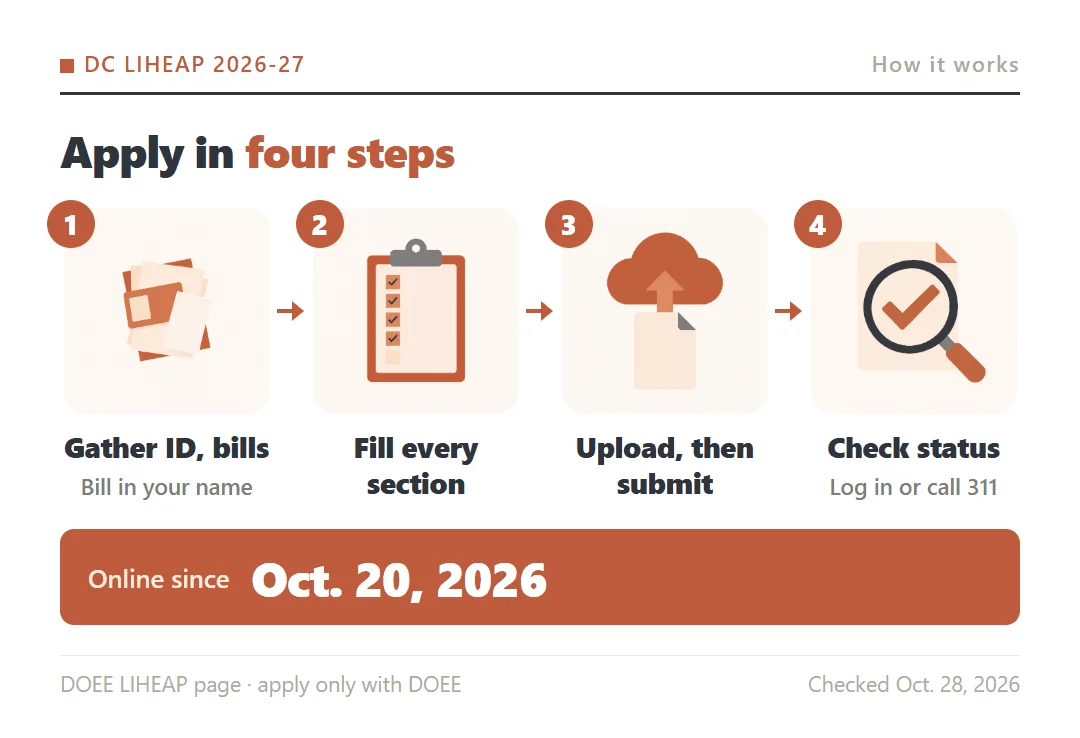
Online, open now: complete every section and upload every document before you submit. To check status, log back in or call 311 or (202) 737-4404.
By mail: DOEE, Attn: Utility Affordability Administration, 1200 First Street NE, 5th Floor, Washington, DC 20002.
In person, by appointment only: call (202) 737-4404 or 311 starting Nov. 10, 2026. Appointments begin Nov. 17 at 1207 Taylor St. NW (Wards 1–6) or 2100 Martin Luther King Jr. Ave. SE (Wards 6–8).
DOEE hasn’t published a closing date for FY27, and it describes benefits as subject to available funding, so there’s no advantage in waiting. When you call to check on an application, this covers both programs at once:
I applied for FY27 LIHEAP [online / by mail] on [date]. Can you confirm my application is complete, and tell me whether it was also reviewed for the Utility Discount Program?
One Application, Two Kinds of Help: The UDP Discount
DOEE’s application is a joint LIHEAP-UDP form, so the same paperwork also covers the Utility Discount Program. DOEE’s LIHEAP FAQ says LIHEAP-eligible households are also approved for UDP and that UDP’s income limits are higher, so a household just over the LIHEAP limit may still get the discount. The current UDP limits are on the DOEE UDP page.
For FY27, DOEE lists these discounts. UDP requires the bills to be in the applicant’s name.
UDP discounts DOEE lists for FY27
Electric is up to $300 a year if you don't heat with electricity
These are discounts on your bills, not a one-time payment, so they don’t add to your LIHEAP amount as one total. If your income is over both limits, DOEE’s page also points to utility-run help such as WAFF and the Pepco Customer Relief Fund.
If You Only Do One Thing Today
Gather the photo ID, Social Security cards, income proof and your latest Pepco, Washington Gas and DC Water bills, and make sure the energy bill is in your name. Then apply online; if you can use the form, there’s nothing to gain by waiting for the Nov. 17 appointments.
Read your row on the matrix while you’re at it, so the amount isn’t a surprise, and keep paying your bill until the benefit shows up on your account. Fuel, home type and household size will set the number; the one part you control is when DOEE gets your application. Ideally, today.
Photos and icons in this post are illustrations made for explanation; they do not show real places, products or people.