

Add up every paycheck, Social Security deposit and benefit check your household received in the 30 days before the day you plan to apply. Use the gross amounts, before taxes. That one total, rather than last year’s tax return, is what Illinois checks for LIHEAP this winter.
Next, find the company that sells you your heat. If it’s Ameren Illinois, ComEd, Nicor Gas, North Shore Gas or Peoples Gas, your 30-day limit comes from DCEO’s 2026-27 table: $3,990 for one person, $5,410 for two, $6,830 for three and $8,250 for four, up to $13,930 for eight. If none of those five sells you your heat, a lower test applies (60% of state median income), and your county agency has that figure.
Priority households (adults 60 and older, people with a disability, families with a child 5 or under, and homes facing disconnection or a propane tank under 25%) could apply starting Oct. 1. Since Nov. 1, 2026, every income-eligible household can, and applications stay open through Aug. 13, 2027, or until the money runs out. Funding is first come, first served.
The Line for Your Household Size and Your Utility
Search results still show lower charts for Illinois, some built on 200% of the poverty line and some on 60% of state median income. For customers of the five utilities above, these are the figures on DCEO’s How to Apply page (checked Nov. 2, 2026):
| Household size | Gross income, last 30 days | Annual equivalent |
|---|---|---|
| 1 | $3,990 | $47,880 |
| 2 | $5,410 | $64,920 |
| 3 | $6,830 | $81,960 |
| 4 | $8,250 | $99,000 |
| 5 | $9,670 | $116,040 |
| 6 | $11,090 | $133,080 |
| 7 | $12,510 | $150,120 |
| 8 | $13,930 | $167,160 |
DCEO labels this its 300%-of-poverty table and reserves the right to adjust the levels if federal funding changes. A total under your line means you may qualify; the local agency makes the determination.
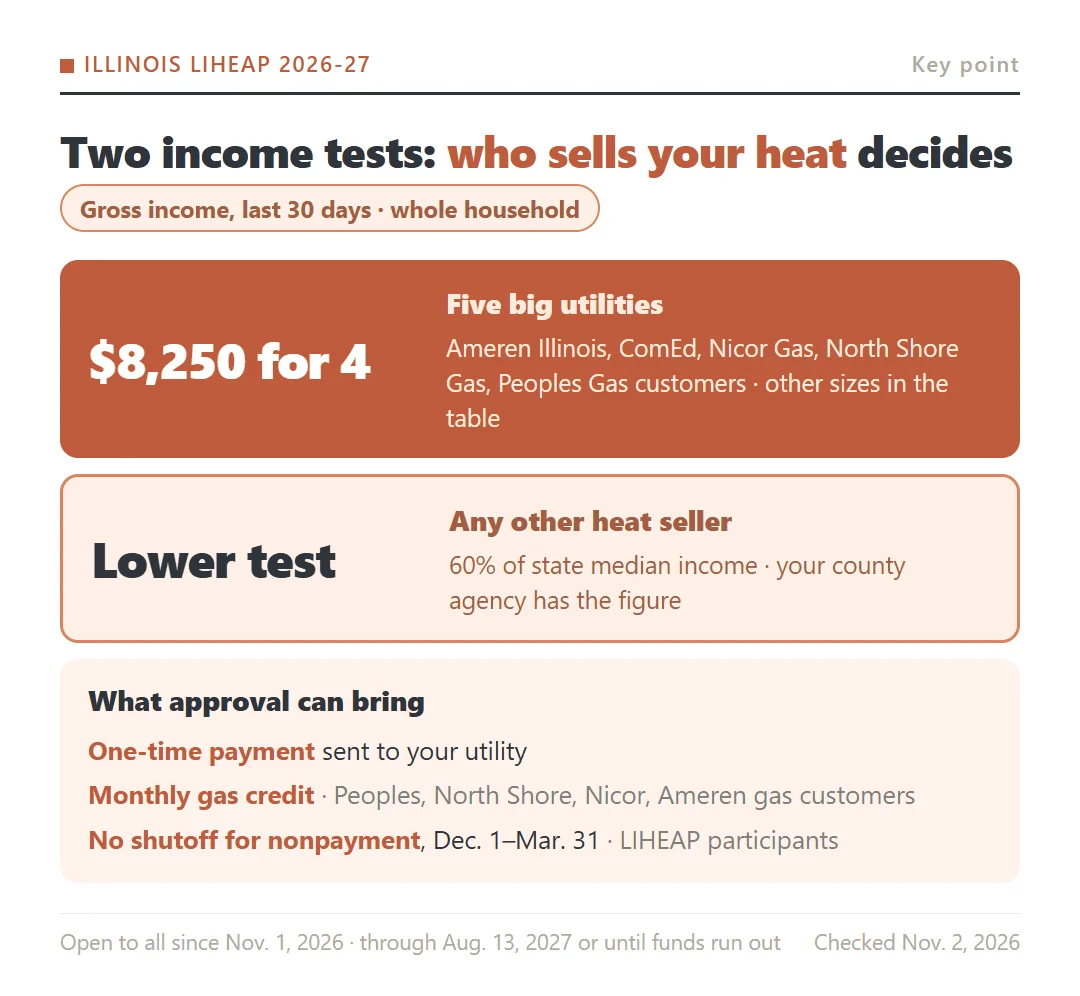
The card sets the two income tests side by side and names the three things approval can bring.
Two households show how the fork plays out. A Chicago family of four that heats with Peoples Gas and buys electricity from ComEd took in $5,200 gross over the last 30 days, which leaves it $3,050 under the $8,250 line. A couple downstate on Ameren gas and electric, with two paychecks totaling $5,600, is $190 over the $5,410 line for two. Only pay received in that 30-day window goes into the comparison.
A third household, heating with propane and buying power from an electric co-op, doesn’t use the table at all. Its county agency applies the 60%-of-median test and can tell it the dollar figure for its size.
Are you under the Illinois LIHEAP line for 2026-27?
Enter your household size, gross income for the last 30 days and who sells your heat.
If your result doesn't match your bill or notice, check the exact figure on DCEO How to Apply page. Rules as of 2026-11-02
Show the breakdown and basis
Line = DCEO 2026-27 30-day limit for your household size (Ameren Illinois, ComEd, Nicor, North Shore and Peoples Gas customers). Share of poverty = income divided by (line divided by 3). Gas credit tiers: ICC, January 2026.
Values are calculated in your browser and are not saved or sent anywhere.
The tool uses DCEO’s table for the five utilities and the ICC’s January 2026 discount tiers. It doesn’t estimate your payment, and the agency and your utility make the final call.
Approval Pays Once, Then Keeps Trimming the Gas Bill
The benefit most people know is a one-time payment per program year, sent directly to your utility. Renters whose heat is included in the rent may receive it as cash instead. The amount depends on income, household size, energy cost, fuel type, region and type of home.
Illinois LIHEAP one-time payment: plan range and last season's average
About 360,500 households received a payment last season
Neither figure predicts what your household will get. LIHEAP doesn’t pay water, sewer or phone bills.
My concern with that average is that it reads like the whole benefit. For customers of Peoples Gas, North Shore Gas, Nicor Gas and Ameren Illinois gas, LIHEAP enrollment automatically qualifies the household for a monthly credit on its total gas bill, set by where income falls against the poverty line. The Illinois Commerce Commission’s tiers (updated January 2026) cover 0–50%, 51–100%, 101–150%, 151–200% and 200–300% of poverty:
- Peoples Gas: 83%, 68%, 45%, 20%, 5%
- North Shore Gas: 79%, 60%, 36%, 12%, 5%
- Nicor Gas: 77%, 57%, 27%, 12%, 5%
- Ameren Illinois gas: 84%, 52%, 19%, 5%, 5%
Your share of the poverty line
30-day income ÷ (your DCEO line ÷ 3) = share of poverty
Chicago family of four5,200 ÷ (8,250 ÷ 3)= about 189%
67-year-old living alone1,900 ÷ (3,990 ÷ 3)= about 143%
The Chicago family’s result points to Tier 4 and a likely 20% credit with Peoples Gas, or 12% if the same family lived in Nicor territory. Two more cases: a family of four bringing in $2,600 sits near 95%, Tier 2, a likely 68% with Peoples. A 67-year-old living alone on Social Security and heating with Nicor lands in Tier 3, a likely 27%, and as someone 60 or older could have applied since Oct. 1.
The utility assigns the final tier, and when income sits exactly at 50%, 100%, 150% or 200%, your utility confirms which side you fall on. ComEd offers its electric customers at or under 300% of poverty a sliding 5% to 80% monthly discount, with ComEd setting the exact percentage. Ameren Illinois electric customers can also ask Ameren about its income-based payment program. If LIHEAP turns you down, DCEO suggests asking your gas utility or ComEd about these discounts anyway.
The third piece is the winter rule. From Dec. 1 through March 31, the ICC’s rules say LIHEAP participants can’t be disconnected for nonpayment, with exceptions for theft, tampering and safety. Other residential heating customers get a narrower shield: the utility can’t cut them off unless it offered a deferred payment arrangement with no more than 10% down and the customer refused it. The ICC encourages applying partly because LIHEAP protects your gas and electric service, and applying early is the way into the participant group.
From Pay Stubs to a Decision Within 30 Days
Apply through the Request for Services form at helpillinoisfamilies.com or at your county’s local agency; DCEO’s Where to Apply list names the agency for each county, and Chicago and suburban Cook County are served separately. The help line, 1-833-711-0374, takes calls in 30 languages. After the request goes in, the local agency contacts you to confirm eligibility and set the amount. Have these ready:
- Proof of gross income for the past 30 days for everyone in the household: pay stubs, benefit checks or award letters
- Your most recent heating and electric bills, issued within the last 30 days
- Social Security cards or ITINs (you can apply without either)
- If heat is included in your rent: a lease showing that, the rent amount and your landlord’s contact information
- Proof of TANF, SNAP or Medical benefits, if anyone in the household receives them
Once the application is complete, the agency has 30 days to decide, and payment reaches the utility within 45 days of approval. Keep your seven-digit Application ID, which starts with 8; DCEO’s customer inquiry portal uses it for status checks.
A shutoff notice changes the order. With a disconnection date within 7 days, service already cut off, or a propane or oil supplier refusing delivery with the tank at 25% or below, call your county agency directly and ask for Reconnection Assistance instead of waiting on the online request. It pays the minimum needed to restore service, up to $2,000 per household per program year, and that maximum isn’t automatic. The agency decides within 48 hours of a complete application, or within 18 hours when the situation is life-threatening or the temperature is below 32°F. Our guide to winter utility shutoff rules by state covers what Illinois requires of you before a cutoff date if the notice has already arrived.
We have a disconnection notice from [utility] dated [date], and there are [number] of us in the household. Can we apply for Reconnection Assistance today, and which documents do you need from us to make the application complete?
For a household anywhere near its line, the useful work this week is collecting last month’s pay stubs and applying, rather than measuring yourself against a chart from another year. For gas customers of the big utilities, one approval brings the payment, the monthly credit and the winter protection together, while the money lasts. Mark the date three weeks after you submit: no call from the agency by then means it’s your turn to phone the county office, Application ID in hand.
Photos and icons in this post are illustrations made for explanation; they do not show real places, products or people.