

The due date on your FPL bill has passed, or it will before your next paycheck lands. The balance itself isn’t the mystery. What you probably want to know is what being late sets in motion: an extra charge, maybe a bigger request later, and how close a shutoff really is.
The charge is small. FPL adds a late payment charge of the greater of $5 or 1.5% of the past-due balance to your next bill, and a payment extension doesn’t take it away. The money that can actually move comes later. A second late payment within six months starts an automatic deposit review, and FPL can ask you to top up your deposit if it falls $50 or more short of two months’ average billing.
The power can’t be cut on the due date. Florida’s rules require a written notice of its own, separate from the bill, at least five working days before a nonpayment disconnection. All of this is FPL residential service, including FPL Northwest Florida; Duke Energy Florida, TECO, JEA, OUC and the electric co-ops set their own charges.
FPL’s Late Payment Charge and the Deposit Review Behind It
The charge is listed on FPL’s service charges page. Since 1.5% of $333.33 rounds to $5, anyone with $333.33 or less past due pays the flat $5. On $180, 1.5% would be $2.70, so the charge is $5.00. Above that line the percentage takes over, and $420 past due brings $6.30. It shows up as a line item on the next bill.

The late charge and a deposit request are two separate lines; the deposit is money FPL holds, not a fee it keeps.
The deposit rule sits on FPL’s payment extension page: late twice in six months, and FPL automatically reviews your deposit. If the gap between the deposit on hand and two months’ average billing is $50 or more, FPL “might ask you to make up the difference.” Under Florida law that two-month average is also the ceiling for an existing account, and the request has to come with at least 30 days’ written notice, separate from the bill, saying why.
Say your bills over the last 12 months averaged $160 and FPL holds no deposit. Two months’ average is $320, the whole $320 is the gap, and that’s what FPL could ask for. A household averaging $210 with $380 already on deposit is $40 short, under the $50 line, so FPL’s stated rule brings no request.
If you already have a deposit, being late can cost you its return. Florida’s deposit rule sends residential deposits back after 23 months of continuous service and a satisfactory record, but not if there was more than one late payment in the preceding 12 months. A payment that bounces adds its own returned-payment charge and counts against that refund too.
What will being late add on your FPL account?
Enter your past-due amount, your average monthly bill and any deposit FPL holds. The defaults are the $180 example above.
If your result doesn't match your bill or notice, check the exact figure on FPL's service charges page. Rules as of 2026-11-10
Show the breakdown and basis
—
FPL residential, including Northwest Florida. Late charge = greater of $5 or 1.5% of the past-due balance. Deposit review follows two late payments in six months: two months' average billing minus the deposit on hand, requested only if that gap is $50 or more, with at least 30 days' written notice. If service is cut for nonpayment: $4 reconnect, or $28 when a field visit collects payment. This tool does not give a shutoff date.
Values are calculated in your browser and are not saved or sent anywhere.
The Notice That Comes Before a Shutoff
FPL can’t disconnect for nonpayment just because the due date passed. Florida’s Rule 25-6.105 requires a diligent attempt to collect plus at least 5 working days’ written notice, separate from the bill. A working day counts only if FPL’s business office is open and the U.S. Mail is delivered, so the count starts from the date on that notice, not from the due date.
Residential power also can’t be cut from noon Friday to 8 a.m. Monday, or from noon the day before a holiday to 8 a.m. the next working day. This season that means noon Wednesday, Nov. 25 before Thanksgiving, noon Thursday, Dec. 24 before Christmas, and noon Thursday, Dec. 31 before New Year’s Day. The rule makes exceptions for a hazard, tampering or fraud, or when the customer asks for the disconnection.
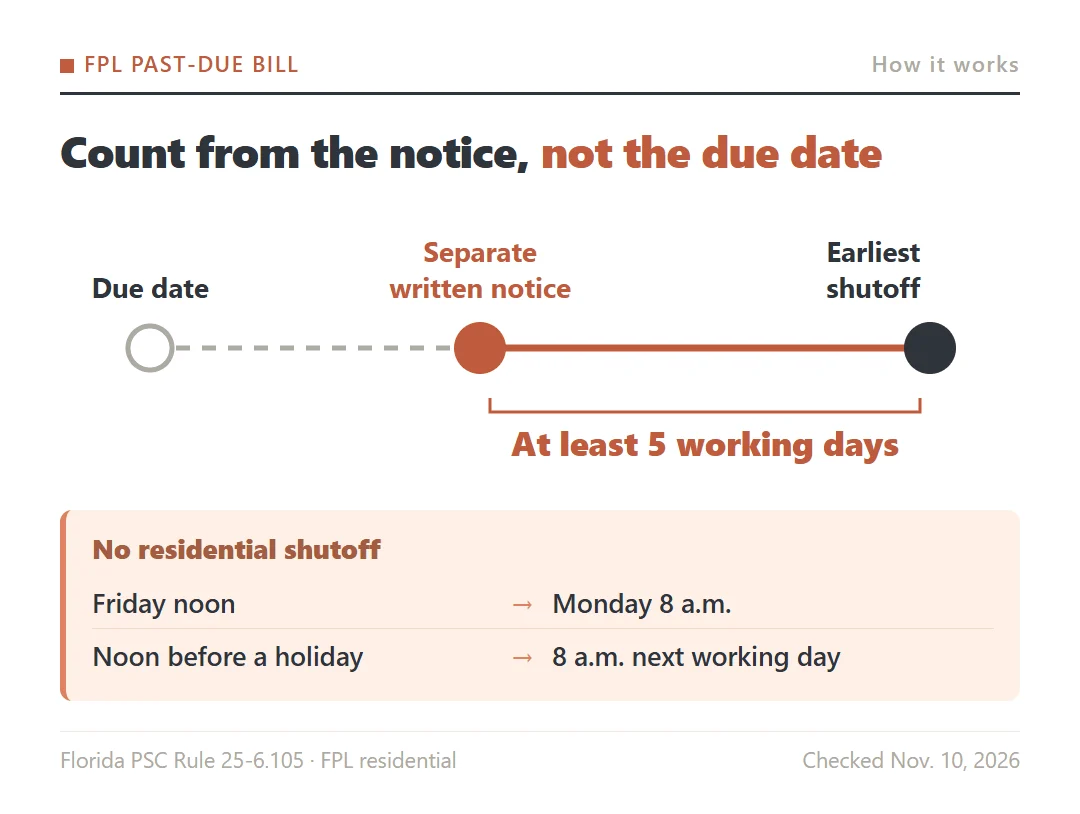
The working-day count runs from the separate notice, and the blocked windows sit on top of it.
If it does come to a disconnection, FPL’s reconnect charge is $4.00. When a field representative comes out and collects payment on the delinquent account instead, the field collection charge is $28.00. The past-due balance is owed either way. The same rule has each utility file a separate disconnection procedure for medically essential service, so ask FPL directly if that applies to someone in your home.
A Payment Extension and What It Leaves in Place
FPL’s online payment arrangement pushes back the due date for accounts that qualify. Whether yours does is FPL’s call, weighed on your payment history, how long you’ve been a customer, and how much is past due and for how long. Online requests get an answer right away and a confirmation email by the next business day.
What the extension doesn’t do is make the payment on time. FPL’s page says it “does not prevent your payment from being considered late”, so the late charge can still post and the payment can still count toward the deposit review. The extension date becomes the real deadline: if payment isn’t in by then, the extension “will default and your power may be shut off,” and a final notice may still arrive while it’s running.
The part I’d watch is the count of late payments, more than the $5 itself. The second late payment in six months is what opens the deposit review, and for a household already holding a deposit, more than one late payment in a year is what holds up its refund. One late payment on its own doesn’t start the review, and a next bill paid by its due date keeps it that way.
Photos and icons in this post are illustrations made for explanation; they do not show real places, products or people.