

Fast-forward to the bill that shows up in April. The heating season closed on March 31, the utility has squared up the account, and anything the winter left unpaid comes back as equal monthly installments from April 1 through Oct. 31, riding on top of the regular bills. Whether that line turns out small or painful was settled between November and March.
Michigan’s Winter Protection Plan keeps gas and electric service on from Nov. 1 to March 31 for customers of DTE, Consumers Energy and the other utilities the Michigan Public Service Commission regulates, once you enroll through your utility. It covers two groups, and they pay very differently. Qualify by income and you owe 7% of your estimated annual bill every month, plus any past-due balance split into equal monthly payments until next November, and you have 14 days to show you’ve applied for heating assistance. At 65 or older there’s no required winter payment, which is exactly why a senior’s April bill can turn into the big one.
Getting on the plan doesn’t take the whole balance. On the income path the utility can’t require more than 1/12 of what you’re behind to restore service or enroll you, and seniors are reconnected without paying. Once you’re enrolled, the minimum that keeps you connected is printed on each bill.
Start With the Path You Qualify For
Everything after this depends on which door you come in through. The income path is for households at or below 150% of the federal poverty guidelines, or anyone receiving food assistance (SNAP), Medicaid or SSI. The senior path is for customers 65 or older who tell the utility their age. The dollar cutoff behind 150% of poverty isn’t in this post. The utility, or MDHHS if you’re applying for assistance, checks your household against it.
The age changed in 2023, when the state’s definition of an eligible senior became 65. DTE adds a note that customers who were 62 before Oct. 31, 2023 stay eligible. That’s DTE’s own statement, so a 63-year-old with Consumers Energy or another utility should ask that utility rather than assume the same.
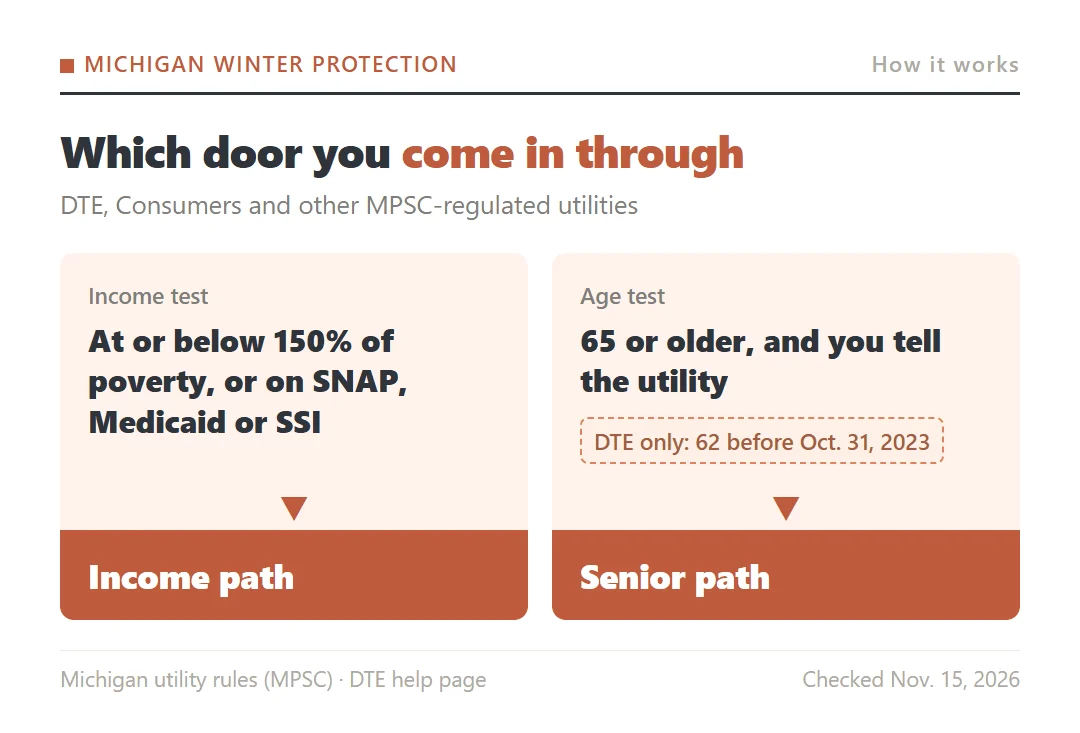
Which test you meet, income or age, decides which payment rules apply to you.
All of this is the state rule for utilities the MPSC regulates. A city-owned utility or a member-run co-op may not follow it, so check with yours directly.
What the Income Path Costs Each Month
The center of the income path is one sentence in Rule 31 of Michigan’s utility rules, R 460.131(1), which has the customer pay “a monthly amount equal to 7% of the estimated annual bill.” DTE’s own help page says you must pay “at least 7% of your estimated annual bill during the protection period,” and that can read like one payment for the season. It isn’t. Five winter months at 7% each comes to 35% of a year’s bill paid between November and March.
Take a DTE gas-and-electric household on SNAP with an estimated annual bill of $2,400, $900 behind, enrolling on Nov. 16, 2026. The 7% part is $168 a month. The $900 is spread over the roughly 12 months until the next heating season starts on Nov. 1, 2027, which is about $75 a month. Together that’s about $243 a month, and to get started the utility can ask for no more than 1/12 of the $900.

The monthly amount has two parts, 7% of the utility’s annual estimate and the past-due balance divided by the months left until November.
The second part moves with the calendar. The rule spreads the past-due balance in equal monthly installments between the day you apply and the start of the next heating season, so the later you enroll, the fewer months share it. If the same household waits until Feb. 2, 2027, the $900 has about nine months to cover instead of twelve, the installment rises to $100, and the monthly total becomes about $268. The utility sets the actual schedule, so treat these month counts as approximate.

Enrolling in February instead of November leaves fewer months for the same past-due balance.
There’s a second clock on this path. Within 14 days of asking for protection, you have to show the utility that you’ve applied for state or federal heating assistance, such as MEAP or State Emergency Relief through MDHHS. DTE’s release points people to 2-1-1 to get connected. The condition is that you applied, not that the grant came through.
Your own figure comes from the utility, not from this math. The estimated annual bill is the utility’s number, and the rule requires bills for enrolled customers to clearly show the minimum amount that prevents a shutoff. The utility may bill more than that to recover the past-due balance, so the line to look for is the minimum.
What will the Winter Protection Plan ask of you each month?
For the income path. Customers 65 or older have no required winter payment and are reconnected without paying. Enter the estimated annual bill your utility gives you, your past-due balance and the month you enroll. The defaults are the DTE household above.
If your result doesn't match your bill or notice, check the exact figure on Michigan's Winter Protection Plan rule (R 460.131). Rules as of 2026-11-15
Show the breakdown and basis
—
Income-qualified path under Michigan's utility rules (MPSC), checked Nov. 15, 2026. Monthly amount = 7% of the estimated annual bill + the past-due balance divided by the months from enrollment to the next Nov. 1 (about 12 from November down to about 8 from March). Most the utility can require to restore service or enroll = 1/12 of the past-due balance. Your utility sets the estimated annual bill and the installment schedule, so the minimum printed on your bill is the number that counts. 65 or older: no required winter payment, and what is owed at March 31 is spread over April 1 through Oct. 31.
Values are calculated in your browser and are not saved or sent anywhere.
Getting the Heat Back On, and What a Missed Payment Starts
If service is already off, or you’re about to enroll, the cost of getting in is capped. On the income path the utility can’t require more than 1/12 of the past-due balance to restore service or put you on the plan, and it can’t ask for a deposit or a restoration fee before you apply during the heating season. Seniors are restored without paying the amount due, a deposit or a reconnection fee. That changes if there was meter tampering or unauthorized use on the account.

What it takes to get service back depends on the path, and neither one asks for the whole balance.
Enrollment goes through the utility, not the state. DTE lists its winter programs on its Empowering Michigan help page and at dteenergy.com/help, and Consumers Energy takes Winter Protection Plan enrollment at 800-477-5050 (consumersenergy.com/help). Both also run their own approved programs, DTE’s Low-Income Self-Sufficiency Plan and Consumers’ CARE, which carry their own terms. On the call, ask for the estimated annual bill the utility is using for your account and the amount needed today to restore service.
Missing a winter payment on the income path doesn’t cut the heat the same day. The utility sends a default notice, and you have 10 days from the date it was mailed to pay what’s past due before service can be shut off. If you think the amount is wrong, you can dispute it by calling the utility.

After a missed payment, the 10 days run from the mailing date on the notice, not from the day it reaches you.
What April Looks Like on Each Path
The April installments from the top of this post apply to both paths, and missing them can lead to a shutoff. What differs is how much is waiting when the season closes.
On the senior path, nothing is forgiven. Rule 32 says the protection doesn’t relieve a customer of the obligation to pay, and DTE encourages seniors to pay monthly “to avoid a large balance in the spring.” Take a 68-year-old Consumers Energy customer whose bills from November through March total $1,050 and who pays none of them. On April 1 the whole $1,050 is spread over the months to Oct. 31, about $150 a month on top of the regular bills.

A senior’s unpaid winter bills come back as about seven equal payments from April through October.
The income path can leave a spring balance too. Say the DTE household’s bills from November through March come to $1,400, and it paid the $168 minimum five times, $840 in all. That leaves $560 owed at April 1, plus any past-due installments it missed, which works out to about $80 a month from April through October.

In this household’s case, the gap carries into spring.
Once the $150 is set beside a summer bill, my own answer for the senior path is that I would pay something each winter month even though the rule asks for nothing. Paying half of those winter bills as they come due cuts the spring installment in half, and the total owed is the same either way. What changes is how much of it lands on the summer bills.
The next decision comes at the end of March. Whatever is still owed when the utility reconciles the account is what gets divided across April through October. How much of it you pay down first is your call.
Photos and icons in this post are illustrations made for explanation; they do not show real places, products or people.