Here’s a hypothetical household, not a real case. Two adults and two kids live together and share their income and expenses. Nobody in the house receives SNAP, Medicaid or another qualifying benefit, and their gross household income is $40,000 a year. They live in one of the 48 contiguous states, not Oregon or Texas. Their only phone is a voice-only landline, and an ad told them Lifeline takes $9.25 off.
On income, they clear the bar on paper. USAC’s 2026 table puts the figure for a household of four in the 48-state column at $44,550, and $40,000 is under it. On the amount, the ad is wrong for them. Voice-only service is supported at $5.25, not $9.25. If they put Lifeline on a home internet plan instead, one that meets the broadband standards and comes from a participating company near them, that plan would sit at the $9.25 level.
So “do we qualify?” and “how much comes off?” have separate answers, and the second one depends on which service gets the discount.
Lifeline takes up to $9.25 a month off one service (phone, internet or a bundle) and up to $34.25 on qualifying Tribal lands. Voice-only service is supported at $5.25, and the exact amount on your bill depends on the Lifeline plan a participating company offers.
The two standard ways to qualify are taking part in a program such as Medicaid, SNAP or SSI, or having household income at or below 135% of the 2026 Federal Poverty Guidelines. Survivors of domestic violence, human trafficking or related crimes have a separate route through USAC’s Survivor Benefit. Only one benefit is allowed per household, and keeping it means recertifying within 60 days whenever you’re asked.
Two Standard Ways In, and Why the Program Route Comes First
Lifeline is “a federal program that helps lower the monthly cost of phone or internet service.” It’s administered for the FCC by USAC, the Universal Service Administrative Company. If you or someone in your household takes part in any of these programs, you qualify without touching the income table, according to USAC’s How to Qualify page:
- Medicaid
- Supplemental Nutrition Assistance Program (SNAP), formerly known as Food Stamps
- Supplemental Security Income (SSI)
- Federal Public Housing Assistance (FPHA), including the Housing Choice Voucher Program (Section 8 Vouchers), Project-based Rental Assistance, Public Housing, and Affordable Housing Programs for American Indians, Alaska Natives, or Native Hawaiians
- Veterans Pension and Survivors Benefit
The housing line is the one people miss. If you hold a voucher or live in public housing, you’re on that list even if you’ve never seen the letters “FPHA” on anything you were sent.
On qualifying Tribal lands, four more programs count: Bureau of Indian Affairs General Assistance, Tribal Temporary Assistance for Needy Families (Tribal TANF), Head Start (only households meeting the income qualifying standard), and the Food Distribution Program on Indian Reservations.
Whichever route you use, the household limit is the same. USAC: “Only one discount is allowed per household. A ‘household’ is a group of people who live together and share income and expenses.” When more than one person at the same address applies, a household worksheet is used to establish whether that address holds more than one household. The criteria are on the official worksheet, and the answer for a particular living arrangement is decided there.
No Qualifying Program? Find Your Row in the 2026 Income Table
USAC’s wording for the standard income route: “You can get Lifeline if your income is at 135% or less than the 2026 Federal Poverty Guidelines.” That works as a lookup, not a single number. Find your household size, then read the column for where you live.
| Household size | 48 states, D.C., territories | Alaska | Hawaii |
|---|---|---|---|
| 1 | $21,546 | $26,933 | $24,786 |
| 2 | $29,214 | $36,518 | $33,602 |
| 3 | $36,882 | $46,103 | $42,417 |
| 4 | $44,550 | $55,688 | $51,233 |
| 5 | $52,218 | $65,273 | $60,048 |
| 6 | $59,886 | $74,858 | $68,864 |
| 7 | $67,554 | $84,443 | $77,679 |
| 8 | $75,222 | $94,028 | $86,495 |
| Each additional person, add | $7,668 | $9,585 | $8,816 |
Count the same household defined above: the people who live together and share income and expenses. And have paperwork ready, because USAC says “you may be asked to show proof of income when you apply for Lifeline (like a tax return or three months of consecutive pay stubs).”
These are the 2026 figures as published when this was checked. The Federal Poverty Guidelines are reissued every year, normally in January, and the whole table moves with them. After a new issue, confirm your row on USAC’s page instead of here.
Alongside the two standard routes, USAC lists a third: survivors of domestic violence, human trafficking or related crimes may qualify for emergency Lifeline support under the Safe Connections Act through the Survivor Benefit.
Voice-Only or Broadband: Which Support Level You’re In
If you remember a much bigger internet credit, that was the Affordable Connectivity Program. USAC sums it up in one line: “The ACP ended on June 1, 2024, due to a lack of additional funding from Congress.” Lifeline is the program still running, and it’s smaller.
The consumer figure is “a monthly discount of up to $9.25 off the cost of their phone, internet, or bundled services,” and “up to $34.25 per month” on qualifying Tribal lands. Two words carry the meaning. “Up to” makes it a ceiling, not a promised credit. “Or” means it covers one service, not each one you pay for.
Under that ceiling, USAC’s minimum service standards page lists support by the type of service you subscribe to:
| What you subscribe to | Support level |
|---|---|
| Voice only | $5.25 |
| Broadband only | $9.25 |
| Bundle, voice meets the standards | $5.25 |
| Bundle, broadband meets the standards | $9.25 |
| Bundle, both meet the standards | $9.25 |
A voice-only landline, or a wireless plan with voice and no data, sits at $5.25. On qualifying Tribal lands, enhanced Tribal support of “up to $25” comes on top of the standard level, which is where the up-to-$34.25 figure comes from.
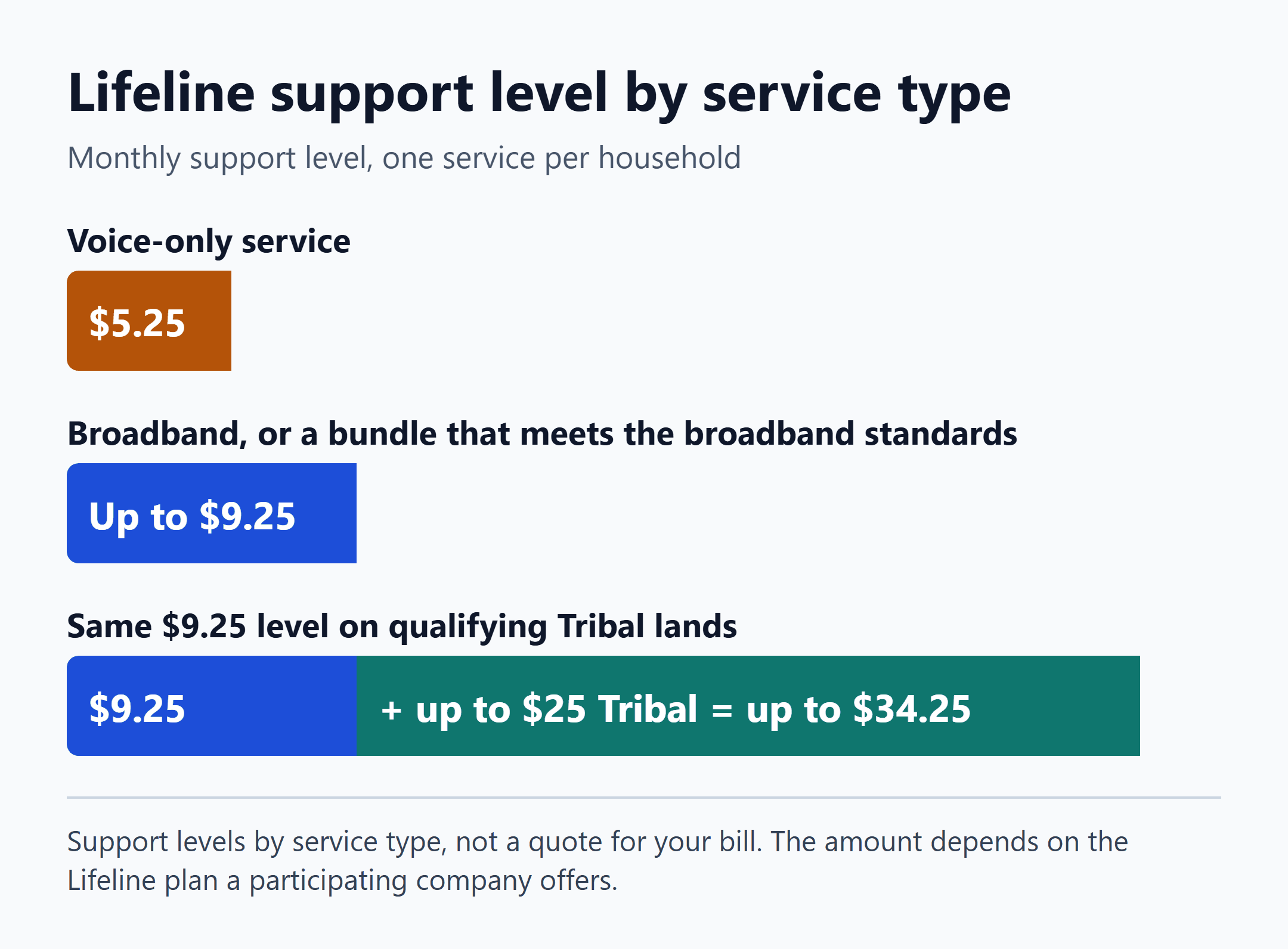
These are support levels by service type, and the “up to $9.25” is how the program describes the discount. Neither is a quote for your account. Whether a plan counts as broadband depends on minimum standards the provider’s plan has to meet, not on anything you measure yourself; the current standards are on the same USAC page.
If you’re on voice-only service, note one date. On July 1, 2026, the FCC’s Wireline Competition Bureau paused the discontinuation of voice-only support for another year, and the $5.25 support “remains available to eligible consumers who subscribe to voice-only service through November 30, 2027.” That end date has been pushed back once already, so check the page again as it gets closer rather than assuming either way.
The Number on Your Bill Comes From a Company Near You
The discount reaches you through a phone or internet company that takes part in Lifeline, applied to a Lifeline plan that company offers. USAC runs the lookup: “To find a Lifeline provider in your area, use the Companies Near Me tool. You can search using your zip code or your city and state.”
USAC attaches two cautions to that tool, and both matter:
- “Not all offer the Lifeline discount.” A company showing up for your area doesn’t mean it has a Lifeline plan.
- “The search results may not show every company that is near you. A company may still offer Lifeline even if it is not on this list.” That could include the company that bills you now, so a missing name is worth one phone call before you rule it out.
Run Companies Near Me for your zip code and compare the Lifeline plans themselves, not headline discounts. For each one, this is what I’d ask the company:
“Do you offer a Lifeline plan for phone, internet or both? What would that plan cost me each month with the Lifeline discount applied, and is it voice-only or does it include broadband?”
The last part of that question tells you which row of the support table you’d be in. Comparing two or three answers is how you get your actual number.
Applying Takes Two Steps, Not One
First you show that you qualify. Then, in USAC’s words, “After you apply, choose a phone or internet company that offers Lifeline and sign up.” Approval alone puts nothing on a bill. The discount starts once you’re enrolled with a company.
Outside Oregon and Texas, USAC lists three ways to apply:
- Online, through Apply Now on USAC’s application page.
- Through a participating phone or internet company, which can help you apply.
- By mail, to PO Box 1000, Horseheads, NY 14845.
If you have a disability and need help applying, USAC lists the Lifeline Support Center at (800) 234-9473.
California Enrolls Twice, Oregon and Texas Go Through the State
California households deal with two programs, and since February 1, 2026, each one takes its own enrollment. The CPUC’s California LifeLine vs. Federal Lifeline notice says the two programs “will require two separate enrollment processes,” and new subscribers “must enroll separately in each program.” The federal side is the Lifeline described above: apply through USAC at lifelinesupport.org, for up to $9.25 a month. The CPUC notice puts California LifeLine at up to $19 on top of that, for up to $28.25 combined.
The state side, California LifeLine, is established and overseen by the California Public Utilities Commission. It “provides discounted home phone and cell phone services to qualified households,” and the CPUC’s instruction for getting started is direct: “Call a participating phone company and ask for the California LifeLine discounts to start the application process.” Approved providers and plans are listed at californialifeline.com. The CPUC’s LifeLine page lists 1-866-272-0349 for general information, 1-877-858-7463 for applications and renewals, and 1-800-649-7570 for complaints or appeals. California LifeLine’s own discount amounts and income limits are set by that program, so get them from californialifeline.com or the company you call; the federal Lifeline amount follows the figures above.
Oregon and Texas handle eligibility outside the federal National Verifier, and the annual recheck there is run by your state. The steps look similar; the office on the other end is different.
Keeping the Discount After the First Year
USAC lists the common reasons a discount stops, without ranking them: you didn’t recertify, you no longer qualify, or you haven’t used the service. Each one has a clock attached.
- Recertify within 60 days of being asked. “Every year, USAC or your state (for Oregon and Texas) will check to confirm you still qualify for the benefit.” The request comes by email, mail or pre-recorded messages on your phone, and “when you are asked to recertify you must do so within 60 days, or you will lose your Lifeline benefit.” The 60 days run from the request, not from a set date. Miss it and “your monthly bill may increase or your free minutes will stop. Your service may be turned off.” Details are on USAC’s recertification page.
- If you pay nothing out of pocket, use the service at least once every 30 days. USAC: “If you don’t pay out-of-pocket for your Lifeline service every month, you must use it at least once every 30 days to keep your service. If you don’t, you will get a 15-day notice to use it or it will be turned off.” If you pay part of the bill yourself, this rule doesn’t apply to you.
- Tell your company within 30 days if you move, if you no longer qualify, or if more than one person in your household is getting Lifeline. That last one is how an accidental duplicate under the one-per-household rule gets fixed, and reporting it is on you.
The First Discounted Bill Is the Real Approval
An approval notice tells you that you qualify. The Lifeline discount showing up on a bill from the company you enrolled with is what tells you it’s working, so keep that first bill and the company’s plan details together.
A household that qualifies through a government assistance program may run into the same kind of check elsewhere. Amazon’s discounted Prime membership also works on a program-or-income check and a re-check every 12 months, covered in who qualifies for Amazon Prime Access, what proof you need, and how to keep the discount.
Then put two things where you’ll see them next year. A recertification request can arrive by letter, email or a recorded call, and the 60 days start when it does, so open anything from USAC or your Lifeline company the day it comes. And if your household stays on voice-only service, write down November 30, 2027, the currently published end date for the $5.25 level.
Sources and scope: USAC’s Lifeline pages (About Lifeline, How to Qualify, Survivor Benefit, Companies Near Me, How to Apply, Recertify, My Service Was Turned Off), USAC’s minimum service standards, consumer eligibility and ACP pages, and the CPUC’s LifeLine page and its California LifeLine vs. Federal Lifeline notice (February 2026), all checked October 16, 2026. This explains the program’s published rules; whether you qualify is decided by USAC or your state, not by this guide.