On November 29, a Texas dog owner renewed his 15-year-old dachshund’s Banfield Optimum Wellness Plan for another year. About a week later, the dog died.
The numbers CBS News Texas reported afterward (story updated January 3, 2024) look upside down at first. The care the dog received in that last week was valued at $1,100 at retail. The payments left on the new plan year, at $91 a month, came to just over $1,000.
In other words, the cancellation bill was bigger than simply paying out the year. Banfield later offered to settle for $200; the report doesn’t say how it ended.
Banfield’s Optimum Wellness Plan page, last updated September 9, 2026, states the rule. If you cancel before the end of your plan term, you may be responsible for the difference between the retail cost of services already used and the payments made toward the plan.
That makes your cancellation cost a number only Banfield can give you. Ask the plan team for it, then put it next to a second number you can work out yourself: the monthly payments left before your term ends.
If the cancellation balance is the bigger of the two, keeping the plan to its end date with auto-renew turned off costs only those remaining payments. That’s the ceiling you control.
This covers Banfield Optimum Wellness Plans paid monthly. The Banfield Access Plan and other clinics’ wellness plans run on their own agreements.
Your Two Numbers, and Which One You Actually Pay
Optimum Wellness Plans are annual plans split into 12 equal monthly payments. When you leave early, the care your pet already got this plan year is counted at its retail cost, and what you’ve paid is subtracted.
Cost to cancel now = retail cost of services used this plan year − plan payments made this plan year.
Cost to finish the term = your monthly payment × the payments left before the term ends.
Whichever number is smaller is your cheaper way out. The second one you can count from your statements. The first has to come from Banfield, so ask the plan team for the balance and how it was figured before you confirm anything.
While you’re on the phone, ask what goes into the retail figure: the plan services your pet used, and whether plan discounts on other items are counted too. Banfield’s public pages don’t spell that out.
If your pet used less care than you’ve paid for, the formula comes out at zero or below. Banfield’s page doesn’t say it refunds the difference, so read that result as owing nothing more, not as money coming back.
Older plan agreements, as quoted in news reports, went a step further. The wording CBS News Texas quoted in 2024 said a canceling member owes “the lesser of” the retail-minus-payments figure or “any remaining monthly payments due under the term of the plan.”
Banfield’s current public FAQ states only the difference rule. Check your own agreement, or ask the plan team whether that lesser-of wording is in it.
Household A: routine care, cancel now
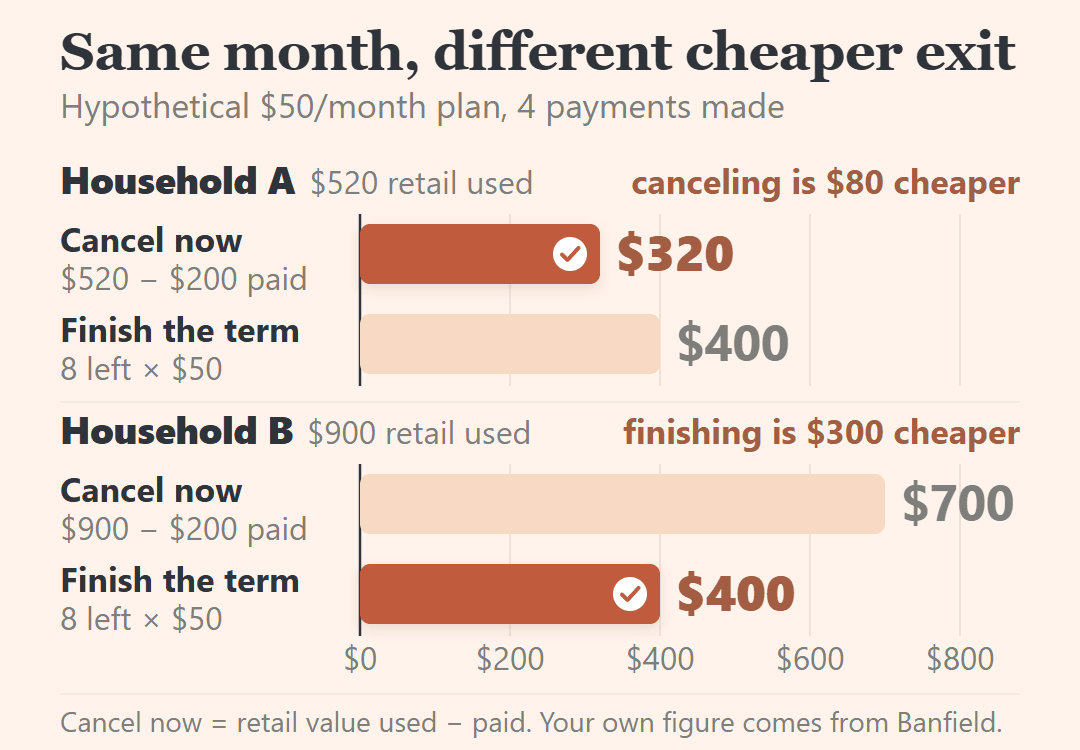
Here’s a hypothetical example, using an illustrative $50 monthly payment rather than a real Banfield price. Household A has made 4 payments, $200 so far. Its pet has had an exam, vaccines and one lab panel, which Banfield prices at $520 retail in this example.
Canceling now costs $520 − $200 = $320. Finishing the term costs 8 × $50 = $400. For Household A, canceling is $80 cheaper.
Household B: same month, more care used
Household B is the same hypothetical $50 plan with the same 4 payments, $200 so far. But its pet also had a dental cleaning and a sick visit, so the retail figure in this example is $900.
Canceling now costs $900 − $200 = $700. Finishing the term still costs 8 × $50 = $400. For Household B, keeping the plan to the end with auto-renew off is $300 cheaper.
Same month, same plan price, opposite answers. That’s why no “cancel after month X” rule works for everyone. The care already used decides it.
| Household | Paid so far | Retail value used | Cancel now | Finish the term |
|---|---|---|---|---|
| A, routine care | $200 (4 × $50) | $520 | $320 | $400 (8 × $50) |
| B, heavy early use | $200 (4 × $50) | $900 | $700 | $400 (8 × $50) |
| C, just renewed | $50 (1 × $50) | $800 | $750 | $550 (11 × $50) |
Household C is the one to look at if your plan renewed recently. It comes up in the next section.
Why the Weeks After a Renewal Can Be the Costliest Time to Leave
Monthly-pay Optimum Wellness Plans can be set to renew automatically each year. A renewal starts a new plan year with a new 12-month term, and the count of payments made starts over.
That’s what turns the formula against you early in a plan year. With only one or two payments made, a single bigger visit can push the cancellation balance above everything left on the year. The Texas case above followed exactly that pattern.
Take hypothetical Household C at the same illustrative $50 a month. It has made 1 payment in the new year, $50, and its pet then had a visit priced at $800 retail. Canceling costs $800 − $50 = $750; finishing costs 11 × $50 = $550, so finishing is $200 cheaper.
If there’s any chance you won’t want another year, turn off automatic renewal in your MyBanfield account before the renewal date. Banfield’s FAQ says that’s where the setting lives.
The same renewal-date check pays off on any auto-renewing bill. For another example, see what SiriusXM renews at once a promo ends, and what to do before its renewal date.
If Your Pet Died, the Plan Doesn’t End by Itself
Banfield’s public FAQ doesn’t list a pet’s death as an exception to the cancellation rule. Plan agreements quoted in the news point the other way.
FOX 35 Orlando, in an October 18, 2023 report, quoted agreement wording that payments may continue “if member cancels for any reason (including but not limited to death or loss of pet or transfer of ownership).” The Florida family in that story was told to keep paying about seven more months after their dog died in May.
WSVN Miami reported in September 2020 on a South Florida owner with a $53-a-month plan whose dog died in April. He said he tried to cancel by phone and email but got no answer, was told he’d be charged until the plan ran out in November, and about seven months of payments, more than $370, ended up in collections. After the station contacted Banfield, the balance was cleared.
In all three reported cases, the bill came down only after the owner pushed back or a TV station got involved. FOX 35’s family got a discount of an unreported amount, the Texas owner was offered $200, and the South Florida owner’s balance was cleared. Those are outcomes, not a policy you can count on, but asking costs nothing.
Something like this, said calmly and with the date in hand, covers both the number and the request:
“My pet died on [date], and I’d like to end the Optimum Wellness Plan. Before I confirm, what is the cancellation balance, and how was it figured, item by item? Does it include anything besides the plan services my pet used? Given my pet’s death, can that balance be reduced?”
Making the Call: What to Ask For and What to Keep
Banfield’s contact page lists one line for plan cancellations and general questions: phone or text 888-649-2716, or email [email protected].
- Get the cancellation balance and ask how it was figured.
- Count your remaining payments: your monthly payment times the payments left before the term’s end date.
- Take the smaller number. If finishing the term is cheaper, keep the plan and turn off auto-renew in MyBanfield instead of canceling.
- If you do cancel, get written confirmation of the cancellation date and the amount you’ll owe.
- Check the next statement for any plan payment dated after that confirmation.
If a payment still posts after the confirmed date, the next step is a refund request or a dispute with your card or bank; this walk-through on getting a refund or disputing a charge after you canceled a subscription covers both.
Paid for the whole year up front? Annual-pay plans don’t renew automatically, and Banfield’s FAQ doesn’t say what comes back if you cancel one early, so ask the plan team before counting on a refund.
What stands out to me in Banfield’s own wording is the savings claim: it’s based on using all the services in the plan over a full year. Leave partway through, and the care you did use gets repriced at retail.
That’s why the expensive moments to walk away are right after a big visit and right after a renewal. Even if you aren’t leaving, look up your plan’s renewal date in MyBanfield this week and decide now whether you want that next year.
Sources: Banfield’s Optimum Wellness Plans page and FAQ (last updated September 9, 2026), its plan FAQs page and contact page. Public cases as reported by CBS News Texas (updated January 3, 2024), FOX 35 Orlando (October 18, 2023) and WSVN Miami (September 18, 2020). Checked October 2026.