On a New York gas or electric bill that suddenly covers several past months, the total is what jumps out. The line that decides how much of it you owe is much smaller: the service period printed for each charge, a “from” date and a “to” date.
Those dates, plus one thing only your billing history can tell you, sort every month on the bill into one of two rules. The thing to find out is whether you were ever billed for that month before. New York’s Public Service Law §41 treats a month that was never billed very differently from a month that was billed, often on an estimate, and is now being charged more.
- Never billed before: the utility had to mail you a bill for that month, or make it available online, within three months after the billing period ended. If it didn’t, it can’t charge you for that month, unless the delay wasn’t the utility’s fault or was caused by something you did.
- Billed before, now charged more (the usual catch-up after estimated bills): the utility can generally adjust charges for service provided in the past 12 months, and nothing more than 24 months back unless you caused the problem.
Either way, you can ask to pay what you do owe in installments, on terms the law sets separately for each situation. And you keep your service while you dispute, as long as you pay the undisputed part and your current charges.
This covers home gas and electric bills from New York utilities regulated by the Public Service Commission (PSC), municipal utilities, and the Long Island Power Authority and its service provider, PSEG Long Island. It doesn’t cover business accounts or water or steam service. The rules here are from state law and the PSC as of October 2026.
What to Copy Off the Bill Before You Call Anyone
Every answer below runs on dates and history from your own account, so write these down first:
- The bill date. When the bill was mailed, or when it was posted to your online account.
- The service period for each charge. The “from” and “to” dates of every period the bill covers. A catch-up bill can cover several.
- Whether each of those periods was billed before. Check past statements or the bill history in your online account, and note whether any earlier bill for that period was marked as estimated.
- The catch-up amount compared with the earlier estimates. For periods billed on an estimate, what you were charged then versus what you’re charged now.
- Any notice explaining why the bill is late. Look for an insert or message with the bill.
- Your usage history. Utilities with more than 15,000 customers must print your average daily or monthly usage for the prior 13 months on every bill. On request, they must also send your monthly billing charges for the 13 months before the current billing period, no later than 30 days after you ask (PSL §44). That history helps you piece together what was billed and when, though it doesn’t by itself show a charge is improper.
Was That Month Billed Before? The Answer Picks the Rule
The law draws the line in its own wording. Section 41(1) covers services “which were not billed to the customer.” Section 41(2) covers a utility that wants to “adjust upward a bill previously rendered.” So ask one question per period: did a bill for this period ever reach you before?
Estimated bills count as bills. A utility may send an estimated bill for a billing period as long as it clearly says it’s based on an estimated reading (PSL §39). If you got estimates for those months and an actual reading later raised the charge, those months were billed before. The three-month rule doesn’t cancel that kind of catch-up.
To see how much this one question changes, picture an August bill that includes charges for March electric service. If no bill for March ever went out before August, that’s a late bill: it came well over three months after March’s billing period ended, so the three-month rule decides whether you owe it. If March was billed earlier on an estimate and August’s bill now charges more after an actual reading, the same March charge is an upward adjustment, and the 12-month rule applies instead. A single catch-up bill can mix both kinds, so sort it period by period.
Three Months, 12 Months, 24 Months: Which Clock Is Yours
Never billed: three months from the end of the billing period
The law says that if a utility doesn’t bill a residential gas or electric customer for a monthly period “within three months from the end date of such monthly billing period,” the customer “shall not be charged” for that service. The PSC reads this as requiring the utility to mail a physical bill or make one available online in that window, so a bill posted to your online account on time counts even if you never opened it. The clock starts when the billing period ended, not when you noticed the charge.
The utility can still charge you if the failure to bill sooner “was not due to the neglect” of the utility or “was due to the culpable conduct of the customer.” The rule also excludes seasonal or short-term customers as the PSC defines them. The law doesn’t define those terms, and the PSC has said existing regulations and past complaint decisions guide their meaning. If the utility says an exception applies, ask it to explain why in writing.
This applies to any bill a utility sent on or after June 19, 2024, even if the service itself was provided before that date, according to the PSC’s May 2024 order. You may still see “six months” for never-billed service in a PSC regulation and a state consumer guide. That’s the older, pre-2024 limit. The PSC has said the law overrides that timing and any conflicting regulation or tariff, so for a never-billed period, the three-month rule and its exceptions are what apply.
Billed before, now charged more: 12 months from when you used the service
A utility “may not adjust upward a bill previously rendered” to a residential customer more than 12 months after the service the adjustment covers was provided. This clock runs from when you used the service, not from the bill date. It doesn’t apply if the billing error was caused by your culpable conduct or wasn’t due to the utility’s neglect, if the adjustment is settling up a budget payment plan, or if there was already a dispute about it within those 12 months. A bill that charges you for service more than 12 months old must come with a notice giving the reason for the late billing.
The outer limit for both: 24 months
No utility may bill for never-billed service, or adjust a past bill upward, more than 24 months after the service was provided. The only exception is when your own culpable conduct caused or contributed to the failure to bill correctly.
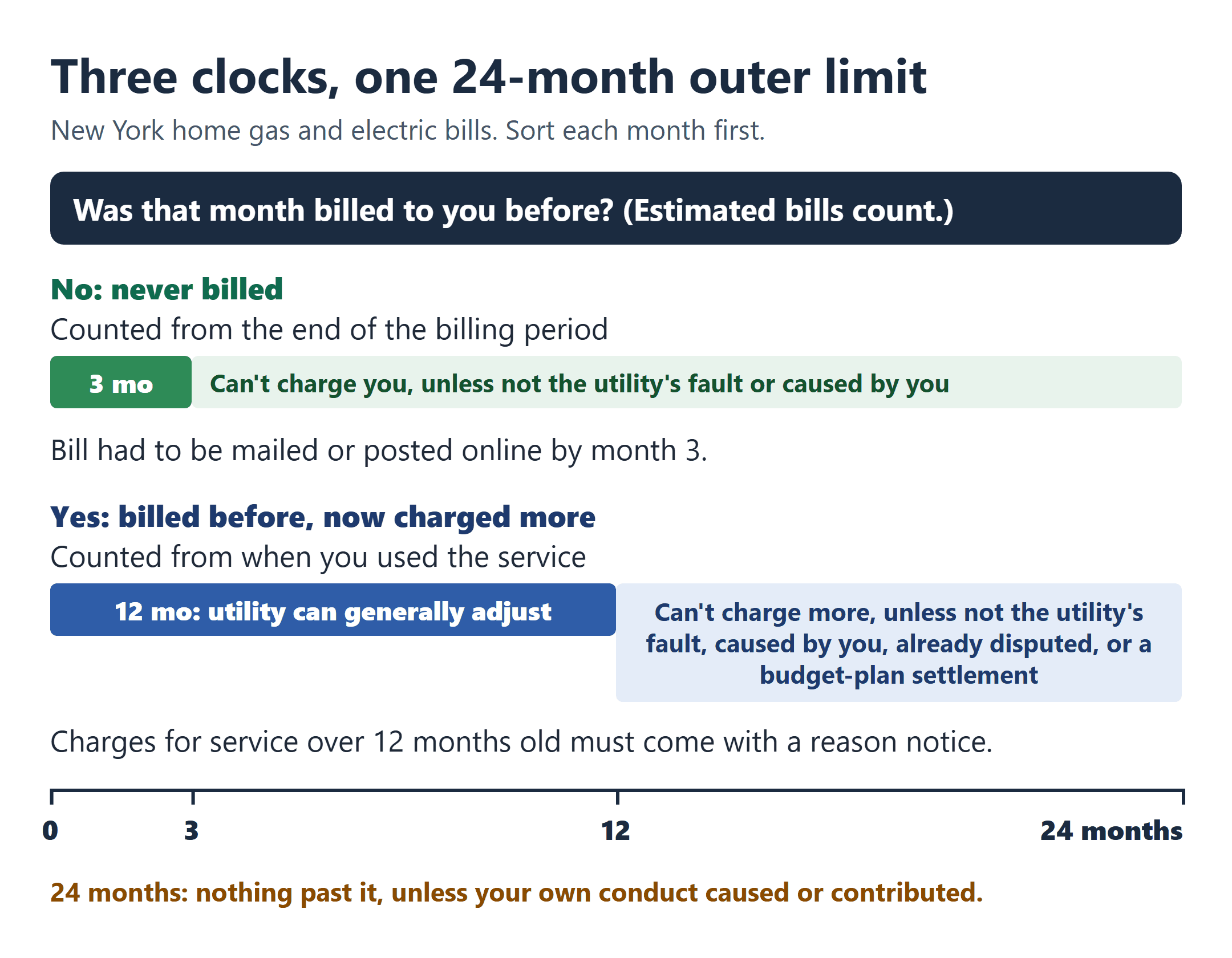
| Never billed before | Billed before, now charged more (including estimates) |
|---|---|
| Deadline: bill mailed or posted online within three months after the billing period ended | Deadline: adjustment within 12 months from when the service was provided |
| Unless: the delay wasn’t the utility’s fault or was caused by you; seasonal or short-term accounts are excluded | Unless: the error wasn’t the utility’s fault, was caused by you, was already in dispute, or it’s a budget-plan settlement |
| Both: nothing past 24 months after the service, unless your own conduct caused or contributed to it | |
Two Installment Rights, and They Don’t Mix
What you can ask for depends on which column your period landed in.
A late bill you still owe. If an exception applies and you remain liable for the late-billed charges, the utility must let you pay them under an installment plan. The plan can ask for a down payment of “up to one-half of the amounts due from the customer, or three months average billing, whichever is less.” If the delay came from your own culpable conduct, the utility may require prompt payment instead.
A catch-up after estimated bills. When estimated bills “significantly understate” what you actually owe, state law gives you the right to pay the difference between the estimated and actual charges in regular monthly installments over a reasonable period of at least three months (PSL §39). Under PSC rules, if the estimates understated your charges by more than 50 percent or $100, whichever is greater, the utility must notify you of that right in writing. The comparison you wrote down earlier is what you’d point to.
The down-payment cap is written into the late-bill rule; the estimate rule doesn’t state one, so don’t assume it carries over. If your bill mixes both kinds of period, ask about each separately.
Disputing a Charge Without Risking a Shutoff
The Department of Public Service asks customers to go to their utility first. When you do, name the periods and the dates, not just the total. Something like this works for a never-billed period:
“My bill dated [bill date] charges for service from [from date] to [to date]. I have no earlier bill for that period, so I believe Public Service Law §41(1) bars this charge because it wasn’t billed within three months after that billing period ended. If you say an exception applies, please explain why in writing. For anything I do owe, I’m asking for the installment plan the law requires.”
For an estimate catch-up, swap in the earlier estimated amount and the new one, and ask for installments under PSL §39.
While the complaint is pending with the utility or the PSC, and for 15 days after, the utility must not shut off your service for nonpayment, as long as you pay the undisputed portions of your bills, including current usage (PSL §43). That protection depends on keeping those payments up, so don’t stop paying the bill altogether.
If the utility doesn’t resolve it, file a complaint with the Department of Public Service through its online complaint form or at 800-342-3377 (Monday to Friday, 8:30 a.m. to 4:00 p.m.). For a shutoff emergency, call 800-342-3355.
Before the Due Date on This Bill Arrives
If I were holding one of these bills, I wouldn’t start with the total or with whatever limit I’d heard from a neighbor. I’d start with a sheet of paper and one row per service period: the dates, whether it was billed before, and whether that earlier bill was an estimate. Once every row has an answer, it’s clear which rule, which installment right and which question belong to each month.
Then pay the part you agree with and your current charges on time, and raise the rest with the utility before the due date. Keeping up those payments is what the shutoff protection rests on while your complaint is pending.
Other surprise bills reward the same habit of reading dates before paying. If a hospital bill is the next envelope on the table, here’s how to check whether you can still apply for hospital financial assistance after the bill arrives.
Sources: New York Public Service Law §41, §39, §43 and §44, the PSC’s 2024 order implementing §41, and the PSC’s rules on estimated bills, as of October 2026. This is general information, not legal advice; your own bill and billing history decide which rule applies to each month.