Picture two Texas renters. They’re hypothetical, not real tenants or real leases. Both pay $1,400 a month, due on the 1st. One rents half of a duplex. The other lives in a 200-unit apartment complex.
Under the same statute, the late fee the law treats as reasonable stops at $168 for the duplex renter and $140 for the renter in the complex. They pay the same rent under the same law, but the line is different because the buildings are different.
That’s why there’s no single “Texas maximum late fee” in dollars. Texas sets a percentage, and you apply it to your own rent.
A Texas landlord can charge a late fee only if the fee is in your written lease and some of your rent is still unpaid two full days after the due date. If rent is due on the 1st, no late fee can start before the 4th.
The fee Texas Property Code §92.019 treats as reasonable is no more than 12% of your rent for the rental period if your building has four or fewer units, or 10% if it has more than four. If your lease charges a flat fee plus a daily fee, the two together count as one late fee under that line.
A fee above the line isn’t automatically unlawful. The landlord would have to show that it’s no more than its uncertain damages from the late payment, such as collection costs and overhead. And paying a fee you think was wrong doesn’t give up your right to challenge it.
First Question: Was the Fee Even Allowed to Start Yet?
Before you look at the amount, check the date on the charge. The statute lets a landlord collect a late fee only when all three of these are true:
- The fee is in a written lease. If your lease says nothing about a late fee, there’s no late fee to collect.
- The fee is reasonable, which is the 12% or 10% line covered below.
- Some rent is still unpaid two full days after the date it was originally due.
The two days are full days. With rent due on the 1st, the 2nd and the 3rd are the two full days, so the 4th is the earliest a fee can be charged. If your lease sets a different due date, count two full days after that date.
Here’s a quick test with a hypothetical ledger: rent due on the 1st, and a late fee posted on the 3rd. That fee came too early. It doesn’t matter how small it is, because the third condition wasn’t met yet.
(This version of the rule applies to leases entered into or renewed on or after Sept. 1, 2019.)
Your Line Is Your Rent Times 12% or 10%, and the Building Decides Which
You need two facts: your rent for the rental period, and how many units are in your building.
- Four or fewer units (a house, a duplex, a fourplex): rent × 0.12
- More than four units (an apartment building): rent × 0.10
Back to the two hypothetical renters at $1,400 a month. The duplex renter’s line is $1,400 × 0.12 = $168. The complex renter’s line is $1,400 × 0.10 = $140. Those two numbers belong to that $1,400 rent and those two buildings. Your own line moves with your rent and your building.
What I’d check first is the unit count, because it’s the input people tend to skip. Rent is printed on your lease. The building size usually isn’t, and it changes the percentage.
The percentage is a safe harbor, not an absolute ceiling. The statute also treats a higher fee as reasonable if it isn’t more than the landlord’s uncertain damages from the late payment, including direct or indirect costs and overhead tied to collecting it. So “over 12%” doesn’t automatically mean “illegal.” It means the landlord is outside the line the law spells out and would have to justify the fee another way.
A Daily Late Fee Isn’t a Separate Charge
Many Texas leases charge an initial late fee and then a daily fee for each day rent stays unpaid. It’s easy to read the daily fee as its own charge with its own limit. The statute says the opposite: a late fee may include an initial fee and a daily fee, and “the combined fees are considered a single late fee.” Every daily charge counts toward the same 12% or 10% line.
Here’s how that adds up for the two hypothetical renters, plus a third renter in the same complex who paid most of the rent on time.
| Renter (assumed) | Lease late fee | Line | Combined fee |
|---|---|---|---|
| A: duplex | $100 on the 4th, then $15 a day | $168 (12%) | $160 on the 8th; $175 on the 9th, past the line |
| B: 200-unit complex | $75 on the 4th, then $10 a day | $140 (10%) | $135 on the 10th; $145 on the 11th, past the line |
| C: same complex, paid $1,300 of $1,400 | Same as B | $140 (10% of the full $1,400) | A fee can start on the 4th even though only $100 is unpaid |
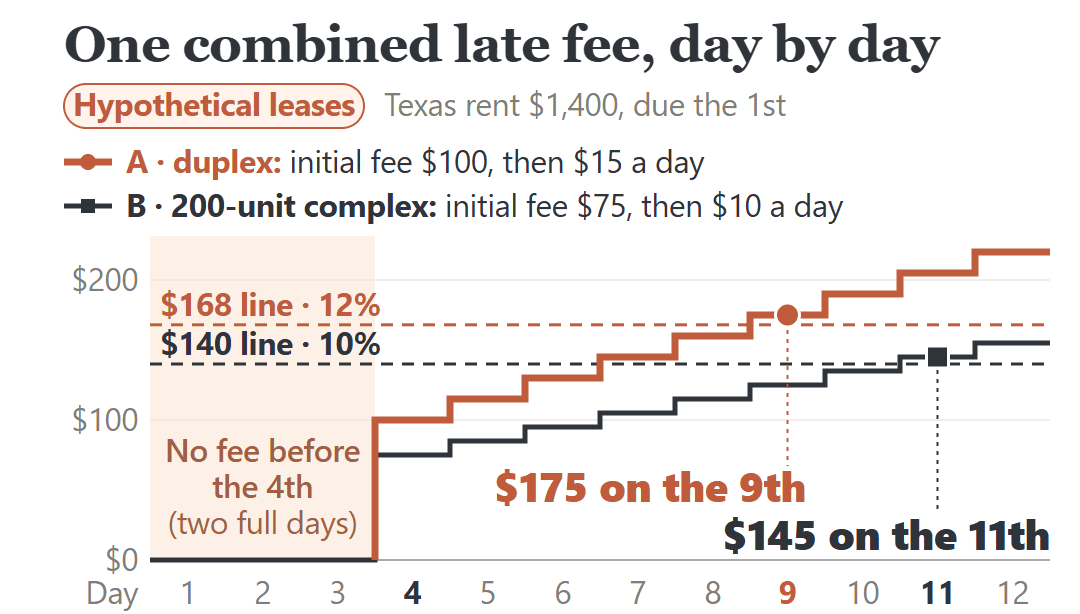
The day a fee crosses the line isn’t a rule. It comes from your lease’s own initial and daily amounts, so a different lease crosses on a different day, or never. To check yours, add the initial fee to every daily charge on your ledger for that month and compare the total with your line.
Renter C shows two details people miss. Any unpaid portion of rent can trigger a late fee, even $100. But the line is still a percentage of the rent for the rental period, the full $1,400. It’s not a percentage of the $100 balance. Paying most of the rent doesn’t shrink the line, so the fastest way to stop a daily fee from growing is to pay the rest.
One more thing to check in your lease. The Texas Tenant Advisor, a nonprofit tenant guide, warns that if a lease lets the landlord decide how to apply payments, next month’s rent can go toward an unpaid late fee first. That can leave the rent itself short and late. Look for a payment-application clause before you leave a disputed fee unpaid.
If the Fee Went Past Your Line: Get It in Writing, Then Ask
Start by getting the landlord’s number on paper. Under §92.0191, you can ask for a written statement of whether you owe a late fee and, if so, how much. The landlord has to send it the way the two of you normally communicate in writing, such as a portal message, email or letter.
“Under Texas Property Code §92.0191, please send me a written statement of whether I owe a late fee for my [month] rent and, if so, the amount. If it includes daily fees, please list each charge and the date it was added.”
Keep in mind that a landlord who doesn’t answer hasn’t erased a fee you actually owe. The statement is a tool for getting the facts, not a way to make a fee disappear.
Next, compare the statement with two things: the first date a fee was charged, and the combined total against your rent × 12% or × 10%. If the fee started too early or the total is past your line, put your request in writing:
“My rent is $[rent] and my building has [number] units. Under Texas Property Code §92.019, a late fee is treated as reasonable up to [12% / 10%] of my rent, which is $[your line]. The late fees for [month] total $[amount], [and the first one was charged on (date), before rent was two full days late]. Please remove the amount over that line [and the early fee], and credit back anything I’ve already paid above it.”
The statute backs that request. A landlord who violates the late-fee section is liable to the tenant for $100, plus three times the late fee collected in violation, plus the tenant’s reasonable attorney’s fees. A lease clause that tries to waive those rights is void, and paying the fee doesn’t waive them. Since that remedy is tied to fees collected, keep proof of every payment.
If the landlord won’t fix it, a claim this size falls within the limit for justice court, where Texas hears small claims.
One thing this rule doesn’t do is protect unpaid rent. The statute says it doesn’t affect the landlord’s right to end the lease or take other action the lease or the law allows, including a notice to vacate. Winning the argument about the fee doesn’t settle the rent itself.
What to Pull Up Before Next Month’s Rent Is Due
- Open your lease and find the late-fee clause: the initial amount, any daily amount, and the due date.
- Write down your rent for the rental period and the number of units in your building. Multiply: × 0.12 for four or fewer units, × 0.10 for more.
- On your ledger, check the date of the first late charge (no earlier than two full days after the due date) and add every late charge for that month into one total.
- If either check fails, ask for the written statement, then send your request in writing. Keep copies and payment records.
- Check the payment-application clause, and get the rent itself in on time while the fee question is open.
The percentage is the one number in this rule that the law hands you directly. I’d work it out before arguing about what’s “reasonable,” because a total measured against your own rent × 12% or × 10% makes the clearest request.
This covers ordinary private residential leases. Federally assisted or income-restricted housing may have its own late-charge rules, so check that lease and program as well.
If late fees are part of the reason you plan to move when the lease ends, your electricity contract is the next Texas bill to look at. Moving out of the address on the contract is one of the cases in when you don’t owe a Texas electricity early termination fee.
Sources: Texas Property Code §92.019 (late payment of rent; fees) and §92.0191 (statement of late fees); the Texas Tenant Advisor’s late fees page. Checked Oct. 16, 2026. The renters, rents and lease fees above are hypothetical examples, not real leases or typical Texas fees. This is general information, not legal advice.