

Yes, Bank of America is raising the monthly fee on Advantage Plus checking, and no, not everyone with the account will pay it. From Feb. 19, 2027, the fee is $15 a month instead of $12, and it’s charged only for a statement cycle in which none of the account’s three waivers was met.
Two other charges go up the same day. An overdraft item costs $15 instead of $10, and a withdrawal at a non-Bank of America ATM in the U.S. costs $3.00 instead of $2.50, plus whatever the ATM’s owner charges. All three changes sit in Bank of America’s Personal Schedule of Fees dated Nov. 13, 2026, on pages 6, 11 and 13, and that schedule applies in every state.
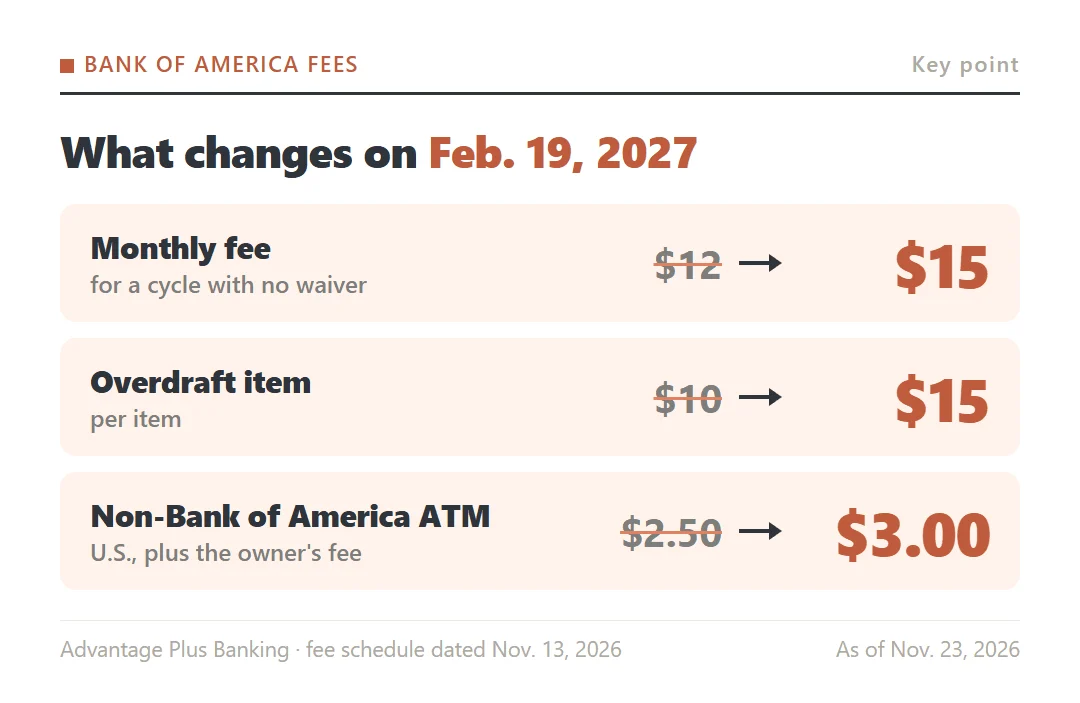
The three Advantage Plus charges that change on Feb. 19, 2027.
What I couldn’t find in the schedule is how it handles a statement cycle that runs across Feb. 19. It says “effective February 19, 2027” and nothing about whether that cycle is charged $12 or $15.
Whether the new fee reaches you is already printed on your last few statements. If a paycheck-type deposit lands every cycle, or the balance never dips under $1,500, you pay no monthly fee. If neither happens, Advantage SafeBalance can be the cheaper Bank of America account, though with a paycheck deposit and a small balance it’s Plus that costs nothing.
Find the Waiver on Your Statements
Bank of America drops the Plus fee for any statement cycle in which one of three things happens. At least one qualifying direct deposit of $250 or more arrives, the balance stays at $1,500 or more every day of the cycle, or an account owner is in the BofA Rewards Preferred Plus tier or higher. Preferred Plus takes a $30,000 average balance across Bank of America deposit and Merrill investment accounts, so if that isn’t you, the first two are the ones that matter.
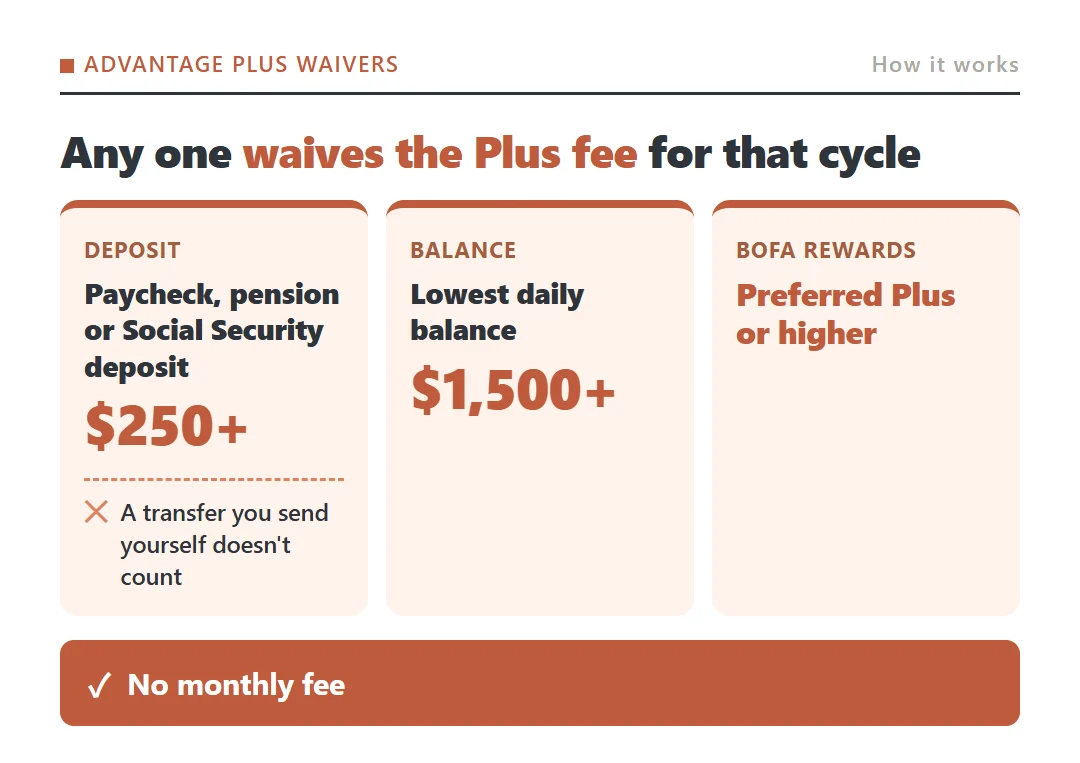
Any one of the three waives the Plus fee for that statement cycle. Money you transfer in yourself doesn’t open the first one.
The deposit waiver is narrower than it sounds. Page 16 of the fee schedule counts only regular income, such as salary, a pension or Social Security, sent by your employer or another payer using the account and routing numbers you gave them. Online and Mobile Banking transfers, moves between accounts, teller deposits, wires and ATM deposits don’t count.
So if your paycheck lands at another bank and you move $300 over every payday, that money has never waived the fee. What counts is the employer or other payer sending $250 or more straight to this account.
The balance waiver has its own catch. The Plus row on page 6 defines “minimum daily balance” as the lowest balance in the statement cycle. An account that sits at $5,000 for 29 days and drops to $1,400 for one day, say when the rent clears the day before payday, pays the full fee for that cycle.
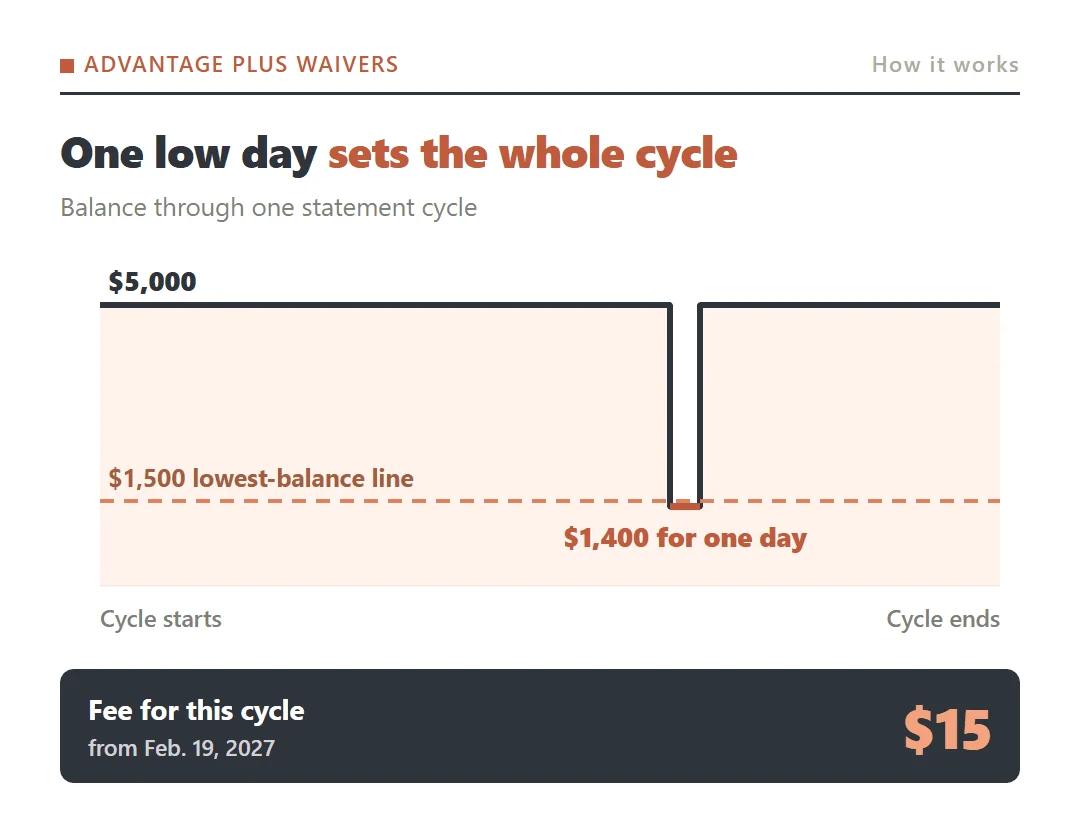
One day under $1,500 is enough to lose the balance waiver for the whole cycle.
This is the waiver I trust least, because it can be lost on a day you never looked at the balance.
Go through your last three statements one cycle at a time. Look for a deposit of $250 or more from an employer, a pension or Social Security, then for the lowest point the balance reached. A cycle with neither will cost $15 after Feb. 19, and the number of those cycles in a year is the first thing the calculator below asks for.
What an Overdraft or Another Bank’s ATM Will Cost
From Feb. 19, the Overdraft Item Fee is $15 per item, up from $10, and Bank of America charges it for no more than two items a day. Three checks or payments that overdraw the account on the same day cost $30, not $45, as long as each one is over $1 and overdraws the account by more than $1.
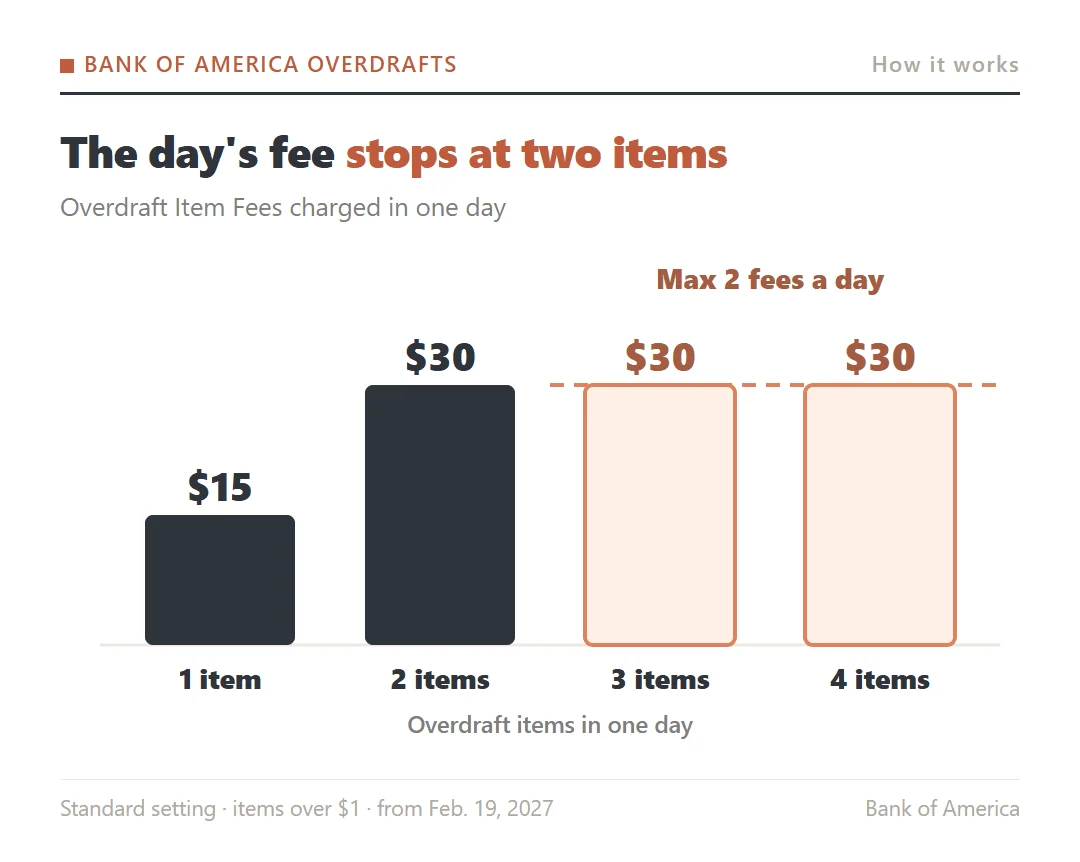
After the second overdraft item in a day, the day’s fee stops growing.
Some things never trigger the fee. Bank of America declines everyday debit card purchases and ATM withdrawals when the money isn’t there instead of paying them into overdraft, and it doesn’t charge for items of $1 or less, overdrafts of $1 or less, or items it sends back unpaid, though the payee may charge you for those. The fee comes from checks, scheduled payments and recurring card charges the bank pays anyway.
Plus accounts start on the Standard setting, where those items can be paid and the fee charged. On the Decline All setting, checks and scheduled payments the balance can’t cover are returned unpaid, and Bank of America charges no Overdraft Item Fee even if the account goes negative. A returned payment can still bring a fee from whoever you were paying.
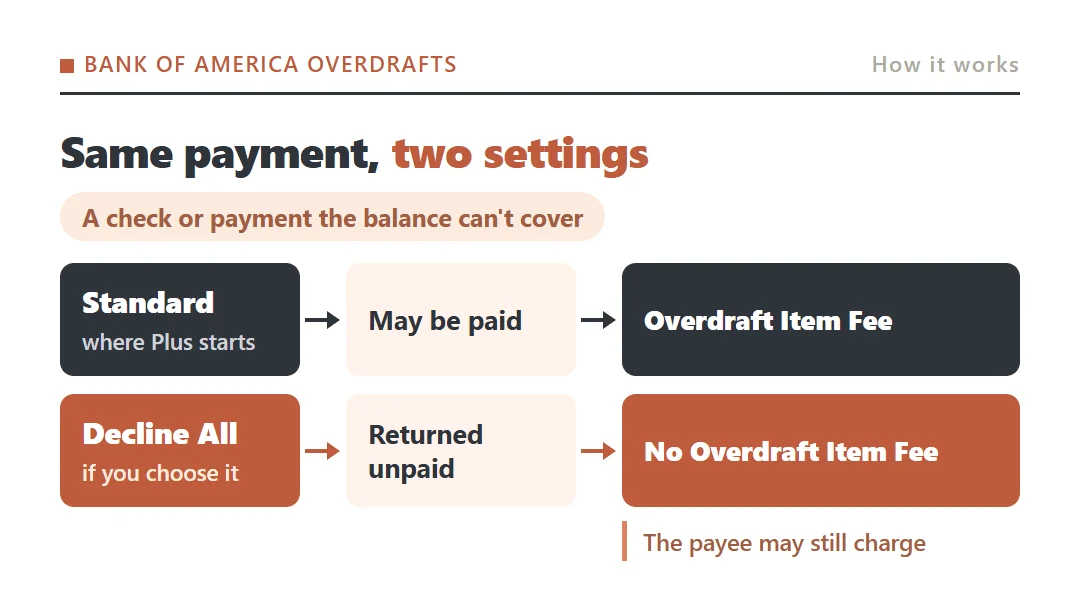
The same short balance under each overdraft setting.
The account documents say you can choose Decline All but not where to do it, so ask whichever way you normally reach the bank.
Please change the overdraft setting on my Advantage Plus checking account ending in ____ from Standard to Decline All, and tell me the date it takes effect.
Returned items used to cost money here. In July 2023 the Consumer Financial Protection Bureau ordered Bank of America to refund about $80.4 million in repeat $35 non-sufficient-funds fees, charged each time the same declined payment was presented again between Sept. 2018 and Feb. 2022. Today’s schedule charges nothing for an item the bank returns unpaid, and nothing on a resubmitted payment labeled “RETRY PYMT” or “REDEPCHECK.”
The ATM change is 50 cents a withdrawal or transfer at a non-Bank of America machine in the U.S., and the machine’s owner or network can still add its own fee on top of Bank of America’s $3.00.
Put it together for one household. Say the pay arrives by transfer from another bank, so the deposit waiver never applies, the balance drops under $1,500 every cycle, four overdraft fees get charged in a year and there are two out-of-network withdrawals a month. That household pays $244 a year in these fees at today’s prices and $312 from Feb. 19, with the monthly fee making up $180 of it.
The calculator starts with that household. Put in your own count of cycles with no waiver, overdraft fees charged in a year and out-of-network withdrawals a month.
What will your Bank of America fees be from Feb. 19, 2027?
Count the statement cycles with no waiver, the overdraft fees you were charged and your non-Bank of America ATM withdrawals.
If your result doesn't match your bill or notice, check the exact figure on Bank of America's Personal Schedule of Fees. Rules as of 2026-11-23
Show the breakdown and basis
Today: $12 for each statement cycle with no waiver, $10 per overdraft fee and $2.50 per non-Bank of America ATM withdrawal in the U.S. From Feb. 19, 2027: $15, $15 and $3.00. Fees the ATM's owner adds are not included.
Values are calculated in your browser and are not saved or sent anywhere.
Would Advantage SafeBalance Cost You Less?
SafeBalance is Bank of America’s other basic checking account. It costs $4.95 a month, and the schedule lists no 2027 change for it. The fee is waived for a cycle when an owner is under 25, the lowest daily balance stays at $500 or more, or an owner has Preferred Plus or higher. There is no direct-deposit waiver, and that is why the cheaper account isn’t the same for everyone.
The table puts one statement cycle from Feb. 19, 2027 through both accounts’ waiver rules on pages 5 and 6 of the schedule, for an owner 25 or older with no BofA Rewards tier, counting the monthly fee only.
| Your statement cycle | Advantage Plus | Advantage SafeBalance |
|---|---|---|
| Paycheck direct deposit of $250+, lowest balance $200 | $0 | $4.95 |
| No qualifying deposit, lowest balance $300 | $15 | $4.95 |
| No qualifying deposit, lowest balance $500 | $15 | $0 |
| No qualifying deposit, lowest balance $1,499 | $15 | $0 |
| No qualifying deposit, lowest balance $1,500 | $0 | $0 |
| Pay moved in from your own account at another bank, lowest balance $1,000 | $15 | $0 |
The answer turns on the deposit. Without a qualifying one, a lowest balance anywhere from $500 to $1,499 costs $15 a cycle on Plus, $180 over a year, and nothing on SafeBalance. Add a paycheck deposit and let the balance sit under $500, and Plus is free while SafeBalance charges $4.95.
Switching has costs that never show up as a fee. SafeBalance has no paper checks. Page 18 of the schedule says Bank of America keeps paying checks you already wrote for 60 days after the switch, then returns them unpaid even when the money is there, and the payee may charge you for that. SafeBalance is also fixed on Decline All, and your account number stays the same when you move between these accounts.
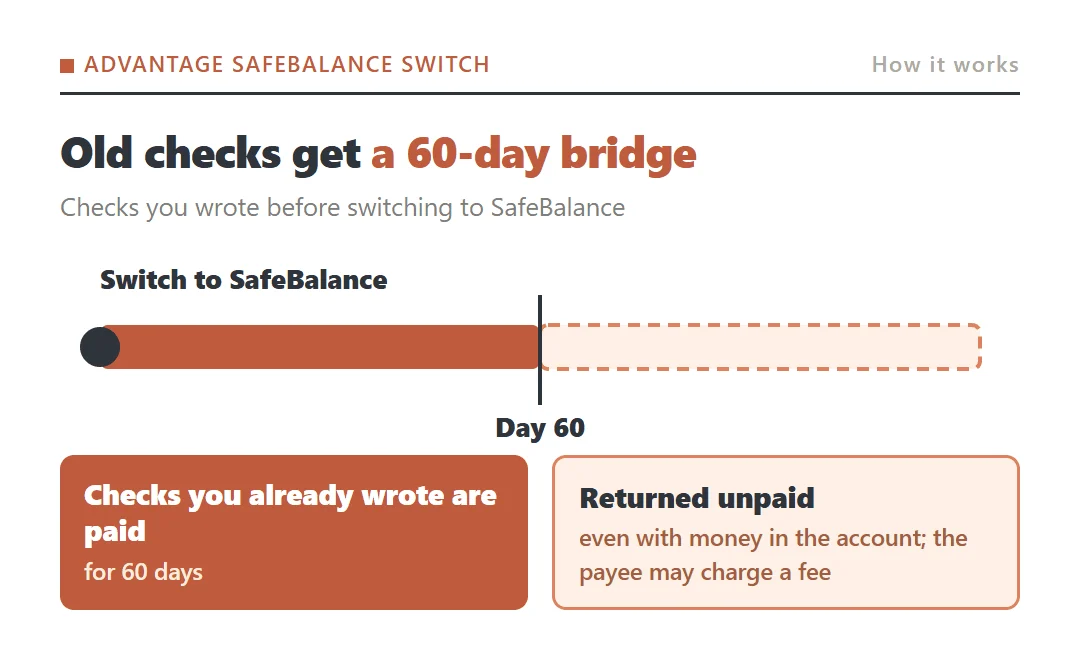
Checks written before a switch to SafeBalance are paid for 60 days, then sent back unpaid.
Before Feb. 19, do the one thing your statements point to. If your pay goes to another bank, have $250 or more of it sent here by your employer or payer. If no paycheck can come here, hold your lowest balances up against the SafeBalance column and decide whether you can live without paper checks. If overdraft fees keep showing up, ask Bank of America for Decline All.

What to do before Feb. 19, depending on what your statements show.
Photos and icons in this post are illustrations made for explanation; they do not show real places, products or people.