Tracking says “delivered.” The porch, the mailbox and the lobby say otherwise. Before you call anyone, answer two questions: where did you buy it, and how did you pay?
Those two answers decide who handles your refund, which deadline you’re on, and which move can shut another option. A card dispute and an Amazon, eBay or PayPal claim don’t stack.
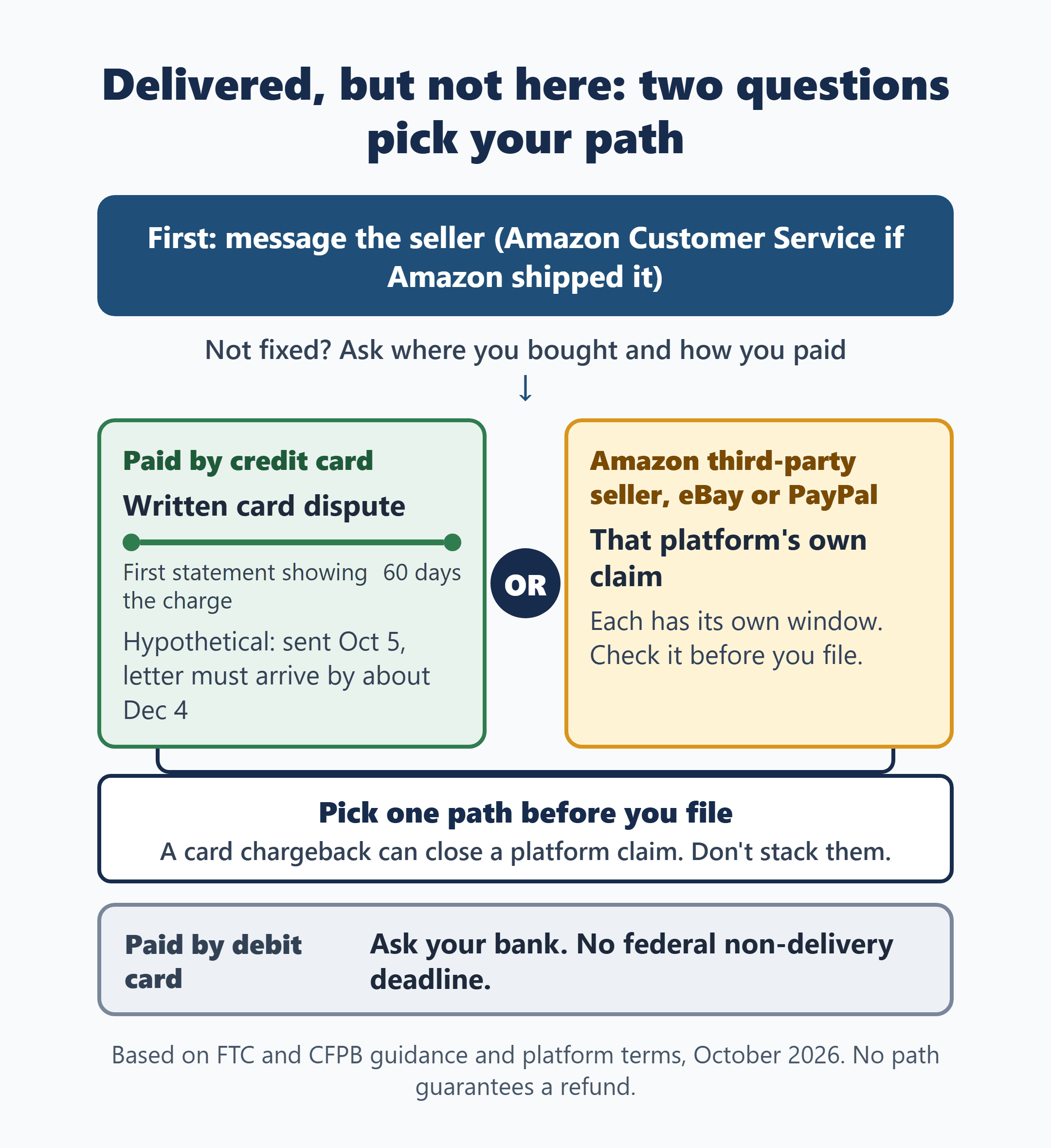
Start with the seller for the refund, or Amazon Customer Service if Amazon shipped the order. The FTC’s advice is to “notify the seller as soon as possible.” If that doesn’t fix it, the next step depends on how you paid:
- Credit card: a package that wasn’t delivered as agreed is a billing error you can dispute in writing. Your issuer must receive the letter within 60 days after it sent the first statement showing the charge. That clock doesn’t start on your order date or your delivery date.
- Debit card: there’s no matching federal right to dispute non-delivery. You’d be asking your bank what help it offers.
- Amazon third-party seller, eBay or PayPal: each has its own claim window, and a card chargeback can close that claim. Pick one path before you file.
This covers online orders shipped to a US home and paid by credit card, debit card or PayPal, including Amazon and eBay, based on FTC and CFPB guidance and Amazon, eBay, PayPal and USPS pages checked October 16, 2026. If the order never shipped at all, a different FTC rule applies; see the FTC’s page on things you’re billed for but never got.
First Message Goes to the Seller, With a Time Stamp
On Amazon, give it a little time. Amazon says “Packages may be scanned as delivered before arrival” and tells you to “Wait 48 hours for the package to be delivered.” Meanwhile, check the delivery confirmation in Your Orders, any delivery instructions you left, and whether someone else at the address accepted it (Amazon Help: Find a Missing Package that Shows as Delivered).
Then contact whoever sold it. The FTC puts it simply: “Contact the seller. Most businesses will work with you to resolve the problem and keep you as a customer.” That’s advice, not a legal precondition, but it’s where the refund conversation starts.
- Shipped by Amazon: Amazon Customer Service. Amazon says to reach out “within 30 days of expected delivery.”
- Sold and shipped by a third-party seller on Amazon, or bought on eBay: that seller.
- A store’s own website: the store.
Write down the date and time you sent the message. Amazon’s A-to-z Guarantee, for one, looks at whether you contacted the seller more than 48 hours earlier. A message like this covers what the seller needs:
“Order [number] shows as delivered on [date], but it never reached me. I’ve checked [the delivery photo / my delivery instructions / with others at the address]. Please refund or replace the order.”
The carrier can still help locate the package, and an insured shipment may have its own claim route: with USPS, either the sender or the recipient may be able to file an eligible insured-mail claim, subject to USPS documentation and filing rules (USPS claims).
Sources: FTC: Billed for things you never got and FTC: What to do if your online order never arrives.
If the Seller Doesn’t Fix It: Find Your Row
Every day count below belongs only to its row and the date it counts from. Your own order page, payment record and card statement hold the actual dates.
| Your order | Where to go | Deadline counts from |
|---|---|---|
| Store’s site, credit card | Written billing-error dispute with your card issuer | Received within 60 days after the first statement showing the charge was sent |
| Store’s site, debit card | Your bank | No federal non-delivery deadline; your bank’s policy |
| Amazon, shipped by Amazon | Amazon Customer Service | Within 30 days of expected delivery |
| Amazon, third-party seller | A-to-z Guarantee claim | Last possible delivery date 90 days or less |
| eBay | Money Back Guarantee request | Up to 30 calendar days after the estimated or actual delivery date |
| Paid with PayPal | PayPal dispute, then claim | Within 180 days of the date you sent the payment |
A few rows carry conditions that change the answer:
- Amazon A-to-z: it applies when you ordered from a third-party seller, the last possible delivery date is 90 days or less, “Three days have passed since the latest estimated delivery date OR the tracking shows a delivery confirmation (whichever is sooner),” and you contacted the seller more than 48 hours ago without a fix (A-to-z Guarantee).
- eBay: if the item doesn’t arrive, eBay says the buyer “is entitled to a full refund, including original shipping costs (if applicable).” But “If the seller provided tracking details, eBay may close the case automatically once tracking shows the item has been delivered.” For orders of $750 or more, eBay’s proof of delivery requires signature confirmation (eBay Money Back Guarantee).
- PayPal: escalate the dispute to a claim “within 20 days after opening the dispute,” or PayPal closes it. And “you will not qualify for a refund under PayPal’s Purchase Protection program for an Item Not Received Claim if the seller has provided proof of shipment or delivery” (PayPal Purchase Protection).
On a debit card, the FTC is blunt: “You may not be able to get a refund for non-delivery.” Federal error-resolution rules for debit cards don’t treat a merchant’s non-delivery as an error the way credit card rules do. That doesn’t mean your bank can’t help; ask about any voluntary protections it offers.
Why the Order of Filing Matters
Each platform says, in its own words, what a card dispute does to its claim:
- Amazon: “If you request a refund or chargeback from your payment provider, you’re not eligible for a refund through A-to-z Guarantee.”
- eBay: eBay “may close a buyer’s eBay Money Back Guarantee case if the buyer files a chargeback or buyer protection claim for the same transaction with their payment provider.”
- PayPal: “You can’t do both at the same time.” If you dispute with your card issuer, you “cannot pursue a dispute/claim with us later.” If you dispute with PayPal and it decides against you, “you can seek to pursue the dispute with your card issuer later.” PayPal also says it will make up the shortfall if its own delay makes you miss your card issuer’s deadline.
So if you bought through one of these and paid by credit card, you have two clocks running: the platform’s, and your card’s 60 days after the first statement showing the charge. Neither path is always the better one. Look at both dates, choose before you file, and don’t file both.
The Credit Card Right, and How to Use It
Under federal billing-error rules, a charge for something “not delivered to the consumer … as agreed” is a billing error. Keeping that right comes down to two things.
Put it in writing, to the right address. The FTC says, “Write to the issuer. Use the address given for billing inquiries, not the address for sending your payments.” The FTC also mentions contacting your issuer online or by phone, but the federal protection is tied to the written notice, so don’t count on a call alone or on a late dispute being accepted.
Count from your statement, not your order. The issuer must receive your letter no later than 60 days after it sent the first statement showing the charge. Here’s a hypothetical to show why that matters: two shoppers are both charged on October 1. One issuer sends the statement showing the charge on October 5, so the letter must arrive by about December 4. The other sends it on October 28, so the letter must arrive by about December 27. Same charge date, different deadlines. Your own statement holds the date that counts.
What happens after the letter arrives:
- The issuer must acknowledge it within 30 days and resolve the dispute within two complete billing cycles, and no later than 90 days.
- While it investigates, “you can withhold payment on the disputed amount and any finance and related charges.” Keep paying the rest of the bill. The issuer can’t make an adverse credit report about the disputed amount during that time.
- The issuer can’t deny a non-delivery dispute without a reasonable investigation, but it can deny it if it determines the item was “actually delivered, mailed, or sent as agreed.” A dispute is not a guaranteed refund.
Card disputes come up for more than lost parcels. If a subscription billed you again after you’d canceled it, the steps are in how to ask for a refund, dispute a charge after canceling, and stop the next one.
Sources: FTC: Using Credit Cards and Disputing Charges and CFPB: Regulation Z, Billing error resolution.
The Date I’d Look Up Tonight
What stands out to me in all of this is that the most important date isn’t on the tracking page. For a credit card, it’s the date your issuer sent the first statement showing the charge. For a marketplace or PayPal, it’s the expected delivery, last possible delivery, delivered or payment date that its own rule names.
Find that date, send the seller a dated message, and then file in one place before your own deadline. If you used a debit card, make the bank call early, since there’s no federal clock working for you there.
Based on FTC consumer guidance, CFPB Regulation Z and Regulation E, and Amazon, eBay, PayPal and USPS help and terms pages, checked October 16, 2026. No path guarantees a refund. Your own order page, statement and account show the dates that apply to you.