

The balance line on the checking account reads −$70.00. That’s the end of Monday in an example Chase publishes on its overdraft FAQ page: the day starts with $5, three $25 checks come in, and Chase pays all three in its nightly processing.
What keeps that account from a $34 fee isn’t $70. In Chase’s example, a $30 cash deposit made by 11 PM ET on Tuesday leaves the balance $40 below zero at the end of the day, and no overdraft fee is charged. The bar is $50 overdrawn, not $0.
That’s Chase Overdraft Assist, and it comes automatically, with no enrollment, on standard Chase checking accounts such as Chase Total Checking. Chase charges a $34 Overdraft Fee per transaction, starting with the first one that takes your balance more than $50 below zero, up to three fees a business day ($102). You avoid it if you bring the balance back to overdrawn by $50 or less by 11 PM ET (8 PM PT) on the next business day.
How much that takes depends on your own account: how far below zero you’ll be at the end of the deadline day, minus $50. A fee that has already posted counts in that number. And if one did post, Chase publishes no policy for refunding it; you can ask, and that’s as far as the published terms go.
If Your Balance Ends the Day More Than $50 Below Zero, Then the Next Business Day Decides the Fee
An overdraft fee isn’t settled the moment your balance turns negative. Chase decides it in nightly processing, and then gives you one more business day.
If the balance at the end of a business day is overdrawn by $50 or less, there’s no fee. If it’s more than $50 below zero, you have until 11 PM ET (8 PM PT) on the next business day to deposit or transfer enough to end that day overdrawn by $50 or less. Make it, and Chase charges no overdraft fees on the previous or the current business day’s transactions.

Business days skip Saturdays, Sundays and federal holidays. A balance left more than $50 negative at the end of a Friday has until 11 PM ET (8 PM PT) on Monday, or Tuesday if Monday is a federal holiday. On the West Coast, the cutoff is 8 PM.
Miss it, and Chase may charge $34 on each of the previous day’s items that took the balance past $50 overdrawn, up to three. Anything new from the deadline day that dug the hole deeper gets its own extra business day.
Chase Sapphire Checking and Chase Private Client Checking follow a different overdraft-fee rule, and Chase Secure, First and High School Checking don’t come with Overdraft Assist; Chase’s Standard Overdraft Practice page spells out both.
Your Number Is Tonight’s Hole, Minus $50
Chase builds the end-of-day balance in a set order: the previous day’s ending balance, plus deposits, minus any deposit not yet available and any hold (Chase’s example of a hold is a garnishment), minus the debits presented that night, with fees last. Your minimum deposit falls out of that:
Minimum to deposit = how far below zero you’ll be at the end of the deadline day − $50
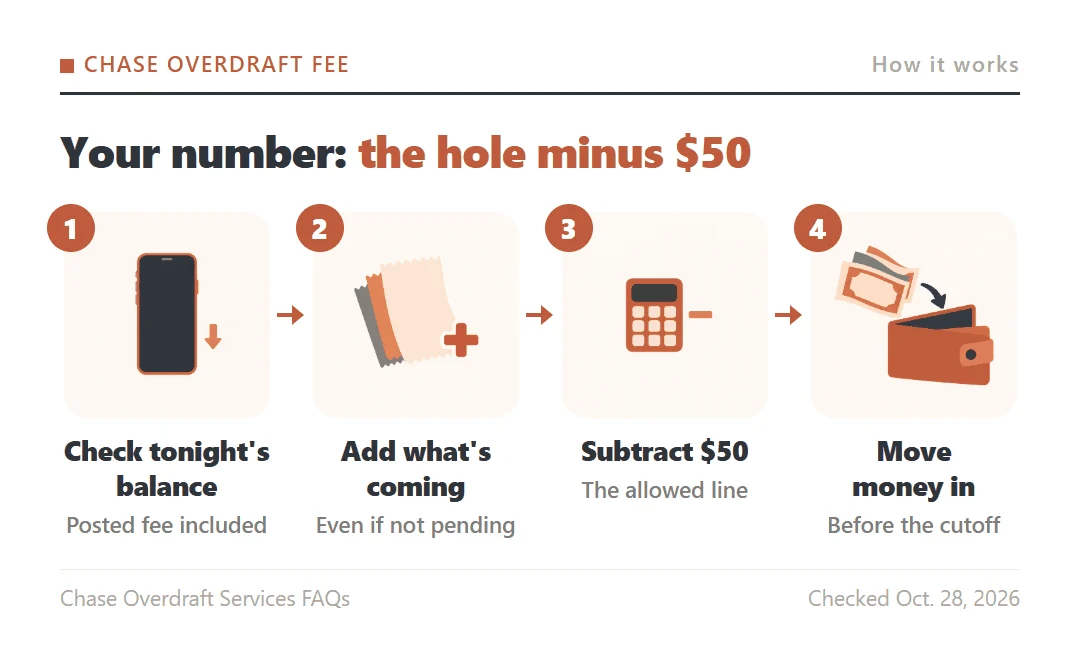
Three things go into “how far below zero” that are easy to miss. A $34 fee that already posted is part of the balance. A check you deposit only helps if Chase doesn’t hold it and it isn’t returned. And Chase tells customers to count transactions that may be presented that day “even if they are not shown as pending.”
Chase’s second example shows the fee piece. The account starts Monday with $5 and has Debit Card Coverage set to Yes. A $100 grocery purchase leaves it $95 overdrawn; a $60 gas purchase on Tuesday makes it $155, and no deposit arrives by Tuesday’s cutoff. Chase charges $34 on the groceries, so on Wednesday the account is $189 overdrawn: $100 + $60 + the $34 fee. A $149 cash deposit by 11 PM ET Wednesday leaves it $40 overdrawn, and the gas purchase carries no fee.
How much do you need to deposit before the cutoff?
Enter what your Chase account shows; leave out any deposit Chase is holding. The defaults are Chase's Wednesday example.
If your result doesn't match your bill or notice, check the exact figure on Chase's Overdraft Services FAQs. Rules as of 2026-10-28
Show the breakdown and basis
—
Least deposit = (overdrawn now, posted fees included + items still to post that day) minus $50
Values are calculated in your browser and are not saved or sent anywhere.
Run the subtraction on Chase’s two examples and the minimums are $20 and $139. Chase’s deposits of $30 and $149 leave $10 to spare in each. Two households show how the same formula moves with each account; both assume Chase pays the items, which it does at its discretion.
Household A: A $210 utility autopay posts on a Friday against a $150 balance, leaving the account $60 overdrawn. The deadline is 11 PM ET (8 PM PT) on Monday. If nothing else posts, $10 brings it to $50 overdrawn; if a $25 streaming renewal also posts Monday, the hole is $85 and the minimum is $35.
Household B: The account starts a day $30 overdrawn, and four recurring charges post that night: $40, $25, $15 and $12. The $40 charge takes the balance to $70 overdrawn and starts the fees, the $25 and $15 charges add two more, and the $12 charge runs into the three-fee cap. That’s up to $102 in fees, all avoided by depositing at least $72 ($122 − $50) before the next business day’s cutoff, if nothing else posts.
| Situation | Overdrawn by, end of deadline day | Minimum deposit |
|---|---|---|
| Chase example 1: three $25 checks | $70 | $20 |
| Chase example 2: $34 fee already posted | $189 | $139 |
| Household A, nothing else posts | $60 | $10 |
| Household A, $25 renewal on Monday | $85 | $35 |
| Household B, four recurring charges | $122 | $72 |
Every minimum in that table assumes nothing else arrives before the cutoff. Items can be presented without showing as pending first, which is why Chase’s own examples leave room.
Money That Counts Before the Cutoff, and Money That Might Arrive Too Late
Chase lists the ways a deposit or transfer can count toward the deadline:
- Chase branch, before it closes: cash, a check, or a transfer from another Chase account.
- ATM, before 11 PM ET (8 PM PT): cash, a check, or a transfer from another Chase account.
- chase.com or mobile, received before 11 PM ET (8 PM PT): a transfer from another Chase account, Zelle, or Chase QuickDeposit.
Transfers from an account at another bank can take longer, and Chase warns they may not settle before the 11 PM ET (8 PM PT) cutoff. Check deposits count only if Chase doesn’t place a hold and the check isn’t returned.
If it were my account, I’d send the money from another Chase account or by Zelle that same evening, and I’d treat a transfer from another bank as extra, not as the deposit that clears the line.
A $34 Fee Already Posted: What You Can Still Ask For
Start by checking whether the fee belongs there. Chase’s overdraft terms say no fee is charged when:
- the transaction is $5 or less;
- a debit card purchase was authorized while the account had enough available balance;
- a check or ACH payment was returned unpaid (a fee can still apply if it’s presented again and paid);
- a debit card purchase or ATM withdrawal was declined.
If the fee fits the rules, Chase doesn’t publish a policy for refunding it: no count, no window, no promise. You can still call or message Chase and ask for it back as a courtesy. The answer is Chase’s to give.
A $34 overdraft fee posted on [date] to my checking account ending in [last four digits], on a [check / autopay / card charge] of $[amount]. I’ve since brought the balance back to [amount]. Would you be able to refund that fee?
In the meantime, the fee is owed right away. Chase’s Deposit Account Agreement says you must immediately pay any overdraft along with its fees, and it lets Chase take them from your next deposit, including a direct deposit. If another day’s overdraft is still inside its window, put the posted $34 into your subtraction.
Keeping the Next Overdraft From Costing $34
Chase’s Standard Overdraft Practice may pay checks, automatic payments such as a phone, mortgage or utility bill, and recurring debit card charges such as a gym membership or a subscription. It pays at Chase’s discretion, so an item can also be declined or returned unpaid instead.
Everyday debit card purchases (groceries, gas, dining out) work differently. With Chase Debit Card Coverage set to No, a purchase that would take the balance below zero is declined, with no fee. Set to Yes, Chase may pay it and charge the fee. Recurring card charges stay under the Standard Overdraft Practice either way, and an ATM withdrawal is declined if neither checking nor a linked savings account has the money.
Then there’s Overdraft Protection: link a Chase savings account, and when checking comes up short Chase transfers the exact amount needed, if savings has it, with no fee for the transfer. It covers everyday debit purchases too. If savings is short, regular overdraft fees can still apply.
Turn on the “My account is overdrawn” alert under Profile & settings, then Alerts, then Choose alerts. Chase says the alert also tells you when you’re more than $50 overdrawn and need to act, and that you’re responsible for making the deposit even if no alert arrives.
If the overdraft started with a recurring charge you thought you’d canceled, here’s how to ask for a refund and stop the next charge on a subscription you already canceled.
Three Checks to Run Before the 11 PM ET Cutoff
- Tonight’s balance, fee included. How far below zero the account ended last night, counting any $34 fee already posted and leaving out any deposit Chase is holding.
- What else is coming today. Autopays, recurring card charges and checks that may be presented, including ones not showing as pending.
- The route. Cash, a check Chase won’t hold, a transfer from another Chase account or Zelle, in before 11 PM ET (8 PM PT), or before the branch closes if you go in person.
Add the first two, subtract $50, and that’s the least the account needs; anything above it is room for an item you didn’t see coming.
Sources: Chase’s Overdraft Services FAQs (Overdraft Assist, cutoff, deposit routes, both worked examples), Standard Overdraft Practice page and Chase Total Checking fees; Chase’s Deposit Account Agreement and Additional Banking Services and Fees for Personal Accounts, both effective June 14, 2026. Checked October 28, 2026.
You’ll see the result the morning after nightly processing, and an account that ended the deadline day $50 or less overdrawn will show no new $34 fee.
Photos and icons in this post are illustrations made for explanation; they do not show real places, products or people.