Before you look up what the broken dresser cost, look for one signature on your bill of lading.
On an interstate move, the bill of lading has to carry a valuation statement: the part where you either chose Full Value Protection or waived it. Waiving it takes your initials and your signature. Whether you gave them decides which set of rules prices your claim.
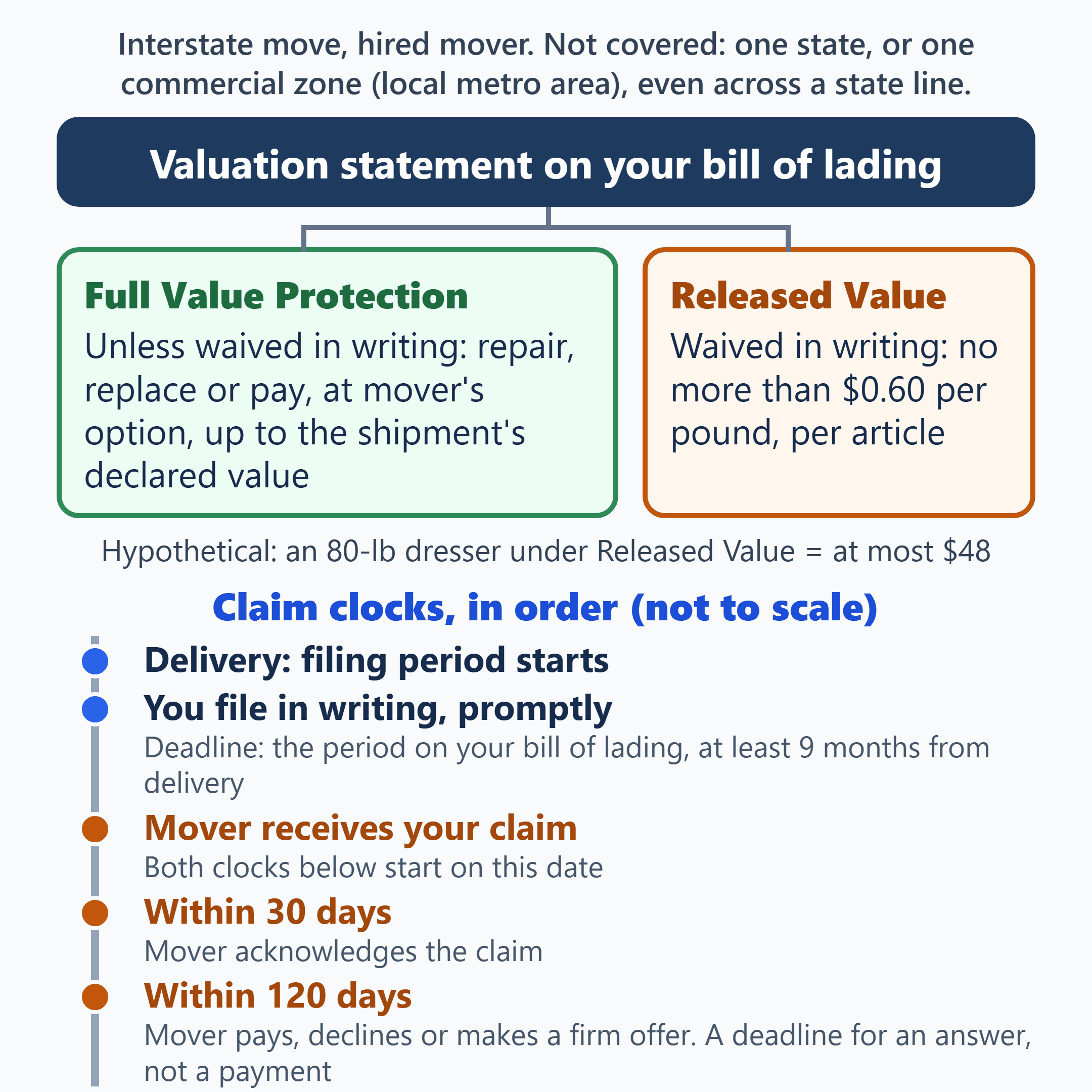
Here’s a hypothetical to show how far apart the two answers can be. Take an 80-pound dresser that came off the truck broken. If you initialed and signed the waiver, the mover owes no more than $48 for it, figured as 80 pounds times 60 cents per pound, per article. If you didn’t, the mover repairs the dresser, replaces it with one of like kind and quality, or pays the cost of that, at its option, up to the declared value of your whole shipment.
Full Value Protection is the level you have unless you waived it in writing. Either way, you have at least 9 months from delivery to file a written claim with the mover, and a note on the delivery paperwork alone isn’t a claim. Your bill of lading states the period, and federal law doesn’t let it be shorter than that. Once the mover receives your claim, it has 30 days to acknowledge it and 120 days to pay it, decline it, or make a firm settlement offer. If the answer is a no or an offer you think is too low, you can ask for arbitration through the mover’s own program or go to court.
These are the federal rules for a move between states with a hired mover you pay yourself (49 CFR Part 370 and Part 375). A move within one state follows that state’s rules, and a move within the same local metro area (a “commercial zone”) isn’t covered by these federal rules even if it crosses a state line. Containers you load and unload yourself and moves someone else pays for aren’t covered here either.
Find the Valuation Statement Before You Price Anything
Pull out your bill of lading, your estimate and your copy of the inventory. The valuation statement is a statement of the mover’s liability, not insurance, and it sets everything that follows. Along with it, look for:
- A signed waiver, or none. Full Value Protection applies unless you waived it in writing. Signed waiver documents are attachments to the bill of lading.
- The declared value of the shipment. Under Full Value Protection, this is the limit on everything the mover owes you.
- A deductible, if you chose one.
- Any written list of high-value items, meaning items worth more than $100 per pound.
- Evidence of separate insurance. If the mover sold or arranged a policy from an outside insurer, the bill of lading has to show it.
- Your copy of the inventory, with any notes made at delivery, and the delivery date.
Keep the bill of lading until every claim is settled. Everything below runs off it.
What Each Level Pays, and the Limit on It
Match the level on your valuation statement to its row. The official wording for both is in the federal consumer booklet movers must hand out, Your Rights and Responsibilities When You Move.
| Your bill of lading shows | What the mover owes | Limit |
|---|---|---|
| Full Value Protection (unless you waived it in writing) | Repair, replacement with like kind and quality, or the cost of that, at the mover’s option | The shipment’s declared value, for all items together |
| Released Value (you waived Full Value Protection in writing) | Under Released Value, no more than 60 cents per pound, per article | Under Released Value, the article’s weight in pounds × $0.60 |
On Full Value Protection, there’s no per-item formula to run. The limit is the declared value written on your valuation statement. If you declared no value, the Surface Transportation Board’s valuation form sets it at $6.00 per pound of the whole shipment’s weight, and not less than $6,000; your mover’s figure may be higher, and it’s on your paperwork. That’s a ceiling on all your claims together, not what any one item pays. As an example, a 5,000-pound shipment with no value declared has a ceiling of $30,000 for the whole shipment.
Three things on your paperwork can lower a Full Value Protection payout, which is also subject to the exceptions in your mover’s tariff:
- A deductible, if you chose one.
- A high-value item you didn’t list. If you didn’t tell the mover in writing about an item worth more than $100 per pound, its liability for that item may be limited to $100 per pound, per article. The booklet’s examples include jewelry, silverware, china, furs and antiques.
- Boxes you packed yourself. Improper packing of containers you pack yourself may limit or reduce the mover’s liability.
If you waived Full Value Protection in writing, the math is the weight of the lost or damaged article times 60 cents, and each article is figured on its own weight, not the weight of the shipment. The booklet’s own example: under Released Value, a 10-pound stereo component valued at $1,000 that is lost or destroyed leaves the mover liable for no more than $6.00. That figure is a ceiling. Sixty cents per pound, per article, is the federal released-value level; the level printed on your own bill of lading is the one that applies.
If the mover has already made you an offer, put it next to your row before you answer it.
A Claim Counts Only When It’s in Writing, With a Dollar Amount
Federal law doesn’t let a mover give you less than 9 months to file, so you have at least 9 months from the date of delivery. If the entire shipment was lost, the period runs from the date it should have been delivered. The period that binds you is the one in your bill of lading, so read it there. If your goods went into long-term storage, the notice your mover sent sets the date.
The clock runs from delivery, not from the day you noticed the damage, and filing promptly is one of the customer’s responsibilities the booklet lists. To count as a claim, what you send the mover has to be in writing and do three things:
- Identify the shipment.
- Say the mover is liable for the loss or damage.
- Ask for a specific dollar amount, or one that can be determined.
A phone call, or a note on the inventory or delivery receipt alone, doesn’t count. Those delivery notes still matter: the booklet says your ability to recover “may depend on the notations made on this form.” They support the claim; they aren’t the claim. Have the bill of lading and proof of value, such as an invoice, ready in case the mover asks for them.
If you bought separate moving insurance, that claim is against the policy, on the policy’s terms. The booklet notes that disputes with third-party insurance companies aren’t subject to these federal rules.
What the Federal Claim Rules Say About the Mover’s Timing
Once your written claim is in, federal claim rules give the mover two deadlines. Both clocks start on the date the mover received your claim, so that’s the date to pin down. A short written request does it:
I sent a written claim for loss and damage on the shipment under bill of lading [number], dated [date]. Please confirm in writing the date you received it.
From that receipt date:
- 30 days: the mover has to acknowledge the claim in writing, unless it has already paid or declined it in writing by then.
- 120 days: the mover has to pay the claim, decline it, or make a firm settlement offer in writing.
Read the 120 days as a deadline for an answer, not for a payment; the answer can be a no or an offer. If the mover can’t finish within 120 days, it has to tell you in writing, at that point and every 60 days after while the claim is pending, where the claim stands and why it’s delayed.
If the Answer Is No, or the Offer Is Too Low
You have two routes, and you aren’t required to use arbitration.
Arbitration through the mover’s program. An interstate mover has to have an arbitration program for disputes about loss and damage, and it has to give you the forms to start if you ask. It can’t charge you more than half the cost of starting the arbitration. For a claim of $10,000 or less, arbitration is binding if you request it, which means the result binds you as well as the mover. Above $10,000, it goes ahead only if you request it and the mover agrees. A decision is due within 60 days of the written notice of the dispute, and that period can be extended. Asking for arbitration doesn’t change the liability level on your bill of lading.
Court. You can file a civil action in court instead. Federal law doesn’t let a mover give you less than 2 years to do that, counted from the date the mover gives you written notice that it has disallowed the claim or part of it. Your bill of lading states the actual period.
Don’t wait on a regulator in the meantime. The Federal Motor Carrier Safety Administration maintains the rules for how movers process these claims, but the booklet says it can’t resolve them for you.
One separate point on the bill itself: if the whole shipment was lost or destroyed in transit, the mover may not collect freight charges on it, though it may still collect a valuation charge, and if part was lost or destroyed it may collect only the share matching the weight delivered, unless the loss was due to something you did or failed to do.
Before You Write to the Mover, Get Three Things on One Page
If I’d just unpacked a broken dresser, I wouldn’t start with the dresser’s price. I’d start with one page and three lines: which level my valuation statement shows, the delivery date, and the dollar amount I’m claiming for each item, worked out under that level’s rules.
Then I’d send the claim in writing well before the period on the bill of lading runs out, rather than treating month nine as the target, and I’d get the mover’s receipt date in writing. Every clock after that runs from it.
If what you’re disputing is the bill at delivery and not what arrived broken, that’s a different set of rules; what you have to pay at delivery when movers charge more than the estimate walks through them.
Based on 49 CFR Parts 370 and 375, the consumer booklet in Appendix A to Part 375, the Surface Transportation Board’s released rates order, and 49 U.S.C. 14706, checked October 16, 2026. Interstate moves only: a move within one state follows that state’s rules, and a move within the same local metro area (a “commercial zone”) isn’t covered by these federal rules even if it crosses a state line.