By October, the reason to quit FPL Budget Billing can look obvious. Summer is over, your actual electric charges have dropped, and the Budget Billing amount you’re still paying may now be higher than what Regular Billing would charge.
FPL saw that thought coming. Its page for managing your enrollment speaks directly to customers who want to discontinue “because your current bill is lower than your Budget Bill amount,” then spells out what happens if they do: “You will be responsible for a deferred balance on your next bill. You will not be eligible to join again for 12 months.”
The deferred balance is the running difference between your actual electric charges and the Budget Billing amounts you’ve paid. If actual charges ran higher, you owe it; if they ran lower, it’s a credit. FPL has no annual true-up, so the balance doesn’t clear once a year. It comes due only when you leave the plan, close the account or are dropped, including for a past-due bill.
Leave, and your account goes back to Regular Billing with the next bill. The whole deferred balance lands on that bill, added if you owe it and credited if you don’t, and you can’t rejoin for 12 months.
So a lower bill this month doesn’t tell you which way your balance points. The Deferred balance on your statement does. This covers FPL residential accounts; business accounts have their own budget billing rules.
When Actual Charges and the Budget Amount Don’t Match
FPL says a Budget Billing statement shows three amounts:
- Actual electric charges, what you would pay under Regular Billing.
- FPL Budget Billing amount, the amount due as a Budget Billing customer.
- Deferred balance, the cumulative difference between the first two.
Each month FPL compares the first two. When actual charges are higher than the Budget Billing amount, the difference is added to the deferred balance. When they’re lower, it’s subtracted. A balance you owe grows in expensive months and shrinks in cheap ones.
It isn’t a missed payment. A past-due amount is a bill you didn’t pay; the deferred balance is the plan’s running gap between what your electricity actually cost and the level amounts you were billed.
Before deciding anything, write down two things from your latest statement: the deferred balance, and whether it’s owed or a credit. If you can’t tell which from the statement, that’s the first thing to ask FPL.
The Budget Amount Is a 12-Month Average Plus a Twelfth of the Balance
FPL’s terms define the Budget Billing amount as the average of your last 12 monthly bills plus 1/12 of the deferred balance. If the balance is a credit, the twelfth is subtracted instead. If you’ve been at the address less than 12 months, FPL blends your billing history with the home’s.
The average rolls. Each month the newest bill goes in and the oldest drops out, and the twelfth of the balance changes with the balance. That’s why the amount drifts a little from month to month instead of staying fixed.
A single-month illustration, not real figures: if this August’s actual charges of $260 replace last August’s $200 in the average, the average rises by $60 ÷ 12 = $5. If that August bill also added about $70 to the deferred balance, the twelfth FPL adds rises by about $5.83. Together, next month’s amount comes out roughly $10.83 higher.
Only three events settle the balance: leaving the plan, closing the account, or being dropped. FPL’s own wording is that “there is no annual ‘true-up’ period” otherwise. Don’t expect the balance to reset to zero after a year.
Here’s a hypothetical household, not a real FPL customer or a typical bill. It enrolls in January with a $0 balance, and this year’s actual charges match last year’s month for month, so the 12-month average stays at $157.50. Actual charges run from $110 in February to $220 in August, $1,890 for the year.
The balance goes into credit through spring and reaches $130.26 in credit after the April bill. It crosses into owed in August and stands at $97.98 owed after September. By December, $19.86 is still owed. The household paid $1,870.14 in Budget Billing amounts; add the $19.86 and you get exactly the $1,890 its electricity cost.
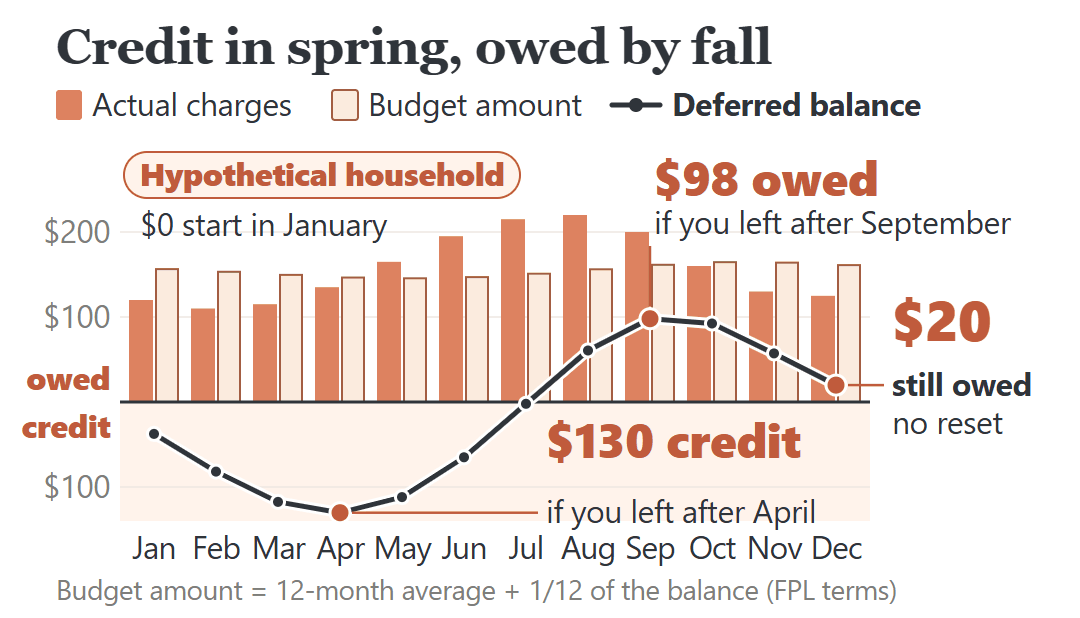
That leftover $19.86 is the plan working as written. The balance keeps being worked off a twelfth at a time, and whatever remains is simply what you’d settle if you left.
Leaving This Fall: What Your Next Bill Would Carry
Back to the same hypothetical household in October. Its actual charges are $160, below that month’s $165.67 Budget Billing amount, exactly the situation FPL’s page describes. Yet its deferred balance is still $92.32 owed.
A lower month chips away at an owed balance. That’s the “reserve” FPL’s page talks about, built in cheaper months and used when bills rise. It doesn’t erase the balance in one go.
If you leave, here’s what FPL’s terms say happens next:
- Your account returns to Regular Billing with the next bill.
- If the deferred balance is owed, it’s billed to you on that next bill, on top of the month’s actual charges.
- If it’s a credit, it’s applied to what you owe. Any remainder goes toward future bills or is returned if you ask.
- You can’t rejoin for 12 months, and FPL requires a zero account balance before Budget Billing can start again.
Now run the same hypothetical household through two different exits. Leave after the April bill, and the $130.26 credit is applied to the next bill. Leave after the September bill, and $97.98 is added to the next bill on top of October’s $160 in actual charges, so that bill is $257.98. Same home, same usage, opposite results, because the balance pointed different ways.
I’m less concerned about the size of an owed balance than about its timing. Leaving doesn’t create a new cost; it moves the whole remaining amount onto the one bill that follows the month you chose.
Neither choice changes what your electricity costs. In FPL’s words, “Budget Billing changes when you pay, not how much you pay overall.” Staying spreads an owed balance across future months; leaving collects it at once and ends the predictable amount for at least a year.
FPL’s Manage your FPL Budget Billing enrollment page is where leaving starts. FPL says the balance goes on your “next bill” but doesn’t tie that to a cut-off date, so ask before you confirm:
“I’m on Budget Billing and thinking about [leaving the program / moving to a new address on (date)]. What is my deferred balance today, and is it owed or a credit? Which bill would it be settled on? If I’m moving within FPL’s service area, will Budget Billing transfer to my new address?”
Moving, Closing the Account, or Falling Behind
A move or a missed payment can settle the balance even if you never meant to leave the plan.
| What happens | Your deferred balance | Budget Billing afterward |
|---|---|---|
| You leave the plan | All of it on your next bill: billed if owed, credited if not | Regular Billing; no rejoining for 12 months |
| FPL ends the plan over a past-due bill | Same as leaving: all of it on your next bill | Regular Billing; no rejoining for 12 months |
| You move within FPL’s service area | Moves to your new address, owed or credit | May transfer to the new address; confirm with FPL |
| You move out of FPL’s area or close the account | Settled on your final bill | Ends with the account |
Take the hypothetical household again and have it move right after the September bill. Moving within FPL’s area, the $97.98 owed follows it to the new address. Moving out of FPL’s area, the same $97.98 is added to the final bill.
The past-due row is the one a household can land in without ever choosing to leave. FPL’s FAQ says the balance comes due when Budget Billing is discontinued, and “this includes if it’s due to a past-due bill.” Its terms also let FPL end participation when an account becomes subject to collection action. The result matches quitting: the balance on the next bill and a 12-month wait.
If the move out of FPL’s area also takes you to another state, the movers’ bill is the next number to watch. Here’s what interstate movers can charge at delivery when the bill comes in over the estimate.
From One Statement Line to a Decision
Start with the number on your latest statement: the deferred balance, and whether it’s owed or a credit. That figure, not the gap between this month’s bill and your budget amount, is what changes hands if you leave or move out.
Then compare it with what you’re planning. Owed means leaving or moving out puts it on your next or final bill, on top of that month’s actual charges. A credit means it’s applied to what you owe, with any remainder carried forward or returned on request. Staying means it keeps being worked off a twelfth at a time, with no year-end settlement coming.
If you want out, pick the month knowing that number and the 12-month wait. If you’re moving within FPL’s area, FPL’s terms say the balance follows you; ask whether the plan does too. And keep the account current, so a past-due bill doesn’t end the plan for you.
Budget Billing is neither a discount nor a trap. The deferred balance is bill timing, printed on every statement, readable before you call.
If you know the sign and the size of that one number, you already know what leaving would add to or take off your next bill.
Sources: FPL’s Budget Billing page and FAQ, Budget Billing Terms & Conditions and Manage your FPL Budget Billing enrollment page, checked Oct. 18, 2026. The household with the $157.50 average, the $260 August bill and the move after September are hypothetical examples, not real FPL accounts or typical bills.