CMS, the federal agency that runs the medical bill dispute process for self-pay patients, publishes a short set of worked examples. One of them is the case most people would get wrong.
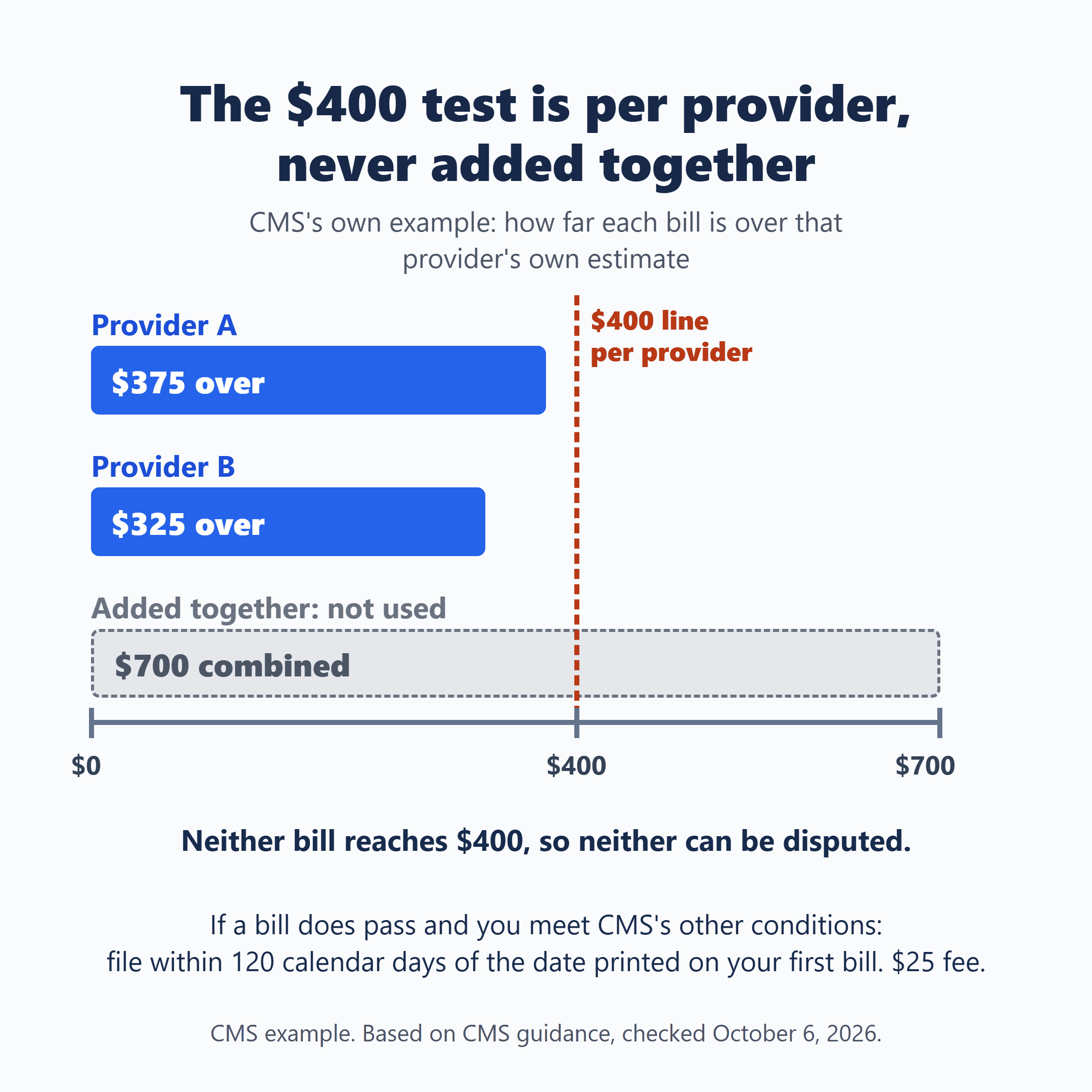
A patient gets bills from two providers. The first bill is $375 more than that provider’s good faith estimate. The second is $325 more than its own estimate. That’s $700 over, all together. CMS’s answer: neither bill can be disputed.
That one example holds the whole rule. The $400 test runs one provider at a time: a provider’s total bill, including charges that weren’t on the estimate, has to be at least $400 more than that same provider’s estimate. Bills from different providers are never added together.
If one of your bills passes, you can file a federal dispute with CMS, as long as you didn’t use insurance for the care, told the provider before the care that you weren’t using it, have the estimate in writing, and got the care on or after January 1, 2022. You have 120 calendar days from your first bill. The safe way to count is from the date printed on it, and the earlier you file, the better. Filing costs a $25 non-refundable fee that comes off what you owe if the decision goes your way, and whatever the outcome, the bill can’t go up. A bill from a provider that never gave you an estimate can’t go through this process.
This is the federal process for people who didn’t have or didn’t use health insurance for the care. If you used insurance for it, the process doesn’t apply; CMS has a separate complaint route for that.
Pair Every Bill With the Estimate From the Same Provider
A good faith estimate currently lists expected charges for a single provider or facility, even when several are involved in your care. CMS’s own illustration is surgery: one estimate from the surgeon and one from the hospital. So one procedure can leave you holding several estimates and several bills, and each bill is measured only against its own estimate.
For each provider or facility that billed you, write down three numbers:
- The total on that provider’s written estimate.
- The total on that provider’s bill, including any line that wasn’t on the estimate.
- The date printed on that provider’s first bill for this care.
Then subtract: that provider’s bill total minus that provider’s estimate total. If the result is $400 or more, that bill passes the dollar test. The federal rule compares totals, so the bill has to be “at least $400 more than the total amount of expected charges listed on the good faith estimate for the provider or facility.” A single line that jumped by $400 doesn’t settle it, and a charge that never appeared on the estimate still counts toward that provider’s total. If one provider passes and another doesn’t, only the one that passes can be disputed.
| Your situation with one provider | Can you dispute that bill? |
|---|---|
| Its total bill is at least $400 more than its own estimate | Yes, if you meet CMS’s other conditions |
| Charges that weren’t on the estimate push its total $400 or more over | Yes, if you meet the other conditions; those charges count |
| It’s less than $400 over its own estimate, even if your bills together are $400 or more over | No; each provider is checked on its own |
| It never gave you an estimate | No; submit a complaint and talk to its billing office |
| You used insurance for this care | No; this process is for people who didn’t |
| More than 120 calendar days since the date printed on your first bill | Likely too late; if it’s been less than 120 days since you received the bill, call the No Surprises Help Desk at 1-800-985-3059 right away |
CMS walks through more cases like the $375-and-$325 one in its dispute examples (PDF).
Lost the estimate, or never got one
You’ll need the estimate in writing to dispute. If you’ve lost it, ask the provider that scheduled your care for a copy of the one it gave you:
I was a self-pay patient for [care] on [date]. Please send me a copy of the good faith estimate you gave me for that care.
If a provider never gave you an estimate, its bill can’t go through the dispute process. You usually get an estimate when you schedule care at least 3 business days ahead or ask for one, and you usually won’t have one for emergency room care. CMS says you can submit a complaint about a missing estimate, but a complaint doesn’t pause or reduce the bill, and you’re still responsible for paying it. So talk to that provider’s billing office as well and ask about financial assistance. If the bill is from a hospital, it’s worth reading how to check whether you can still apply for hospital financial assistance after the bill arrives.
Count the 120 Days From the Date Printed on Your First Bill
You have 120 calendar days, about 4 months, from your first bill for that care. CMS’s consumer page and dispute form describe the window by the date on the bill, while the federal rule, 45 CFR 149.620, describes it from when you received the bill. The printed date never comes after the day you received the bill, so counting from it gives you the safer working deadline. Don’t plan around extra days; file as early as you can.
Two dates don’t start the clock: the day of your appointment and the date on the estimate. A later reminder statement for the same charges doesn’t restart it either.
If 120 days from the printed date have passed but it’s been less than 120 days since you received the bill, call the No Surprises Help Desk at 1-800-985-3059 right away.
Asking the billing office why the bill is higher is a reasonable first move, and you can keep talking to billing after you file. Just don’t let that conversation run past your date.
What the $25 Fee Risks, and What the Reviewer Can Change
Filing costs a $25 non-refundable administrative fee, and the dispute doesn’t start until it’s paid. Online, you can pay by credit card, PayPal or Venmo. If you file by mail or fax, CMS’s form says you’ll be sent a link to pay electronically, and CMS also accepts a money order or cashier’s check by mail. Cash and personal checks aren’t accepted.
If the dispute is decided in your favor, meaning the amount decided is lower than what you were billed, the $25 comes off what you owe the provider. It isn’t refunded separately.
On the downside, CMS is plain: “No matter the outcome, your costs won’t increase if you dispute your bill.” What can change depends on whether the provider can back up the extra charges:
- If the provider can’t show that the extra charges were medically necessary and couldn’t reasonably have been foreseen, charges for items on the estimate come down to the estimate amount, and charges for items that weren’t on the estimate can be removed.
- If the provider can show that, the reviewer can leave those charges as billed or set a lower, market-based amount.
So a dispute doesn’t promise that you’ll pay only the estimate. What it does fix is the worst case: the bill stays where it is and you’re out the $25. The decision is final, though the provider can still agree to accept less or offer financial assistance.
While the dispute is open
Once your dispute is under way, the provider or facility can’t move your bill into collections or threaten to, can’t collect late fees on the unpaid bill until the process ends, and can’t take action against you for disputing. If the bill is already in collections, the provider must stop pursuing payment until the dispute is resolved. Paying part of the bill before the decision doesn’t mean you’ve agreed to that amount.
Filing Online or by Mail, With Copies in Hand
Start from CMS’s Dispute a medical bill page, which links to the federal dispute portal. You’ll be asked for your email address and to request a one-time PIN. The form resets after a period of inactivity and deletes your answers, so gather these first, as digital or paper copies, never originals:
- That provider’s good faith estimate.
- That provider’s bill.
- The provider’s contact information.
- The date of the care, a short description of the items or services you’re disputing, and the state where you got the care.
To file on paper instead, use CMS’s dispute form (PDF). As listed on that form in October 2026, mail it to StrategyGen Co., Patient-Provider Dispute Resolution, 50 N. Laura Street, Ste 2500, Jacksonville, Florida 32202, or fax it to 904-245-1826.
When you sign the form, you agree to pay the amount the reviewer decides. If the reviewer says your request is missing something, you get 21 calendar days to send it. CMS’s help desk for questions is 1-800-985-3059.
Filing doesn’t close the door on billing. You can still check the bill for errors, ask why it’s higher than the estimate, and ask about financial assistance, and none of that stops your 120-day clock. If you and the provider settle while the dispute is open, CMS says the provider must reduce your bill by at least $12.50, half the $25 fee.
Where I’d Start With a Stack of Bills and Estimates
I wouldn’t start with a phone call. I’d clip each estimate to the bill from the same provider and do one subtraction per pair. That tells you which bills can go to a dispute at all. For the ones that can’t, the next step is the provider’s billing office, and a complaint as well if that provider never gave you an estimate.
Next, I’d write the date printed on each first bill on the front of its envelope, count 120 calendar days from it, and aim to file well inside that window.
When filing, I’d send copies with the request, pay the $25, and note the date. Once the dispute is under way, a provider that keeps pushing that bill toward collections or adding late fees is doing something CMS says it can’t.
The subtraction is the easy part. The 120 days are what won’t wait while billing gets back to you.
Based on CMS’s No Surprises Act pages for patients not using insurance, its dispute examples and dispute form, and the federal rule, 45 CFR 149.620, checked October 16, 2026. This covers the federal dispute process for people who didn’t have or didn’t use health insurance for the care.