Google’s Voice help page has one sentence worth reading slowly. The $10 Voice Starter plan for Gmail users, it says, “previously required a Google Workspace add-on subscription.” A few lines later, it settles the question: “No Google Workspace plan is needed.”
For an owner who has been handing customers a personal cell number, that’s most of the answer: one business number on Google Voice costs $10 a month, with no Workspace account underneath it. It covers exactly one person, though.
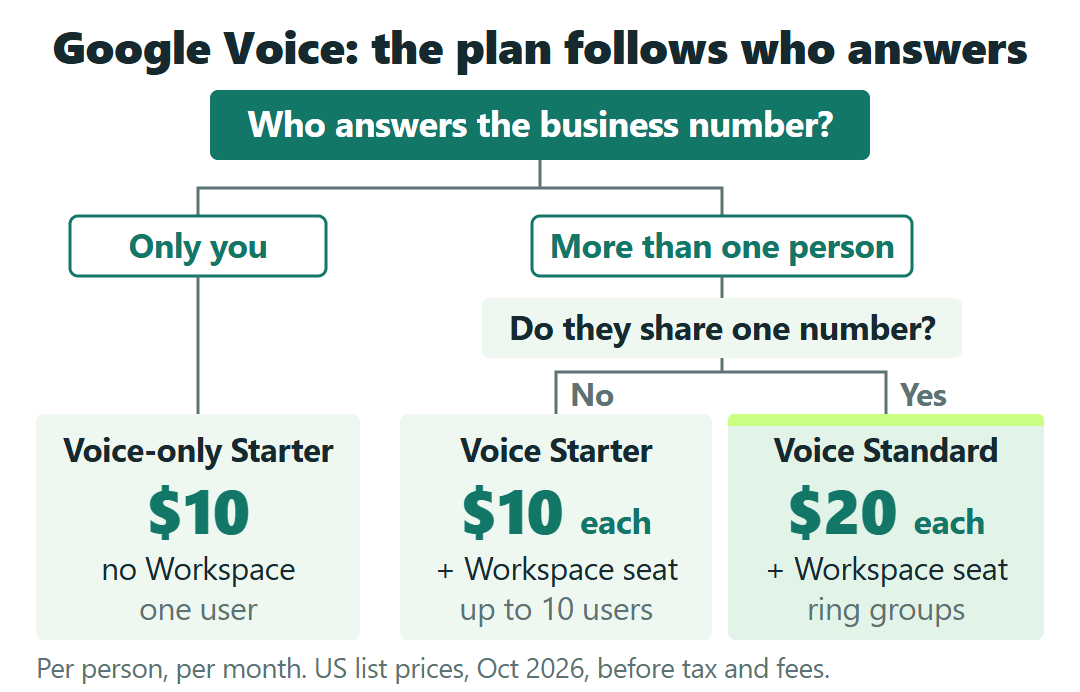
The picture changes the week your office manager also has to pick up the customer line. Google Voice for more than one person still sits on top of Google Workspace, so each person who answers needs a Workspace seat and a Voice license. And if two of you must answer the same number, that license has to be Voice Standard at $20, because Voice Starter has no ring groups.
Per person per month, that’s $10 for just you on the Voice-only plan, $17.00 to $18.40 for a team where everyone has their own number (Workspace Business Starter plus Voice Starter), and $27.00 to $28.40 once everyone shares one line (Workspace Business Starter plus Voice Standard). The lower figure in each pair is Workspace on its one-year Annual plan; the higher is Flexible.
The free Google Voice isn’t part of this math. Google describes the no-charge version as “for personal, consumer use,” and the paid plans are the ones it sells for business, with 911 calling and 24/7 support added.
All prices are Google’s US list prices in US dollars, checked October 17, 2026, before tax and fees, for plans bought directly from Google. They come from Google’s Voice plans page, the Workspace pricing page, Google’s Voice and Workspace help articles and the Voice terms, not from a Google Voice account. Every business below is a hypothetical example.
If you’re the only one who answers the business line
The Voice-only plans are for US users 18 or older with a personal Google account ending in @gmail.com, not a Workspace or custom-domain login. You sign up on the web, since Google says the plan isn’t available as an in-app purchase on mobile, and you pay in US dollars.
For $10 a month, Voice Starter gives you one number on all your devices, unlimited US calling and texting (subject to Google’s Voice terms), voicemail transcription, call transfers, three-way calling, on-demand call recording, up to 6 forwarding numbers and 24/7 support.
What it doesn’t give you is a second person. The plan is for one user, so there’s no team line and no ring group on it.
Why not keep the free version?
Free Google Voice needs an existing phone number to forward calls to, and Google’s terms for it say it “isn’t capable of placing or receiving emergency services calls.” Google labels it a personal, consumer product. If the number is going on your truck and your invoices, the $10 plan is the version Google sells for business use, and it includes 911 calling.
The $20 Voice-only option with a phone menu
Google’s help pages also list a $20-a-month Voice-only Standard for the same single @gmail.com user. It adds an auto attendant, the “press 1 for service, 2 for billing” menu. The Voice plans page showed only the $10 plan in its Voice-only column when this was checked, so confirm the $20 option is offered when you sign up. It’s still one user, and it still has no ring groups.
Example: a solo electrician
Take a hypothetical electrician who wants customers to stop calling a personal cell. Voice-only Starter is $10 a month, or $120 a year. Adding the phone menu with Voice-only Standard would be $20 a month, $240 a year, if Google offers it at sign-up. Neither plan gives you a ring group, because there’s only one user.
If it doesn’t work out, cancelling ends access right away with a prorated bill, and the account drops back to free Google Voice. Google holds the number for you to reclaim for up to 90 days, and you have to wait 30 days before buying the plan again.
A second person on the same number means two charges per person
Google Voice for a team is sold only as an add-on to a paid Google Workspace subscription. Any paid plan qualifies, so Workspace Business Starter is the lowest-priced way in. Workspace runs on your business domain, so you’ll need one if you don’t have it yet.
If you start on the $10 Voice-only plan and grow, the route is to upgrade to a Workspace Business edition and verify your domain. Google says your Voice service then “converts to an add-on subscription.” Its help doesn’t spell out what happens to the number itself, so ask Google support before you switch.
On top of each Workspace seat, Voice is priced per user per month:
- Voice Starter, $10: up to 10 users. No ring groups, no auto attendant.
- Voice Standard, $20: unlimited users. Ring groups, call queuing and auto attendants.
- Voice Premier, $30: unlimited users, ring groups and auto attendants, plus automatic call recording (you’re responsible for getting consent where the law requires it).
Why “up to 10 users” doesn’t mean one shared line
Voice Starter lets up to ten people each have a Voice number. It doesn’t give them a way to share one. A ring group, one number that rings everyone at once or one at a time until someone picks up, is a Standard and Premier feature, and so are call queuing and the auto attendant.
Every paid plan can forward calls to linked phone numbers. Google doesn’t present forwarding as a team line, though; the ring group is the feature it builds for that.
Each ring-group member must have their own Voice license and number, and Voice bills monthly for every license you assign. So everyone who answers the shared line pays twice: a Workspace seat plus a Voice Standard license. A tech who keeps a personal cell and never picks up the business line doesn’t need a Voice license. Watch the automatic licensing setting, though: if it’s on, every user in your organization gets a Voice license and a monthly charge.
Google’s comparison page says an organization “can choose one of these plans to cover users who need Voice,” so plan on one tier for everyone on Voice, and ask Google before assuming you can mix Starter and Standard licenses.
| Plan (users) | Per person / mo | Ring group / phone menu |
|---|---|---|
| Voice-only Starter (1 user, @gmail.com, US) | $10 | No / No |
| Voice-only Standard (1 user; confirm at sign-up) | $20 | No / Yes |
| Workspace Business Starter + Voice Starter (up to 10) | $17 / $18.40 | No / No |
| Workspace Business Starter + Voice Standard (unlimited) | $27 / $28.40 | Yes / Yes |
| Workspace Business Starter + Voice Premier (unlimited) | $37 / $38.40 | Yes / Yes + auto recording |
The Compare Voice subscriptions help page has the full feature list by plan if you need more than the shared-line question.
Example: an owner and an office manager on one line
Picture a hypothetical plumbing company where the owner and the office manager both answer one customer number, and the two techs keep their own cells, off Voice.
On Workspace Business Starter Flexible with Voice Standard: 2 × $8.40 + 2 × $20 = $16.80 + $40 = $56.80 a month ($681.60 a year). On Annual: 2 × $7 + 2 × $20 = $14 + $40 = $54.00 a month ($648 a year), with those 2 seats locked for 12 months.
The same two people on Voice Starter would pay $36.80 on Flexible or $34.00 on Annual, each with a separate number and no shared ring group. For these two people, the shared line itself is the $20 a month difference (2 × $10).
Example: a five-person crew where everyone answers
Now a hypothetical five-person crew where the owner, the office manager and three techs all answer the business line. Voice Standard is 5 × $20 = $100. Workspace adds 5 × $8.40 = $42 on Flexible, for $142 a month ($1,704 a year), or 5 × $7 = $35 on Annual, for $135 a month ($1,620 a year).
On Voice Starter, with no ring group, the same five would pay $92 on Flexible or $85 on Annual.
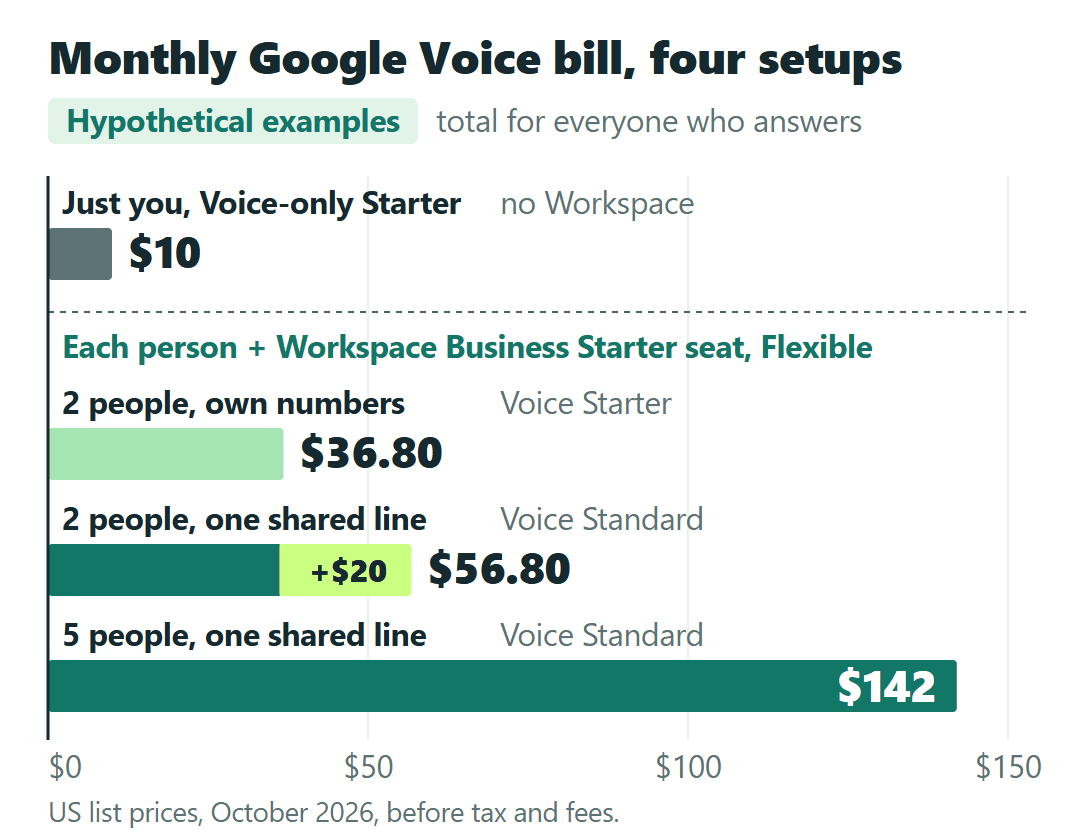
Two things move those bars. Going from two people to five is headcount; going from separate numbers to one shared line is the feature. Below Starter’s 10-user cap, no headcount forces Voice Standard. The shared line does.
If you’re weighing other ways to give a small crew one number, the Quo pricing breakdown for a small service crew sharing one number works through the same per-user question on a different phone system.
Annual or Flexible: the $7 seat comes with a one-year seat count
Workspace’s pricing page opens with the Annual switch on, so $7 per user per month for Business Starter is the first number you see. Switch it off and the Flexible price is $8.40. Both are billed monthly.
The difference is the commitment. Annual is a one-year contract for a set number of seats: you can’t reduce seats until renewal, and cancelling early leaves the rest of the contract due, with no refund. Flexible lets you remove users or cancel any time.
New Workspace customers also see a first-year discount of 10% for 12 months on up to 20 users, which brings Business Starter to $6.30 Annual or $7.56 Flexible. It’s a discount on the first year, not the price you’ll keep paying.
Voice runs on its own clock. The add-on is month to month: Google bills at the start of each month for the users you had each day of the month before, prorates when you add or remove someone, and lets you cancel any time, charging only for the days before you cancel. The Voice-only plans are billed monthly too, and Google gives at least 30 days’ notice before a price increase.
That split shows up when a tech leaves mid-year. In the five-person example, the departed tech’s Voice license comes off prorated either way. On Flexible, their Workspace seat stops billing the next cycle; on Annual, it stays paid until renewal. Annual saves $1.40 per seat per month, and Flexible keeps the exit open.
All of these figures leave out taxes, regulatory fees, the flat per-number E911 and 988 fees and calls to paid or international destinations, and if you port in an existing business number, any porting fee from your current carrier is yours to pay.
Does your second person really need to answer the same number?
That question decides the bill more than the size of the crew does. What I keep coming back to is that Google prices the shared line as a feature: two people on one number need Voice Standard, while a team where everyone has their own number can stay on Voice Starter, up to 10 users.
If customers can reach each of you directly, Workspace Business Starter plus Voice Starter keeps it at $17.00 to $18.40 per person. If they call one number and whoever is free picks up, budget a Workspace seat plus a Voice Standard license for every person who will actually answer, and leave out the techs who won’t. Flexible costs $1.40 more per seat and lets you drop a seat when someone leaves; Annual is the lower price in exchange for paying every seat until renewal.
Taxes and E911 fees sit on top of whichever total you land on. And for a solo owner, the $20 Voice-only version matters only if you want a phone menu and Google offers it at sign-up.
If you’re still the only one answering, the $10 Voice-only plan is enough, and Workspace can wait until the day a second person needs to pick up.