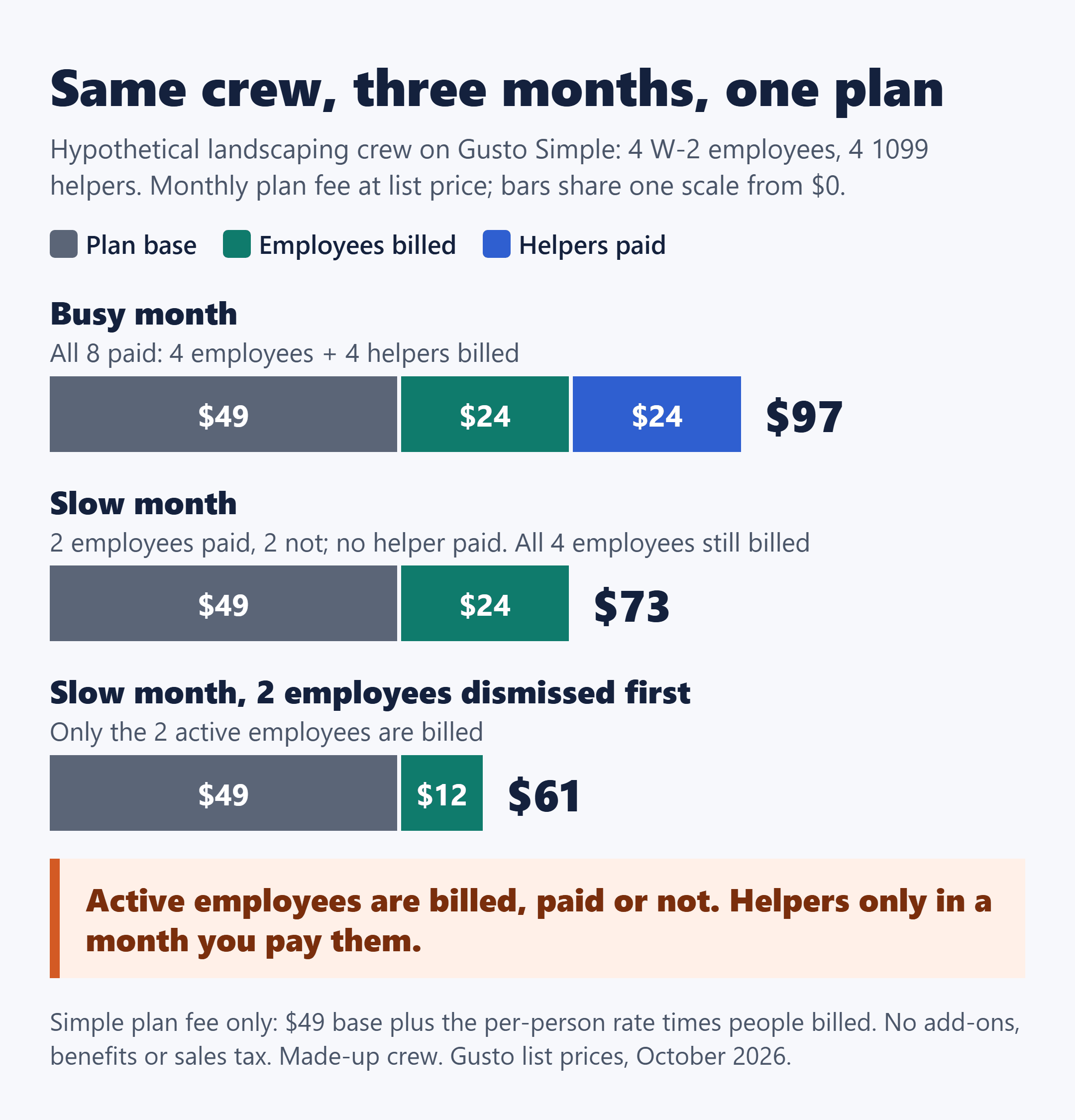
Here’s a hypothetical invoice. A landscaping company runs Gusto’s Simple plan with four W-2 employees and four 1099 helpers. October is slow: two of the employees get paychecks, two don’t, and none of the helpers is paid. On November 1, Gusto posts the invoice for October.
The per-person charge on that invoice counts four people, not two. Every active employee is billed whether or not you paid them that month, while a contractor is billed only in a month you paid them. So October comes to $49 + $6 × 4 = $73, at list price with no add-ons or sales tax. In a busy month with all eight paid, the same crew is $97.
Gusto Simple is $49 a month plus $6 a month per person; Plus is $80 a month plus $12 a month per person. Both are month-to-month with no long-term contract. The one need that requires Plus is payroll in more than one state; time tracking and next-day pay are included on Plus, and Gusto’s pricing page lists both as paid add-ons on Simple. Your plan fee is the base plus the per-person rate times the people billed that month.
Figures are Gusto’s list prices from the Gusto pricing page and billing rules from its Help Center, as published on Oct 11, 2026 for accounts opened on or after October 1, 2026. They cover the plan fee only: no add-ons, benefits, workers’ comp or sales tax. None of it comes from using a Gusto account, new-customer promotions run under separate terms, and nothing here is tax or worker-classification advice.
Two lines on the invoice, counted two ways
Gusto’s billing article describes the per-person charge as two separate items: a fee per active employee and a fee per contractor you paid that month.
- W-2 employees are billed every month while they’re active, including a month you didn’t pay them. “Active” is Gusto’s term for any employee not marked as dismissed.
- US contractors are billed only in a month you paid them, and once for that month however many times you paid them.
The rate is the same for both groups and follows your plan: $6 per person on Simple, $12 on Plus. So a 1099 helper paid in June and then not again until September is billed for two of those four months. A W-2 employee paid in the same two months is billed for all four while they stay active.
How often you run payroll doesn’t change the count. Every plan includes unlimited payroll runs, off-cycle runs included, so paying the crew weekly doesn’t add to the plan fee.
Gusto closed its contractor-only plan to new customers on October 1, 2026; you can pay contractors on any plan. The billing wording is in Gusto’s billing invoice article.
If the same crew also logs into project software, the headcount question comes back under a different rule there: how a construction project management tool decides which of your people are paid internal users sorts the same names another way.
Simple and Plus before any add-ons
| Plan | Base fee | Per person billed | Payroll states |
|---|---|---|---|
| Simple | $49 | $6 | One state |
| Plus | $80 | $12 | Multi-state payroll included |
“Per person billed” means every active employee, paid or not, plus each US contractor paid that month. Gusto also lists a Premium plan at $180 a month plus $22 a month per person, and it doesn’t switch an account to Premium until you’ve talked with its team.
The pricing page shows monthly prices only. Gusto posts the invoice on the 1st of each month for the previous month’s service and debits your bank account one business day later. It doesn’t accept credit cards for the plan fee, and a failed debit adds a $100 fee to that month’s invoice.
Two things sit outside these figures. Some states require sales tax on the subscription, which shows up as a separate invoice line based on your company’s filing address. And benefits administration, workers’ comp, 401(k) and other add-ons are priced separately, so the plan fee isn’t your whole payroll cost.
Your crew at its busiest and slowest
Simple = $49 + $6 × people billed that month
Plus = $80 + $12 × people billed that month
People billed = active W-2 employees, paid or not, + US contractors paid that month
| People billed | Simple | Plus | Plus minus Simple |
|---|---|---|---|
| 3 | $67 | $116 | $49 |
| 5 | $79 | $140 | $61 |
| 8 | $97 | $176 | $79 |
| 10 | $109 | $200 | $91 |
| 15 | $139 | $260 | $121 |
At the same number of people billed, Plus costs $31 + $6 × people billed more per month than Simple. That gap is the monthly price of whatever would move you to Plus, so it’s the number to hold against the next section.
Now run the hypothetical crew from the top, four W-2 employees and four 1099 helpers, through three different months at list price with no add-ons or sales tax:
- Busy month, all eight paid: $49 + $6 × 8 = $97 on Simple.
- Slow month, no helper paid, all four employees still active: $49 + $6 × 4 = $73, even if two of the four got no paycheck.
- The same slow month, if two of those employees had been dismissed before it began: $49 + $6 × 2 = $61.
On Plus, the same three months are $176, $128 and $104. Do the same for your own busiest and slowest months; the slow one is where the people on the invoice and the people you actually paid can differ.
Skipping a paycheck is not the same as dismissing
Skipping an employee on a payroll run does not remove their per-person charge. Gusto’s Help Center says dismissing them removes them from future invoices, and someone dismissed mid-month still appears on that month’s invoice, so the change shows up the month after.
A dismissal is an employment record change, not a billing setting. Gusto’s dismiss and rehire article notes that a rehire date replaces the original hire date and that a new Form I-9 may be needed.
For an off-season, Gusto’s Help Center describes dismissing employees who won’t be paid for an extended period and rehiring them later, or keeping the account active and skipping payrolls. An account that stays active without payroll still gets a monthly invoice.
One more line to read before you plan around a slow season: Gusto’s seasonal businesses article says Gusto “does not currently support seasonal businesses because they require special filing information that we do not collect at this time.” If your business files as seasonal, raise that with Gusto or your accountant before you sign up.
The one reason Plus isn’t optional
Payroll in more than one state is the need with no add-on route. Gusto describes Simple as running payroll in one state and includes multi-state payroll from Plus up, with no per-state charge added to the Plus subscription. State tax registration is a separate add-on on every plan, priced by state. Whether your crew needs payroll in a second state is a tax question this post doesn’t answer, so put it to Gusto or your accountant before you pick a plan.
Time tracking and next-day pay: Plus, or an add-on
Time tracking and scheduling are included on Plus. On Simple they come through the Time & Attendance Plus add-on, which Gusto lists as “Try it free, then $6/mo per person” and describes as time tracking synced to payroll, project tracking, time off and scheduling.
Next-day pay is listed on Gusto’s pricing page as included in Plus and Premium, and as a Simple add-on at $15 a month plus $3 a month per person. Without it, Gusto’s Help Center says most new employers start on a 4-day schedule, with 2-day pay available after a 15-day waiting period and one successful payroll debit. Next-day and 2-day pay both depend on eligibility and account standing.
Three other Plus features have no Simple add-on: contractor invoice upload, workforce cost reports and unlimited custom earning types. A new Simple account gets one custom earning type.
Pricing the add-ons against Plus
If you don’t need multi-state payroll, you can set the add-ons against Plus. The figures below rest on one assumption: that each add-on’s per-person fee is counted on the same people as the plan’s per-person fee. Gusto’s pages don’t say which people an add-on fee counts, so treat this as an example and confirm the add-on total when you select a plan.
Simple + time tracking = $49 + $12 × people
Simple + time tracking + next-day pay = $64 + $15 × people
Plus = $80 + $12 × people
| People billed | Simple + time tracking | Simple + both add-ons | Plus |
|---|---|---|---|
| 3 | $85 | $109 | $116 |
| 5 | $109 | $139 | $140 |
| 6 | $121 | $154 | $152 |
| 10 | $169 | $214 | $200 |
Under that assumption, Simple with the time tracking add-on alone stays $31 a month under Plus at any head count. Simple with both add-ons comes to $139 against $140 for Plus at five people billed, and $154 against $152 at six. Neither add-on gives you multi-state payroll, and Plus also carries the features above that no add-on mirrors. Figures exclude benefits and sales tax.
When a plan change reaches the invoice
An upgrade takes effect immediately, and the new pricing applies to the current month. A downgrade, or removing an add-on, takes effect on the 1st of the next month, so the month you changed in still bills at the old plan. You can change your plan once per month.
That means moving to Plus partway through a month, for a busy season or because you start running payroll in a second state, costs the whole month at Plus pricing. For eight people billed, that month is $176 instead of $97 at list price, plan fee only. The rules are in Gusto’s change your plan article.
Month-to-month doesn’t mean prorated, either. Gusto’s cancellation article says that if you cancel after the fifth of the month, or after running payroll that month, you’re charged for the full month.
Before choosing between Simple with add-ons and Plus, I’d put two questions to Gusto, because its pages leave them open:
Which of my people is the Time & Attendance Plus per-person fee counted on, and how long is its free period? If I sign up partway through a month, what does the first invoice include?
If another payroll service is on your list too, a payroll pricing breakdown for a small service crew, counted per person paid walks through that product’s billing unit the same way.
Whichever plan you lean toward, count your slowest month first, name by name: every active employee, paid or not, plus only the helpers you paid. That count, not the busy-season one, tells you what Gusto costs when the work is thin. Then confirm today’s figures on gusto.com/product/pricing before you subscribe.