Picture a hypothetical cleaning company where the office manager is the only person who answers the business line. Then the owner decides the crew lead should text customers from that same number when a team is running late. Nothing about the number changes. The bill does.
On Quo (formerly OpenPhone), sharing the number costs nothing extra, but the crew lead becomes a second paid user. On Starter with monthly billing, the subscription goes from $19 a month to $38, before texting registration, taxes and fees. Add the owner as a third person on the line and it’s $57.
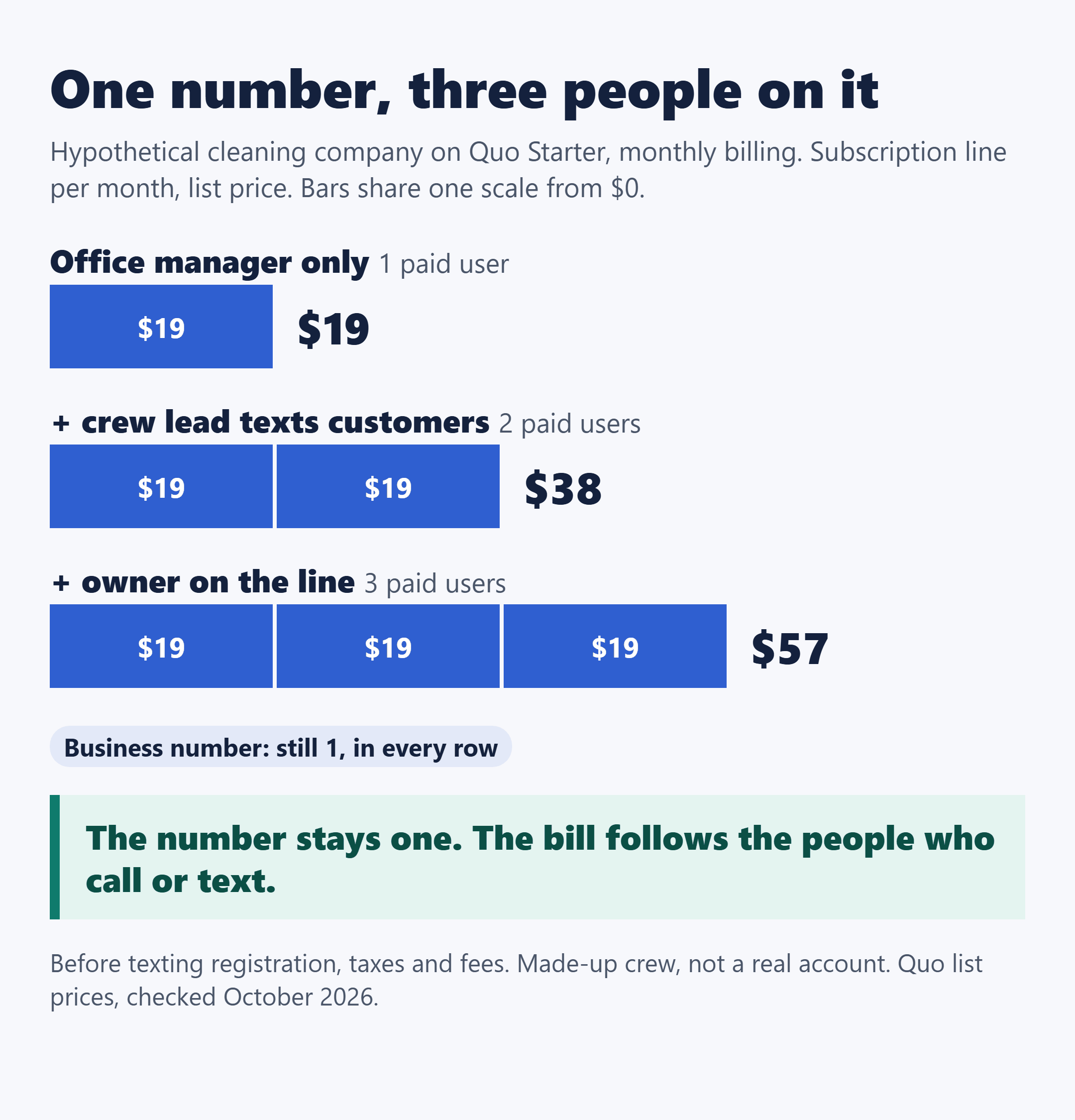
Quo bills per user. Starter is $19 per user per month, or $15 per user per month billed annually; Business is $33, or $23 billed annually. Everyone who calls or texts from your business number needs their own paid user, even when the whole crew shares one number, and on Starter up to 10 paid users can share it. Texting US customers adds a carrier registration of $19.50 once plus $1.50 a month for a business with an EIN, or $2 a month without one. Each user includes one phone number, and extra numbers are $5 a month each.
Prices are Quo’s US list prices in dollars from the Quo pricing page, and the billing rules come from Quo’s help center and Terms, all checked as of Oct 17, 2026. None of it comes from using a Quo account. The figures assume you sign up on Quo’s website with a card; subscriptions bought through the Apple App Store or Google Play aren’t covered here.
The second person on the line is the second seat
Quo’s help center says you’re “billed per user, not per number access.” So the question that sets your bill isn’t how many numbers you need. It’s how many people will pick up calls or send texts from them.
Walk through a normal week. If the owner, the office manager and one crew lead all answer and text from the main line, that’s three paid users. If only the office touches it, that’s one. Someone you never add to the Quo workspace isn’t on the bill.
Two limits sit around that count. On Starter, one shared number can have up to 10 paid users. And because each user comes with one number, local or toll-free, a crew sharing one main line needs no add-on number. You’d pay $5 a month for an extra number only when you want more numbers than you have users.
If the same people also clock in through a crew app, the head count can follow a different rule there; what a crew time-clock app’s free 10-user plan becomes when you add the eleventh person walks through one example.
Per-user prices, monthly and annual
| Plan | Monthly billing, per month | Annual billing, per month | Annual, charged per year |
|---|---|---|---|
| Starter | $19 | $15 | $180 |
| Business | $33 | $23 | $276 |
| Scale | $47 | $35 | $420 |
Quo states the annual saving as $48 per user per year on Starter, $120 on Business and $144 on Scale. Scale is in the table for completeness; the rest of this post sticks to Starter and Business.
These are list prices. Quo adds applicable taxes and telecom fees at checkout based on your billing address, so your charge can be higher than any figure here. Quo’s Plans and Pricing help page lists the states where that applies.
Three lines that sit on top of the seats
Texting registration, once per workspace
Texting US numbers requires carrier registration, called A2P 10DLC, and it has its own fees. You pay them once per workspace, not per user.
| Your business | Fees | Numbers that can text US numbers |
|---|---|---|
| Has an EIN | $19.50 once + $1.50 a month | Every number in the workspace |
| Sole proprietor, no EIN | $19.50 once + $2 a month | One number only |
The one-time fee goes to The Campaign Registry, not to Quo, and a rejected application costs $15 to resubmit. A toll-free number uses a separate verification that Quo doesn’t charge for.
The second line is simpler: extra phone numbers are $5 a month each, for every number beyond one per user.
Sona, the AI agent
Every plan includes 1,000 Sona credits a month, which Quo counts as about 10 answered calls. The allowance is per workspace, not per user, and calls under 15 seconds don’t count. More credits are a monthly add-on.
| Tier, per month | Calls a month, by Quo’s count | Each extra call, if overages are on |
|---|---|---|
| Included ($0) | About 10 | $1.00 |
| $25 | 40 | $0.75 |
| $49 | 100 | $0.65 |
| $99 | 250 | $0.55 |
| $199 | 600 | $0.45 |
Overages are off by default. When the credits run out, Sona stops answering and calls follow your fallback path, with no extra charge. The per-call rate applies only if you switch overages on.
Your bill, one person at a time
Put the pieces together and the monthly bill is four lines:
Monthly = paid users × plan price + $5 × extra numbers + registration ($1.50 with an EIN, $2 without) + Sona tier ($0 on the included credits)
One-time = $19.50 for registration
| Paid users | Starter | Business |
|---|---|---|
| 2 | $38 / $30 | $66 / $46 |
| 3 | $57 / $45 | $99 / $69 |
| 5 | $95 / $75 | $165 / $115 |
| 10 | $190 / $150 | $330 / $230 |
List prices before taxes and fees; extra numbers, registration and paid Sona tiers aren’t included. The annual figures are per-month equivalents, because Quo charges the year up front: $360, $540, $900 and $1,800 on Starter for 2, 3, 5 and 10 users, and $552, $828, $1,380 and $2,760 on Business.
Back to the hypothetical cleaning company, now with three people on the line, one shared number, EIN registration, monthly billing and the included Sona credits, before taxes and fees:
- On Starter: $57 + $1.50 = $58.50 a month, plus $19.50 once, so the first month comes to $78.00.
- On Business: $99 + $1.50 = $100.50 a month, plus $19.50 once.
- On Starter with one extra number and the $25 Sona tier: $57 + $5 + $1.50 + $25 = $88.50 a month, plus $19.50 once.
Without an EIN, the first line becomes $59.00 a month plus $19.50 once, and only one of the numbers can text US numbers. These are illustrations, not a typical bill: your head count, extra numbers, registration type and Sona tier decide your total.
Starter or Business depends on what happens to a call
Business costs $14 more per user per month on monthly billing, or $8 more on annual billing, which is $96 per user per year. For the three-person example on monthly billing, that’s $42 a month.
Starter already covers a shared number for up to 10 paid users, calls and texts to US and Canadian numbers, voicemail transcripts, auto-replies and basic call forwarding. These are the call-handling rows where Quo’s compare table splits the two plans:
| What you need | Starter | Business |
|---|---|---|
| Hand a live call to the office or a tech (call transfers) | No | Yes |
| A “press 1 for scheduling” phone menu | No | Yes |
| Ring order on a shared number | No | Yes |
| Call forwarding | Basic | Basic and advanced, including unanswered calls by business hours |
| Call recording | Manual | Automatic |
| AI call summaries and transcripts | Sona-handled calls only | All calls |
| Call analytics and reporting | No | Yes |
| CRM and field-service integrations, including Jobber and HubSpot | No | Yes |
I’d treat that list as the whole decision, because crew size alone doesn’t decide it. If one row describes how you want calls handled, price your crew on Business. If none does, Starter covers a shared number for up to 10 paid users.
The integration row matters most if Jobber already runs your schedule. In that case, how Jobber’s plans count logins for a small field-service team is worth reading next, since that bill also depends on how many of your people need their own access.
What annual billing commits you to
Annual billing saves $48 per user per year on Starter and $120 on Business, by Quo’s own figures. What you trade for it is flexibility:
- You pay the year up front. Five paid users on Starter with annual billing is $900 charged at once, with texting registration on top.
- Payments already made aren’t refunded. If you cancel, service runs to the end of the period you paid for.
- Removing a user doesn’t lower the current bill. The seat stays on your subscription until the billing period ends. You can fill it with someone else at no charge until then, and it drops off at renewal if you leave it empty.
- Adding a user is charged the moment you send the invite, as a prorated charge, before the person accepts. If the invite is never accepted, you keep paying until you remove it.
- Plan changes work one way mid-term. An upgrade takes effect right away with a prorated charge; a downgrade starts at your next renewal.
The same seat and no-refund rules apply on monthly billing. The period is just one month, so an empty seat drops off at the next monthly renewal instead of at the end of the year.
My practical reading: the annual price fits a head count you’d stand behind for twelve months. If your crew grows for summer and shrinks in winter, set the per-user saving against the seats you’d still be paying for in the slow months. Before prepaying, I’d put two questions to Quo, because its pages don’t answer them:
How are the $5 extra-number fee and the monthly texting registration fee billed on an annual plan? If I start on monthly billing, can I switch to annual later, and how is that charged?
Quo’s seat and refund rules are in Managing your subscription.
Texting won’t show up in the trial
Quo’s 7-day trial won’t tell you how texting works for your crew. You can’t text US numbers during the trial or before your registration is approved, and registration can only be done once you’re on a paid plan. Approval isn’t instant: it often takes a day or two and sometimes weeks. If texting customers is the reason you’re buying, plan to start registration the day you pay.
The other thing to watch is the invite button. Each invite is billed as soon as you send it, so send them only to people you’re sure about.
So before you choose a plan, write down names. Every name that will answer or text from the business number is a line on the bill; the shared number isn’t. Confirm current prices on the Quo pricing page, and read Quo’s carrier registration guide before you count on texting customers.