Here’s a hypothetical to hold up against your own calendar. Your AT&T bill period ends on the 21st of each month. Your flight leaves on the 16th and you land back home on the 29th: 14 days abroad, one phone, used every day.
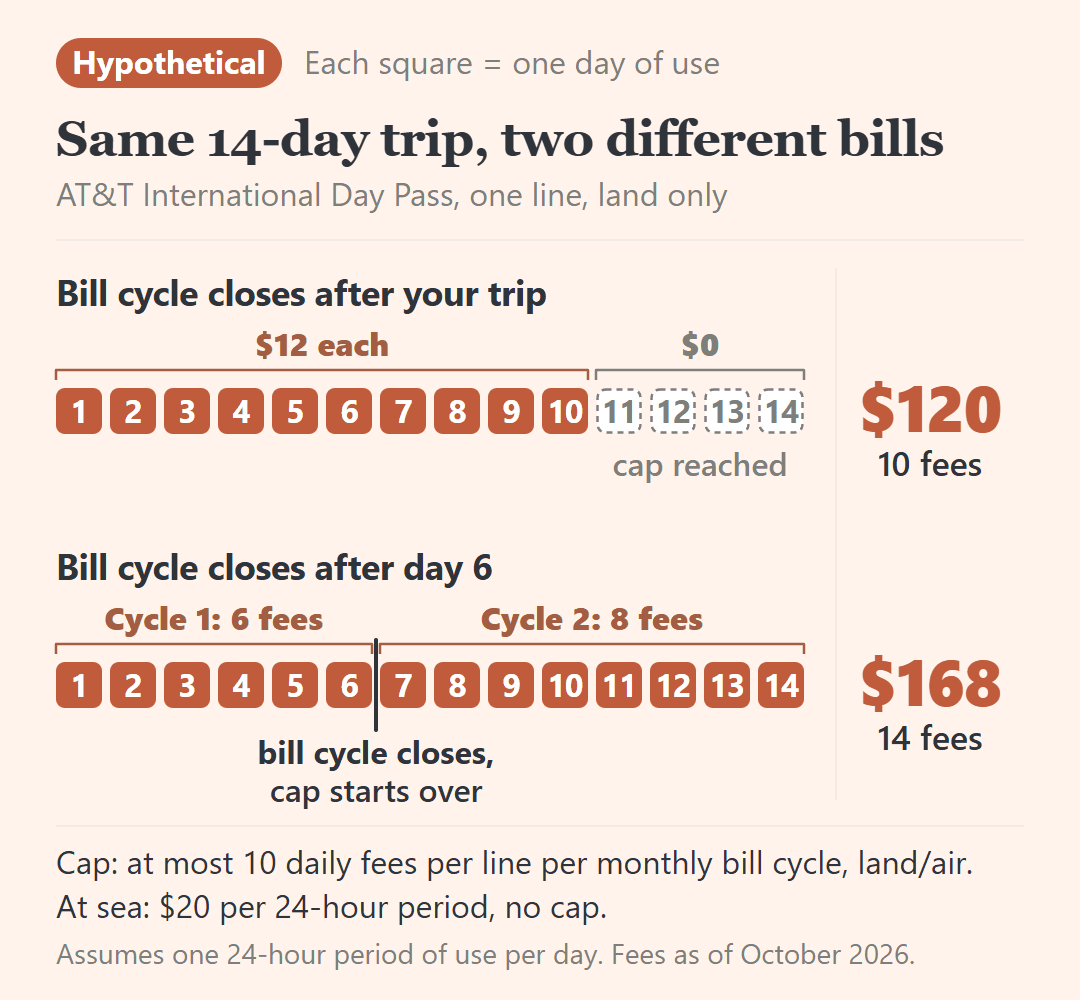
Shift that same trip so all 14 days fall inside one bill period, and International Day Pass comes to $120 on that line. With the period closing after day 6 of the trip, it comes to about $168. Same trip, same phone, and the only thing that moved is where the bill period ends.
That gap comes from how AT&T’s cap is counted: per line, per bill cycle, not per trip.
On land, International Day Pass costs $12 for each 24-hour period you use a line abroad, and $6 for each additional line on the same account used on the same calendar day. AT&T charges at most 10 daily fees per line per monthly bill cycle on land. On an included cruise ship it’s $20 per line for each 24-hour period, with no second-line discount and no cap.
So your total depends on four things: how many lines you’ll actually use, how many days you use each one, land days versus ship days, and where your bill cycle closes during the trip.
You don’t have to sign up for it. If a line has no other international feature, AT&T adds International Day Pass automatically the first time the phone is used in a destination your domestic plan doesn’t include, and sends a text. Texts you receive don’t start a fee; using data, or making or answering a call, does.
This covers AT&T postpaid consumer lines on Unlimited plans. If your plan includes Mexico and Canada, there’s no daily fee there, and AT&T Premium 2.0, Unlimited Premium and Unlimited Elite have no daily fee in included Latin America countries. Some older articles still quote $10 and $5; the fees here are from AT&T’s terms as checked in October 2026.
Count Fees per Line, per Bill Cycle, Not per Trip
Before you run any numbers, pull together four values from your own account and itinerary.
- Your bill cycle close date. It’s the end of the bill period shown on your AT&T bill. Write it next to your departure and return dates.
- Which lines will be used abroad. Each line that uses data, makes or takes a call, or sends a text gets its own fee.
- Land days and ship days. They’re priced differently, and only land days have a cap.
- Whether your plan includes Mexico and Canada, if that’s where you’re going. If it does, those days carry no daily fee.
Then, for each line and for each bill cycle the trip touches: fees = the 24-hour periods of use in that cycle, up to 10. One line on a given calendar day is charged $12, and each additional line used that same calendar day is charged $6.
One detail about the $6: the calendar date is set by your home U.S. time zone, not the local date where you are. And the line charged $12 isn’t necessarily the one used first that day.
The examples below assume one 24-hour period of use per day. Your real count depends on when you first use the phone each day, because each fee covers 24 hours from that first use.
The same two weeks, two different bills
Back to the hypothetical solo traveler: one line, land only, 14 days, phone used every day, at AT&T’s October 2026 fees. If all 14 days fall in one bill cycle, the line reaches 10 fees by day 10, and days 11 to 14 add nothing: $120.
If the cycle closes after day 6, the first cycle gets 6 fees and the cap starts over for the remaining 8 days. Neither cycle reaches 10, so all 14 days are charged: $168. For a trip that crosses the close, treat your total as an estimate and check the fee count per line on the bill.
| Trip | Lines used | Where the bill cycle closes | Fees charged | Total |
|---|---|---|---|---|
| A: 14 days, solo | 1 | After the trip | 10 (cap reached) | $120 |
| A2: same 14 days | 1 | After day 6 | 6 + 8 = 14 | $168 |
| B: 9 days, couple | 2 | After the trip | 9 per line ($12 + $6 a day) | $162 |
| C: 25 days, solo | 1 | After day 12 | 10 + 10 = 20 | $240 |
Example C shows the cap working twice. If those 25 days had fallen inside a single bill cycle, the line would have stopped at 10 fees and $120. Split 12 and 13 across a close, it reaches the cap twice.
That’s why I wouldn’t trust any “most you’ll pay for a trip” figure for International Day Pass. The cap is 10 daily fees per line per bill cycle on land, and how it plays out depends on your dates.
On a Cruise, There’s No Cap to Lean On
On one of AT&T’s 400+ included ships, each line pays $20 for every 24-hour period of use at sea. There’s no $6 rate for a second line and no 10-fee cap, so every day a line is used on the ship is charged.
A day with both ship use and land use is one $20 fee, not $20 plus $12.
Take hypothetical example D: a couple on a 7-day cruise, both phones used on the ship every day. That’s 2 lines × 7 days × $20 = $280 at AT&T’s October 2026 at-sea fee, and a longer cruise just keeps adding $40 a day.
At sea you get 500 MB of best-speed data per 24 hours, then speeds of up to 512 Kbps on certain ships. The ship’s network is off near land and in port. AT&T sums up the at-sea pricing in its support note on International Day Pass for cruise ships.
What Starts a Daily Fee, and What Doesn’t
A fee starts the first time a line uses data, makes or receives a call, or sends a text in an included destination. It covers 24 hours from that first use, and the next use after those 24 hours starts another fee.
Texts you receive don’t start a fee. Answering a call does, and so can apps using data in the background while the phone sits in your bag.
Wi-Fi calling has its own rule. A Wi-Fi call to the U.S. carries no additional charge, but a Wi-Fi call to anywhere other than the U.S. triggers a daily fee.
Settings for the lines that don’t need service
AT&T’s International Day Pass support page lists these steps to avoid unintended charges. They help; they don’t make a fee impossible.
- Put the phone in airplane mode and turn Wi-Fi on.
- Turn off cellular data roaming.
- Turn off Wi-Fi Calling, or call only U.S. numbers over Wi-Fi.
- Check which apps run in the background.
- Skip Data Free TV abroad; it isn’t available outside the U.S.
Why removing the pass isn’t the same as saving money
When AT&T adds the pass automatically, the text it sends gives you the option to opt out. Later, you can remove it by texting NO to 8048, in myAT&T, or by calling 833-669-2516. Otherwise it stays on the line for future trips.
Without it, AT&T bills pay-per-use rates: $2.05 per MB of data, up to $3 a minute for talk, $0.50 per text sent and $1.30 per photo or video message sent. Removing the pass only saves money on a line that truly stays off the network.
Daily fees are calculated and charged at the end of your billing cycle, so they show up on the bill after the trip, not while you’re away.
Write the Close Date on Your Itinerary
First, the date. Find where your bill period ends and see whether it lands inside your trip. If it does, count land days on each side of it separately.
Then, the lines. Decide which phones really need service abroad. On the others, use the settings above, and remember a received call still counts.
Then, the ship days. Count them on their own at $20 per line, with no cap.
After you’re home, compare the fees on the bill with the days each line was used. If the count looks off, this is the question I’d put to AT&T:
“My bill shows International Day Pass fees for a trip from [date] to [date]. Can you show me how many daily fees were charged on each line in this bill cycle, and when each 24-hour period started? I count [number] days of use on land and [number] at sea.”
If the same statement also carries a credit card’s annual fee, a date decides that one too: here’s how long you have to cancel for an annual fee refund, and which date starts the clock.
If your plan isn’t unlimited, data and minutes abroad come out of your plan’s allowance, and overage charges or slower speeds can apply. Passport package holders pay International Day Pass fees in its destinations unless they remove it. Business and government accounts use a separate business version, and prepaid lines, wearables and hotspots aren’t covered.
The part of AT&T’s terms I’d underline is how narrow the cap is. It’s ten fees per line per bill cycle, and only on land. The travelers it’s least likely to protect are the ones whose trip straddles the close date and the ones spending their days at sea. If you have questions while abroad, AT&T lists +1.314.925.6925 as a free call from your AT&T phone.
Sources: AT&T’s International Day Pass terms and conditions (fees, cap, triggers, removal, destination exceptions), its International Day Pass support page and cruise changes note, and the International Day Pass product page (billing at the end of the cycle). Checked October 2026.