Day 1: you start Audible’s 30-day free trial. Day 30: the trial ends; cancel before then and you pay nothing, do nothing and the monthly plan you picked renews at its list price, every month, until you stop it. Twelve months after each Premium credit is issued: if you haven’t spent it, it expires.
That’s the clock you’re signing up for. The price on it, as listed on audible.com in the US on October 28, 2026: Standard $8.99 a month, Premium $14.95 a month, and two Premium Annual plans, $149.50 a year for 12 credits and $229.50 a year for 24 credits. Tax may be added, and Audible’s terms say membership fees “may change at any time.”
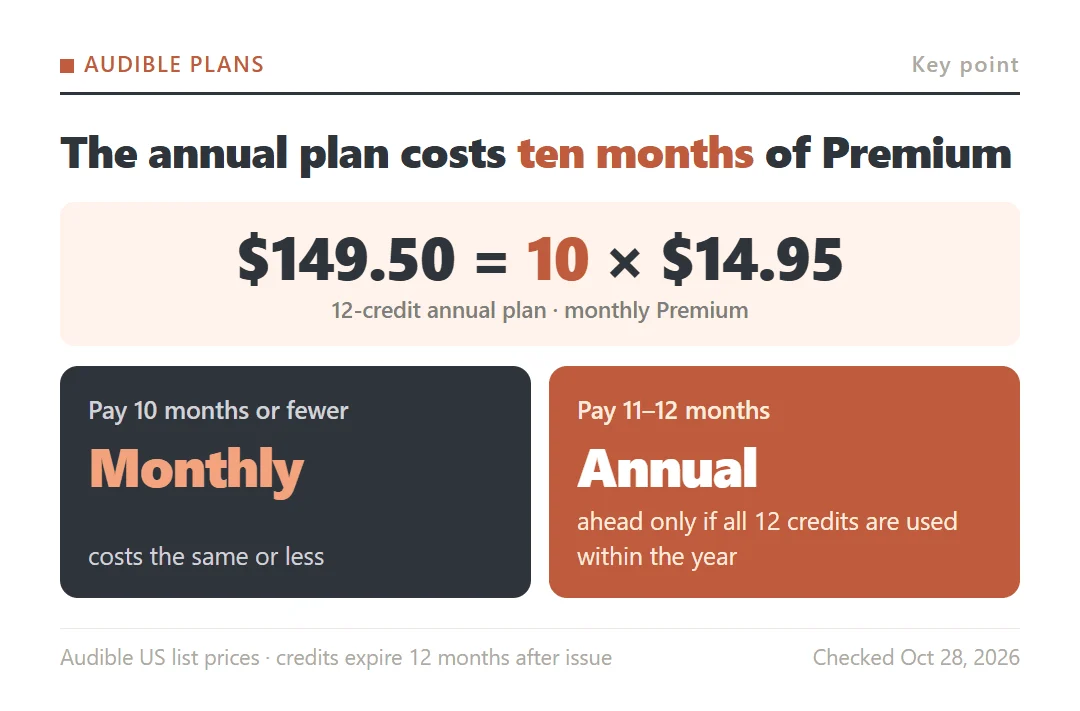
The two monthly plans aren’t a cheap and an expensive version of the same thing. Standard lets you listen to one pick a month only while you’re a member; Premium’s monthly credit buys a book you keep even after you cancel. And at those list prices, the 12-credit annual plan costs exactly ten months of monthly Premium, so it saves money only if you’d otherwise pay all year and actually spend the 12 credits within 12 months.
It Depends on Whether You Want to Keep the Book: What $8.99 and $14.95 Buy
Standard lets you select one audiobook a month from Audible’s entire collection without using credits, and you can listen to your picks for as long as you’re a member. A month’s pick you don’t use doesn’t roll over, and any extra book costs full price.
Premium, the monthly plan formerly called Premium Plus, gives you one credit a month for any title, and the book you spend it on is yours to keep, even if you cancel. Credits roll over month to month but expire 12 months after they’re issued, or when you cancel. Premium also includes the Plus Catalog, which you can listen to while you’re a member, and Premium member-only sales.
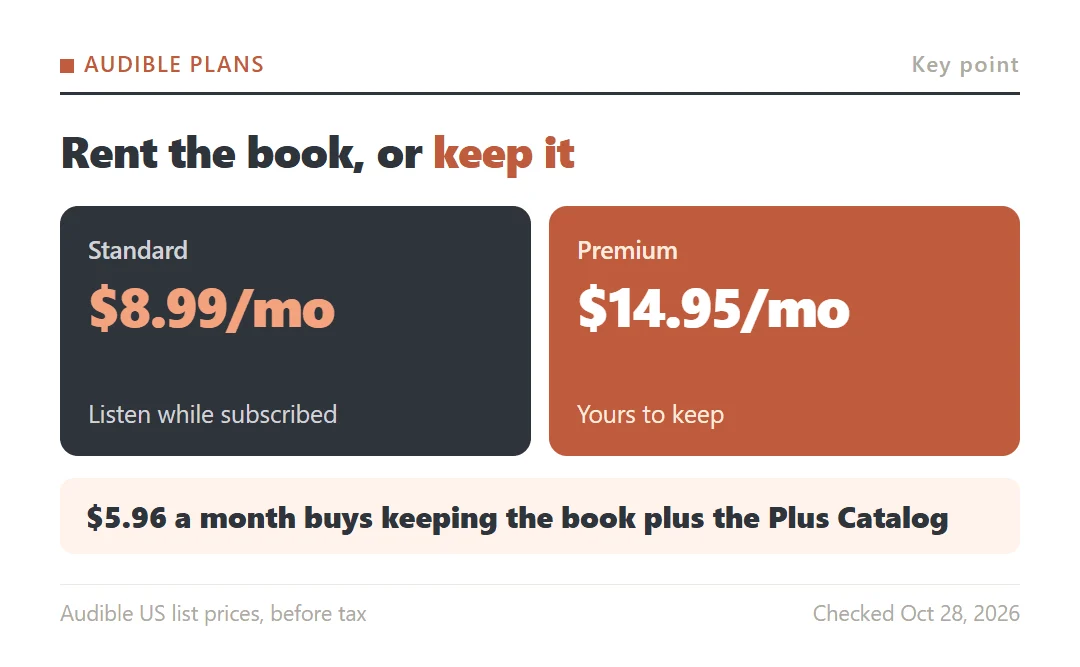
The difference shows up the day you leave. Cancel Standard and every pick you’ve made locks at the end of your final billing cycle, with a lock icon in your Library; rejoin a membership later and those titles unlock again. Books bought with Premium credits or with cash stay in your Library either way.
So the gap is $5.96 a month, or $71.52 a year, and it buys ownership plus the Plus Catalog and Premium member-only sales. Whether that’s worth paying depends on whether you go back to books you’ve finished and whether you expect to stop subscribing someday. No count of books settles that for everyone.
Cost per Book: What You Pay Divided by the Books You Finish
Your real price per book is what you pay divided by the books you actually finish before the credits expire. Here are Audible’s four US list prices, worked out per book only for the case where every credit or pick gets used:
| Plan | List price | Per book, if every credit or pick is used |
|---|---|---|
| Standard (listen while a member) | $8.99 a month | $8.99 per pick |
| Premium monthly (keep the book) | $14.95 a month | $14.95 per credit |
| Premium Annual, 12 credits | $149.50 a year | $12.46 per credit |
| Premium Annual, 24 credits | $229.50 a year | $9.56 per credit |
The annual plans hand you all 12 or 24 credits up front, but each credit still expires 12 months after it’s issued. The annual rate is only cheap if you finish the books inside that year.
The 12-credit plan has a tidy number behind it: $149.50 is exactly 10 × $14.95. At the list prices checked October 28, 2026, it costs the same as ten months of monthly Premium. If you’d pay for Premium ten months or fewer in a year, monthly costs the same or less; the annual plan comes out ahead only if you’d otherwise pay for 11 or 12 months and use all 12 credits within the year.
Both listeners below are priced at the list prices in the table, before tax.
Listener A: a book a month, every month
Listener A finishes 12 books a year. Monthly Premium costs 12 × $14.95 = $179.40, and A keeps all 12 books. The 12-credit annual plan costs $149.50, which works out to $12.46 a book and $29.90 less than paying monthly. Standard would cost 12 × $8.99 = $107.88, but those 12 picks lock if A ever cancels, until A rejoins.
Listener B: six books in one six-month stretch
Listener B listens hard for six months and finishes six books. Monthly Premium for those six months, canceling after spending the credits, costs 6 × $14.95 = $89.70, and B keeps six books. The 12-credit annual plan costs $149.50 with six credits expiring unused, which is $24.92 for each book actually used. Standard for six months would cost 6 × $8.99 = $53.94, with the picks locked once B cancels.
What would each Audible plan cost you per book?
Pick a plan, enter the books you would really finish in 12 months and, for a monthly plan, how many months you would pay.
Cost per book you finish on each plan, for the books and months you entered. US list prices before tax.
If your result doesn't match your bill or notice, check the exact figure on Audible's plans and pricing page. Rules as of 2026-10-28
Show the breakdown and basis
Cost per book = what you pay in 12 months divided by the books you finish, counting one pick or credit per paid month on a monthly plan and 12 or 24 credits on an annual plan. US list prices before tax.
Values are calculated in your browser and are not saved or sent anywhere.
Instead of canceling between stretches, B could pause a monthly plan for 30, 60 or 90 days (up to 90 days in a 12-month window, after at least 30 paid days). Payments stop during a pause; Premium keeps its existing credits but gets no new ones, and Standard picks lock until the pause ends. Annual plans can’t be paused, and memberships billed through the Apple App Store have a shorter pause.
The 24-credit plan runs on the same math, stretched further. Its $9.56 a credit holds only if you finish 24 books within 12 months of getting the credits. Compared with the 12-credit plan, the extra $80.00 buys 12 more credits at $6.67 each, which pays off only if you’d really use more than 12 in that year. Before you pay, check that the checkout screen shows the credit count you expect.
Switching, Pausing or Canceling Without Losing What You Paid For
On the Audible website, go to your name → Membership Details → Switch membership, pick a plan and confirm. Moving from Premium to Standard keeps your unused credits until their original expiry dates; moving from Standard to Premium keeps your earlier Standard picks playable.
If you signed up inside the Audible app through Apple or Google, you switch and cancel in that store’s subscription settings instead. Audible’s switching page doesn’t say when the new plan’s price starts, so ask before you confirm:
Before this plan change goes through, how many unused credits are on my account, when does each one expire, and on what date will the new plan’s price first be charged?
Canceling never refunds fees already paid, and unused credits disappear when the membership ends. Credits bought through the Apple App Store or Google Play are the exception; those don’t expire. Anything you bought with credits or cash stays yours.
If your account shows a limited-time offer, your first-year price can be lower than the table. Offers vary by account and renew at the list price, so check what yours renews at before you count it.
All of these figures are audible.com list prices in the US; if you’re billed through Apple or Google, or on another country’s Audible site, check the price shown there.
Sources, checked October 28, 2026: Audible Membership Plans & Pricing and Conditions of Use; Audible Help Center, Learn about Standard plan, Learn about credits, Switch plans and Pause your membership.
Why Your Listening Pace Matters More Than the Plan Name
If you asked me, I’d count the books I actually finished in the last 12 months before looking at a single plan card. Every per-book number in this post runs on that count, not on the pace you hope to keep.
If you’re already paying and leaning toward leaving instead, read our guide to canceling Audible with credits left first, since unused credits end with the membership.
Put a reminder on your calendar a few days before the trial’s day 30, or before an annual plan renews, and decide with your own count in hand. The good news: moving from Premium to Standard keeps the credits you already have until their original expiry dates, so trying the cheaper plan doesn’t cost you them.
Photos and icons in this post are illustrations made for explanation; they do not show real places, products or people.