The sticker on your rear license plate shows a month and a year. The registration card that goes with it shows a specific day, and that day is the one California’s DMV goes by.
DMV doesn’t offer a grace period after it. A renewal paid after midnight on the date printed on the card is late, even if the month on the sticker still has weeks left in it.
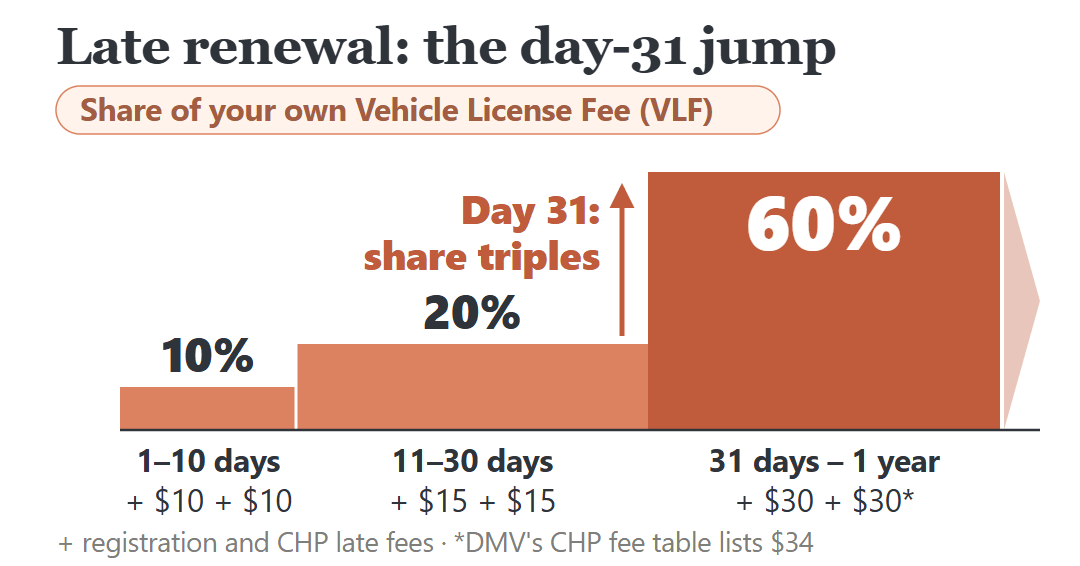
What a late renewal adds isn’t a flat fee. It’s a percentage of your own car’s Vehicle License Fee (VLF), plus a registration late fee, plus a California Highway Patrol (CHP) late fee. Paid 1 to 10 days late, that’s 10% of the VLF + $10 + $10. Paid 11 to 30 days late, 20% + $15 + $15. From day 31 up to one year, the percentage jumps to 60% and the two flat fees rise to $30 each (DMV’s separate CHP fee table lists $34 for the CHP part).
Because every car’s VLF is different, two cars renewed on the same late day can owe very different amounts. There’s no single “California late fee” in dollars. There’s a formula, and your car supplies the main input.
If a smog check is what’s holding you up, pay the renewal fees anyway. DMV says paying the full renewal fees by the due date prevents penalties even when the smog certification or proof of insurance isn’t done yet. If the date has already passed, the tier you land in depends on the day you pay, so paying now keeps the penalty from moving up a row.
Two Numbers Behind Your Penalty: the Date on the Card and Your VLF
The date. DMV’s fee page puts it plainly: your plates display only the month and year, but your registration expires on a specific day, so check the registration card for the actual expiration date.
DMV mails a billing notice about 60 days before that date. If none arrived, DMV’s advice is to contact Customer Service or use its online fee calculator. A missing notice isn’t something to count on as extra time.
The VLF. The Vehicle License Fee is 0.65% of the vehicle’s purchase price or value, and it goes down over the car’s first 11 renewal years, or until the car is transferred to a new owner, whichever comes first. A newer, pricier car carries a bigger VLF. An older one carries a smaller one.
To find yours, look at the fee breakdown on your renewal notice, or use the VLF calculator or renewal fee calculator on DMV’s Registration Fees page. That number is what the percentages in the next table multiply.
Working Out the Penalty on Your Own Car
The formula behind DMV’s penalty table is your VLF × the percentage for your tier + the registration late fee + the CHP late fee. All of it is added on top of the regular renewal fees.
| Days late | Share of your VLF | Registration late fee | CHP late fee |
|---|---|---|---|
| 1 to 10 days | 10% | $10 | $10 |
| 11 to 30 days | 20% | $15 | $15 |
| 31 days to one year | 60% | $30 | $30* |
| More than one year to two years | 80% | $50 | $50* |
| More than two years | 160% | $100 | $100 |
These tiers are for renewing a vehicle that’s already registered in California. A first registration, including a new resident’s, uses a different penalty schedule, and commercial vehicles add the weight fee to the amount the percentage applies to.
Two cars, the same late day
Here are two hypothetical cars, not real DMV bills. Car A is newer, with an assumed VLF of $260 (at 0.65%, that’s a value of about $40,000). Car B is older, with an assumed VLF of $45. Each renewal is paid the same number of days late:
- 5 days late: Car A, $26 + $10 + $10 = $46. Car B, $4.50 + $10 + $10 = $24.50.
- 15 days late: Car A, $52 + $15 + $15 = $82. Car B, $9 + $15 + $15 = $39.
- 35 days late: Car A, $156 + $30 + $30 = $216. Car B, $27 + $30 + $30 = $87. Using the CHP table’s $34, those become $220 and $91.
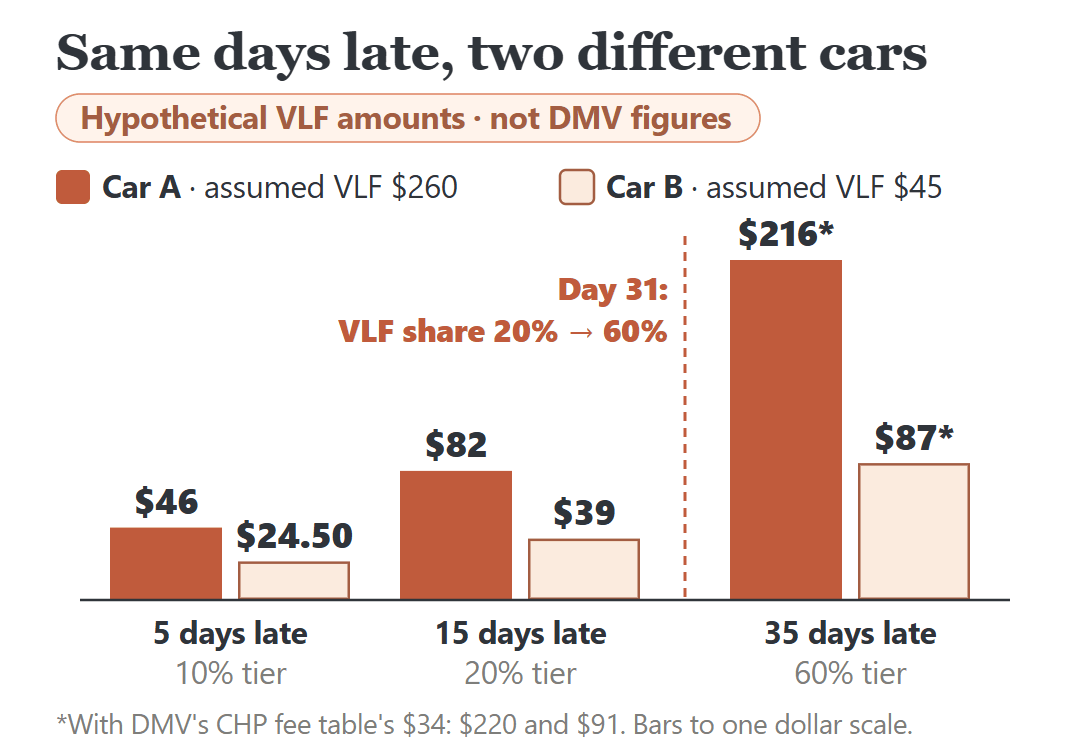
The step from day 30 to day 31 is where the two cars split the most. Car A goes from $82 to $216, a $134 jump. Car B goes from $39 to $87, a $48 jump. Same rule, same day, a different dollar answer for each car.
When I worked both cars through DMV’s table, the first month turned out to be the gentle part. Within days 1 to 30 the percentage only doubles. On day 31 it triples, and both flat fees double with it.
Paying Before the Smog Check Is Done Still Stops the Penalty
Say the smog appointment is a week after the date on your card (an assumed example). DMV’s instruction on its Important Vehicle Information page is to pay the full renewal fees by the due date even if you can’t provide a required smog certification or evidence of insurance yet. Paying on time prevents the penalty.
Two limits come with that. Paying is not a permit to drive the car on the expired registration. And the renewal isn’t finalized, so no new card or sticker, until the smog certification and any other requirements, such as outstanding parking tickets, are cleared. Driving on an expired registration can also bring a ticket, which is separate from DMV’s penalty.
When the date on the card falls on a weekend
If the expiration date, or the last penalty-free date, falls on a Saturday, Sunday or state holiday, DMV doesn’t assess a penalty when the fees are paid on the next business day.
Here’s how the tiers fall on a calendar, as a labeled example. Suppose the card says Saturday, Oct. 31, 2026 (an assumed date). Paying on Monday, Nov. 2, is on time. Counting Nov. 1 as day 1, a payment through Nov. 10 lands in the 10% tier, Nov. 11 through Nov. 30 in the 20% tier, and Dec. 1 or later in the 60% tier. For a real date, DMV’s fee calculator gives the exact figure.
One more timing case: if you bought the car recently and no renewal penalty had built up when you got it, you have 20 days from the transfer to pay without a penalty.
Not Driving It: Planned Nonoperation Has a 90-Day Window, but Penalties Stay
If the car is sitting unused, Planned Nonoperation (PNO) status can be filed up to 90 days after the expiration date, but only if the vehicle was not operated in any manner. Late penalties that are already due still have to be paid.
“Not operated” is strict. A PNO car that’s driven, or parked, towed or left standing on a public street, can be cited or impounded, and the owner can owe full registration fees and late penalties for that year. PNO fits a car that’s kept off public streets, not one that’s still parked out front.
When You Paid on Time and a Penalty Showed Up Anyway
DMV can waive penalties, but the conditions are narrow. The main one for an ordinary owner is that the penalties built up “through no fault or intent of the owner.” Others cover buyers who didn’t know about unpaid fees, stolen vehicles and deployed military members. Forgetting the date or being short on money isn’t on the list.
A payment that went through on your end but not on DMV’s is the kind of case that can fit. In January 2024, NBC Los Angeles reported that DMV had rejected thousands of online electronic-check payments after drivers got confirmations, and then added late fees. DMV sent demand letters to about 30,000 drivers in 2022 and nearly 40,000 in 2023. One driver was charged nearly $200 in late fees, and DMV waived them after the station asked. That’s a 2024 news report, not a description of how DMV handles payments today.
The useful part is the paper trail. Keep the confirmation, the payment date and the bank record for every renewal; the bank record is what shows the problem wasn’t on your side. If a penalty follows a payment you made on time, ask DMV to waive it and include that proof. DMV’s form for explaining these situations is the REG 256 Statement of Facts. A waiver isn’t guaranteed.
“I paid the registration renewal for plate [number] on [date], before the expiration date on my registration card, and received confirmation [number]. A late penalty was added afterward. Because the penalty accrued through no fault of mine, I’m asking DMV to waive it. My confirmation and bank record are attached.”
Before the Calendar Moves You Up a Tier
- Read the expiration date on your registration card, not the sticker.
- Find your VLF in the fee breakdown on your renewal notice, or with DMV’s VLF calculator.
- Count how many days late today is, find your row in the table and multiply. Then look at what the next row would add.
- Pay the renewal fees now, even if the smog check or proof of insurance is still pending. If the car truly isn’t being used, PNO is the alternative within 90 days, with any penalties already due still owed.
- Finish the smog check, keep the payment confirmation, and watch for the new card and sticker.
Of the two numbers, the VLF was settled by the car, and I treat the payment day as the one input still in your hands, so if you’re still inside the first 30 days, pay before day 31 arrives and moves the VLF share from 20% to 60%.
If your household also has rooftop solar on PG&E, there’s another once-a-year California bill that builds before it arrives. This walk-through shows how to find your PG&E solar true-up running total and plan how to pay it.
Sources: California DMV’s Registration Fees page (penalty table, CHP fee table, VLF and fee calculators), Important Vehicle Information and Vehicle Registration Renewal pages; DMV’s registration manual sections on penalty exceptions and waivers; California Vehicle Code §9554; NBC Los Angeles, Jan. 29, 2024. Checked Oct. 16, 2026. Car A, Car B, the smog appointment and the Oct. 31 date are hypothetical examples. For the exact amount on your own car, run DMV’s renewal fee calculator.