The itemized statement from your old landlord just arrived. It lists your $2,200 deposit, $350 to replace carpet, $180 to repaint, and a refund of $1,670. (Those figures are a hypothetical example, not a real lease, with a move-out on Sept. 30, 2026.)
What isn’t on the page matters as much as what is. Repairs and cleaning come to $530, over California’s $125 line, so copies of the receipts or invoices, plus photos, should have come with the statement. Whether move-in photos belong in that stack depends on when your lease began: they’re owed only for tenancies that started on or after July 1, 2025.
Then there’s the question of how the $1,670 is coming back: as a check in the mail, or into a bank account.
In California, a landlord has 21 calendar days after you move out to send an itemized statement of your deposit and return whatever isn’t deducted. Count from your own move-out date: out on Sept. 30 means Oct. 21. Deductions are limited to unpaid rent, damage beyond ordinary wear and tear, and cleaning back to how clean the place was when you moved in, and only in amounts that are reasonably necessary.
Since Jan. 1, 2026, if you paid the deposit or rent electronically, the refund has to go electronically to a bank account you designate in writing, unless the two of you agreed in writing on a check or another method. If the statement hasn’t come yet, put two things in writing now: where the money should go, and your forwarding address.
Counting Your 21 Days From Move-Out Day
The statute starts the clock on the day you vacated the unit, and it counts calendar days, not business days. Use the day you actually moved out and handed the place back, which isn’t always the date the lease was set to end.
Keep proof of that date, such as the text or email where you returned the keys, or a move-out inspection record.
By day 21 the landlord has to send the statement and the rest of the deposit. The law allows first-class mail but doesn’t say whether a mailed envelope has to arrive by then, so one slow mail day isn’t the signal. If nothing has come a few days after your day 21, ask in writing.
Mail goes to the address you give the landlord. If you don’t give one, it goes to the unit you just left, which is why the forwarding address belongs in the same note as your bank details.
“I moved out of [unit address] on [date]. Because I paid [rent / the deposit] electronically, please return the remaining security deposit electronically to this account: [bank name, routing number, account number]. Please send the itemized statement to my forwarding address: [address].”
If you paid by check or cash, leave out the bank line and keep the address. Landlords are supposed to tell electronically paying tenants about the electronic-refund right in writing before the tenancy ends. Whether or not that notice came, your written account designation is the step that matters.
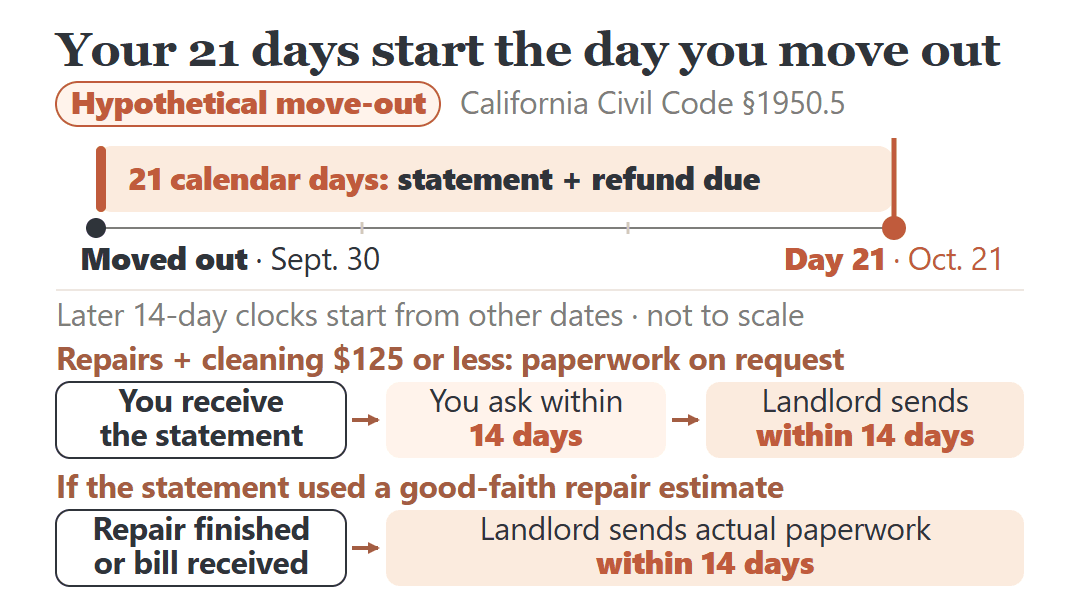
The timeline has one more branch. If a repair can’t reasonably be finished within 21 days, or the contractor’s bill isn’t in hand yet, the landlord may deduct a good-faith estimate on the statement. It then has 14 days after finishing the work or receiving the bill to send the actual paperwork. The statement itself is still due by day 21.
If you haven’t moved out yet
You can ask the landlord for a pre-move-out inspection, held no earlier than two weeks before you leave. The landlord has to give you a list of the deductions it plans so you can fix them first.
After that, it generally can’t deduct for something it didn’t list, apart from damage that happens after the inspection or that your belongings were hiding.
What a California Landlord May Keep, and What It May Not
The statute lets the deposit cover four things, and only in amounts reasonably necessary:
- Unpaid rent.
- Repairing damage beyond ordinary wear and tear caused by you or your guests.
- Cleaning, but only back to the level of cleanliness the place had when you moved in.
- Restoring or replacing items that came with the rental, if your lease allows the deposit to be used that way.
Three things are off the table: ordinary wear and tear, damage that was there before your tenancy, and professional carpet cleaning or other professional cleaning, unless it’s needed to bring the place back to its move-in condition. Repairs stop at move-in condition, too, so a deposit can’t pay for an upgrade.
That’s why the carpet line on the example statement is the one to question. A $350 replacement belongs on the statement only if the damage goes beyond normal wear, and only up to what it takes to restore the condition the carpet was in at move-in.
Look back at fees you paid under other names. A lease can’t make any part of a deposit “nonrefundable,” and a “cleaning fee” or “pet fee” charged at the start to cover the landlord’s costs counts as deposit, so it comes back under the same rules. Application screening fees are separate.
If you’re wondering whether the deposit itself was too large: for deposits collected on or after July 1, 2024, the general limit is one month’s rent, with a narrow exception for some small landlords.
Receipts and Photos Hinge on $125 and on When Your Lease Began
Add up only the repair and cleaning lines on your statement. Unpaid rent doesn’t count toward this number.
Over $125: the statement has to come with copies of the bills, invoices or receipts, with the contractor’s name, address and phone number. If the landlord or its employee did the work, the statement has to describe it and list the time spent and the hourly rate.
$125 or less: that paperwork isn’t automatic. If you ask for it within 14 days of receiving the statement, the landlord has to send it within 14 days of your request. Let the 14 days pass and that right is gone.
Photos come with deductions for repairs or cleaning, and which photos depends on dates. Move-out photos, taken after you hand the unit back and before the work, then again after it’s done, apply to any move-out since April 1, 2025. Move-in photos are owed only if your tenancy began on or after July 1, 2025.
The photos can come by mail, email, flash drive or an online link. At $125 or less, they come only on request, along with the receipts.
“I received your itemized statement for [unit address] on [date]. Under California Civil Code §1950.5, please send the receipts, invoices and photographs supporting the repair and cleaning deductions within 14 days of this request.”
Here’s how the line and the dates sort four hypothetical households. A and B received the same $530 statement as the example above; C and D show two other cases.
| Household (assumed) | Deductions | Repair + cleaning | Paperwork with the statement | Refund |
|---|---|---|---|---|
| A: lease began Aug. 1, 2025; rent by mailed check | Carpet $350 + paint $180 | $530, over $125 | Receipts, move-out and move-in photos | $1,670 by check to the forwarding address |
| B: renting since 2021; rent by Zelle | Carpet $350 + paint $180 | $530, over $125 | Receipts and move-out photos; no move-in photos | $1,670 to the bank account B named in writing |
| C: renting since 2023; rent through a tenant portal | Cleaning $95 | $95, $125 or less | Receipt and photos only if requested within 14 days | $2,105 to the bank account C named in writing |
| D: last month’s rent unpaid | Rent $1,800 + cleaning $80 | $80; rent doesn’t count | Cleaning receipt and photos only if requested within 14 days | $320 |
Households A and B lose the same $530 and get the same $1,670 back, yet the paperwork and the delivery differ. Household D shows the other surprise: $1,880 comes out of the deposit, but only $80 of it counts toward the $125 line.
If I were in Household A’s place, the move-in photos would be the first page I looked for. They’re the landlord’s own record of the carpet on day one, and the statute now requires them for tenancies that began after June 2025.
Day 22 With No Refund, or a Deduction You Don’t Accept
Start with a letter or email asking the landlord for the deposit, or for the receipts and photos behind the deductions, and keep a copy. The California Courts’ self-help guide puts that step first, before any lawsuit.
“I moved out of [unit address] on [date], and 21 days passed on [date]. I haven’t received [the remaining deposit / an itemized statement / the receipts and photos for the deductions]. Please send [the remaining $____ / those documents] by [date]. If I don’t receive them, I plan to file in small claims court.”
If the letter doesn’t settle it, small claims court is the next step, where an individual can sue for up to $12,500. In that lawsuit, the landlord has to prove its deductions were reasonable. If the court finds the landlord kept the deposit in bad faith, it can add damages of up to twice the deposit, on top of the actual damages.
What a late statement doesn’t do on its own is wipe out every deduction or double your money. Losing the right to keep any of the deposit, and the extra damages, are both tied to bad faith, and a court decides that.
A few situations bring rules of their own. If you shared the place with other adult tenants, a refund goes by default as one check payable to all of you, unless you all signed a written agreement on how to split it. State law doesn’t require interest on deposits, though some city rent ordinances add it. Ending a lease early because of domestic violence, or a sale of the building, has separate provisions in the full text of Civil Code §1950.5, which covers California homes rented as a residence.
Put Your Three Dates on Paper
Write down your move-out date and the day 21 that follows it, whether you paid rent or the deposit electronically, and the date your lease began. Those three facts decide your deadline, how the refund travels and which photos you’re owed.
When the statement arrives, hold it against the allowed list and add up the repair and cleaning lines. Over $125, the receipts and photos should already be with it. At $125 or less, your 14-day request window starts the day you receive it.
If the move crossed state lines and the movers broke or lost something on the way, that claim runs on its own clock. Here’s what interstate movers owe for lost or damaged items and how long you have to file a claim.
The statute already makes the landlord itemize what it keeps and, in court, prove it was reasonable. Which of your three dates isn’t written down yet?
Sources: California Civil Code §1950.5 (as amended effective Jan. 1, 2026); the California Courts Self-Help Guide’s guide to security deposits; California Code of Civil Procedure §116.221 (small claims limit). Households A through D are hypothetical examples, not real leases or typical California deductions. This is general information, not legal advice. Statute text checked Oct. 16, 2026.