Near the end of a fixed-rate electricity contract in Texas, your provider has to send you written notices that the contract is about to expire. On the final notice, one sentence has to be printed “in bold lettering no smaller than 12 point font.” It says that no termination penalty applies 14 days before the expiration date stated in that notice.
If you’re thinking about leaving your plan, that printed date is the most useful thing in your mailbox. Count back 14 days from it, and you’re in the stretch where your plan’s early termination fee no longer applies.
If you chose your own retail electricity provider in Texas and you’re on a fixed-rate residential contract, the fee for leaving early is the one written on your plan’s Electricity Facts Label (EFL), if your plan has a fee at all. The Public Utility Commission of Texas (PUCT) rules take it off the table in four situations:
- Your contract has already ended and you’re on month-to-month service.
- You’re moving, and you give your provider a forwarding address, plus reasonable evidence of the move if it asks.
- Your switch happens within the 14 days before the expiration date on your notice.
- Your provider sent you a notice changing your contract’s terms. That opens a separate 14 days, counted from the date the notice was sent.
Outside those, the amount comes from your plan, not from a Texas-wide figure, and the way it’s worded decides whether waiting makes it smaller. The rule statements here reflect the PUCT’s customer protection rules as checked October 16, 2026.
The Date on Your Expiration Notice Sets the Window
Under the PUCT’s rule for retail electric providers, 16 TAC §25.475, a fixed-rate contract gets “at least three written notices” during “the last third of the fixed rate contract period.” For a contract longer than four months, the final notice must arrive at least 30 days before expiration. For four months or shorter, it’s at least 15 days.
Don’t mistake that 30 days for the window. It’s the latest the final notice can show up. The fee-free stretch is the 14 days before the expiration date printed on it. If your contract ends at a meter read, the notice gives an “on or after” date instead, and the 14 days count back from that.
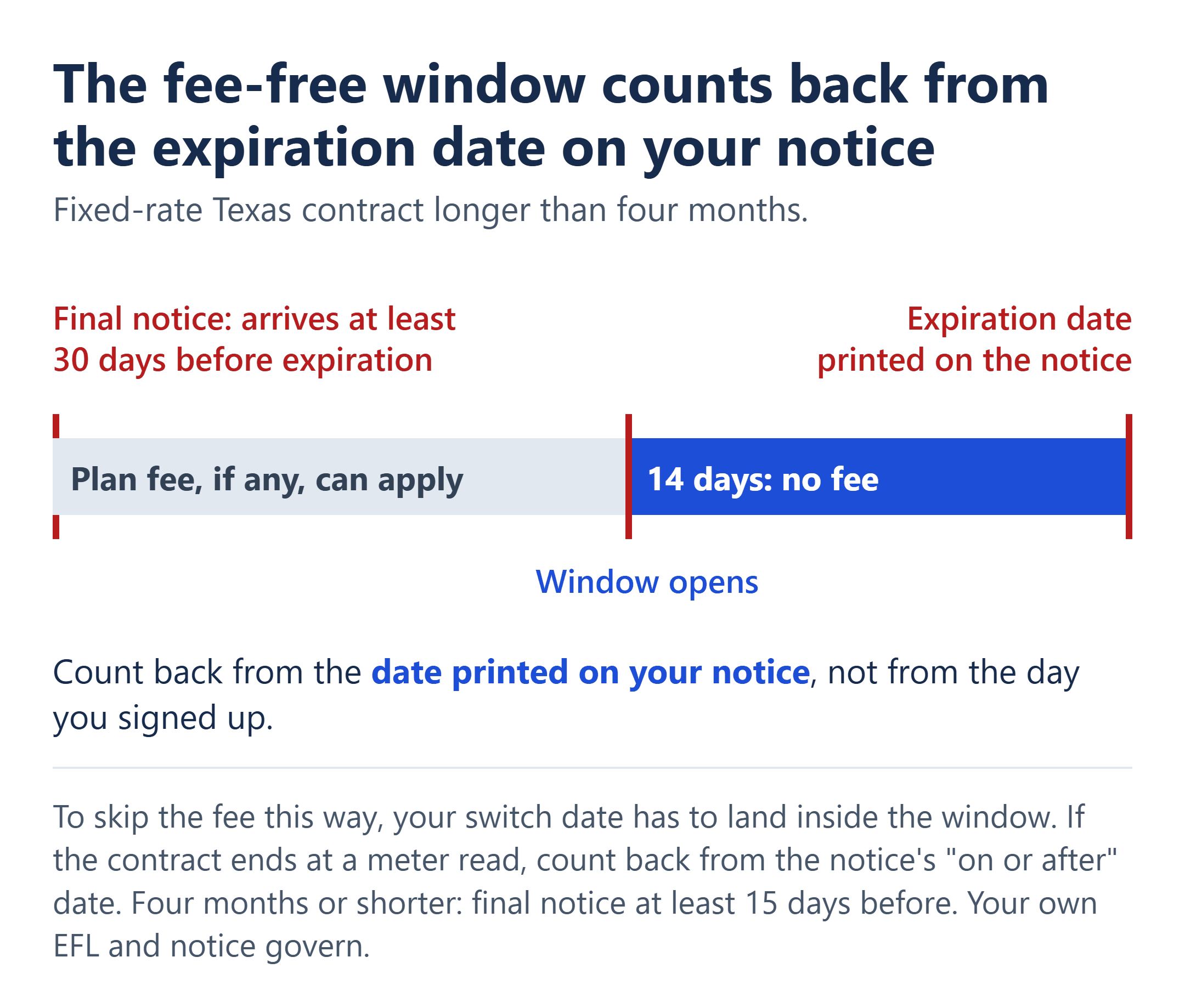
Use the date on the notice, not one you work out from the day you signed up. If you can’t find the notice, your provider has to give you your contract’s start and end dates when you ask. And if your original contract had no termination fee, the rule doesn’t require the bold sentence at all, because there’s no fee to lift.
Three Other Ways the Fee Doesn’t Apply
These are requirements in the same rule, not courtesies some providers offer.
Your contract has already ended
When a fixed-rate contract expires after the required notices and you haven’t picked a new plan, the provider must serve you on a default month-to-month product “that the customer may cancel at any time without a fee.” The rule’s definition backs it up: “A month-to-month contract may not contain a termination fee or penalty.”
Check the plan or product name on your latest bill rather than going by the calendar. And don’t treat month-to-month as a place to settle in. The same rule says its price “may vary between billing cycles.”
You’re moving out of the address on your contract
The rule says you’re “under no obligation to continue the contract at another location.” No early termination fee may be charged because of the move “if the customer provides a forwarding address and, if required, reasonable evidence that the customer no longer occupies the location specified in the contract.” Give the address, and keep proof of the move handy in case the provider asks. The rule doesn’t add any condition about moving outside a service area.
A move usually means closing the internet account at the old address too. If that’s Spectrum, check whether Spectrum prorates your final bill and which dates to check before you cancel. If it’s Xfinity, read up on the 10-day clock on returning Xfinity equipment.
Your provider sent a notice changing your contract’s terms
During a fixed-rate term, a provider can’t change your price beyond what your EFL already allows, and it can’t change the contract term. It can change other provisions, with written notice at least 14 days before the change takes effect. That notice has to say, in bold, that if the new terms aren’t acceptable you may terminate the contract, and that no termination penalty applies “for 14 days from the date that the notice is sent.” After those 14 days, the fee can apply again.
This window runs from the send date on that notice. It has nothing to do with your expiration date, so keep the two apart.
If None of Those Fit, Read the Fee Line on Your EFL
The rule requires every EFL to disclose “the length of term, minimum service term, if any, and early termination penalties, if any.” Use the EFL for the plan you actually enrolled in. If you don’t have it, your provider has to send your EFL, Terms of Service and Your Rights as a Customer document “upon a customer’s request, at any time free of charge.”
The rule doesn’t set the fee’s format, and the format decides whether waiting helps. Two published EFLs show the two kinds.
| Example EFL and its fee sentence | Does waiting lower it? |
|---|---|
| Green Mountain Energy, Pollution Free e-Plus 12 Choice (Oncor area, EFL dated 10/04/2026): “Yes. $150. Applies through the end of the contract term.” | No. A flat fee stays the same until a fee-free window. |
| Rhythm, Simply Bright 24 (Oncor area, EFL dated 07/19/2024, Version 9.0): “An early termination fee in the amount of $20 (twenty dollars) for each whole month remaining in the contract term will be assessed.” | Yes. The fee falls as fewer months remain. |
Find the matching sentence in your own EFL. If it states one amount, that’s your fee on any date before a fee-free window. If it charges per month remaining, your fee is that amount times the months left on the day you leave, counted the way your EFL words it. “Whole month” is Rhythm’s wording; your plan may count differently. If your EFL shows no termination fee, there’s nothing to plan around.
Leave Now or Wait for the Window? Use Your Own Bills
If you’re leaving for a cheaper plan rather than moving, the question is whether switching now beats waiting for the 14 days before your expiration date. Nobody can settle that for you ahead of time, because both sides come out of your own paperwork:
- What leaving costs on your planned date: the flat amount, or the per-month amount times the months remaining, as your EFL words it.
- What the new plan could save before your window opens: for each month between your planned switch date and the start of the window, the price difference between the two plans at your own monthly kWh.
Compare prices at your usage, not a headline rate. An EFL’s average price changes with usage, which is why every EFL lists it at 500, 1,000 and 2,000 kWh. Use the column closest to what your bills show.
If the fee is bigger than the savings, waiting costs less on those numbers; if it’s smaller, leaving on your planned date does. With a per-month fee, rerun it for a later date, because the fee side shrinks as months pass. That’s the part a single “months to break even” rule of thumb can’t capture.
What Counts Is the Day Your Service Moves
The window is about when your service actually moves to the new provider, not the day you fill out the enrollment form. When you enroll, the new provider submits either a standard switch or, if you ask for a specific date, a self-selected switch, and you must be told the approximate scheduled date (16 TAC §25.474).
So don’t take whatever date the switch lands on. This is what I’d say when enrolling:
“My current contract’s expiration notice shows [expiration date]. I’d like my service with you to start on [date], which is inside the 14 days before that. Can you request that date as a self-selected switch, and what scheduled start date are you showing for me?”
Check the date they give you. If it falls before the window opens, the fee on your EFL can still apply. If you’re moving instead, the paperwork matters more than the date: forwarding address in, proof of the move ready.
Two Lines on the Final Bill That Aren’t the Fee
An average or level billing balance. If you’ve been on an average or level payment plan, the gap between what you paid and what you used settles when service ends, separately from any termination fee. The rule requires the provider to credit or refund an over-payment, and lets it collect an under-payment, so the balance can be a charge or a credit. If the running balance isn’t on your bill, you can call your provider any time and ask for it. Look it up before you pick a date.
A deposit. If your old provider holds one, it must either transfer the deposit plus accrued interest to your new provider or refund it to you, less anything you still owe it.
Put the Bold Date on Your Calendar
When the final notice arrives, write the expiration date somewhere you’ll see it, and mark the day 14 days before it. Then pull up your EFL’s fee line and your last few bills. With those three things, you can tell whether you owe a fee today, how much it is, and the first day it goes away.
Sources and scope: the PUCT’s customer protection rules, 16 TAC §25.475 (contracts, notices and termination fees), §25.474 (switching), §25.478 (deposits) and §25.480 (level and average payment plans), plus the two EFLs linked above, as checked October 16, 2026. This applies to residential customers of retail electric providers in Texas’s competitive areas. Your plan’s own EFL and Terms of Service set your fee, and nothing here recommends a provider or plan.