
You’re on the Leave Google Fi screen, the new carrier’s SIM is already out of its envelope, and all that’s left is copying down your account number and port-out PIN. Before you hand those over, it’s worth knowing what your last two Fi statements are going to say.
Google Fi’s help center leads with the reassuring part: you can cancel at any time, and “there are no termination fees.” A few lines down, the same article adds that if you finance your device with Fi, “you’re charged the full balance when you close your account.”
So the final bill isn’t zero. With no fee in the picture, what you pay on the way out comes from your phone and your promo: the remaining phone balance comes due on your final bill, the monthly promo credits you haven’t received yet stop, and, if you’re still in your first months, an upfront “off now” discount can be charged back. On an Unlimited plan, you also pay the full billing cycle you leave in.
None of those amounts is the same for two subscribers, so there’s no single month that’s the right time for everyone to leave. What you can do is pull four values from your own account and add them up before the PIN goes to the new carrier.
The One Number That Decides What Leaving Fi Costs You
Of those lines, only one is money you won’t see again. The phone balance is still the price of the phone you’re keeping: Fi’s 24-month installments carry no interest or fees, so canceling doesn’t make the phone cost more. It moves the remaining payments onto your next statement after you cancel, charged to the card on the account.
The number that decides the cost of leaving early is the promo credits you haven’t collected yet. Fi’s phone deals pay part of the price back as monthly bill credits over 24 months, and the terms are blunt: cancel before the 24 months and “you will forfeit all remaining monthly credits.” Unused credits don’t roll over, and switching to another Fi plan before 24 months forfeits them too.
The value you give up is your monthly credit times the months left. For Subscriber A, worked through below, leaving after payment 10 puts $525.00 of phone balance on the final bill and forfeits $606.76 in credits; only the second figure is a loss.

Recent Fi deals actually run on two clocks. In Fi’s 2026 Pixel 11 Pro XL offer, the “$300 off now” part required staying active and in good standing for 120 consecutive days on the required plan, and pausing, changing or suspending the account voided it; miss that and “$300 will be charged to your Google Pay account.” The “$800 back over 24 monthly bill credits” part needed the account active for 24 months. The Galaxy Z Fold8 offer used the same 120-day and 24-month structure.
So a subscriber at day 130 owes no chargeback but still loses every remaining credit. Your own promo may set a different hold period or amount, so check its terms; Fi’s help center says only that canceling early “can result in a chargeback of the promotional value.”
Four Values to Pull Before You Start the Port
Each of these lives in your account or your promo terms, and each one changes the total.
- Remaining device balance. In the Google Fi app or website, Home → Manage plan shows how much you’ve paid and how much you have left to pay.
- Your monthly promo credit and the months left. Your promotion’s terms give the monthly amount; count the credits applied so far and subtract from 24. A deal can carry more than one monthly credit, and all of them stop: the Pixel 11 Pro XL terms, for example, paid $33.34 a month toward the device plus $10 a month for staying on Unlimited Premium, $43.34 a month in total. Add up every credit on your own deal.
- Days since activation, against your promo’s hold period. It was 120 consecutive days in Fi’s recent phone deals; read your own terms for yours.
- Plan type and the date your billing cycle ends. Flexible, or one of the Unlimited plans (Essentials, Standard, Premium). This decides what the last cycle costs.
If any of the four isn’t clear from the app, ask before you start the transfer:
Before I port my number out, can you confirm four things on my account: my remaining device balance, how many monthly credits are left on my phone promotion, whether I’ve met that promotion’s minimum active period, and the date my current billing cycle ends?
Add the Four Values, Then Run the Waiting Test
Your exit splits into what’s due and what’s lost:
- Due on the final bills: remaining device balance, plus the upfront discount if you’re still inside its hold period, plus the rest of the current cycle if you’re on Unlimited.
- Lost for good: monthly promo credit × months left.
The subscribers below are built on one Fi offer’s terms.
Subscriber A: month 10, then month 22
Imagine Subscriber A financed a phone at $37.50 a month for 24 months and gets the Pixel 11 Pro XL deal’s $43.34 in monthly credits ($33.34 device + $10 Unlimited Premium), well past 120 days. Leaving after payment 10 leaves 14 months: $525.00 of phone balance on the final bill (14 × $37.50) and $606.76 in credits forfeited (14 × $43.34).
The same subscriber leaving at month 22 would owe $75.00 (2 × $37.50) and forfeit $86.68 (2 × $43.34). The numbers moved; the rule didn’t.
What would leaving Google Fi cost you right now?
Enter the values from Manage plan and your promo terms. The defaults are Subscriber A at month 10.
If your result doesn't match your bill or notice, check the exact figure on Google Fi Help. Rules as of 2026-10-28
Show the breakdown and basis
—
—
Balance due = monthly installment × (24 − installments paid). Credits lost = all monthly credits × (24 − credits received).
Values are calculated in your browser and are not saved or sent anywhere.
Subscriber B: day 90 of the same deal
At day 90, Subscriber B is still inside the 120-day hold. On top of the balance and the forfeited credits, the deal’s $300 upfront discount is charged back. Waiting 30 more days removes that one line; after that, the credit loss keeps shrinking one month at a time.
Does waiting pay for you?
Each extra month on Fi collects one more credit, but you’re also paying Fi’s bill instead of the new carrier’s. Compare the credits still to collect over those months with (your Fi monthly bill − the new carrier’s monthly price) × the same months.
For Subscriber A at month 10, staying to the end collects $606.76. That’s worth it only if 14 more months on Fi cost less than $606.76 more than the new carrier would, and only your two plan prices can settle that. The phone balance stays out of the comparison: you pay it either way, all at once or monthly.
Unlimited or Flexible Decides Whether the Port Date Matters
On any Unlimited plan (Essentials, Standard or Premium), cancel before the cycle ends and you’re “charged the full amount of that billing cycle.” On Flexible, you get a credit for the unused days on a second bill about 30 days later.
That makes the port date a real choice on only one of the two. On Unlimited, porting near the end of the cycle wastes nothing, and porting early in it saves nothing.
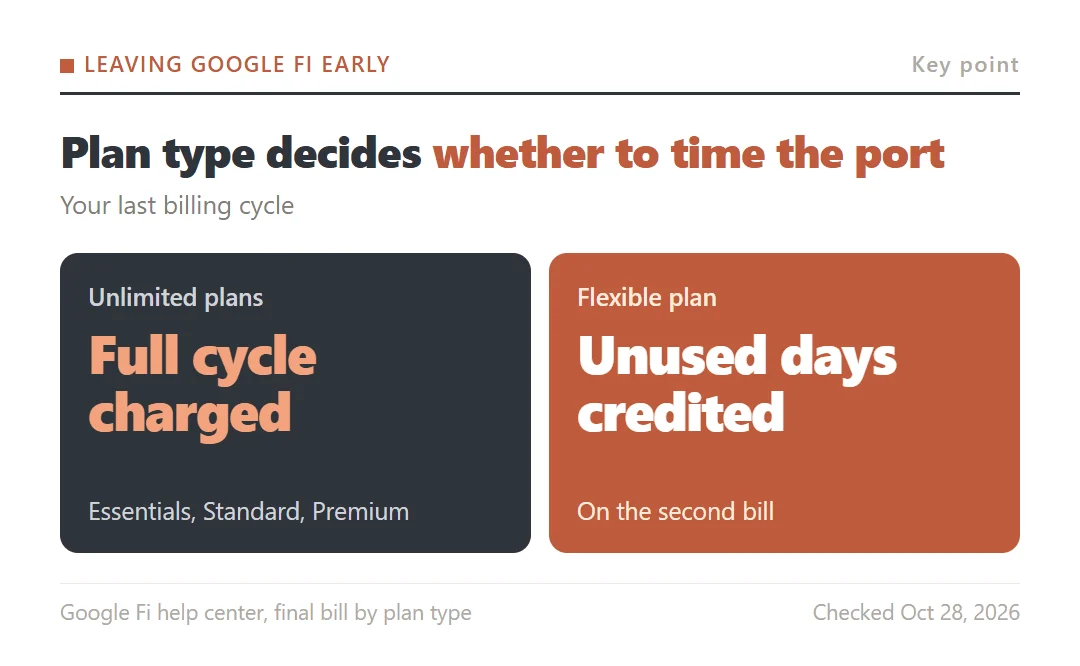
Take Subscriber C, porting on day 5 of a 30-day cycle. On Unlimited, C is billed for the full cycle. On Flexible, the 25 unused days come back as a credit on the second bill.
Paying the phone off first doesn’t save the credits: Fi warns that early payoff “may void any remaining promotional credits,” and the balance is due either way. Pausing isn’t a way out either, since device payments continue during a pause and the recent deal terms say pausing voids the promotion.
Porting Out Without Stalling the Transfer
- Clear any overdue balance. An amount owed from an earlier billing cycle must be paid in full before you can cancel. If you have one and want to port out, contact Google Fi support.
- On a group plan, members go first. The owner has to remove members before canceling, each member gets their own port-out info, and members typically have 60 days to leave, which can push back the owner’s final bills.
- Get your port-out info. Account → Manage plan → Leave Google Fi shows your account number and port-out PIN. The PIN is valid for 14 days; if the transfer takes longer, you may need to generate a new one.
- Give it to the new carrier. Include your name and service address exactly as they appear on your Fi account; they’re case-sensitive.
- Let the transfer finish. Fi service stays active until your number moves, which usually takes less than 24 hours, and then cancels automatically.
Your phone isn’t locked to Google Fi, so it goes with you. If you received it 15 days ago or less, returning it for a refund is still an option.
After the port, expect 2 final statements: one at the end of the current cycle, and a second up to 30 days later for delayed charges such as international use. Any eligible refund goes to your original payment method within 30 days after that second statement, and the whole process can take up to 90 days. Service credits are non-refundable.
Trade-in deals, phones financed through the Google Store, Fi device protection and Google One or YouTube Premium benefits follow their own terms, so check those separately; for everything above, Fi’s pages on canceling your Google Fi service and paying for your device in monthly installments are the official source.
Sources, checked October 28, 2026: Google Fi Help, Cancel your Google Fi service, Understand your final bills after you cancel Google Fi and Pay for your device with monthly installments; Google Fi Pixel 11 Pro XL promotion terms (offer ended October 6, 2026; terms kept for reference) and Galaxy Z Fold8 promotion terms (ended October 7, 2026).
Before Your November Statement Closes
I wouldn’t count on the “no termination fees” line to tell you what leaving costs. It’s accurate about the fee and says nothing about the phone deal, and the phone deal is where the money is.
If you’re weighing more than one exit, the same question at another carrier is in our look at leaving Verizon before your phone is paid off. And if the cheaper carrier you’re moving to is Mint, check what Mint Mobile charges after the intro period before you put its price into the waiting test.
Write down your remaining credits times the months left, set that next to what staying would cost, and then pick the port date. The sentence that prices an early exit isn’t in Fi’s cancellation article; it’s in your promo terms: “If you cancel service at any time before the 24 months, you will forfeit all remaining monthly credits.”
Photos and icons in this post are illustrations made for explanation; they do not show real places, products or people.