Before leaving Verizon, the number you’d probably check first is the remaining balance on your phone, on the Device Overview page in My Verizon. That number matters, but it isn’t really the cost of leaving. It’s money you already owe for the phone, and moving your number out only changes when it’s due.
The number that measures what you give up is on a different line of your bill: the device promo credit that sits next to the device payment charge, if your phone came with a promotion. Every credit you haven’t received yet goes away when the line is canceled. And Verizon’s Customer Agreement is plain about what porting counts as: “If you port a number from us, we’ll treat it as though you asked us to cancel your Service for that number.”
On a Verizon standard monthly line with a device payment agreement, moving your number out makes the remaining device balance due on your next bill (Missouri customers have the option of continuing to pay it over time), stops your monthly device promo credits and forfeits the ones you haven’t received, and keeps you billed through the end of that billing cycle. If you accepted a plan discount that came with a minimum term commitment, the discounts you’ve received are charged back, capped at a rolling 6 months. Whether the phone works on another carrier depends on when it was activated.
Paying the phone off first doesn’t rescue the credits, because Verizon stops them for an early payoff too. So the real question isn’t “do I have to pay it off?” It’s how many credits you’d be walking away from, and whether you’re keeping the phone.
This covers Verizon standard monthly (postpaid) consumer accounts, using Verizon’s Customer Agreement and support pages as checked October 16, 2026. Prepaid and business accounts follow different rules, and a separate early termination fee applies only if your line still has a minimum contract term that hasn’t been completed.
The Balance You Owe Sooner, and the Credits You Give Up
These are two different kinds of money, and they’re easier to judge apart.
The remaining device balance: owed sooner, not a fee
Verizon’s device payment FAQs say that if you disconnect a number with an active device payment agreement, “the remaining balance of that agreement is due on your next bill.” Missouri customers have the option of continuing to pay it over time. To see yours, sign in to My Verizon, open Device Overview, and select Manage for the phone.
You’d pay this balance whether you stay or go. Leaving moves its due date up; the balance itself is the same number either way.
The device promo credit: the value you lose
A promotion shows on your bill as a device promo credit alongside the device payment charge. Verizon applies the promo over your device payment term, 36 months on current agreements. According to its deals and promos FAQs, the credits stop if you cancel service on that line or pay off the device payment agreement early, and you “forfeit any remaining monthly device promotional credits.”
To price it for your own line, multiply your monthly device promo credit by the number of credits you haven’t received yet, which you can count from the months left on your device payment term. If there’s no device promo credit on your bill, this part is zero.
I’d keep the two figures on separate lines rather than adding them into one “penalty.” The balance was always yours to pay. The lost credits are the part that depends on timing, and only your own count of credits left says how big it is. There’s no month that’s right for every account.
| What happens when you port | Where to find your number |
|---|---|
| Remaining device balance: due on your next bill (Missouri customers can keep paying over time) | My Verizon, Device Overview, Manage |
| Device promo credits: they stop, and credits you haven’t received are forfeited | Device promo credit line on your bill, plus months left on your term |
| Plan discount with a term commitment: discounts you received are charged back, capped at a rolling 6 months | Terms of the discount you agreed to, and the discount line on your bill |
| Final billing cycle: you’re charged through the end of it | Billing cycle end date on your bill |
| Watch, tablet or hotspot lines: they keep billing until you cancel them, if you move your last phone line | Lines listed on your account |
A Discount With a Term Commitment Can Come Back as a Charge
The third item only applies to some accounts. Verizon’s port-out FAQs say that if you agreed to an optional promotional monthly discount with a minimum term commitment, moving your line to another carrier before the term ends voids that agreement, and “you are required to repay the monthly discounts received so far (capped at a rolling maximum of 6 months).”
Read that carefully. It’s the discounts you actually received, up to that cap, not a flat six months. If none of your discounts carries a term commitment, this is zero. Verizon says the device balance and any discount chargeback will both be clearly itemized on your final bill.
It also matters if you’re offered a discount to stay. Read its terms before you accept. If it comes with a term commitment, it’s the kind that can be charged back if you leave before the term ends. And if a new carrier offers to cover your balance, the Verizon amounts above are what that offer has to cover.
Your balance, credits left and discount terms are all specific to your account. If any of them is unclear from My Verizon and your bill, this is the question I’d put to Verizon before porting:
“Before I move my number, can you confirm the remaining device balance on this line, how many monthly device promo credits are still left on it, and whether any plan discount on my account comes with a minimum term commitment? If one does, how many months of that discount have I received?”
Whether the Phone Comes With You Depends on Its Activation Date
If your new carrier is giving you a new phone and you’re not keeping this one, the lock doesn’t matter. The remaining device balance is still due on your next bill (Missouri customers can keep paying over time).
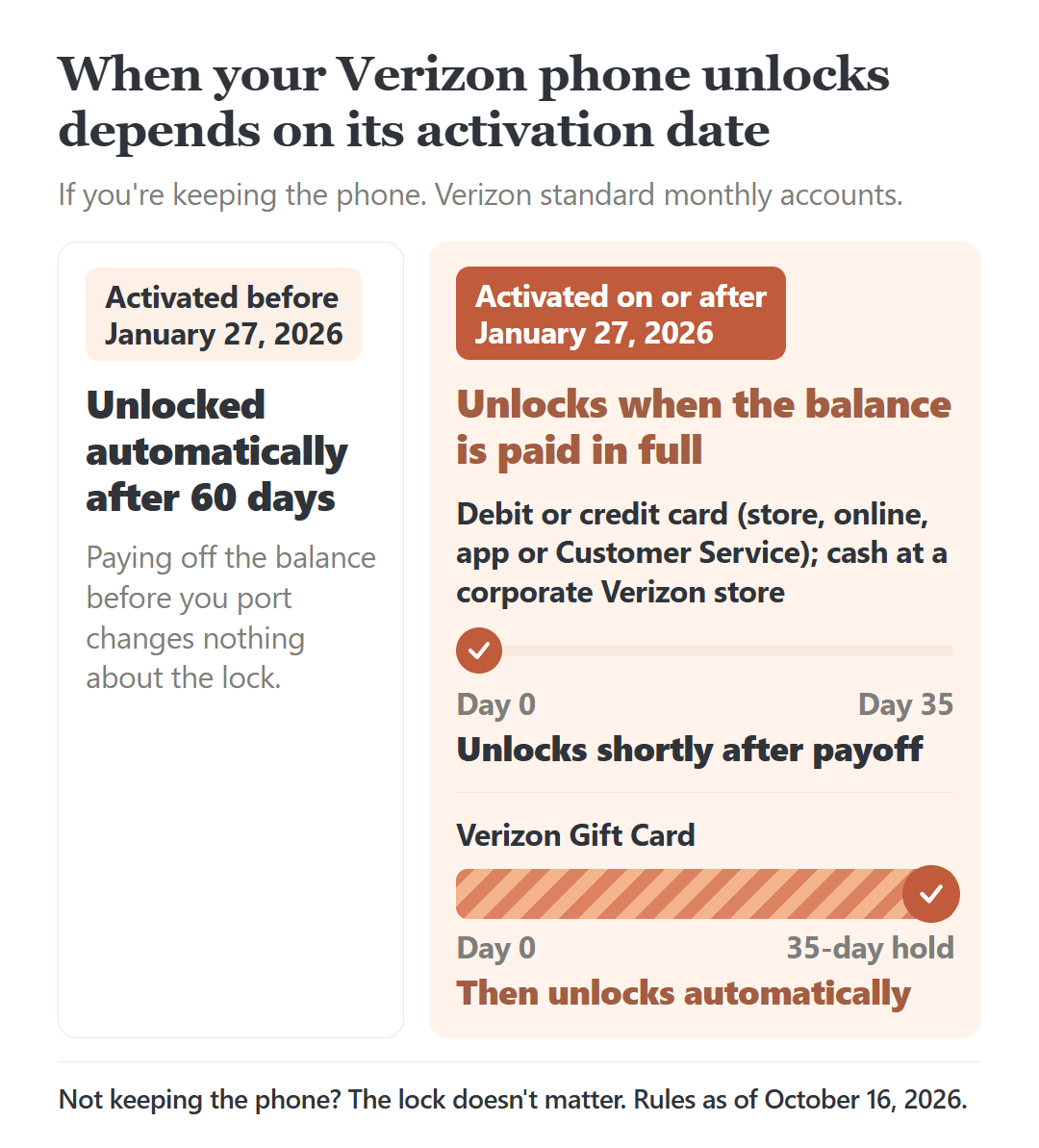
If you’re keeping the phone, find its activation date. These are Verizon’s unlock rules as of October 2026, from its Device Unlocking FAQs and Device Unlocking Policies.
Activated before January 27, 2026
Verizon-bought devices with standard monthly service activated before that date unlocked automatically after 60 days. Paying off the balance before you port changes nothing about the lock, and Verizon says that once a device is unlocked, it will never re-lock it.
Activated on or after January 27, 2026
The phone unlocks automatically when the device balance is paid in full. If you want to keep it, pay it off before you port, and skip the one payment method that delays the unlock:
- Unlocks shortly after payoff: a debit or credit card at a Verizon store, online, in the My Verizon app or with Customer Service. Cash works at a corporate Verizon store.
- 35-day hold, then unlocks automatically: a Verizon Gift Card.
Verizon’s FAQ ties the 35-day hold to Verizon Gift Cards. If you bought the phone within the last 30 days, Verizon says paying cash in a store is the only way to trigger the automatic unlock. One more reason to pay off only once you’ve decided to leave: an early payoff stops any remaining promo credits on its own, whether or not you port afterward.
Check before you port. Put a non-Verizon SIM in the phone. A locked device shows “SIM Not Supported,” though the message may vary by manufacturer. If you’ve paid in full and it still looks locked, one reason Verizon gives is that your payment hasn’t posted to your account yet. An unlocked Verizon phone may still have limited functionality or not work at all on another carrier’s network, so run your new carrier’s compatibility check too.
Moving the Number Without Canceling It Too Early
Verizon says it doesn’t charge a specific fee for moving your number to another carrier. The costs come from what the move does to the line, which is everything above. On timing, the Customer Agreement says that if you cancel service, “you’ll remain responsible for all fees and charges through the end of that billing cycle,” and your Verizon account stays open until your last line has been moved and the final bill issued. Note your billing cycle end date so you know what that final bill will cover.
Then run the move in this order:
- Pay off the phone first only if the activation-date check says you need to, with a card or cash rather than a Verizon Gift Card, and confirm the unlock.
- Turn off Number Lock. Verizon says it must be disabled before the number can move.
- Generate a Number Transfer PIN in My Verizon. It expires after 7 days, so give it to your new carrier right away.
- Let the new carrier move the number, and don’t disconnect Verizon first. If you do, you’ll have to reactivate your Verizon number before the new carrier can move it.
- If this was your last phone line, cancel any watch, tablet or hotspot lines. Otherwise they keep billing.
When the final bill arrives, look for the itemized device balance and any discount chargeback. If a charge keeps showing up after that and you can’t tie it to anything above, here’s how to ask for a refund, dispute a charge after canceling, and stop the next one.
What I’d Settle Before Giving Anyone the Transfer PIN
The PIN feels like paperwork, but once the number moves, Verizon treats the line as canceled and the cancellation rules above apply. So I’d settle two things first, while staying is still an option.
First, the credit math: your monthly device promo credit times the credits you haven’t received. That’s the figure to set against whatever the new plan saves you, not the balance on Device Overview. Second, if you’re keeping the phone, its activation date, and a way to pay it off that doesn’t trigger the 35-day hold if the date calls for one.
It’s also worth pricing the new plan past its first months. If it’s an introductory price, check what it costs once the intro ends before you compare it with the credits you’d give up. For one prepaid example, see what each Mint Mobile plan costs to renew after the intro period.
Sources and scope: Verizon’s Customer Agreement (updated June 16, 2026), device payment FAQs, device deals and promos FAQs, Device Unlocking FAQs and Policies, and port-out FAQs, as checked October 16, 2026. This applies to Verizon standard monthly consumer accounts. Your own account and bill set your amounts, and nothing here recommends a carrier or plan.