
For years the dependent care line on a benefits enrollment form topped out at $5,000 per household. Starting with the 2026 tax year the federal limit is $7,500, and because the law sets a flat amount with no inflation adjustment, $7,500 is the number again as you choose for 2027.
The change that doesn’t show up on the form is on the tax side. The child and dependent care credit got bigger for 2026 too: under the 2025 rules a family with income above $43,000 got a 20% credit, and now a married couple filing jointly with income between about $43,000 and $150,000 gets 35%.
So the answer has two parts. $7,500 is a ceiling for your whole household’s tax return (both spouses’ elections combined, $3,750 if you’re married filing separately), not a target: elect what you’ll actually spend on qualifying care next year, because money you don’t use is forfeited. And before you pick the amount, run the FSA against the credit with your own income and number of children, because every FSA dollar shrinks the credit and the winner changes from family to family.

Working Out What Your Household Can Put In
Start with the number your employer’s plan allows, not the federal one. The plan sets what you can actually elect, and it can be lower than $7,500.
One reason it can be lower is a separate limit for highly compensated employees. For 2026, the IRS test was pay over $160,000 in 2025 or being a 5% owner, and your enrollment materials will say which line applies for 2027. One large employer’s 2026 plan, the University of California’s, caps those employees at $3,200 while everyone else can elect $7,500.
Then add your spouse. If you both have a dependent care FSA at work, the two elections together should stay within $7,500 on a joint return. Anything over that becomes taxable income, so decide between you which of you elects how much before either of you submits.
Which Care Costs Will Count Next Year
The election should match care that will qualify, and three rules can make that number smaller than your total child care bill.
- Under 13, counted by the day. Care counts only while your child is under 13. IRS Publication 503’s own example: a child who stops qualifying on September 16 counts only through September 15, so a child turning 13 in 2027 needs a smaller election.
- Care so you can work. The care has to let you and your spouse work or look for work.
- The lower earner’s pay. The tax-free amount can’t exceed the earned income of the lower-earning spouse. If one spouse has no earned income, the tax-free amount is generally $0, with limited exceptions.
Payments to your spouse, to the child’s parent, or to your own child under 19 don’t count. Whatever you pay for, whether daycare, preschool, before- and after-school care or summer day camp, check it against the rules in IRS Publication 503 before you add it to the estimate.
Getting the estimate right matters because money left in the account is forfeited. If your plan has a grace period, it can run up to 2½ months after the plan year for new expenses; one employer’s 2026 plan runs it through March 15 and takes claims until April 15, 2027. The carryover some health FSAs offer doesn’t apply to dependent care FSAs.
If you also have a health FSA, that’s a separate account with its own year-end rules, and it’s worth reading how health FSA use-it-or-lose-it deadlines work before you fill in that box too.
Does the FSA or the Credit Save Your Family More?
The two ways to save come from different places. FSA money skips federal income tax plus Social Security and Medicare tax, which is 7.65% for most employees; the credit gives back a percentage of up to $3,000 of care costs for one child or $6,000 for two or more.
The catch is that every dollar you run through the FSA is subtracted from that $3,000 or $6,000. A $7,500 election wipes the credit base out entirely, even for a family with two kids.
The credit rate depends on adjusted gross income, and the steps sit at different incomes on a joint return:
| Credit rate | Joint return | Other filers |
|---|---|---|
| Starts at 50%, steps down | Up to about $43,000 | Up to about $43,000 |
| 35% | About $43,000 to $150,000 | About $43,000 to $75,000 |
| Steps down from 35% | $150,000 to about $206,000 | $75,000 to about $103,000 |
| 20% | Above about $206,000 | Above about $103,000 |
With those pieces, the comparison is two lines:
FSA value
your election × (federal tax bracket + 7.65%)
Household 1 below, 12% bracket, full FSA7,500 × (12% + 7.65%)= about $1,474
Credit value
credit rate × ($3,000 or $6,000 − your FSA election)
Household 1 below, two kids, no FSA35% × 6,000= about $2,100
Add your state rate to the FSA side if your state also exempts the money. On the credit side, what’s left of the $3,000 or $6,000 can’t go below zero or above the care costs left after the FSA.
Add the two for the amount you’re considering and pick the bigger total. If one of you earns more than the Social Security wage base ($184,500 in 2026), that earner’s FSA dollars save only the 1.45% Medicare part of payroll tax, so use that instead of 7.65%. The credit also can’t exceed the federal tax you owe; it doesn’t come back as a refund.
I’ll be honest: the $7,500 line reads like an invitation to max it out, and for some families that’s the more expensive choice. The three households below show the winner switching sides.
Household 1: two children, $95,000 joint income
A married couple filing jointly with adjusted gross income of $95,000 (the 12% federal bracket on 2026 brackets), two children under 13 all year and $14,000 of eligible care, both working and both under the wage base; federal tax only, no state tax, and they owe enough tax to use the full credit.
A full $7,500 FSA leaves no credit base, so the credit alone wins by about $626, and a split such as $3,000 in the FSA plus the credit on the remaining $3,000 (about $1,640) lands in between.
FSA or the credit: which saves more at your numbers?
Defaults are Household 1 above. Federal tax only; assumes both spouses work and you owe enough tax to use the credit.
If your result doesn't match your bill or notice, check the exact figure on the IRS. Rules as of 2026-10-27
Show the breakdown and basis
—
FSA value = election × (bracket + payroll rate). Credit = credit rate × what is left of the $3,000 or $6,000 base after the FSA, capped at care costs left. Federal tax only.
Values are calculated in your browser and are not saved or sent anywhere.
The same household with one child
Same couple and income, but one child under 13 and $9,000 of care. Credit only: 35% × $3,000 = about $1,050; a full FSA is still about $1,474, so the FSA wins by about $424. Nothing changed but the number of children, which halves the credit base.
Household 2: two children, $210,000 joint income
Another couple: married filing jointly, adjusted gross income of $210,000 (the 22% bracket on 2026 brackets), two children under 13 and $14,000 of care, each spouse earning under $184,500; federal tax only. The credit rate at that income is 20%, so credit only is about $1,200, while a full FSA is $7,500 × 29.65% = about $2,224, a win of about $1,024 for the FSA.
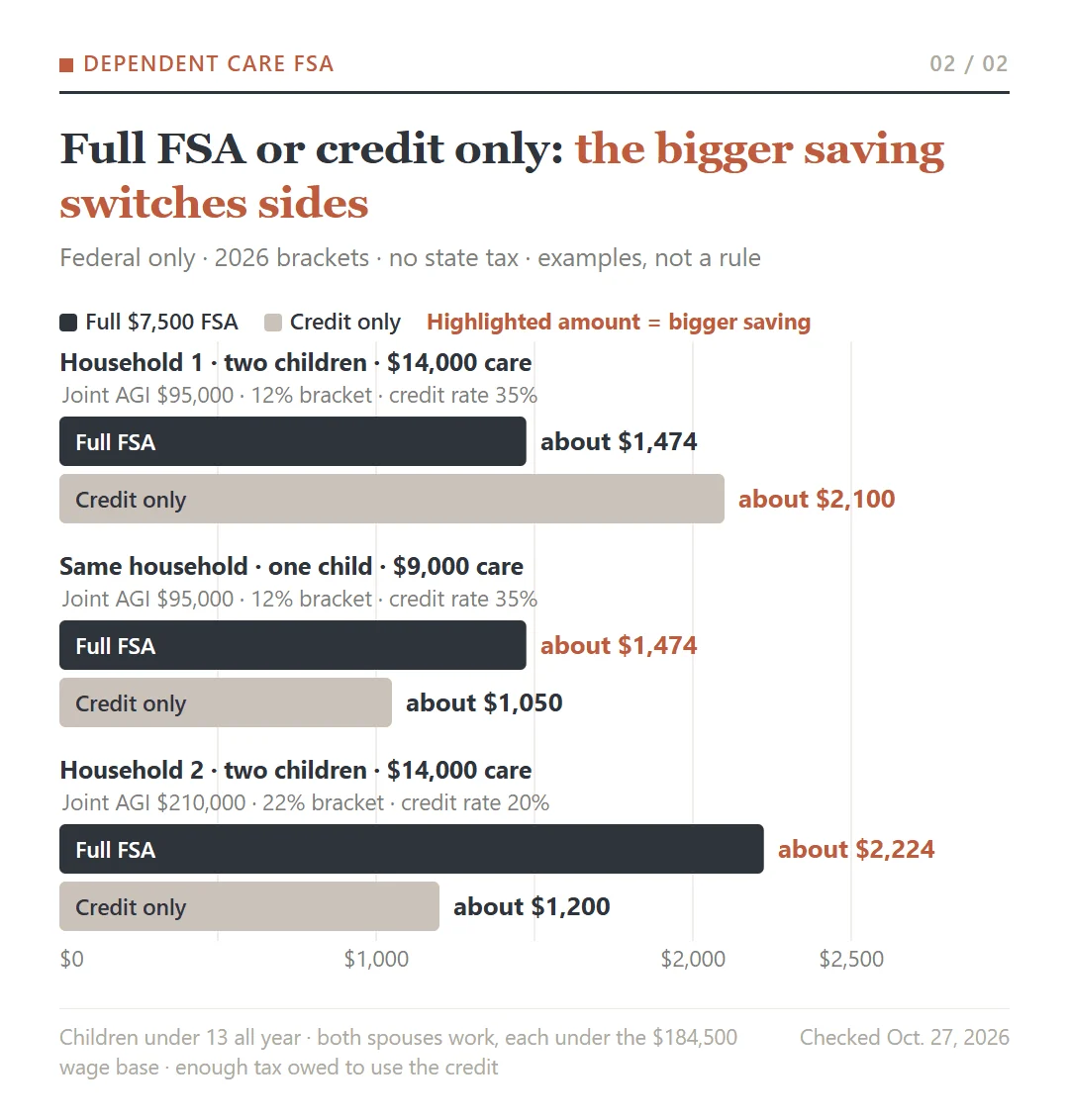
None of these is a line to copy. Your bracket, your credit rate and the number of children in care move both sides, and this is a comparison of federal rules, not advice for your own return.
Your Election Locks When Enrollment Closes
The amount is set during open enrollment for the coming plan year, which for most people choosing now is the 2027 calendar year. After that it generally can’t change mid-year except for qualifying events.
One exception is specific to dependent care: if a provider who isn’t a relative changes what they charge, your plan may let you change your election to match. Many plans also don’t roll your dependent care election into the next year, so check whether yours needs a new election every enrollment period.
Some plans pay a claim only up to what you’ve contributed so far and hold the rest until later paychecks, which matters if your biggest care bills come early in the year. If your enrollment materials don’t answer the rest, this is the question to send HR or the benefits administrator:
Before I enroll: what is the 2027 dependent care FSA maximum for my pay level, does the plan have a grace period and a claims deadline, and do I need to make a new election every year?
Your Care Estimate Is the Real Election
Before you submit, write down three numbers: your plan’s 2027 maximum, what your spouse is electing, and what you’ll actually pay a qualifying provider next year, trimmed for a 13th birthday or a summer gap. Then run the two lines once at the full amount and once at zero.
The bigger total tells you how much to elect; the federal $7,500 only tells you where to stop. That’s the number to type into the enrollment box, whether it ends up at $7,500, somewhere below it, or at zero because the credit does more for your family.
Sources, checked Oct. 27, 2026: IRS Publication 15-B (2026); 26 U.S.C. § 129 and 26 U.S.C. § 21 (Cornell LII); IRS, One, Big, Beautiful Bill provisions; IRS Publication 503 (2025); IRS Notices 2005-42 and 2013-71; Treas. Reg. § 1.125-4; IRS Topic 751; IRS 2026 inflation adjustments; example employer plan: University of California 2026 Dependent Care FSA summary. Households above use 2026 federal brackets and leave out state tax.
Photos and icons in this post are illustrations made for explanation; they do not show real places, products or people.