Most people who cancel a home warranty in the middle of the term expect one question: how much comes back. Choice Home Warranty’s national agreement has a sentence for the other direction. “If our Service Costs are greater than the Agreement Fees to be refunded, You shall pay us the lesser of” two amounts the agreement then spells out.
So under that contract, canceling can end with a bill instead of a refund. That clause is Choice’s, and nothing here says other companies write the same thing. What it does show is that the refund is not a share of what you paid. It’s a subtraction, and the numbers in it are yours.
At the four national providers whose terms are quoted below, a mid-term refund is the agreement fees you already paid that cover the rest of the term, minus the service and claims costs the company has already incurred on your account, minus an administrative fee. It isn’t “the unused months,” and no honest article can turn it into a percentage. It can come out to zero.
The one exit with no math at all is letting the term end and stopping the renewal, so find your term end date before you do anything else. This covers a plan you bought directly for your own home; plans bought as part of a home sale can be written under separate terms. Every clause here is quoted from the provider’s own published terms, checked October 16, 2026.
Start With What You Already Paid, Not the Months Left
Read the base phrase in each contract closely, because it’s narrower than it sounds. American Home Shield refunds, after the first 30 days, “a prorated refund of any agreement fees you paid for the rest of the agreement term.” Choice uses “the Agreement Fee paid for the unexpired term,” and Home Warranty of America uses “the total purchase price paid for the unexpired term.”
All three point at money you have already handed over that covers time you haven’t used yet. That’s the same thing as the months left on the calendar only if you paid for those months up front.
And paying up front is a choice. American Home Shield’s FAQ puts it this way: “Yes, you can customize your payment options to be billed either monthly or annually. Please note that no additional finance fee applies for monthly billing.” If you pay month to month, your payments have generally covered the months you’ve already had, so there may be little or nothing covering time ahead for the proration to work on, while the deductions still apply. That describes what the base is made of, not what your account holds. Your billing history will tell you which situation you’re in.
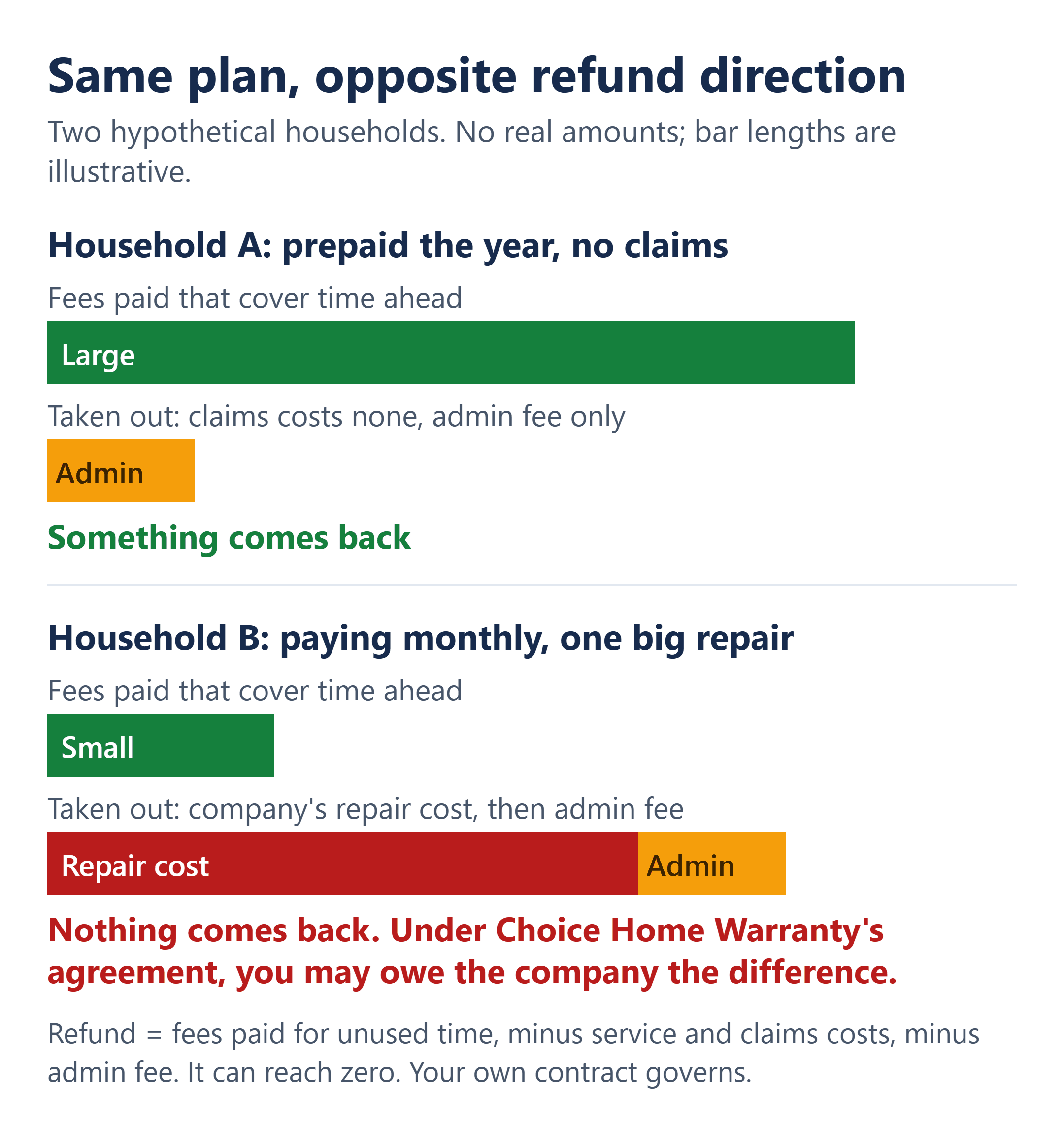
Hypothetical Household A: prepaid the year, no claims
Here’s a hypothetical, not a real account, and without dollar figures, because two of the inputs are numbers only the provider can state. Household A paid a full year up front, is a few months in and has never placed a claim. A real part of what A paid covers months ahead, so there is a base to prorate. Nothing has been spent on A’s repairs, so the only thing coming out is the administrative fee.
Hypothetical Household B: paying monthly, one big repair
Household B is the same number of months in, pays monthly and had a compressor replacement approved this term. B’s payments have mostly covered months already used, so the base may be small or nothing. The company’s cost of that compressor is then subtracted. Under Choice’s agreement, if those costs are greater than the fees to be refunded, B could owe the company money.
Same kind of plan, same point in the term, and the result doesn’t just shrink between A and B. It can change direction.
The Deduction That’s Bigger Than Your Service Fees
“Minus any service costs” sounds like the small fee you paid each time a technician came out. It isn’t. Choice’s agreement defines it: “Service Costs refer to any costs incurred by Us for access, diagnosis, repair and/or Replacement during the term of Your Fixed-Term Plan or, in the case of Monthly Plans, each respective 12 month period beginning on the Order Date or Your coverage effective date (whichever is later).”
That’s the company’s own cost of the work, replacement included. One approved major repair can use up the entire refund, which is why the household with the worst year of breakdowns can get the least back.
The per-visit fees are a separate pot of money, and they stay spent. American Home Shield says, “You can expect to pay a non-refundable service fee of either $100 or $125 each time you place a service request for a covered item.”
What I’d watch for here is that this is the one number you can’t work out at home. The company knows what it paid contractors on your account; you usually don’t. Ask for it before you agree to anything.
“Full Refund Within 30 Days” Comes With a Condition
All four providers checked have a 30-day window, and none of them makes it a plain full refund. Three subtract what they’ve already spent on you. The fourth, Home Warranty of America, pays in full only if you haven’t made a claim. After 30 days, the administrative fee changes form from company to company.
| Provider | First 30 days | Fee after 30 days |
|---|---|---|
| American Home Shield | Fees back “minus any service and claims incurred” | “up to one month’s payment (where permitted by law)” |
| 2-10 Home Buyers Warranty | Same wording as AHS, with 2-10’s name | Same as AHS |
| Choice Home Warranty (national agreement) | Paid fee back “less any Service Costs,” counted from the Order Date | “the lesser of: $50, or such amount as is permitted by law” |
| Home Warranty of America (homeowner plans) | Full refund only if “you have not made a claim” | “the lesser of $30 or 10% of the total purchase price” |
Choice adds one more detail that moves the number. Its proration runs on the fee paid for the unexpired term “at the end of the month of which You cancelled,” so the month you cancel in isn’t part of what comes back.
So if a page quotes you one cancellation fee, it’s quoting one company’s contract. Find the sentence in yours.
Your State’s Version Can Change the Fee
The same company can use a different administrative fee depending on where you live. Choice’s agreement carries “Terms may vary in different states” at the top, with state pages linked, and 2-10’s cancellation page says “Terms may vary by state.”
Choice’s California agreement shows how much that can matter. There, canceling within 30 days of receiving the agreement brings back the full Agreement Fee if “We have incurred no Service Costs.” After that, the refund is pro rata, “less any Service Costs incurred by Us, less an administrative fee of up to 10% of the Agreement Fee or $25, whichever is less, unless otherwise precluded by law.” That’s a different cap from Choice’s national $50.
California is one example, not a list. Open the version for your own state on your provider’s site and read its cancellation section. Everything quoted here is contract language the providers published themselves, not a description of what any state law requires.
If the Term Ends Soon, Stopping the Renewal May Be Simpler
Waiting out the term skips the whole subtraction, so check how far off the end date really is. American Home Shield says “The homeowner home warranty plan is 13 months long, which includes a 30-day waiting period and 12 months of coverage,” and that after the initial term, “your plan will renew for consecutive 12-month terms.” Count twelve months from the day you signed and you’ll put your first renewal a month too early.
Monthly plans have their own clock. Choice’s agreement says a monthly plan renews automatically each month at the then-current rate “unless you notify us in writing 30 days prior to the end of your monthly-plan agreement term.” That’s written notice with a lead time, not a phone call on the last day. Your own agreement sets the method and the notice period. If a charge still shows up after you’ve given notice, there’s a walk-through of how to get a refund and stop the next charge after you’ve canceled.
If canceling now is still the better move, you can. American Home Shield answers, “Yes, you can cancel your AHS plan at any time,” and lists 855.822.7419 for cancellations. Use the cancellation contact in your own agreement.
Get the Provider’s Numbers Before You Say Yes
Have your billing history open and your state’s agreement on screen. The agent can quote a figure in seconds. Without the inputs, you can’t tell whether it’s the figure your contract produces. Here’s what I’d ask before agreeing to process the cancellation:
“Before you cancel the plan: how much of what I’ve paid covers the rest of this term, what service and claims costs have you recorded on my account, and what administrative fee applies under the agreement for my state? Is the result a refund, zero, or a balance I would owe?”
Then do the subtraction yourself: the prepaid amount, minus the costs they named, minus the fee in your contract. If it lands at zero or below, canceling now brings nothing back, and giving notice so the plan ends at its term date may be the cleaner exit. If the prepaid amount is larger than the other two, canceling now returns the difference.
Two Things to Write Down Before You Dial
Your term end date, and the company’s figure for what it has spent on your account. The first tells you whether you need a refund at all. The second tells you whether there will be one. Get both, then read your own agreement on American Home Shield, 2-10, Choice or Home Warranty of America.
If a device protection plan is also on your list of bills to trim, the refund logic there is different, and how AppleCare+ refunds work when you cancel after an upgrade or trade-in walks through it.
Sources and scope: cancellation terms published by American Home Shield (FAQ), 2-10 Home Buyers Warranty (help center), Choice Home Warranty (national user agreement and California agreement) and Home Warranty of America (30-day money-back guarantee page), all checked October 16, 2026. This covers plans bought directly by homeowners from these four providers; your own contract governs, and nothing here recommends a provider.