Here’s a number that catches a lot of Minnesota households off guard: for the 2026–27 season, a family of four with household income up to $73,969 a year is under the income line that unlocks the Cold Weather Rule’s strongest payment protection. For three people, the line is $62,134.
That line only helps if you do one thing first. The rule is often summed up as “they can’t shut off your heat in winter,” but Minnesota Power’s own page puts it plainly: the Cold Weather Rule does not forbid winter shut-off.
Minnesota’s Cold Weather Rule runs October 1, 2026 through April 30, 2027, and it doesn’t stop a gas or electric shutoff by itself. You’re protected only if you set up a payment plan with your utility and keep making the payments.
If your household income is at or below the 2026–27 line and your utility is a public utility such as Xcel Energy or CenterPoint Energy, the utility can’t require more than 10% of your household income toward current and past heating bills, and it can’t charge a deposit or late fee while you’re on the plan. Above the line with a public utility, you still have the right to a plan, just without that 10% ceiling. With an electric co-op or municipal utility, the plan protection uses the same income line, but the law sets no 10% ceiling.
This applies when natural gas or electricity is your home’s primary heat and the account is in your name, renters included. Some older articles still show an October 15 to April 15 window; the current law says October 1 through April 30.
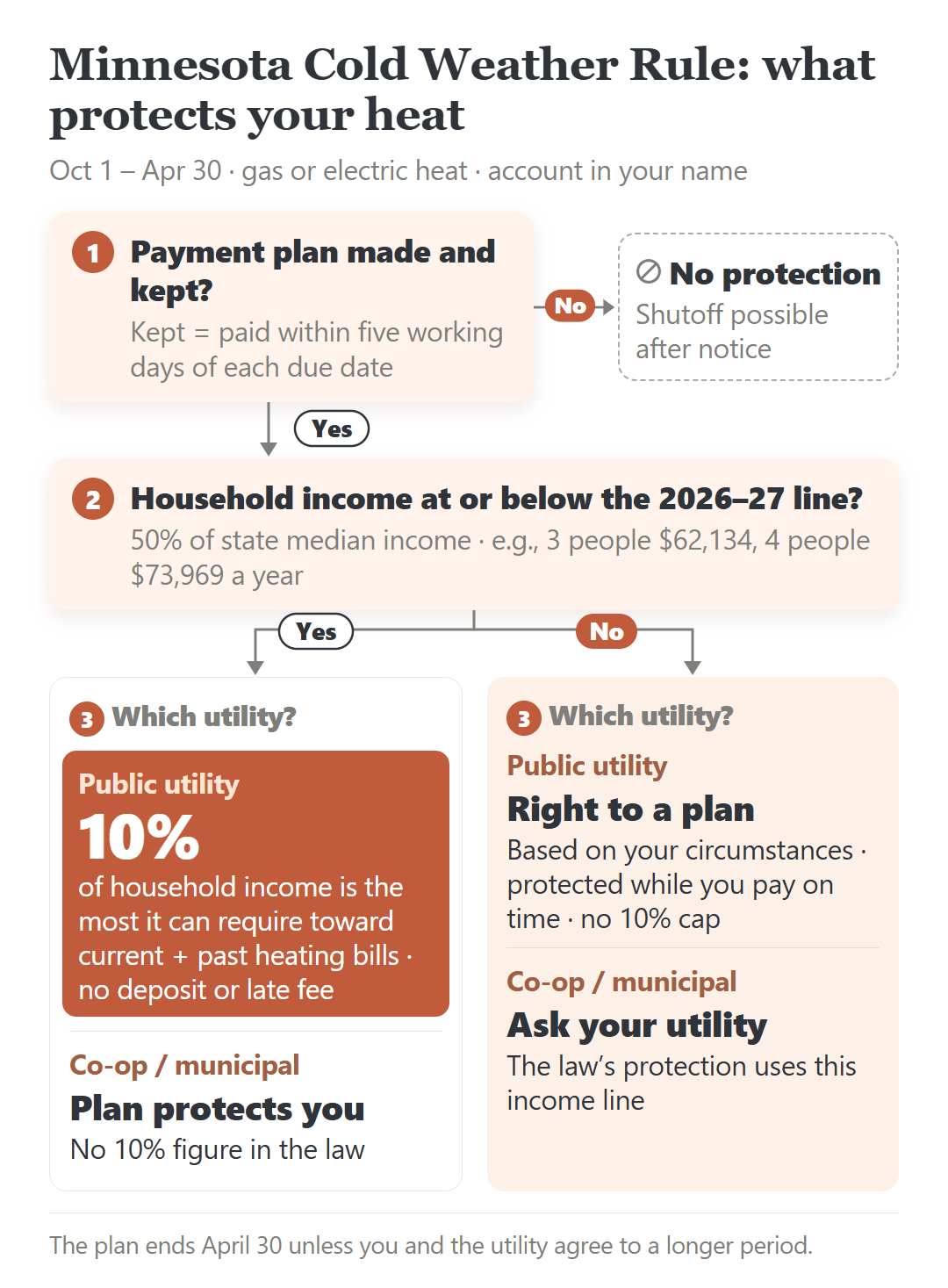
First, Check That the Rule Covers Your Account
Two things have to be true. Natural gas or electricity has to be the primary heat source for the home you live in, and that counts electricity needed to run a gas furnace. And the gas or electric account has to be in your name. Renting doesn’t disqualify you; an account in your landlord’s name does.
You don’t have to be caught up by October 1 to ask for protection. You can set up a Cold Weather Rule plan at any point during the season, including after a disconnection notice arrives.
Propane, fuel oil and wood aren’t covered (if that furnace runs on electricity, the PUC says to apply with your electric company), and if heat is included in your rent, the rule doesn’t apply to you as a customer. It’s also a rule about utility shutoffs, not evictions.
Where Your Household Lands Against the 2026–27 Income Line
The line is 50% of state median income, and Minnesota’s Department of Commerce publishes the figures by household size. Compare the line with your household’s combined annual income, meaning everyone in the household, not just the name on the account.
| Household size | 2026–27 annual income line |
|---|---|
| 1 person | $38,464 |
| 2 people | $50,299 |
| 3 people | $62,134 |
| 4 people | $73,969 |
| 5 people | $85,804 |
| 6 people | $97,639 |
Use the annual figure. The full table, including larger households, is on the Department of Commerce’s Energy Assistance income guidelines page.
Energy assistance you receive doesn’t count as income. And if your household gets energy assistance, you’re automatically eligible on income, so the utility can’t require other proof.
Otherwise, the utility may accept your signed statement that you’re under the line, or ask for something like your most recent tax return or the last two months of pay stubs for each person who works. It’s worth pulling those together before you call.
What a Public Utility Can Require Each Month, With Your Own Numbers
If you’re at or below the line and your heating utility is a public utility, the math is short: your household’s annual income × 10% ÷ 12 is the most the utility can require each month toward current and past heating bills combined.
That’s a ceiling, not a bill. A plan can come in lower, and you can agree to pay more if you choose. The examples below are hypothetical households, not real customers, using the 2026–27 line.
Household A and Household B: same size, different side of the line
Household A is a hypothetical family of three earning $36,000 a year, heated by a public utility. $36,000 is under the $62,134 line, so the utility can’t require more than $3,600 a year, or $300 a month, toward current and past heating bills, and there’s no deposit or late fee while they’re on the plan.
Household B is the same hypothetical family of three, with the same public utility, earning $68,000. That’s above $62,134, so there’s no 10% ceiling. They still have the right to a payment plan that takes their circumstances into account, and they’re protected while they pay on time under a plan the utility accepts. The deposit and late-fee bar doesn’t apply to them.
Household C: a middle income still under the line
Household C is a hypothetical family of four earning $70,000, also with a public utility. $70,000 is under $73,969, so the most the utility can require is $7,000 a year, about $583 a month. That’s why I’d check the table even if “low income” doesn’t sound like you.
If your heat comes from an electric co-op or a municipal utility
Co-ops and municipal utilities follow a parallel Minnesota law with the same October 1 to April 30 season, the same income test and the same protection while you keep a plan. The difference: the 10% ceiling in the law applies to public utilities, not to co-ops or municipal utilities. If hypothetical Household A were on a co-op, its plan would be worked out with the co-op directly, so ask what it will accept.
If your gas and electric come from two different companies, ask each one how it applies the 10% before you agree to an amount.
Setting Up the Plan Is One Call. Keeping It Is the Hard Part
Call your gas or electric company and ask for a Cold Weather Rule payment plan. The utility provides the forms. If your service has already been shut off, the utility must use reasonable efforts to restore it within 24 hours of an accepted payment plan.
Here’s a way to open the call:
“I’d like to set up a Cold Weather Rule payment plan on my [gas/electric] account. There are [number] people in my household and our combined annual income is about [$amount]. Can you send me the forms, and tell me what monthly payment you’d accept toward my current and past heating bills?”
Once the plan is in place, the definition that matters most is “on time.” Under the law, a payment counts as reasonably timely only if it’s made within five working days of each agreed due date.
If a payment is going to be short or late, call before you miss it and ask to change the plan; the law lets you request a change when your circumstances shift. The Minnesota PUC warns that if you don’t make your payments, your service may be shut off, and the utility doesn’t have to set up another payment plan until the next Cold Weather Rule season.
“I’m on a Cold Weather Rule payment plan and I can’t make the full payment due [date]. Can we change the plan before that payment is late?”
Then mark April 30 on the calendar. The plan ends that day unless you and the utility agree to a longer period, and a past-due balance left on April 30 can lead to disconnection unless you make and keep a new plan.
If the Utility Won’t Agree to an Amount You Can Pay
With a public utility, ask for the appeal form. That covers both cases: you can’t agree on a plan, or the utility says your income is over the line. Submit it to the Minnesota Public Utilities Commission within 10 days of the date on the form. Your service stays on while the appeal is pending, and the commission decides appeals informally within 20 working days.
With a co-op or municipal utility, ask for its inability-to-pay form instead and submit it promptly; that utility handles it through its own process.
If you get stuck, the PUC’s Consumer Affairs Office is at 651-296-0406 or 1-800-657-3782, or [email protected]. Its Cold Weather Rule page has the FAQs.
What I’d Do This Week If the Heating Bill Is Behind
- Confirm gas or electricity is your main heat and the account is in your name.
- Find your household size in the 2026–27 table and compare it with your combined annual income, leaving out energy assistance.
- If you’re under the line with a public utility, work out annual income × 10% ÷ 12 so you know the ceiling before the call.
- Call the utility, ask for a Cold Weather Rule plan and the forms, and have your income proof ready.
- Put every due date on the calendar and pay within five working days of it. Call before any payment you can’t make.
- Plan for April 30, and appeal within 10 days of the date on the form if you can’t agree.
If I had to name the two ways a covered household still loses heat under this rule, they’d be waiting for a winter freeze that isn’t coming, and letting one payment slip past five working days without calling first. The rule is a right to a plan. It’s worth using early.
For energy assistance, call 2-1-1 or start from the Commerce page above. And if the phone or internet bill is slipping too, here’s who qualifies for the Lifeline phone and internet discount in 2026.
Sources: Minnesota Statutes 216B.096 (public utilities; co-ops and municipal utilities are covered by 216B.097), the Minnesota PUC’s Shut-Off Protection page, and the Department of Commerce’s FFY27 income guidelines. Checked October 2026; income figures are Minnesota’s 2026–27 guidelines.