The “three-day right to cancel” is a real federal rule. It just wasn’t written for car lots. It’s the FTC’s Cooling-Off Rule, aimed at door-to-door style selling: certain sales made at your home, workplace or dorm.
The rule’s own text leaves dealerships out. It doesn’t cover deals finished at the seller’s permanent place of business. It doesn’t cover cars sold at tent sales, auctions or other temporary sites by dealers that have a permanent lot, either.
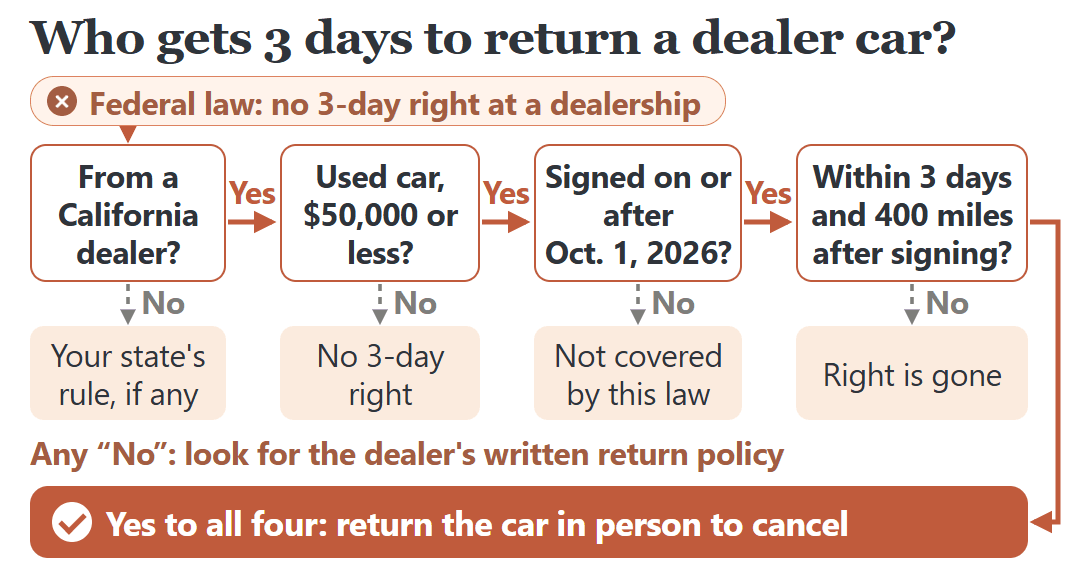
No federal law lets you return a car you bought at a dealership. In California, a used car bought or leased from a California dealer on or after Oct. 1, 2026, for $50,000 or less can be canceled for any reason within three days after signing. The car must not have been driven more than 400 miles since you signed. Everywhere else, a return exists only if your state requires one or the dealer gave you a return policy in writing.
In California, day 1 is the day after you sign, and day 3 ends at the dealer’s close of business. The dealer can keep a restocking fee of 1.5% of the sale price, at least $200 and at most $600, plus $1 for each mile over 250, up to $150. New cars get no cooling-off period in California.
Outside California, go through your purchase paperwork today for a written return policy. If there isn’t one and your state doesn’t require a return, the contract you signed stands.
Not a Federal Right, Only a State Law or a Dealer’s Written Promise
The FTC puts it plainly on its used-car buying page: “Federal law doesn’t require dealers to give you three days to cancel the deal and return the car.”
That leaves three places a right to undo the deal can come from:
- California’s CARS Act, for used cars and used-car leases from a California dealer at $50,000 or less, signed on or after Oct. 1, 2026.
- Your own state’s rule. The FTC says that in some states, dealers must give you the right to cancel.
- The dealer’s own policy, which dealers may call a “cooling-off” period, a money-back guarantee or a “no questions asked” return. It exists only if the dealer chose to offer it, and the FTC’s advice is to get it in writing and read it carefully.
California’s right has firm edges. It doesn’t cover new cars: the first-page notice the law now requires says in capital letters that California has no cooling-off period for new vehicles. It doesn’t cover a used car priced above $50,000.
It also doesn’t reach a deal signed before Oct. 1, 2026. The older paid two-day cancellation option it replaced ended that day, and any two-day window from a September purchase has passed.
Private sales between individuals aren’t covered, because the right applies to licensed California dealers. The law also leaves out motorcycles, auction sales, vehicles rated at 10,000 pounds or more and a few other cases listed in the bill text.
The Clock Starts the Day After You Sign and Stops at Closing Time
For a covered used car, the dealer has to hand you a separate document titled “3-Day Right to Cancel Used Car Purchase or Lease.” It states your time limit, how the restocking fee is calculated and the 400-mile limit. That page, not a news summary, is where your own deadline and fee come from.
Near the $50,000 line, whether you got that page is also the practical signal of whether your deal is covered. The statute says “price” without spelling out whether taxes and fees count.
The count works like this. Day 1 is the calendar day after you sign, and weekends count. The right ends at the dealer’s close of business on day 3, not at midnight.
If the dealership is closed to the public on day 3, the deadline moves to the next day it’s open.
Two hypothetical signings show how the same rule lands on different days. Sign on Friday, Oct. 16, 2026, and Saturday is day 1, Sunday is day 2, and the deadline is close of business on Monday, Oct. 19.
Sign on Thursday, Oct. 22, and day 3 is Sunday, Oct. 25. If that dealership is closed on Sundays, the deadline becomes close of business on Monday, Oct. 26.
Then look at the odometer. The right is gone once the car has been driven more than 400 miles since you signed. Miles start costing money before that, at $1 for every mile over 250.
So a car with 320 miles on it since signing can still go back, with $70 added to the fee. At 401 miles, this law no longer lets it go back at all.
Your disclosure may show better terms than these. Dealers are allowed to offer a longer window, more vehicles or a smaller fee, so the law’s numbers are a minimum.
What Giving the Car Back Costs Depends on Its Price and Its Odometer
The restocking fee has two parts, and the dealer’s disclosure has to explain both:
- Price part: 1.5% of the sale price, never less than $200 and never more than $600.
- Mileage part: $1 for each mile over 250, never more than $150.
The floor and the cap do most of the work. On a car priced up to about $13,333, 1.5% comes to $200 or less, so the price part is $200.
From $40,000 to $50,000, 1.5% is $600 or more, so the price part is $600. Only in between does it follow 1.5% exactly.
That’s why the figure that circulated when the law took effect tells only part of the story. A KQED explainer on Oct. 5, 2026, said “the DMV estimates something around $200.” Under the statute, $200 is the floor, not the going rate, and miles over 250 can add as much as $150 on top of the price part.
The dealer can’t charge you for the right itself. The fee comes out of whatever refund you’re owed, and if the refund doesn’t cover it, the rest is due when you cancel.
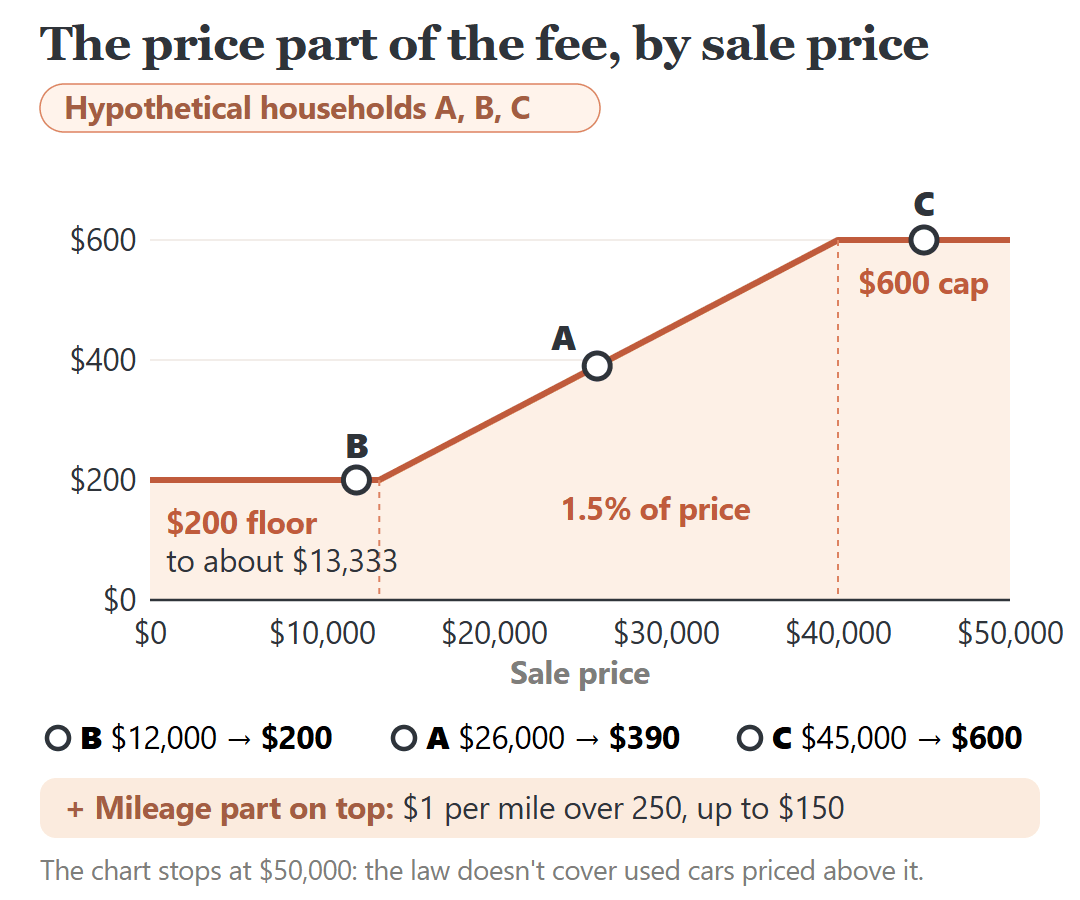
Here’s the full fee for three hypothetical households. The prices and miles are assumptions chosen to show the formula, not real deals or typical fees.
| Household (assumed) | Sale price | Price part | Miles since signing | Total fee |
|---|---|---|---|---|
| A: used SUV | $26,000 | $390 (1.5%) | 320, so +$70 | $460 |
| B: used compact | $12,000 | $200 (1.5% is $180; floor applies) | 90, so +$0 | $200 |
| C: used truck | $45,000 | $600 (1.5% is $675; cap applies) | 400, so +$150 | $750 |
Same law, three totals: $200, $460 and $750. There’s no single California restocking fee. Your sale price and your odometer set yours, and $750 is the most the formula allows once the mileage part is maxed out.
My read of the formula is that the fee is the predictable part of this decision. It has a ceiling, and you can work it out tonight from two numbers.
Taking It Back in Person, and What the Dealer Owes You Afterward
A phone call or an email telling the dealer you’ve changed your mind isn’t the method the law sets out. The right applies when you personally deliver the car to the dealer during business hours, along with the rest of what the law lists:
- the car in the condition you got it, apart from normal wear and any defect or mechanical problem you didn’t cause;
- no liens on it other than the one created by this deal;
- any other cash or items you received with the sale;
- the restocking fee, unless it’s being taken out of your refund.
The dealer can ask you to sign the paperwork needed to cancel the contract and process the refund.
Within 48 hours of your cancellation, the dealer has to cancel the contract and refund your money, minus the deductions the law allows. Delays caused by a bank or card company don’t count against the dealer. If you paid by check, the dealer can wait until two business days after your payment is verified.
Your trade-in and its keys come back. If the dealer has already sold the trade-in or started transferring its title, you’re owed the greatest of three numbers. Those are the trade-in value in your contract, what the dealer sold it for, or its fair market value. Any loan still owed on the trade-in comes out of that amount.
Take hypothetical Household A from the table, with an assumed $3,000 cash down payment and a $6,000 trade-in with no loan on it. They’d get $3,000 − $460 = $2,540 back within 48 hours, plus the trade-in, or at least $6,000 for it if the dealer had already sold it.
Before you leave, ask for the itemized receipt the law requires, showing each deduction and the date and time you canceled.
“I’m exercising my 3-day right to cancel under California Civil Code §1784.43 for the [year, make and model], VIN [number], signed on [date]. I’ve brought back the car and everything I received with the sale, and the odometer reads [miles]. Please give me the itemized cancellation receipt with today’s date and time, and tell me when my refund of $[amount] and my trade-in will be returned.”
If the dealer drags its feet, the law is specific about what it can’t do. It can’t get in the way of a cancellation, overcharge the fee, hold back your down payment or trade-in, or claim damage beyond normal wear without a reasonable basis. It also can’t say the person who can process the refund isn’t available. The DMV and the Bureau of Automotive Repair enforce these rules, so keep the receipt and every page of your paperwork.
Bought New, Paid Over $50,000 or Signed Outside California
In any of these cases, the contract stands unless the dealer offered a return or your state requires one. The FTC’s guidance points to two checks.
First, read every page you signed and took home for a return policy, a money-back guarantee or a “cooling-off” period. If you find one, its deadline and conditions are the ones to meet, so act on it today. Second, if you’re outside California, your state attorney general’s office can tell you whether your state has its own rule.
“Did my purchase include a return policy, money-back guarantee or cooling-off period? If it did, please send me its terms in writing, including the deadline and any fee.”
If the reason you want out is a defect or something the dealer misrepresented, that’s a separate question. Warranty, lemon-law and misrepresentation claims run under other laws, and California’s 3-day right doesn’t replace them.
Three Days and 400 Miles Run Out Faster Than the Fee Adds Up
Gather four things: the date you signed, the sale price, the odometer reading now and, in California, the “3-Day Right to Cancel” page. Then hold your deal against three gates: a used car at $50,000 or less, still inside day 3, and 400 miles or fewer since signing.
If it passes and you still want out, work out the fee from the formula above and drive the car back before close of business on day 3, with everything that came with it. If it doesn’t pass, a written return policy is the one thing left to look for, and the call to the dealer belongs to today, not next week.
The riskiest choice here is waiting to see how the car feels by the weekend.
If you keep the car, registration renewal is the next California date attached to it. Here’s how California’s registration late penalty is worked out from your own car’s fee.
For a California deal, write the day-3 date and the dealer’s closing time on the disclosure itself, and check the odometer before every drive until you’ve decided. The fee can be worked out at any point, but the three days and the 400 miles only run one way.
Sources: California SB 766 (2025), the CARS Act, chaptered text (Civil Code §§1784.28, 1784.31 and 1784.43; also readable on CalMatters Digital Democracy). Also the FTC’s Buying a Used Car From a Dealer and Buyer’s Remorse: The FTC’s Cooling-Off Rule May Help, and the California DMV’s 2026 new laws release. KQED’s Oct. 5, 2026 explainer, quoted for comparison. Checked Oct. 16, 2026. Households A, B and C and the signing dates are hypothetical examples, not real deals or typical fees. This is general information, not legal advice.