

Miss a $3,000 rent payment in New York and the late fee stops at $50. In a Texas building of four or fewer units, a fee is considered reasonable up to 12% of rent, which is $360 on that same payment.
On Nov. 18, 2026, I read the late fee rules for 19 states and D.C. in official sources. Of the 19 states and D.C. we read, 8 states and D.C. put a hard number on the fee, Texas sets percentages at which a fee is considered reasonable, 3 states control timing or who can be charged without a number on the amount, and the sources for the other 7 give no number at all.
No number in a source doesn’t mean no limit. It means the text I read doesn’t state one, and four of those seven still tie the fee to what is reasonable.

Ten rows put a number on the fee amount and ten don’t, of the 19 states and D.C. we read.
Does Your State Put a Number on the Late Fee?
These ten rows carry a number. Nine are firm limits, and the Texas row gives the percentages at which a fee is considered reasonable. Each state name links to the text I read, with the citation under it so a row can be quoted on its own.
| State and source | Amount in the rule | Earliest it can apply, and conditions |
|---|---|---|
| Connecticut Conn. Gen. Stat. § 47a-15a(a), (b) |
Lesser of $5 per day up to $50, or 5% of the delinquent payment | After the 9-day grace period (4 days on a one-week tenancy). One late charge per late payment. Reaching $50 takes 10 charged days. |
| Delaware 25 Del. C. § 5501(d) |
5% of monthly rent | Not within 5 days of the due date. With no local payment office, the time to pay runs 3 days longer. |
| D.C. D.C. Code § 42-3505.31(a)-(c) |
5% of the full amount of rent due | Only after 5 days, and once per late payment. The written lease must state the maximum. No eviction for an unpaid late fee. |
| Iowa Iowa Code 2026 § 562A.9(4) |
Rent of $700 or less: $12 per day, $60 per month maximum. Rent above $700: $20 per day, $100 per month maximum | No grace period in the text read. |
| Maine 14 M.R.S. § 6028(1)-(3) |
4% of one month’s rent | Rent counts as late only after 15 days. Written notice at signing is required. |
| Maryland Md. Real Property § 8-208(d)(3) |
5% of the unpaid rent for that rental period. Weekly rent: $3 per week, $12 per month | No grace period in the text read. |
| Minnesota 2026 Minn. Stat. § 504B.177(a) |
8% of the overdue rent payment | No grace period in the text read. A written agreement is required, and it must say when the fee applies. |
| New York Real Property Law § 238-a(2) |
Lesser of $50 or 5% of monthly rent | Only if rent is unpaid 5 days after the due date. Applies to residential dwelling units, with a carve-out for co-ops. |
| Texas S.B. 1414 (2019), amending Property Code § 92.019 |
Considered reasonable up to 12% of rent (4 or fewer units) or 10% (more than 4 units). Not a hard cap | Rent must be unpaid 2 full days. Notice of the fee must be in a written lease. |
| Virginia Va. Code § 55.1-1204(E) |
Lesser of 10% of periodic rent or 10% of the remaining balance | No grace period in subsection E. The fee must be in the written rental agreement. |
In Texas, a higher fee is also considered reasonable if it is not more than the landlord’s uncertain damages related to the late payment. The Texas text I read is the enrolled S.B. 1414, effective Sept. 1, 2019, which amended Texas Property Code § 92.019. The Texas State Law Library’s guide, updated Nov. 13, 2026, still describes that bill and the two-full-days rule. If yours is a Texas lease, our walk-through of the Texas late fee rule is the next stop.
Iowa’s limit moves at a single dollar of rent. A $700 lease has a $60 monthly maximum, and a $701 lease has $100.
When the Source Names No Number
Three states regulate when a fee can start or who gets extra time, and the source I read puts no number on the amount.
| State and source | What the source says | Source type |
|---|---|---|
| Massachusetts AG’s Guide to Landlord and Tenant Rights |
Lists a late fee on rent less than 30 days late as an illegal lease term. States no amount. | Attorney General publication |
| New Jersey Truth in Renting, PDF pp. 7, 23 |
Late charges are allowed. 5 business days of grace apply only to seniors on qualifying pensions and recipients of SSDI, SSI or Work First NJ, when rent is due on the first. Gives no amount. | State agency publication, undated |
| Washington RCW 59.18.170(2) |
No late fee on rent paid within 5 days of the due date. Separately, an unlawful detainer judgment counts late fees only up to $75 in total (RCW 59.18.410(1)), a court-judgment rule and not a general cap. | State code |
For the other seven, the source gives no percent or dollar figure for a residential late fee.
| State and source | What the source says | Source type |
|---|---|---|
| Arizona A.R.S. § 33-1368(B) |
Refers to “a reasonable late fee set forth in a written rental agreement.” I read this section only. | State code |
| California California Tenants, 2026 Edition, printed pp. 42-43 |
The fee should not exceed a reasonable estimate of the landlord’s costs, and a fee so high it is a penalty is not valid. Local rent control ordinances can limit fees. | State agency publication |
| Florida 2026 Fla. Stat. ch. 83, Part II |
The residential part contains no late fee wording. | State code |
| Georgia Landlord Tenant Handbook, rev. Aug. 29, 2024, PDF p. 10 |
Says the lease should state late charges. Names no amount. | State agency publication |
| Michigan Residential Landlord-Tenant Law Benchbook (2026), ch. 1, “5. Late Fees” |
Treats a late fee as a penalty-or-liquidated-damages question. A landlord seeking one must establish that the amount is reasonable. | State court-system publication |
| Pennsylvania Consumer Guide v1.1 (June 13, 2022), printed pp. 6-7 |
Late fees should not be excessive and should bear a reasonable relation to the landlord’s cost. | Attorney General publication |
| South Carolina S.C. Code Title 27, ch. 40 |
Mentions late charges only inside the definition of rent. No number in the chapter I read. | State code |
Florida has a number that is easy to misread. Chapter 83 does contain “$20, or 20 percent of the monthly rent,” but that line is s. 83.808(3) in Part III, which covers self-service storage units.
Each row reports one source and goes no further. Georgia’s handbook naming no amount, for instance, isn’t proof that Georgia has no limit.
What the Same Missed Month Costs in Dollars
To put the ten numbered rows on one scale, I worked each formula at two rents, holding three things fixed: one full month unpaid, past any grace period, and the highest figure the rule states.
| State | $1,000 rent | $3,000 rent |
|---|---|---|
| New York | $50 | $50 |
| Connecticut | $50 | $50 |
| Iowa | $100 | $100 |
| Maine | $40 | $120 |
| Maryland | $50 | $150 |
| Delaware | $50 | $150 |
| D.C. | $50 | $150 |
| Minnesota | $80 | $240 |
| Virginia | $100 | $300 |
| Texas, more than 4 units (considered reasonable up to 10% of rent) | $100 | $300 |
| Texas, 4 or fewer units (considered reasonable up to 12% of rent) | $120 | $360 |
The spread widens as rent rises. At $1,000 the figures run from $40 to $120, a factor of 3. At $3,000 they run from $50 to $360, a factor of 7.2, because New York and Connecticut stop at $50 while the percentage rows keep climbing. The top of both ranges is the Texas level for 4 or fewer units, which is not a ceiling.
New York’s rule reaches its $50 limit at $1,000 rent and stays there.
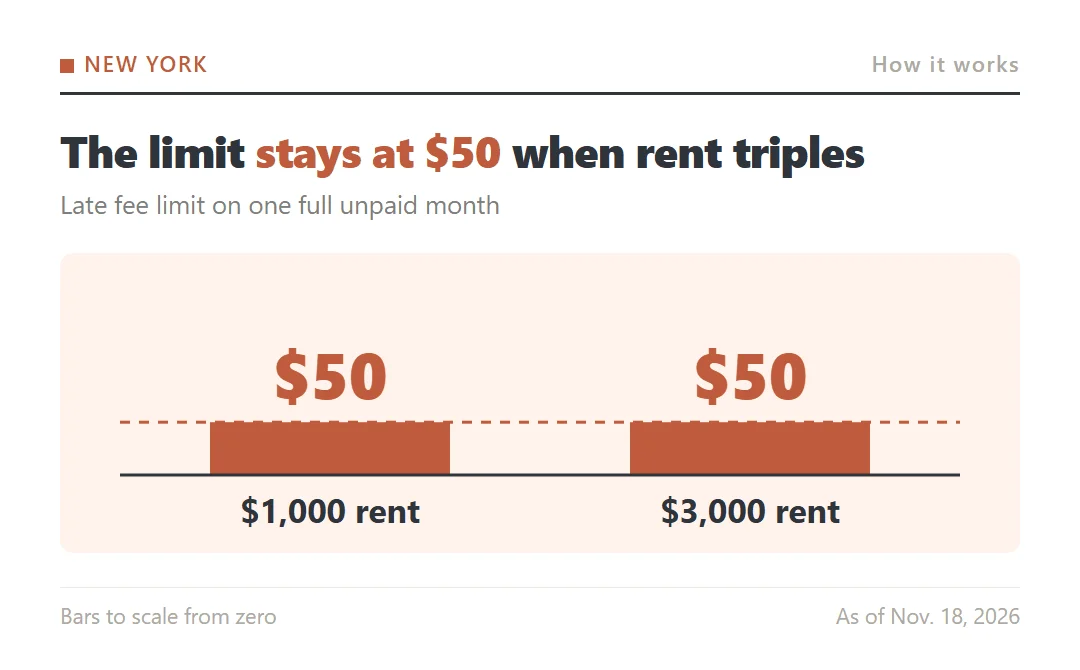
New York’s limit is the same at both rents.
The Texas figure moves with the rent instead, because it is a percentage with no dollar stop.

In a Texas building of 4 or fewer units, the level considered reasonable triples when the rent does.
The calculator opens on New York at $3,000. Choose your state and enter your own rent. A state whose source names no number shows that in place of a dollar figure.
What does your state's rule allow on your rent?
Pick one of the 19 states or D.C. on this page, then enter your monthly rent.
If your result doesn't match your bill or notice, check the exact figure on your state's source in the tables on this page. Rules as of 2026-11-18
Show the breakdown and basis
—
Assumes one full month of rent unpaid, past any grace period, and the highest figure the rule states. A partial payment can change the figure in some states.
Values are calculated in your browser and are not saved or sent anywhere.
Paid Most of the Rent? Ask What the Percentage Applies To
Reading these rules one after another, the word I kept stopping on was “of.” Five percent of what? Some rows count only the rent still unpaid, and others count the whole month.
Say rent is $2,000 and you pay $1,800, leaving $200 unpaid. These are the rows whose base is clear from the text.
| State | Base in the text | Fee figure |
|---|---|---|
| Maryland | 5% of unpaid rent | $10 |
| Virginia | Lesser of 10% of rent ($200) or 10% of balance ($20) | $20 |
| New York | Lesser of $50 or 5% of monthly rent ($100) | $50 |
| Maine | 4% of one month’s rent | $80 |
| Delaware | 5% of monthly rent | $100 |
| Texas, more than 4 units | Considered reasonable up to 10% of rent | $200 |
| Texas, 4 or fewer units | Considered reasonable up to 12% of rent | $240 |
Maryland’s 5% lands on the $200 and comes to $10.

In Maryland the percentage follows what is still unpaid.
Texas’s 12% lands on the period’s full rent, so in a building of 4 or fewer units a $240 fee is considered reasonable, more than the $200 still owed.

In Texas the percentage follows the full rent for the period, whatever part of it was paid.
If the fee on your ledger doesn’t line up with your row, the lease clause and the landlord’s math are the two things to see. A short written question gets both.
Which clause in my lease sets this late fee, what amount was it calculated on, and what date was it charged?
Where This Table Stops
Illinois, Ohio, North Carolina, Colorado, Tennessee, Wisconsin, Oregon, Nevada and Hawaii are not yet verified. I haven’t read their current official text on late fees, so this page makes no claim either way about whether they set a limit. States not named on this page weren’t part of this round.
The rows cover private residential leases with monthly rent. Commercial leases, self-storage, manufactured home parks, federally subsidized housing and city ordinances are left out, and a local rule can be stricter than the state row.
This is a reference to what each source says, not legal advice on one lease. Every figure here is as of Nov. 18, 2026, and that date belongs next to any number you quote from this page.
Photos and icons in this post are illustrations made for explanation; they do not show real places, products or people.