A lot of PG&E solar households on NEM or NEM2 read the small bill that shows up each month as their electricity bill, with the panels covering the rest. PG&E’s own sample statement says otherwise: the monthly amount “will not include actual charges for electricity until your True-Up month.”
So the electricity part of the bill waits, and then it all arrives at once. That’s the True-Up. Whether it lands as a large bill, a small one or a credit depends on your plan and your year, and you don’t have to wait for the statement to see where it’s heading.
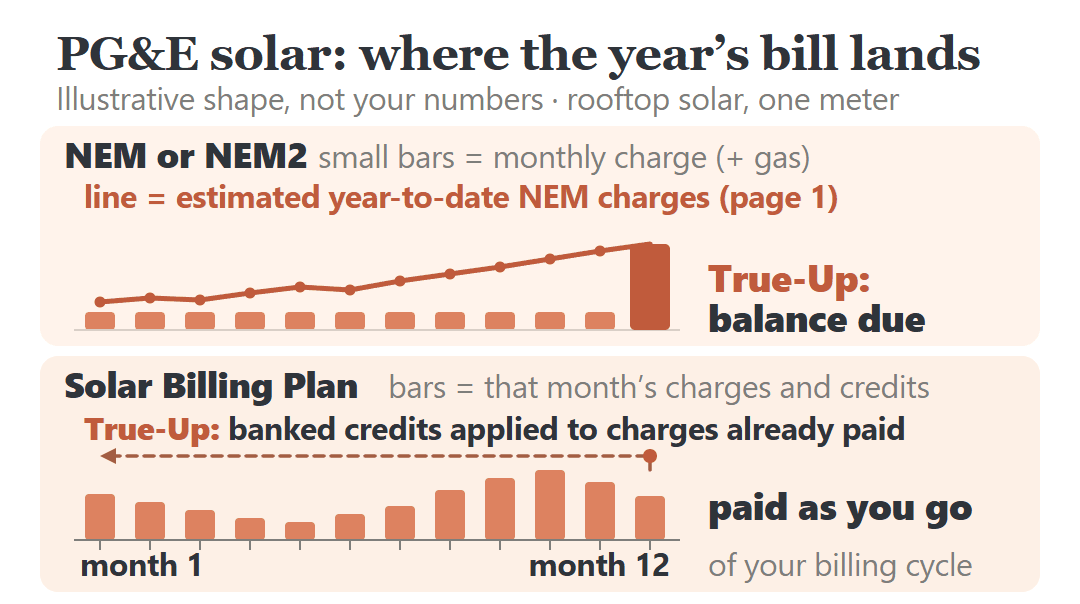
On NEM or NEM2, each monthly bill covers only the monthly electric charge (the Base Services Charge since March 2026) plus any gas. The year’s energy charges and credits are settled on one True-Up statement at the end of your own 12-month billing cycle, not in a month everyone shares. Page 1 of every monthly statement already shows PG&E’s running estimate, the “estimated year-to-date NEM charges,” along with the month and year they come due.
On the newer Solar Billing Plan, you pay each month’s charges as you go, and the True-Up mostly applies your banked credits to charges you’ve already paid. If a community choice aggregator (CCA) such as MCE or San José Clean Energy supplies your power, it settles the generation side on its own schedule. That can mean two true-up dates in one year.
This covers PG&E residential customers with rooftop solar on one home meter. SCE and SDG&E customers, business accounts, and solar paired with battery storage or shared (virtual) metering have their own billing details.
Two Things to Find First: Your Plan and Your True-Up Month
Start with the plan name on your statement. It will say NEM or NEM2, or it will say Solar Billing Plan. The dividing line is your interconnection application: systems that applied on or before April 14, 2023 are generally on NEM or NEM2, and those that applied after that date are on the Solar Billing Plan.
Then find your True-Up month. PG&E ties it to the anniversary of when your NEM participation started, so your neighbor with panels installed in a different month has a different date. On a NEM or NEM2 statement, the Net Energy Metering account summary on page 1 shows when the year-to-date charges are due (month and year). PG&E also notes that some Solar Billing Plan cycles can run shorter than a year, so read the date rather than counting forward from installation.
If you can’t find either one, PG&E’s Solar Customer Service Center handles NEM billing questions at 1-877-743-4112. A question you can read off the screen:
“I have rooftop solar on this account. Which billing plan am I on, NEM, NEM2 or the Solar Billing Plan, and what month and year is my True-Up?”
On NEM or NEM2, the Running Total Is the Bill in Waiting
The number to watch is on the front page: “estimated year-to-date NEM charges.” PG&E calls it the monthly update on the charges that will be due on your True-Up date. Page 2 breaks it down in the “Summary of your NEM year-to-date charges” and the “Explanation of Calculations,” and the NEM charts show the cumulative balance month over month.
Treat it as PG&E’s running estimate, not the final bill. It moves every month with what you use from the grid and what your panels send back, and PG&E’s own advice is to check it monthly so you can plan and budget for the payment.
Why it grows: PG&E points to household changes such as another person moving in, large new appliances, an electric car or a pool, plus your system’s size, roof orientation and the weather. Solar customers are on time-of-use rates, where grid power in the peak window (typically 4 to 9 p.m.) costs more, so the dollar total doesn’t always track your kWh totals.
Household A: turning the running total into a monthly set-aside
Household A is a hypothetical NEM2 customer buying power from PG&E, not a real customer’s bill. Its October statement shows estimated year-to-date NEM charges of $540, due 01/2027. Splitting today’s figure over the three months left, $540 ÷ 3 = $180 a month set aside.
That’s a budgeting step, not a forecast. Evening use and shorter winter days in the months still to come can push the figure up, so Household A would recheck page 1 on each new statement and adjust the set-aside. Your own number and due date are on your statement; the $540 here is only there to show the arithmetic.
On the Solar Billing Plan, You’ve Been Paying Along the Way
Solar Billing Plan statements show that month’s charges and credits, plus the monthly charges, so the year isn’t held back the way it is on NEM. At the True-Up, PG&E applies unused credits to current and previously paid charges from the 12-month cycle, and credits still left over carry forward toward future PG&E charges.
That doesn’t mean the True-Up is always zero. PG&E’s True-Up video walks through a statement where a positive True-Up adjustment means you owe that amount, because no banked credits were left to cover the charges.
| Your plan | What each monthly bill pays | What the True-Up does |
|---|---|---|
| NEM or NEM2 | The monthly electric charge, plus any gas | Bills the year’s net energy charges at once. Leftover credits reset to zero; an energy surplus for the year earns Net Surplus Compensation |
| Solar Billing Plan | That month’s charges and credits, plus the monthly charges | Applies banked credits to charges already paid. Leftover credits carry forward; you can still owe an adjustment |
| Either plan, with a CCA | PG&E side as above | The CCA settles generation on its own schedule (San José Clean Energy: every April) |
One monthly charge works differently. On NEM or NEM2, since March 1, 2026, you pay a Base Services Charge that PG&E puts at about $24 a month. For NEM customers it replaced the old minimum charge, runs roughly $10 more, and is partly offset by a lower price per kWh; CARE and FERA customers pay a reduced amount. On NEM or NEM2, PG&E says solar credits can’t offset it, so expect to pay it every month whatever your panels produce. On the Solar Billing Plan, your monthly bills include the Base Services Charge too.
If MCE, San José Clean Energy or Another CCA Supplies Your Power
With a CCA, PG&E still delivers the electricity and runs its own annual True-Up, while the CCA bills and trues-up the generation part on its schedule. San José Clean Energy says it plainly: you’ll have two annual true-up dates, and “you are not being double charged.”
The schedules differ by CCA. San José Clean Energy trues-up generation for all its solar customers every April; most who owe see the charge on the May bill, and most with extra credit get it in June. MCE bills NEM customers for generation monthly after applying credits, then does an annual cash-out after the April billing cycle. Those are two examples, so look up your own CCA’s NEM page rather than assuming either schedule.
One number from San José Clean Energy puts the stakes in view: it says about 75% of its solar customers use more energy than their panels make, and its residential solar customers owe about $600 on average at its annual true-up. That’s SJCE’s figure for its own customers’ generation true-up, not a typical PG&E True-Up, and not a prediction of yours.
Household B: two dates instead of one
Household B is a hypothetical Solar Billing Plan customer whose generation comes from a CCA that trues-up every April, as San José Clean Energy does. Its monthly bills already include each month’s net charges and the Base Services Charge. At its PG&E True-Up, banked credits are applied to what it paid during the year and anything left carries forward. Its calendar still needs two entries: the PG&E True-Up month printed on its statement, and the CCA’s April true-up, with the charge or credit showing up on a later bill.
Credits Left at the True-Up, and Why a Negative Balance Isn’t Always $0 Due
On NEM or NEM2, PG&E is direct about leftover credits: by law, any remaining credits are reset to zero before your new 12-month cycle begins. They aren’t paid out at the value they had during the year.
What can come back is Net Surplus Compensation, and only if your system produced more energy (kWh) than your home used over the 12 months. PG&E checks this automatically at the True-Up and applies it as a credit on the True-Up statement, at a rate set by the California Public Utilities Commission that PG&E puts at about $0.02 to $0.04 per kWh. If a CCA supplies your power, its surplus compensation may differ. PG&E also notes that on time-of-use rates your account can show a dollar credit even when your system hasn’t produced an energy surplus.
On the Solar Billing Plan, leftover credits after the True-Up carry forward instead of resetting.
Household C: a running balance below zero
Household C is a hypothetical NEM2 customer whose page 1 shows estimated year-to-date NEM charges of –$120, a credit. It’s tempting to read that as “nothing due.” PG&E’s NEM bill guides show state-mandated non-bypassable charges that are figured on the energy you use, can’t be offset by credits from exports, and are reconciled at the True-Up. And whatever credit is left at the True-Up resets. If your running total is negative, ask the Solar Customer Service Center what your True-Up will still include before planning on $0.
If the True-Up Is More Than You Can Pay at Once
PG&E’s own answer to “need more time paying your True-Up bill?” is a payment arrangement, which you set up after signing in to your account. Ask for the payment amounts and due dates before you agree, so the plan fits your budget alongside the regular monthly bill.
“My True-Up statement shows [amount] due on [date], and I can’t pay it in one payment. Can you set up a payment arrangement on this account and tell me what each payment and due date would be?”
For questions about how the True-Up was calculated, the Solar Customer Service Center at 1-877-743-4112 is the line PG&E lists for NEM bills. And if the True-Up lands in a month when the phone or internet bill is also hard to cover, it’s worth checking who qualifies for the Lifeline phone and internet discount, which has its own California route.
The Order I’d Work Through Before Your True-Up Month
- Read the plan name on your statement: NEM or NEM2, or Solar Billing Plan.
- Write down your True-Up month and year from the statement, not from a calendar guess.
- On NEM or NEM2, note today’s estimated year-to-date NEM charges on page 1, and look again on every new statement.
- If a CCA appears on your bill, find its NEM page and add its true-up date as a second entry.
- Divide the current figure by the months left as a set-aside, and if the final bill is still more than you can pay, ask PG&E for a payment arrangement.
What stood out to me in PG&E’s own pages is that the True-Up isn’t a surprise fee. On NEM it’s the year’s electricity bill held back until one month, and PG&E prints the running number on page 1 every time. The surprise mostly comes from never looking at it. Ten minutes with your current statement turns that number into a plan.
Sources: PG&E’s solar bill page (sample monthly and True-Up statements, Net Surplus Compensation, Base Services Charge), Net Energy Metering bill page and Solar Billing Plan page; San José Clean Energy’s True-Up bill guide for rooftop solar customers; MCE’s Net Energy Metering page. Checked October 2026 against PG&E’s solar billing pages and sample statements (including the 2026 Base Services Charge versions). Households A, B and C are hypothetical examples, not real customers’ bills.