“Even if the ‘Valid Thru’ date has passed, the available funds on your Card do not expire.” That sentence comes from the ManageMyCard Visa or Mastercard Gift Card Cardholder Agreement, issued by Pathward, and Pathward’s myprepaidbalance gift card agreement carries the same words.
The example this guide follows is a hypothetical birthday card with $38 still on it, last used in the spring, whose valid-thru date passed in August. Checkout now declines it, because the date on the front only marks when the plastic stops working. The $38 runs on a separate, longer clock.
For a Visa or Mastercard gift card sold in the US, federal rules say the money can’t expire sooner than five years after the card was bought or last loaded (or the card’s own date, if that’s later), and both cardholder agreements I read say the funds don’t expire at all. If the card expires with money on it, the issuer has to replace it at no cost. Only a lost or stolen card can carry a replacement fee.
What can shrink the balance is a monthly inactivity fee. It’s allowed only after 12 months with no activity, no more than once a month, and only if the amount is printed on the card. How much it takes depends on your card, so the number that matters is on the back of yours.
This covers network-branded Visa and Mastercard gift cards sold in the US. Store gift cards sit under the same federal floor, but each retailer writes its own terms, and cards bought in Canada, Australia or elsewhere follow different rules.
Your Card Already Prints the Rules That Matter
Look at both sides of the card for these:
- The “valid thru” date, usually on the front. That’s when the plastic stops working.
- What it says about the funds, such as “funds do not expire,” or a separate date for the money.
- The fee line: whether there’s a monthly inactivity or maintenance fee, how much it is, and when it starts.
- A toll-free number and website for balance checks and replacements.
Then look up the balance and the transaction history on the issuer’s website listed on the card. Fees show up there as charges, so the history tells you whether one has already started.
Expired With Money Still on It: The Replacement Costs Nothing
The federal gift card rule requires the card to show a toll-free number, and a website if the issuer keeps one, for getting a replacement after the card expires. It also bars any fee for replacing the card, or for giving you the remaining balance some other way, before the funds expire.
Both agreements put it plainly: no charge for a replacement sent because the card expired. For the $38 card, that means a call or a visit to the website on the back, and the balance goes onto the new card.
“My gift card ending in [last four digits] is past its valid-thru date and still has a balance of $[amount]. Please send me a replacement card. Can you confirm there’s no fee for a replacement due to expiration, and tell me how long it will take to arrive?”
The exception is a card that’s lost or stolen. Then a replacement can cost money: $6.95 in the ManageMyCard agreement, deducted from the card’s balance, and $5.00 in Pathward’s myprepaidbalance agreement. The ManageMyCard terms add that a reissued card can take up to 30 days.
Where a Shrinking Balance Goes: Counting the Monthly Fees
If the balance is lower than you remember and you haven’t been using the card, check the history for an inactivity fee. Federal rules allow one only when all three of these are true:
- There’s been no activity in the 12 months ending on the day it’s charged.
- It’s charged no more than once in a calendar month.
- The amount, how often it’s charged and the fact that it’s for inactivity are printed on the card.
The amount belongs to the card, not to Visa or Mastercard. In the two agreements: $4.95 a month on the ManageMyCard gift card, starting the 13th month in a row without activity, counted from activation, and $2.95 a month on Pathward’s myprepaidbalance card, also from the 13th month. Either one keeps coming “as long as there are funds remaining and no activity occurs.”
So what the fees have taken is one multiplication: your card’s monthly fee × the number of months it’s been charged. The count starts with the 13th month without a purchase or load, and it stops when you use the card or the balance reaches $0.
Here’s how that plays out on three hypothetical $50 cards. The card values and months are assumptions; the fee amounts come from the two agreements.
Card A, ManageMyCard terms ($4.95 a month), activated and never used. Nothing comes out in months 1 through 12. Fees in months 13 through 22 add up to 10 × $4.95 = $49.50, leaving $0.50, and the next fee takes the rest.
Card B, myprepaidbalance terms ($2.95 a month), activated and never used. The same 10 fees come to 10 × $2.95 = $29.50, leaving $20.50 at month 22.
Card C, ManageMyCard terms, one $5 purchase in month 11. The purchase counts as activity, so no fee can start until another 12 months pass without one, month 23 at the earliest. At month 22 the card still holds $45.
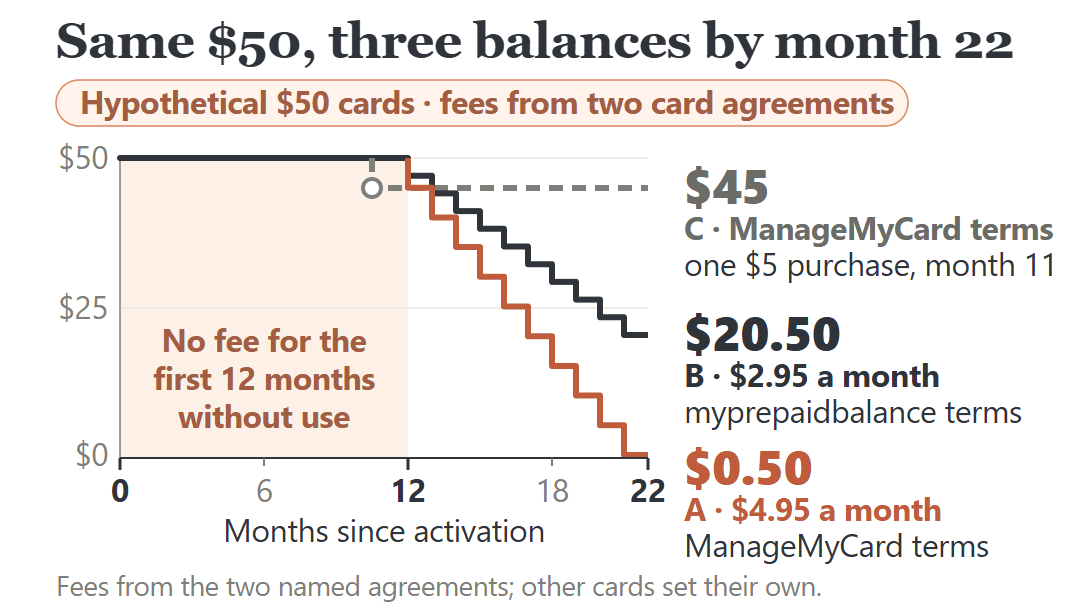
Same $50, same 22 months, three different balances. That’s why there’s no single “you lose $X” for Visa gift cards. Your number comes from your card’s fee line, its activation date and the date of its last purchase.
I didn’t expect the higher fee to work this fast once it starts: an untouched $50 card goes from full to nearly empty in less than a year of fees.
While you’re in the history, look at when each fee posted. The federal rule bars a fee within 12 months of the last purchase or load (the first load counts), more than once in a month, or on a card with no fee printed on it, and the ManageMyCard terms count their 12 months from activation. If a fee breaks the federal rule or the card’s own terms, call the number on the back and ask for it to be reversed.
One Purchase Restarts the 12 Months. Looking Up the Balance Doesn’t
Under the federal definition, activity means money going onto or off the card. A purchase counts, and so does a load. A fee doesn’t count, and looking up the balance doesn’t change the funds.
The ManageMyCard terms say it in one line: “You may avoid this fee by using your Card at least once every twelve months.” The myprepaidbalance terms define the inactive stretch as one with “no loads or purchase activity.”
That leaves two ways to stop a fee-bearing card from leaking. Spend it down now, or keep it and make one small purchase before 12 months go by without one. If no inactivity fee is printed on your card, it can’t charge one, and waiting costs nothing.
If you spend it down, keep in mind that restaurants, hotels and similar merchants can place a hold for more than the bill until the final amount posts, which can leave a small balance short at the register.
Rebate and Reward Cards Follow Their Own Date
A card that came from a rebate, a loyalty program or a promotion, rather than one somebody bought, isn’t covered by the five-year and 12-month limits. It has to say on the front that it’s promotional and show when its funds expire, and that date can come much sooner. So if a “Visa rewards card” expired, read its front first: that date is the one that applies.
Reloadable prepaid cards that aren’t sold or labeled as gift cards fall outside these gift card rules too.
If the Card Has Been Sitting in a Drawer
Read the card first: valid-thru date, the line about the funds, the fee line and the number. Then pull up the balance and the history. Expired with money left means a free replacement. A shrinking balance means counting the fees, then either spending it down or making one small purchase before the year runs out. A reward card means using it before the date on its front.
A balance left untouched for a very long time can eventually be sent to the state: both agreements say remaining funds may go to a state agency after a period of inactivity, and from there you claim it through that state’s unclaimed-property office. Your state may also add protections beyond the federal floor.
A gift card isn’t the only money in a drawer with a date attached. If you’re also holding an airline credit, here’s how Southwest flight credits expire and what you have to finish by the date.
The date on the front retires the plastic. It takes a full year with no purchase or load before a fee can start on the money.
Sources: 12 CFR 1005.20, the federal gift card rule (Regulation E); the CFPB’s archived post Giving or receiving gift cards? Know the terms and avoid surprises; the ManageMyCard Visa or Mastercard Gift Card Cardholder Agreement and Pathward’s myprepaidbalance Gift Card Cardholder Agreement, both issued by Pathward, N.A., as examples of card terms. Checked Oct. 16, 2026. Other cards set their own fees, so read yours. The $38 card and Cards A, B and C are hypothetical examples, not real cardholders’ balances.