An Ohio disconnection notice has to show the total amount required to prevent disconnection. When a household is a few months behind on gas or electric, that figure is the one that makes the notice feel final.
From Oct. 12, 2026 through Apr. 16, 2027, there’s a second, capped number to work with. Under the Public Utilities Commission of Ohio’s Special Reconnect Order, a residential customer pays no more than $175 to keep or restore service, “regardless of how much a consumer may owe,” in PUCO’s words. PUCO says more than 227,637 Ohioans used the order last winter.
Your upfront amount is the smaller of your past-due amount or $175, plus a reconnection charge of no more than $36 only if service is already off. Any reconnection charge above $36 can go on your next bill. What you still owe after that goes onto an extended payment plan. The order keeps the service on; it doesn’t erase the balance.
It applies to residential customers of PUCO-regulated gas and electric utilities, with no income test, at your primary residence, once per winter per utility. City-owned utilities and electric co-ops don’t have to offer it.
First, Is Your Utility One the Order Covers?
Start with the company name on your bill. The order covers any residential customer of a PUCO-regulated electric or natural gas utility, regardless of income, and all regulated gas and electric companies must follow it. PUCO keeps the list of regulated companies, linked from its Special Reconnect Order page. If your utility is on it, the order applies.
If your power or gas comes from a municipal utility or an electric cooperative, that utility isn’t bound by the order. Those households can still get help from the Winter Crisis Program covered further down, with a higher maximum benefit for them.
Two more limits. With more than one residential account, you can use the order only at your primary residence. And it’s once per winter heating season per utility: use it with your gas company in October, and you won’t have it with that gas company again before the season ends on April 16.
That last point deserves a minute before you call. If you can cover the past-due amount another way, or work out a payment arrangement with the utility without the order, asking about that first keeps the order available for a harder month later in the winter. If service is already off or the shutoff date is close, there’s nothing to save it for. That’s a judgment about your own winter, not a rule.
Working Out Your Own Upfront Number
Two facts from your account decide it: your past-due amount, and whether service is already off.
- Still connected, notice in hand: pay the smaller of your past-due amount or $175.
- Already disconnected: the same amount, plus your utility’s reconnection charge up to $36. If its PUCO-approved charge is higher, the rest can be added to next month’s bill. A utility with no approved reconnection charge can’t add one.
PUCO’s pages say “no more than $175.” Utilities spell out the same idea: Enbridge Gas Ohio and Ohio Edison describe it as the past-due balance or $175, whichever is less. If you’ve fallen behind on an existing payment plan, those two utilities compare $175 with the plan payments you missed instead of the full balance.
If the utility asks for a security deposit, it has to fit inside the same $175 + $36 cap, and any extra goes on the next bill. Starting brand-new service with no old balance works in a similar way: up to $175 instead of the full deposit, with the rest of the deposit on the next bill.
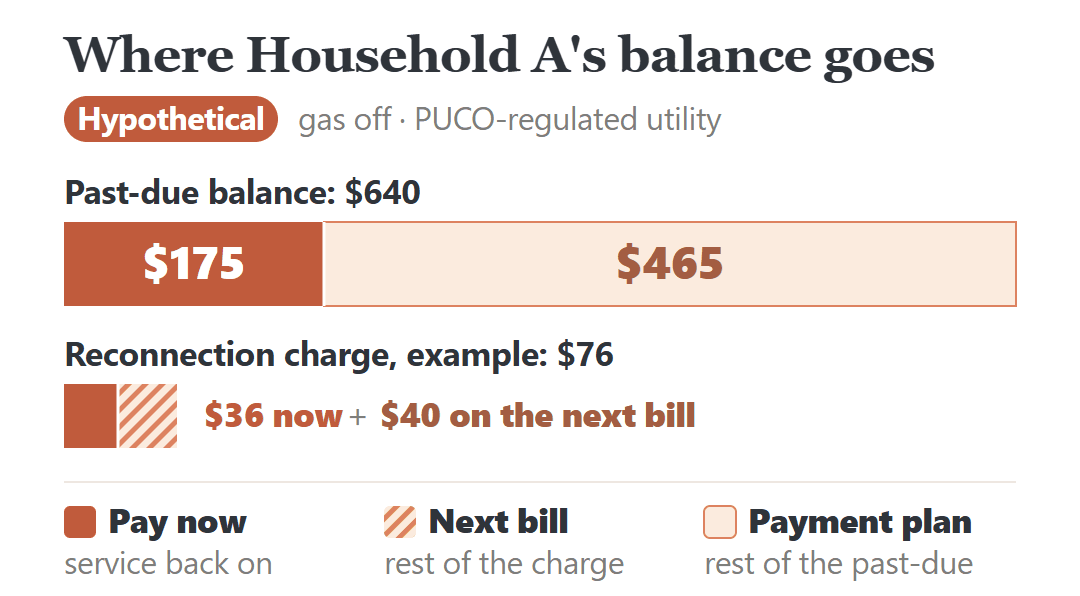
Household A: gas off, $640 behind
Household A is a hypothetical example, not a real customer’s bill. Its gas is off, it’s $640 past due, and its utility’s approved reconnection charge is $76 (Enbridge Gas Ohio’s published figure, borrowed only to show the math). Upfront it pays $175 + $36 = $211. The other $40 of the reconnection charge goes on the next bill, and $465 of past-due ($640 minus $175) moves to a payment plan.
Household B: a notice, $120 behind
Household B, also hypothetical, has an electric disconnection notice, is still connected and is $120 past due. It pays $120, the smaller number. There’s no reconnection charge and nothing left on the past-due side to spread out.
Same order, two very different checks. That’s why neither $175 nor $211 is the figure to plan around until your own numbers are in.
Behind on Both Gas and Electric? One $175 Can Be Split Between Them
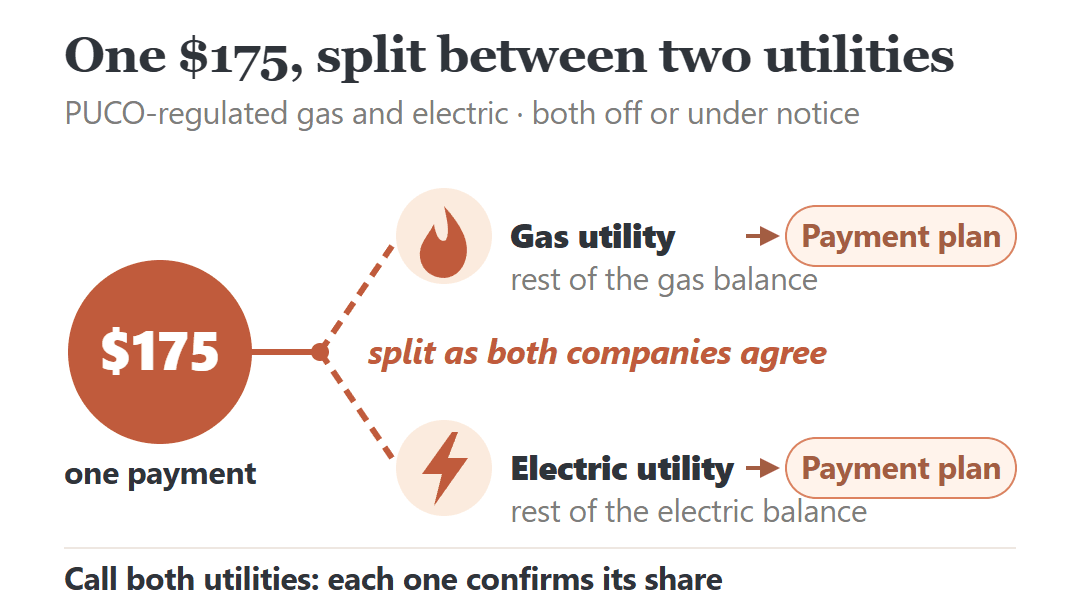
This is the line most summaries skip. PUCO: “The Special Reconnect Order payment of $175 can be split between two regulated utility companies if both utilities have been disconnected or are threatened with disconnection.” The Ohio Consumers’ Counsel adds that the split is made “as agreed upon by both companies.”
So it’s something you ask for, and you have to contact both utilities. Neither page says how the $175 gets divided, so don’t count on one payment covering both until each company has confirmed its share.
Take Household C, a hypothetical household that is $400 behind on gas and $300 behind on electric, with notices from both. If the two utilities agree to split one $175 as, say, $100 to gas and $75 to electric, $300 and $225 remain, or $525 across two payment plans. The split amounts are only an example; the companies settle the real one. And Household C has now used the order with both utilities for this season.
“My gas and electric are both [disconnected / under a disconnection notice]. I’d like to use the Special Reconnect Order and split the $175 between you and [other utility]. How much of it do you need, and what should I tell the other company?”
The Rest of What You Owe Goes on a Payment Plan, So Ask Which One
PUCO says customers who use the order “are required to enroll on an extended payment plan.” If you’ve read how Minnesota’s Cold Weather Rule makes a payment plan the price of protection, Ohio’s order works the other way around: the capped payment comes first, and the plan follows. Ohio’s payment-plan rule, Ohio Admin. Code 4901:1-18-05, sets out these options:
| Plan | What you pay each month | Worth knowing |
|---|---|---|
| One-sixth | One-sixth of the past-due balance, plus your full current bill | Six equal payments on the old balance |
| One-ninth | One-ninth of the past-due balance, plus a budget-billing amount for current bills | Nine equal payments on the old balance |
| One-third (winter) | One-third of the balance due: past-due plus the current bill | Offered to customers not already on a plan, for bills with Nov. 1 to Apr. 15 usage. Anything left after the last one-third bill: pay it, switch plans or move to PIPP Plus |
| PIPP Plus | A payment set as a percentage of household income (Percentage of Income Payment Plan) | For household income at or below 175% of federal guidelines. If you’re on it, anything over $175 is added to your PIPP arrearage |
Two rules apply across the plans: no late fees while you’re current on the plan, and a missed plan payment can lead to disconnection.
The plan you land on may be a default. Enbridge Gas Ohio, for example, enrolls customers who use the order in its One-Ninth plan automatically and lets you pick a different plan by calling. Other utilities handle this their own way, so ask on the call.
Household A’s $465, three ways
Using Household A’s assumed $465 remaining past-due: one-sixth adds 465 ÷ 6 = $77.50 a month on top of each full current bill for six months. One-ninth adds 465 ÷ 9 = $51.67 a month plus the budget amount for nine months. On the one-third plan, with an assumed $180 December bill, that month’s payment is (465 + 180) ÷ 3 = $215. These show how the formulas work, not what a typical payment looks like; your own balance and winter bills set yours.
What I’d want before hanging up is the monthly figure under each plan, not just its name. A smaller add-on spread over nine months and a heavier winter payment suit different households, and only your own bills say which one you can keep up with.
Using the Order: Call, Name It, Keep the Receipt Number
There’s no sign-up. PUCO’s instruction is to contact your utility and mention the Special Reconnect Order. The representative explains the steps and sets up the payment plan for what’s left after the $175 is applied.
“I’d like to use the Special Reconnect Order on this account. What do I need to pay today, including any reconnection charge? Which payment plan will the rest go on, and what will my monthly payment be?”
If you pay at an authorized payment agent instead of directly to the utility, call the utility afterward with the receipt number to report the payment. Amounts paid through an assistance agency can take a few business days to post; Enbridge Gas Ohio says up to three.
Call as soon as you’ve paid. If service has been off for 10 business days or less, Ohio’s reconnection rule has the utility restore it by the close of the next regular working day after payment. Off longer than that, the utility may treat you as a new customer.
A few situations have their own rules. Some utilities exclude certain accounts; Enbridge Gas Ohio, for one, excludes accounts in a business name and accounts with a history of unauthorized usage, NSF or fraud. And if a disconnection would endanger someone’s health, a medical certification from a doctor or another listed professional can hold off disconnection for 30 days at a time, up to 90 days in 12 months, though you’d still need a payment plan.
Can’t Cover the $175? Help Starts Nov. 2, and October Has Its Own Hold
If household income is at or below 175% of the federal income guidelines, the HEAP Winter Crisis Program can pay up to $175 for customers of PUCO-regulated utilities, and up to $750 for municipal and co-op customers. This winter it runs Nov. 2, 2026 through Mar. 31, 2027, three weeks after the order opens. It requires an appointment with your local Energy Assistance Provider or Community Action Agency; you can find yours at energyhelp.ohio.gov.
Booking the appointment matters on its own. Once you have a Winter Crisis Program appointment, a PUCO-regulated utility must delay disconnection for 30 days. In October, before the program opens, a pending HEAP or PIPP Plus application gets the same 30-day delay. The hold can be used once a year.
The program pays the $175; it doesn’t reduce the rest of the balance, which still goes on a payment plan.
With the Notice on the Table: What I’d Do This Week
- Check that the utility on the bill is on PUCO’s regulated list and that the account is your primary residence.
- Write down your past-due amount and note whether service is already off.
- Work out the smaller of your past-due amount or $175, and add up to $36 if you’ve been disconnected.
- Call the utility (both utilities, if gas and electric are behind), mention the Special Reconnect Order, and ask which payment plan the rest goes on and what it costs each month.
- If your income is at or below 175% of federal guidelines, book a Winter Crisis Program appointment from Nov. 2, or in October file a HEAP or PIPP Plus application for the 30-day hold.
The part I’d keep in mind is that $175 is a ceiling, and the payment plan is the real commitment that comes after it. Hear the monthly figure before you agree to a plan, because a missed plan payment is what can put a disconnection notice back in the mailbox. The order runs through April 16, 2027.
Sources: PUCO’s Sept. 30, 2026 release on the 2026-2027 Special Reconnect Order and its Special Reconnect Order consumer page; the Ohio Consumers’ Counsel fact sheets on the Special Reconnect Order and the HEAP Winter Crisis Program; Ohio Admin. Code 4901:1-18-05; Enbridge Gas Ohio’s Special Reconnect Order page. Checked Oct. 16, 2026. Households A, B and C are hypothetical examples, not real customers’ bills.