In Texas, a landlord who says nothing for a week after you hand in a completed rental application has, as far as the law is concerned, said no.
That sounds like the worst outcome. For your money it can be the better one, because rejection is what makes an application deposit refundable. Texas Property Code §92.352 treats you as rejected if the landlord hasn’t told you you’re accepted on or before the seventh day after you submitted a completed application.
The application fee and the application deposit follow different rules. The fee pays for screening and is nonrefundable, with one exception: the landlord rejects you without having made its written tenant-selection criteria available. The deposit comes back if you’re rejected, and that includes the day-7 kind of rejection.
Backing out runs the other way. The statute gives no refund for withdrawing, and under the Texas Apartment Association (TAA) standard rental application, the landlord keeps the deposit if you withdraw, change your mind, or are approved and don’t sign the lease within 3 days (5 if the approval was mailed).
So the first move isn’t a phone call. Find the receipt or application that shows which amount was the fee and which was the deposit, and look for an acknowledgment you signed about the landlord’s selection criteria.
This covers the application stage in Texas. A security deposit after you sign a lease, separate admin or holding fees, and disputes over a screening report follow other rules.
Your Receipt Has Two Lines, and Only One Is Meant to Come Back
Texas law defines both payments. An application fee is a nonrefundable sum that offsets the cost of screening you. An application deposit is money that is refundable if you’re rejected as a tenant.
Your paperwork’s labels tell you which is which. The TAA standard application, for example, prints two separate lines: “Application fee (non-refundable)” and “Application deposit (may or may not be refundable).” If your receipt shows one lump sum, ask the landlord to put the split in writing.
The fee has exactly one way back. If the landlord rejects you and didn’t make its printed tenant-selection criteria available when you got the application, it has to return the fee and any deposit. Those criteria are the grounds for denial, such as credit history, rental history, current income or criminal history.
Proof comes down to a signature. The law has the applicant sign an acknowledgment that the criteria were made available, and if you never signed one, the law presumes you weren’t given them. The landlord can still try to prove otherwise.
On the standard TAA application, that acknowledgment is a paragraph inside the application itself, so check the copy you signed before assuming the exception applies.
I can’t find anything else in §§92.351–92.355 that returns the fee, so the acknowledgment is the first page to find before asking for it.
Denied, Unanswered, Withdrawn or Approved: Where Your Money Goes
With the two labels sorted, find your situation. The first three rows come from the statute. The last comes from the standard TAA form, so a landlord using a different form may have different terms.
| Your situation | Application fee | Application deposit |
|---|---|---|
| Denied, and you signed the criteria acknowledgment | Not refunded | Refunded |
| Denied, and the criteria were never made available (no signed acknowledgment) | Refunded | Refunded |
| No acceptance on or before day 7 | Not covered by the day-7 rule | Refunded |
| You withdrew, or were approved and didn’t sign in time (standard TAA form) | Not refunded | Kept by the landlord |
Here’s one receipt run through all four rows, for a hypothetical applicant rather than a real case or a typical Texas price: a $50 application fee and a $250 application deposit. Denied after signing the acknowledgment, the applicant gets $250 back; denied with no criteria notice, $300; no acceptance by day 7, $250; withdrew or missed the signing window on the standard form, $0.
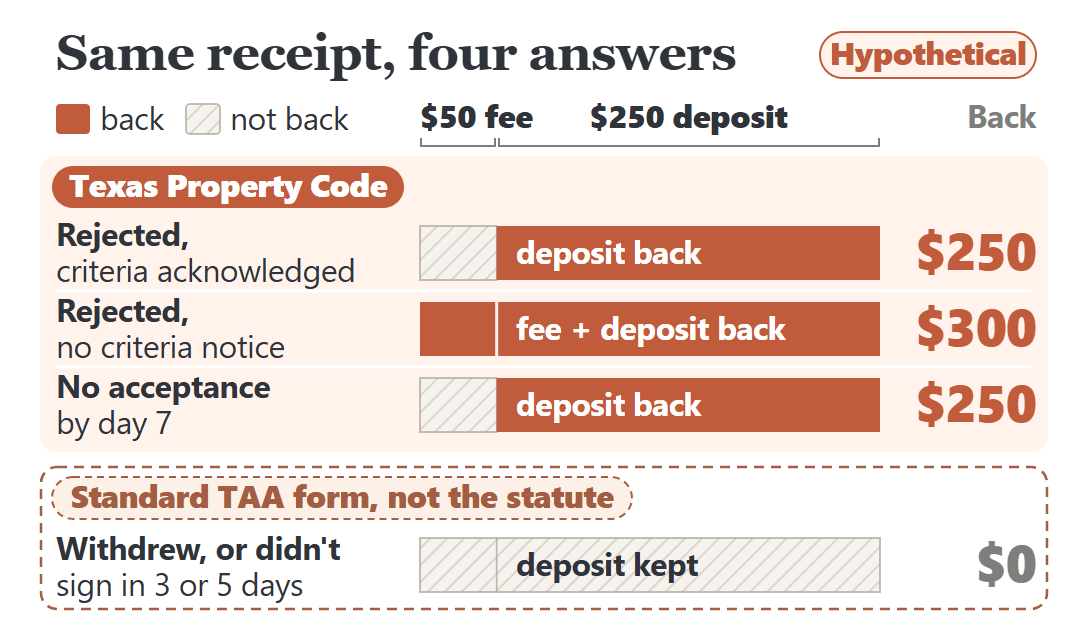
Same receipt, four answers. That’s why no single dollar figure answers “do I get it back.” Your row does.
Applying with someone else? Under the statute, a landlord’s rejection of one co-applicant counts as a rejection of all of you.
Backing Out Is Where the Standard Form Keeps the Deposit
Nothing in the Texas statute gives you a refund for withdrawing an application. What happens then is set by the form you signed.
The TAA standard application is direct about it. If you or a co-applicant withdraws, or tells the landlord you’ve changed your mind, the landlord is entitled to keep all application deposits as liquidated damages. The fee was nonrefundable to begin with.
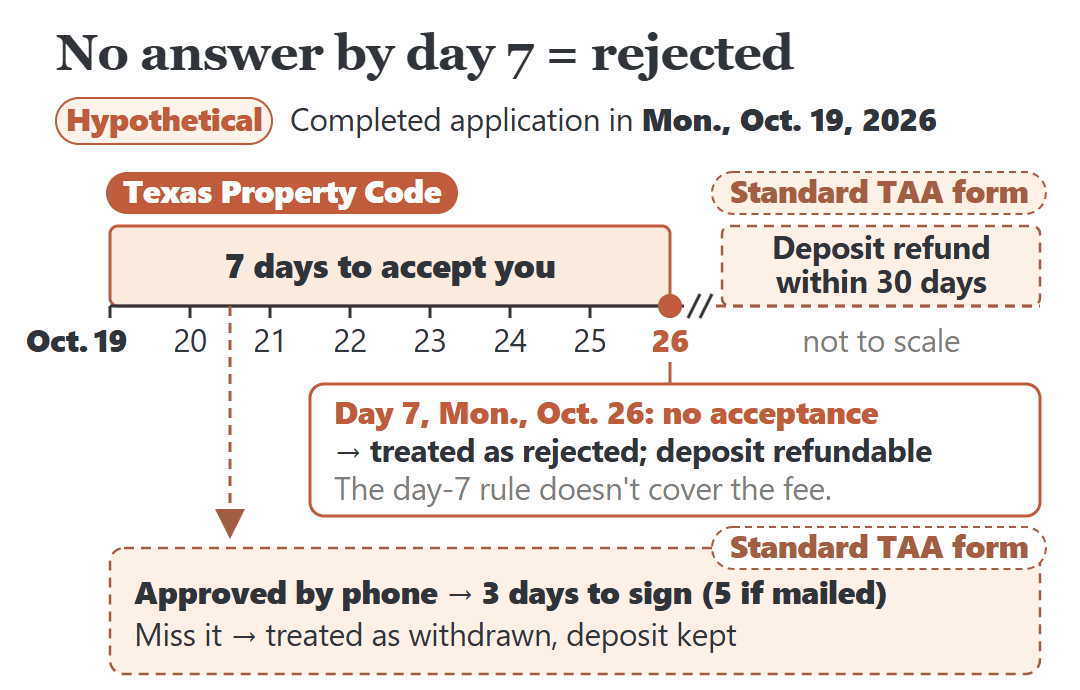
Approval starts a short clock on the same form. Unless the landlord agrees otherwise in writing, every applicant must sign the lease within 3 days of an approval given in person or by phone, or within 5 days of an approval sent by mail. Miss it, and the application is treated as withdrawn, so the deposit can be kept.
If your landlord used another form, read its paragraphs on withdrawal and approval. You may also come across pages describing a refund for withdrawing before an application is processed, or a $500 penalty on landlords; those were bills in 2015 and 2025 that didn’t become law.
The tenant-rights site Texas Tenant Advisor (texastenant.org) puts the practical side plainly: “you should never pay an application deposit if you are not certain that you will move into the unit if approved.” On the standard form, a deposit works less like a placeholder and more like a commitment.
Day 7 Counts From the Day a Completed Application Went In
The seven days start when you submit a completed application on the landlord’s form. If the landlord had no form and simply took a deposit, they start the day it accepted the deposit. Keep whatever shows that date.
Take the hypothetical applicant again, with the $250 deposit. The completed application went in Monday, Oct. 19, 2026, so day 7 is Monday, Oct. 26. If no acceptance has reached the applicant on or before Oct. 26, the applicant is treated as rejected and the $250 is refundable.
An acceptance counts if it came by phone to you, a co-applicant or someone living with you by that day, or by mail postmarked by that day. If day 7 falls on a Saturday, Sunday or holiday, the TAA form and the TAA’s renter guidance move the deadline to the next business day.
Two cautions. The standard form says the 7-day period can be changed only by a separate written agreement, so check whether you signed one. And a day-7 rejection makes the deposit refundable; the law doesn’t say it brings back the fee.
From there, the standard TAA form promises to refund application deposits within 30 days of a disapproval, including one that happens by day 7. That 30 days is the form’s promise, not a deadline written into the statute. With co-applicants, the form allows one check made out to all of you and mailed to one.
Asking for It in Writing, and What Bad Faith Costs a Landlord
Put the request in writing and keep a copy. Texas law lets you ask the landlord to mail a refund to an address you give, and the landlord has to send it there.
Texas Tenant Advisor’s Applications & Deposits page offers a “Demand for Return of Application Deposit” letter. A shorter version you can adapt:
“On [date], I submitted a completed rental application for [unit address] and paid an application deposit of $[amount]. [I was told on (date) that my application was denied. / I have not received notice of acceptance, and the seventh day after I submitted it was (date).] Please mail the refund of my application deposit to [your address]. [If denied and you never signed a criteria acknowledgment: I did not sign an acknowledgment of your tenant selection criteria, so please also refund my $(amount) application fee under Texas Property Code §92.3515.]”
If the landlord keeps money it owes you in bad faith, Texas law makes it liable for $100, plus three times the amount wrongfully kept, plus your reasonable attorney’s fees. Bad faith is a condition, not something that follows automatically from a slow refund.
On the hypothetical receipt, a $250 deposit kept in bad faith works out to $100 + 3 × $250 = $850, plus attorney’s fees. In the no-criteria-notice case, with $300 owed, it’s $100 + 3 × $300 = $1,000, plus fees. Those show how the formula works, not what a court would award.
A clause in a rental application that waives these rules is void, so fine print can’t sign them away. If the letter goes unanswered, a claim can go to justice court, which handles cases up to $20,000, filed in the precinct where the rental is.
Matching Your Paperwork to a Row
Start with your own paper: the amount labeled fee, the amount labeled deposit, whether you signed a criteria acknowledgment, and the date your completed application went in. If your landlord used the standard TAA form, add its withdrawal and approval paragraphs.
Then hold that paper against the table above. If your row says money is owed, ask for it in writing with your mailing address and the dates you counted, and keep the form’s 30-day mark in view.
Approved and moving in instead? Once the lease is signed, its own fees take over; here’s how Texas limits rent late fees and the earliest day one can start.
Whichever row you land in, a dated written request puts your count and your claim on the record.
Sources: Texas Property Code Chapter 92, Subchapter I, §§92.351–92.355 (rental applications); Texas Government Code §27.031 (justice court limit); the Texas Apartment Association’s Applying for Rental Housing page and its 2025 standard rental application (October 2025 sample); the tenant-rights site Texas Tenant Advisor (texastenant.org), Applications & Deposits. Checked Oct. 19, 2026. The applicant with the $50 fee, the $250 deposit and the Oct. 19 application is a hypothetical example, not a real case or a typical Texas amount. This is general information, not legal advice.