Every month Georgia’s utility regulator, the PSC, publishes a chart of what certificated gas marketers charge. It works out a “Total Monthly Bill for Typical Customer” this way: the marketer’s rate times a low monthly usage figure that changes with the month (13 therms on the September 2026 chart, 18 therms on the October 2026 chart), plus the customer service charge, plus the base charge.
Either figure is a low-usage month. Winter is when most of a home’s gas gets used, and at winter usage the same two plans can swap places. A plan that looks cheaper in the chart’s typical month can cost more across your year, and the reverse can happen too.
If Atlanta Gas Light delivers your gas, compare marketers on your own year: for each plan, take your therms for each month times its price per therm, then add 12 months of its customer service charge. Atlanta Gas Light’s charge stays the same whichever marketer you pick, so leave it out of the comparison. Before you sign, check whether the price is variable or fixed, when an intro rate or fixed term ends, and what the exit fee is.
This applies to homes where Atlanta Gas Light delivers the gas. If another utility delivers yours, this choice may not apply, so check your bill. The rules quoted here come from the Georgia PSC and Atlanta Gas Light’s tariff, checked October 16, 2026.
The Charge That Stays Put When You Switch
Two companies show up on the bill. Atlanta Gas Light (AGL) delivers the gas and bills a base charge. Your marketer sells you the gas and sets its own price, on a variable or a fixed plan. AGL’s rates page is direct about it: “No matter which marketer you select, you’ll see charges from our company, Atlanta Gas Light, on your bill… If you change marketers, this charge will remain the same.”
So when you change marketers, only these things change:
- The price per therm. The PSC’s chart notes that its prices include interstate capacity and balancing charges unless otherwise noted.
- The monthly customer service charge.
- The plan terms: variable or fixed, how long the term runs, and any exit fee.
Leave the AGL charge out when you compare marketers, but keep it in your household budget. AGL bills higher base charges in winter and lower ones in summer, whichever marketer you use, so a bigger winter bill isn’t automatically your marketer’s doing.
Your Therms Are Already on Your Bills
Georgia’s billing rules for marketers require each bill to show, among other things, the therms you used during the meter-reading period and the price per therm, itemized charges including the exact base charge Atlanta Gas Light is billing, and whether your rate plan is fixed or variable.
One bill covers one period, though. To get a year, collect the therms from your past bills, or ask your marketer for your monthly usage. Write down twelve numbers, one per month, plus your current price per therm, your monthly service charge and your plan type.
If you’re on a fixed plan or an intro rate, add its end date and exit fee. The disclosure statement you received when you signed up lists the price, the length of the agreement, its start and expiration dates, and any cancellation fee.
Run the Year, Then Compare
For every plan you’re considering:
(your therms for each month × that plan’s price per therm) + (12 × its monthly customer service charge)
Compare the totals. Because winter carries most of the therms, the price per therm does most of the work in winter, and the service charge matters more in summer, when you use little gas. On a variable plan the price can change every month, so your total is an estimate, not a quote.
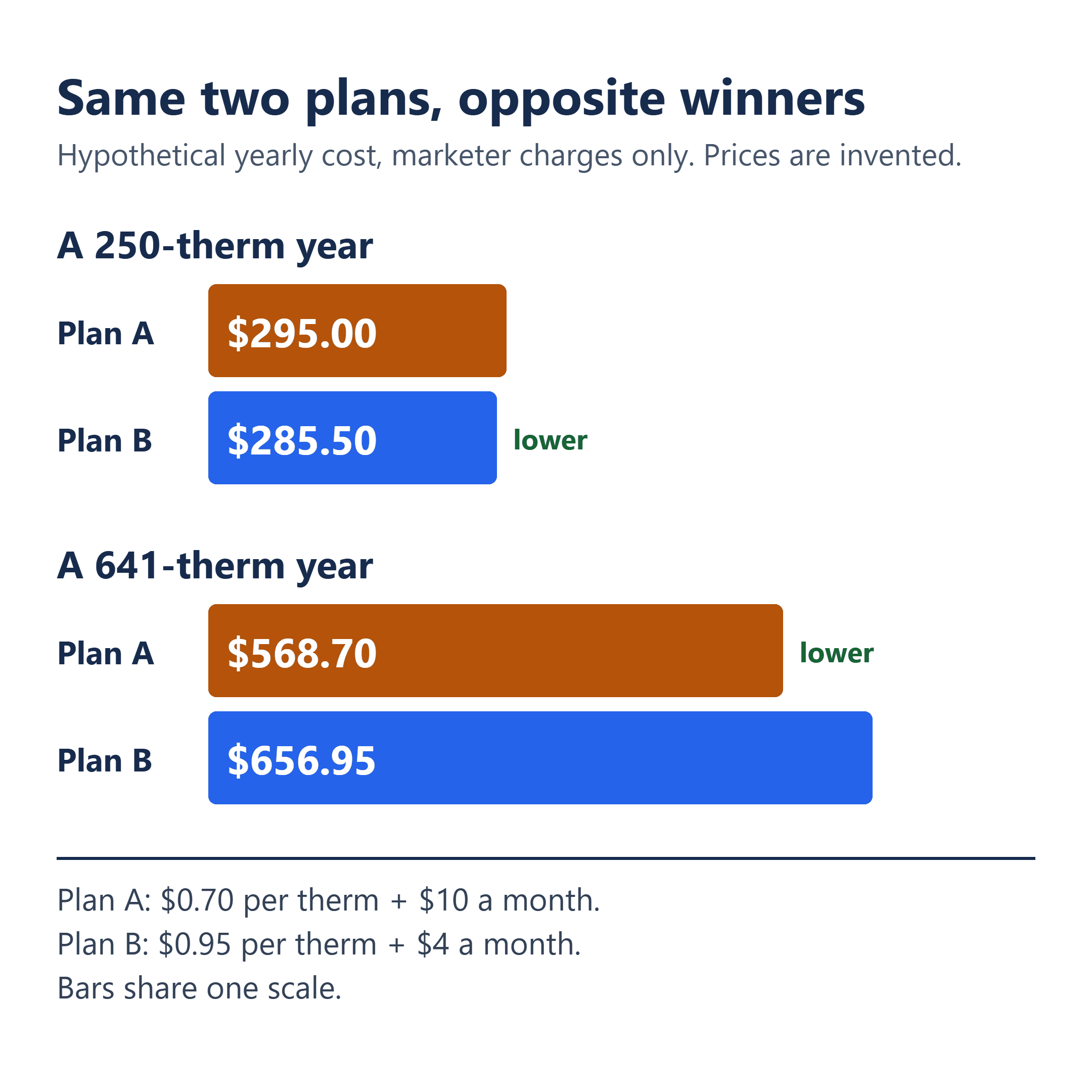
Here’s a hypothetical with invented round numbers, not real marketer prices. Plan A charges $0.70 per therm plus a $10 monthly service charge. Plan B charges $0.95 per therm plus $4 a month. Leave the AGL charge out, since it’s the same for both, and run them at different levels of usage:
| Usage | Plan A | Plan B |
|---|---|---|
| One 13-therm month | $19.10 | $16.35 |
| One 100-therm month | $80.00 | $99.00 |
| A 250-therm year | $295.00 | $285.50 |
| A 641-therm year | $568.70 | $656.95 |
Plan B wins the chart-style month and the light-use year. Plan A wins the winter month and the heavier year; 641 therms is the PSC chart’s own typical year. Neither plan is “the cheap one.” The answer comes from how many therms your home uses across all 12 months, and with real plans the numbers will be different, which is why you run your own.
Where the PSC chart helps, and where it doesn’t
The PSC’s monthly pricing chart is the easiest place to collect each plan’s inputs. Marketers must file their prices by the 5th of each month, and the chart says not every available plan is listed. A few things to keep in mind when reading it:
- The typical monthly bill is one low-usage month, a figure that changes with the month (13 therms on the September 2026 chart, 18 therms on the October 2026 chart), plus the AGL charge. It lines plans up; it isn’t what you’ll pay.
- The annual column uses the PSC’s typical year of 641 therms. That’s closer to a real year, but it still isn’t your home’s usage.
- If a marketer’s service charge depends on credit, the chart shows the highest charge in that range. Ask which one would apply to you.
What I’d take from the chart is each plan’s price per therm and service charge, and nothing from its bottom-line column. Those two inputs go into your own twelve months.
What a Variable Plan Leaves Open, and What a Fixed Plan Locks
Neither type is cheaper by rule. Whether fixed beats variable over a term depends on future gas prices, and nobody publishes those. What the rules do spell out is what each type holds steady.
Variable and intro plans
On a variable plan, the PSC says the price “changes every month depending on the market,” and “Marketers may offer different rates based on credit history.” Within a billing cycle, you can’t be billed more than the price on file at the start of that cycle. A new or additional service charge or fee on a variable plan needs written notice at least 25 days before it takes effect.
Intro rates end. One promotion on the PSC’s September 2026 chart, for example, runs a promo price and a $0 service charge “for first 2 months,” after which the customer is billed under the marketer’s standard variable plan, with the service charge and price per therm based on credit criteria. If you’re on an intro rate, find out when yours ends and exactly which plan and charges come next.
Fixed plans
A fixed plan keeps the same price per therm for the term, “usually 12 months,” and the marketer can’t raise the service charge or add new charges during it. Your bill still moves with your usage: “Your bill may increase or decrease monthly based solely upon the amount of gas you consumed during the billing cycle.”
Leaving early can cost an exit fee, and that fee is set plan by plan. The PSC’s fixed-rate chart has an exit fee column, and at least one marketer’s fee changes with the term length. Get the exact figure for the plan in front of you before you sign. If your move to Georgia also means leaving a Texas electricity plan before its term ends, that state works on its own rules, covered in when a Texas electricity early termination fee doesn’t apply, and how to read the one on your EFL.
If Your Fixed Term Ends Soon, Two Notices Come First
Under the PSC’s terms-of-service rule, your marketer must send a first notice at least two billing cycles or 60 days before the term expires, listing your options, including the option to seek another marketer. A second notice must arrive at least 25 days before expiration, with the new offer and the plan you’ll be placed on if you don’t say what you want.
Read both, and use the time they give you to run the comparison above before the end date, not after.
If you say nothing, the marketer can’t put you on a new fixed term unless your current contract provides for it. If it does and you’re placed on a new fixed term that way, you can leave with no exit fee for 90 days from the start of that new term, and the new term can’t be longer than the old one. That 90-day window doesn’t cover a fixed term you chose yourself.
Signing Up: The 19th, the Three-Day Window and the Switching Charge
The PSC’s consumer guide says, “If you sign up with a marketer by the 19th day of a given month, your switch may become effective the first day of the following month.”
A marketer can’t charge you a switching service charge if you haven’t changed marketers in the previous 12 months. That’s a different thing from a fixed plan’s exit fee. A marketer also can’t require advance notice before you leave, except as provided in a legally binding contract. And you can cancel within three days after you receive the enrollment materials, or a notice of changed terms or new charges.
Before enrolling, I’d get the inputs for your year confirmed in writing, because the chart may show a different service charge from the one you’ll actually pay:
“Which price per therm and which monthly customer service charge will apply to me after your credit check? Is this plan variable or fixed, when does the intro period or term end, what plan follows it, and what is the exit fee?”
Twelve Months of Therms, Not One
The chart’s low-usage month, which changes from chart to chart (13 therms in September 2026, 18 in October 2026), is a fair way to line plans up and a poor way to choose one. The twelve numbers on your own bills make the choice. Put each candidate plan’s price per therm and service charge against them, check the term, the end date and the exit fee, and sign up by the 19th if you want the switch to have a chance of starting next month.
If you’re 65 or older with limited income, ask Atlanta Gas Light about its senior discount. It reduces the AGL charge whichever marketer you use. If marketers turn you down, the PSC has a Regulated Provider for qualifying low-income customers and for customers who can’t get or keep gas service.
Based on Georgia PSC rules, the PSC’s October 2026 pricing chart notes and Atlanta Gas Light’s tariff, checked October 16, 2026. This covers residential service where Atlanta Gas Light delivers the gas. Nothing here recommends a marketer, and your own bills and each plan’s disclosure statement decide the final numbers.