Here’s a right most people don’t know they have until the truck is in the driveway: on a move between states, the new total the mover names at the door isn’t automatically what you have to pay to get your things off the truck.
Federal rules for interstate household moves set the most a mover can require before it hands over your shipment. That limit doesn’t come from the mover’s new number. It comes from the estimate you signed.
The most the mover can require at delivery is 100% of a binding estimate, or 110% of a non-binding estimate. The base is the estimate you signed. If you signed a new one before loading, it’s that one, and an estimate can’t be changed after loading. Two things can be added: services you requested after the bill of lading was issued, and charges the mover’s tariff calls impracticable operations, which can’t be more than 15% of all the other charges due at delivery.
That figure is a ceiling, not an amount you have to reach. If the mover’s bill at delivery is at or under it, that bill is what’s due. If the bill is over it, you can’t be required to pay more than the ceiling: pay up to it in a payment form listed on your paperwork, and the mover must hand over your shipment. If you don’t pay what’s due at delivery, the mover can put the shipment in storage at your expense.
Anything above the ceiling isn’t wiped out. On a non-binding estimate, the remaining charges are billed after delivery. On a binding estimate, the mover can’t collect more than the estimate, apart from those two add-ons and extra services billed later. A later bill you think is wrong can go to the mover’s arbitration program.
These are the federal rules for a move between states with a hired mover you pay yourself (49 CFR Part 375). A move within one state follows that state’s rules, and a move within the same local metro area (a “commercial zone”) isn’t covered by these federal rules even if it crosses a state line; the rules’ own example is a move between Brooklyn, New York, and Hackensack, New Jersey. Containers you load and unload yourself and moves someone else pays for aren’t covered here either.
The Estimate That Counts Is the One You Signed Before Loading
Pull out your estimate and your bill of lading. Five things on them set your own numbers:
- The estimate type. The estimate has to say whether it’s binding or non-binding. A non-binding estimate also has to state that you won’t be required to pay more than 110% of it at delivery.
- The estimate total. You and the mover both have to sign the estimate, and the mover has to give you a dated copy.
- Any new estimate you signed before loading. If there is one, its total is the one that counts.
- The payment forms. The estimate has to specify the form of payment the mover will honor at delivery.
- The maximum-at-delivery line. The bill of lading has to show the maximum amount the mover will demand at delivery to release the shipment.
Also keep any written attachment to the bill of lading you signed for extra services. If your estimate uses some other label, look for the words binding or non-binding and the maximum-at-delivery line on your bill of lading.
Why the third item matters: the rules let an estimate be amended before loading if you and the mover both agree. If the mover believes you’ve added goods or services, it has to reaffirm the estimate or prepare a new one for you to sign before loading. With a binding estimate, you can instead agree in writing to treat it as non-binding, which changes the percentage. If you can’t reach an agreement, the mover “is not required to service the shipment.” Once the shipment is loaded without a new signed estimate, the original stands, and nothing can be amended after loading.
Work Out Your Own Ceiling
Apply the percentage for your estimate type to your estimate total, not to the mover’s new total. Then add only the add-ons that actually apply to you.
| Your estimate | Most required at delivery | Charges above that |
|---|---|---|
| Binding | 100% of the estimate you signed | The mover can’t collect more, apart from the add-ons and extra services billed later |
| Non-binding | 110% of the estimate you signed | Billed after 30 days from delivery, based on actual weight and the mover’s tariff |
On top of either row, the mover can add services you requested after the bill of lading was issued, and impracticable-operations charges up to 15% of all the other charges due at delivery.
Here’s a hypothetical to show the arithmetic. Say the estimate you signed totals $4,000 and neither add-on applies. If it’s non-binding, the mover can require up to $4,400 at delivery. If it’s binding, the figure is $4,000. If the mover’s final total on the non-binding estimate comes to $5,200, the $800 above $4,400 is billed after delivery, not collected at the door. Your own estimate total sets your number, and any add-ons go on top.
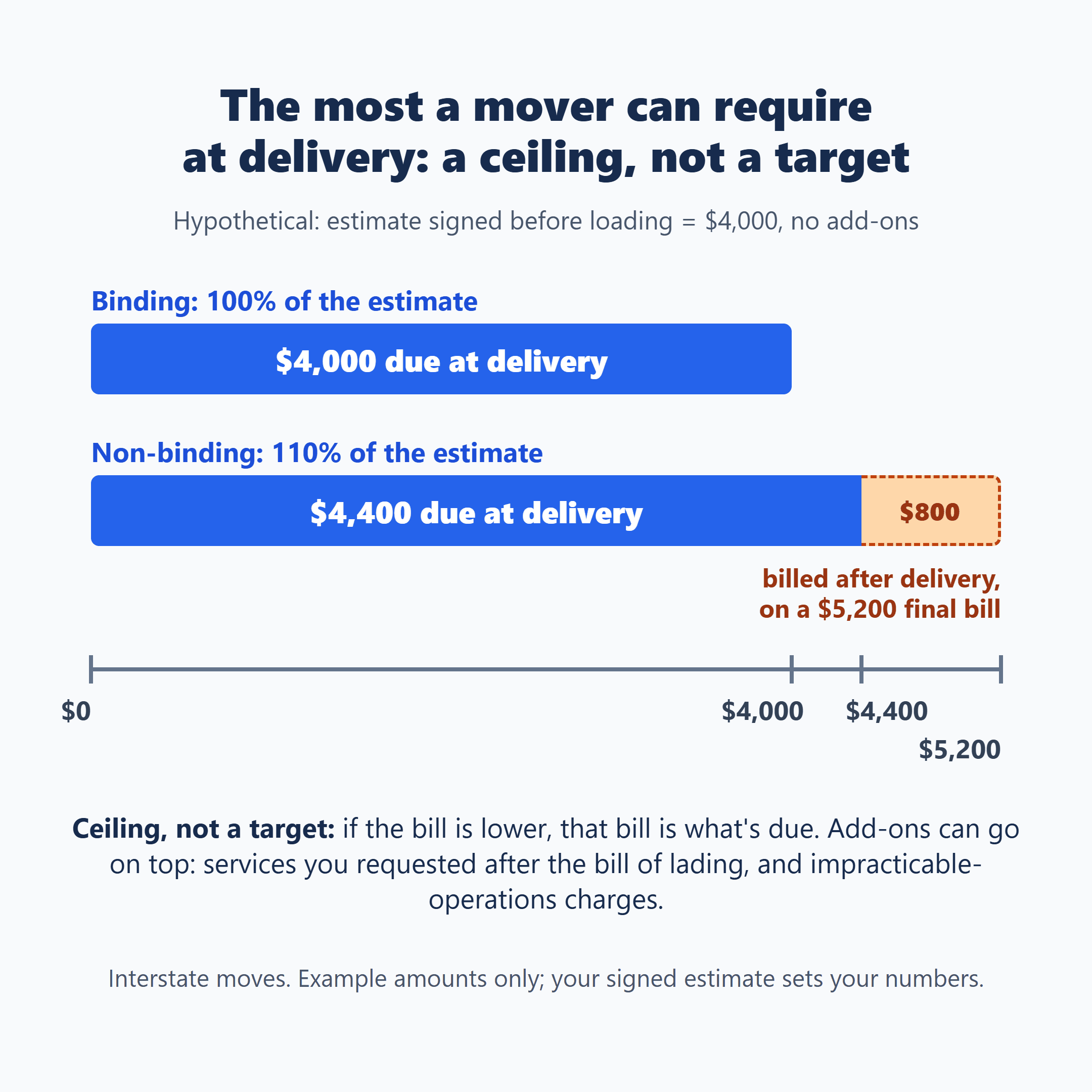
Check your result against the maximum-at-delivery line on your bill of lading and against what the crew is asking for. If they’re asking for more, the next step is to find out what the extra is.
When the Crew Names Extra Charges, Sort Them Before You Pay
Ask the mover to name each charge above the estimate. Each one falls into a group, and the group decides when it can be collected:
- Services you requested after the bill of lading was issued. These can be collected at delivery, in full.
- Charges the mover’s tariff calls impracticable operations. These can be collected at delivery, but only up to 15% of all the other charges due at delivery.
- Services the mover says are necessary that you didn’t request. Here’s the second right people rarely hear about. The mover has to tell you what the services are before performing them and give you at least one hour to decide. If you agree, you sign a written attachment to the bill of lading and the mover bills you after 30 days from delivery. If you don’t, the mover should perform only what’s required to complete the delivery and bill you for that after 30 days from delivery.
- Charges for things like elevators or long carries. The mover is supposed to work these out before preparing the bill of lading. If it didn’t ask you about them and didn’t determine them by then, it has to deliver and bill you after 30 days for them.
Whether a particular fee is impracticable operations or an ordinary added service depends on the mover’s tariff, not on what it’s called at the door. So ask:
My signed estimate is [binding / non-binding] for [estimate total], and the bill of lading shows a maximum at delivery of [amount]. For each charge above that, can you tell me whether it’s a service I requested after the bill of lading, an impracticable-operations charge (and where it is in your tariff), or something you’ll bill after delivery?
Billed later doesn’t mean not owed. It means it isn’t a condition of getting your things off the truck.
At or Over the Ceiling: What Gets Your Shipment Off the Truck
Your ceiling (100% of a binding estimate or 110% of a non-binding estimate, plus either add-on that actually applies) is the most the mover can require at delivery. Compare it with what the mover is asking for:
- The bill is at or under your ceiling. That bill is what’s due at delivery.
- The bill is over your ceiling. You can’t be required to pay more than the ceiling to get your shipment. Once you pay up to it, the mover has to give you possession at delivery. The rest is handled after delivery.
The federal consumer booklet movers must hand out puts it bluntly: if the mover doesn’t relinquish possession after that payment, “the mover is holding your shipment hostage in violation of Federal law” (Your Rights and Responsibilities When You Move).
That right comes with two conditions worth taking seriously. The first is the payment form. The mover has to accept the payment forms written on your estimate and bill of lading unless you agree in writing to a change, and the booklet warns: “Do not assume your mover will accept payment by credit card unless it is clearly indicated on the bill of lading.” Be ready to cover up to your ceiling in a listed form.
The second is paying what’s due. If you don’t pay the charges due at delivery, which can’t be more than your ceiling, the mover can refuse to deliver under the bill of lading and place your shipment in storage at your expense. If only part of your shipment is delivered, the mover can require only the same percentage, by weight, of the binding estimate or of 110% of the non-binding estimate.
The Rest Comes Later, as a Bill You Can Challenge
Paying at delivery doesn’t close the account. On a non-binding estimate, your final charges are based on the actual weight of your shipment and the mover’s tariff. The booklet is plain about it: “This does not excuse you from paying all the charges due on your shipment. The mover will bill you for any remaining charges after 30 days from delivery.” On a binding estimate, the mover can’t collect more than the estimate except for the two add-ons and the extra services described above.
If you think the later bill is wrong, every interstate mover has to have an arbitration program for disputes over charges beyond those collected at delivery, and it has to give you a summary of the program before the bill of lading. The mover can’t charge you more than half the cost of starting the arbitration. For a claim of $10,000 or less, arbitration is binding if you request it, meaning the result binds both you and the mover; above $10,000, the mover has to agree. A decision is due within 60 days of the written notice of the dispute, and that period can be extended. Going to court instead of arbitration is also an option.
Have Your Number Before the Truck Arrives
The time to work out your ceiling is the night before delivery, not on the curb with a crew waiting. If I were moving, I’d write three things on one page: the estimate type and total from the estimate I signed last before loading, the ceiling that gives me, and the payment forms listed on the paperwork. Then I’d check that the maximum-at-delivery line on the bill of lading matches.
At the door, sort any new charges into their groups. Pay the bill if it’s within your ceiling, or no more than the ceiling if it’s over, in a listed form, and take your things. Keep every page the mover hands you, because the later bill and any arbitration will run off those papers.
Once the boxes are inside, the next thing to check is what came off the truck broken or didn’t come off at all; the deadlines for that are in movers lost or damaged your things on an interstate move: what they owe you and how long you have to file a claim.
You can also report a mover to the Federal Motor Carrier Safety Administration through its National Consumer Complaint Database. That’s a report to the agency, not a way to settle the bill.
Based on 49 CFR Part 375 and its consumer booklet (Appendix A), checked October 16, 2026. Interstate moves only: a move within one state follows that state’s rules, and a move within the same local metro area (a “commercial zone”) isn’t covered by these federal rules even if it crosses a state line.