New York City’s Department of Environmental Protection has a number on its toilet-leak page that deserves a second read. Water can run through a stuck-open fill valve at three to five gallons a minute, “up to 4,000 gallons of water being wasted each day.”
Price that at this year’s rates and the worst case is roughly $74 a day, or about $2,200 over 30 days. That’s my conversion of DEP’s figure, using the FY2027 water rate of $5.35 per 100 cubic feet plus the wastewater charge, which is 159% of the water charge. It isn’t anyone’s actual bill, but it shows how a quarterly bill can turn into a shock.
The relief people usually mention is DEP’s Leak Forgiveness Program, often summed up as “DEP forgives half.” Half is the best case, not the rule.
If you own a New York City property on metered water billing and a leak pushed your average daily use to at least double normal, DEP can cut that high bill by up to one half, but the revised bill can’t go below 150% of a normal bill for the same number of days. If the math gives a credit under $50, the credit is $50, under the rule in effect since July 1, 2026.
Miss the deadline and the formula never comes into play. The leak has to be repaired, and your written request has to reach DEP, within 120 days of the Bill Date of the first high bill. That’s not 120 days from when you noticed the leak or when the plumber left.
Does Your Bill Clear the Double-Normal Line?
Start with who can ask. The program is for the property owner, or the owner’s authorized representative, on metered billing. DEP bills owners, so if you rent, the request is your landlord’s to make. Larger buildings on the flat per-unit Multi-family Conservation Program aren’t billed on meter readings, so this formula doesn’t fit them.
Then the line itself: the leak bill’s average daily use has to be at least 200% of the daily use on your most recent representative bill. Below double, there’s no forgiveness at all.
Compare daily use, not the two dollar totals. Bills can cover different numbers of days, and rates went up 6.0% on July 1, so a dollar comparison can mislead. Divide the water used on each bill by the days in its billing period, then compare the two daily figures.
Two more checks. Every kind of leak counts, including toilets, sinks and showers, not only burst pipes or a broken service line. And forgiveness is granted only once per owner per property in any two-year period, counted from the original high bill’s date, so a second leak next year won’t get the same help.
One narrow exception: if the period before the high bill was estimated for at least 180 days for reasons outside your control, the line drops to 150%. And if the bill is wrong for some other reason, such as a meter or billing error, that’s a general dispute, not a leak request; DEP’s rules give four years from the Bill Date for those.
If the surprise is on your gas or electric bill rather than water, that’s a different set of New York rules; I’ve covered them in how to tell which past months a New York gas or electric utility can still charge.
Half Is a Ceiling: Work Out What You’d Still Owe
The NYC Water Board’s rate schedule spells out the math. You can run it with two numbers from your own bills:
- Normal bill for the same days. Take your normal daily use, multiply by the number of days on the high bill, and price it at the rates in effect for the high-bill period. If your last normal bill covered about the same days at the same rates, its amount is close.
- Half the high bill. Divide the high bill by two.
- Your revised bill is the larger of half the high bill and 1.5 times the normal bill.
- Your credit is the high bill minus the revised bill. If that comes to less than $50, the credit is $50.
Here’s how that plays out for four hypothetical households. None of these are real customers’ bills, and the dollar amounts aren’t typical New York City bills.
| Household (assumed) | Normal bill, same days | High bill | Revised bill | Credit |
|---|---|---|---|---|
| A: toilet ran for weeks (6.4× normal) | $280 | $1,800 | $900 | $900 (half) |
| B: slow leak, fixed (2.5×) | $280 | $700 | $420 | $280 (floor) |
| C: small user (2.1×) | $70 | $150 | $100 | $50 (minimum) |
| D: just under the line (1.8×) | $280 | $500 | $500 | $0 (doesn’t qualify) |
Household A gets the full half: $1,800 ÷ 2 = $900, well above the $420 floor (1.5 × $280). Household B doesn’t. Half of $700 is $350, which is below the $420 floor, so B still owes $420 and gets $280 off, 40% of the bill.
That’s the pattern worth knowing before you estimate anything. The full half only applies when the high bill is at least three times a normal bill for the same days. Between double and triple, the 150% floor decides, and the credit is smaller than half. For a household whose normal bill for those days is an assumed $280, that switch happens at $840.
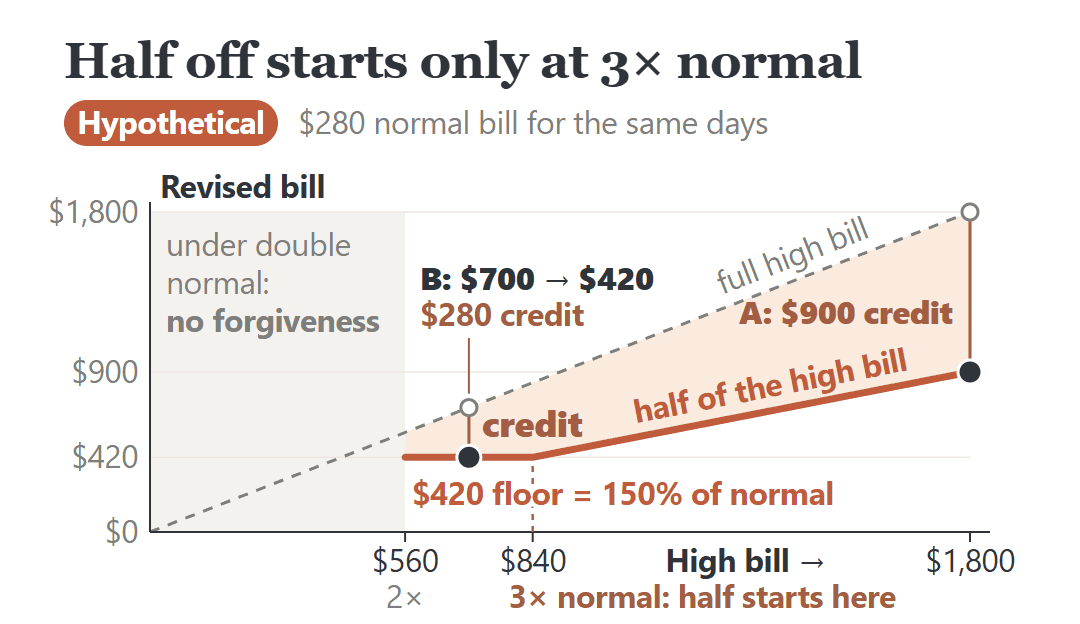
Household C shows what the new $50 minimum does. Half of $150 is $75, but the floor is 1.5 × $70 = $105, which leaves a calculated credit of $45. Because that’s under $50, the credit becomes $50 and the bill $100. Household D’s leak raised its use to 1.8 times normal, so it doesn’t qualify at all.
My advice on the math: run it so you know roughly what to expect, but don’t let it hold up the request. DEP does the official calculation, and the deadline doesn’t wait for yours.
The 120 Days Start on the Bill Date, Not the Day You Found the Leak
The Water Board defines the Bill Date as the date a bill was issued on DEP’s billing system. Both clocks run from the Bill Date of the first high bill: the repair, and your written request.
Here’s why that catches people. DEP’s meters are read every four hours by an automated meter reading (AMR) device, but most customers are billed once every three months. A leak can run for weeks before the bill that shows it even exists. DEP says it contacts customers when it notices unusual spikes, but that’s not something to count on as your warning.
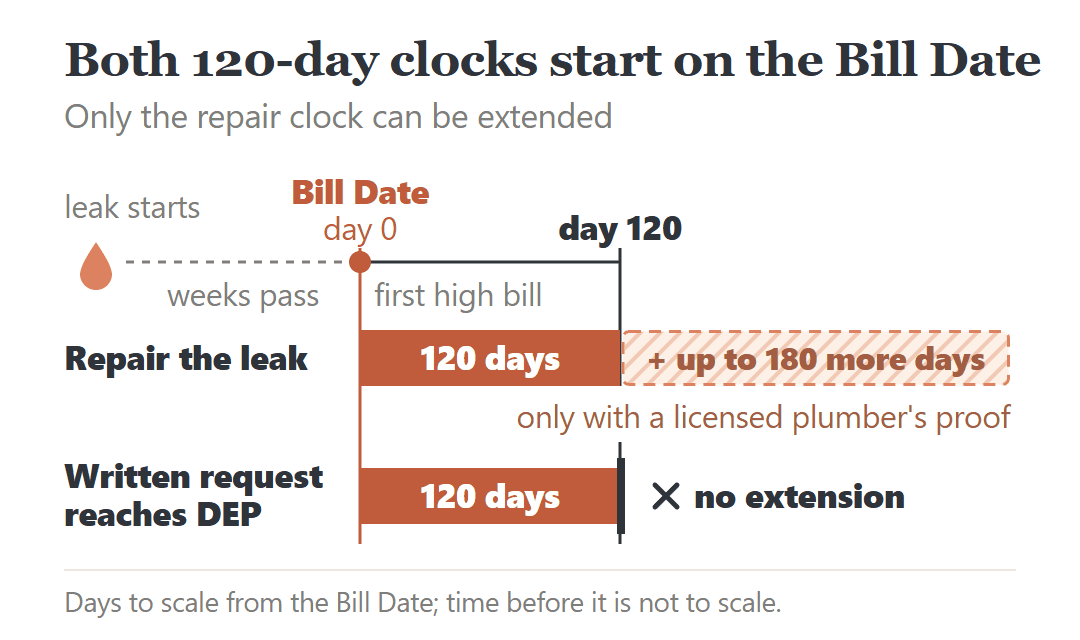
There’s one extension, and it’s narrower than it sounds. If a licensed plumber documents that the leak couldn’t reasonably have been found within the 120-day repair period, DEP may give you up to 180 more days to make the repair. The rule text extends the repair time only. Send the written request inside the original 120 days, even while the repair is still pending.
What missing the window can look like: in May 2018, NY1 reported on a Canarsie couple who got a $44,064.60 water bill after a basement pipe leak. DEP said they had missed the 120-day window. According to the report, after a lawyer got involved the bill was cut to about $23,000, payable over 10 years plus interest. That’s one news report from 2018, not an outcome anyone else should expect.
Filing the Request: Where It Goes and What Proof DEP Wants
DEP takes the request two ways. You can mail a written request to the address DEP prints for the program:
BCS Correspondence—Leak Program
59-17 Junction Blvd. 7th Floor
Flushing, NY 11373
Or you can create a high bill dispute online in your My DEP Account. Either way, DEP answers in writing, and an approved credit shows up on your next bill.
Proof of repair depends on your meter. If it has a working AMR device, DEP can confirm the repair from the meter readings and you don’t need to send proof. Without one, you’ll need an itemized, dated bill from a licensed plumber or a similarly verifiable document. Even with AMR, I’d keep the plumber’s itemized bill. It’s also the document you’d need if you ask for the hidden-leak repair extension.
DEP doesn’t publish a sample letter or a required form for this program; it asks for a written request. These are the details I’d put in so nothing has to be asked twice:
- Your DEP account number and the property address
- The Bill Date and amount of the first high bill
- What leaked, and the date it was repaired
- The plumber’s itemized, dated bill, if your meter has no working AMR device
“I am requesting Leak Forgiveness for account [number] at [property address]. The bill dated [Bill Date] was unusually high because of a leak at [toilet / sink / pipe / service line], which was repaired on [date]. [The plumber’s itemized bill is enclosed.] Please apply the Leak Forgiveness Program to this bill, and also review it under the Metered Bill Cap if it qualifies.”
If you mail it, use a method that gives you a delivery record, since the request has to reach DEP within the 120 days. And if DEP asks to inspect the property, allow it: any leak an inspection finds has to be fixed within 10 days, with a plumber’s report.
When the Leak Was Hidden, or What’s Left Is Still Too Much
For a large, unexpected bill from a leak you couldn’t reasonably have known about, ask DEP about the Metered Bill Cap as well. For residential properties it limits metered water and sewer charges to $3,205.13 a year for the first dwelling unit and $2,135.93 a year for each additional unit.
The conditions are strict. DEP’s inspection has to find no leak or waste left at the property, you have to give access if asked, at least 70% of the toilets have to be low-flow models, and you have to ask within 120 days of the Bill Date. It’s granted once per two years and doesn’t apply to a known or knowable leak. The schedule says Leak Forgiveness doesn’t rule out the cap, so asking for both in the same request is reasonable. How the yearly cap applies to a single quarterly bill isn’t spelled out, so let DEP do that math.
Whatever remains after a credit can go on an installment payment agreement: up to 120 months, no minimum down payment required, with interest. Ask DEP for the rate and the monthly amount before you sign.
These rules are New York City’s. Other cities handle high water bills their own way; Austin, for instance, sets residential sewer charges from a winter averaging window, which I walked through in when Austin’s winter averaging window runs and what extra water costs.
Start With the Bill Date, Then Work Forward
- Find the Bill Date on the first high bill and count 120 days. That’s your deadline for both the repair and the request.
- Get the leak fixed and keep the plumber’s itemized, dated bill.
- Compare daily use on the high bill with your last normal bill. If it’s at least double, run the four-step math for a rough number.
- File in writing, by mail to the Leak Program address or as a high bill dispute in My DEP Account, well before day 120.
- If the leak was hidden and the bill is large, ask for a Metered Bill Cap review in the same request, and ask about a payment agreement for anything left.
Then set things up so the next leak shows up sooner. In My DEP Account you can track your usage, sign up for leak notifications and switch to monthly billing. With a quarterly bill, the first sign of a running toilet can arrive weeks late, and the 120 days start whether you’re ready or not. The best time to send the request is the week you have the plumber’s bill in hand.
Sources: NYC DEP’s Leak Forgiveness Program page, Billing FAQs and toilet leak page; the NYC Water Board’s Water and Wastewater Rate Schedule, effective July 1, 2026 (leak forgiveness, Metered Bill Cap, payment agreements); NY1’s May 21, 2018 report on the Canarsie bill. Checked Oct. 16, 2026. Households A through D and the $74-a-day figure are illustrations, not real customers’ bills.