The heat pump is already installed. It keeps the house warm, and every winter the electric bill arrives as usual.
But here’s a question worth asking before another heating season begins:
Is your electric company actually charging you the special Massachusetts heat pump rate?
Having a heat pump and being enrolled in the heat pump rate are two different things.
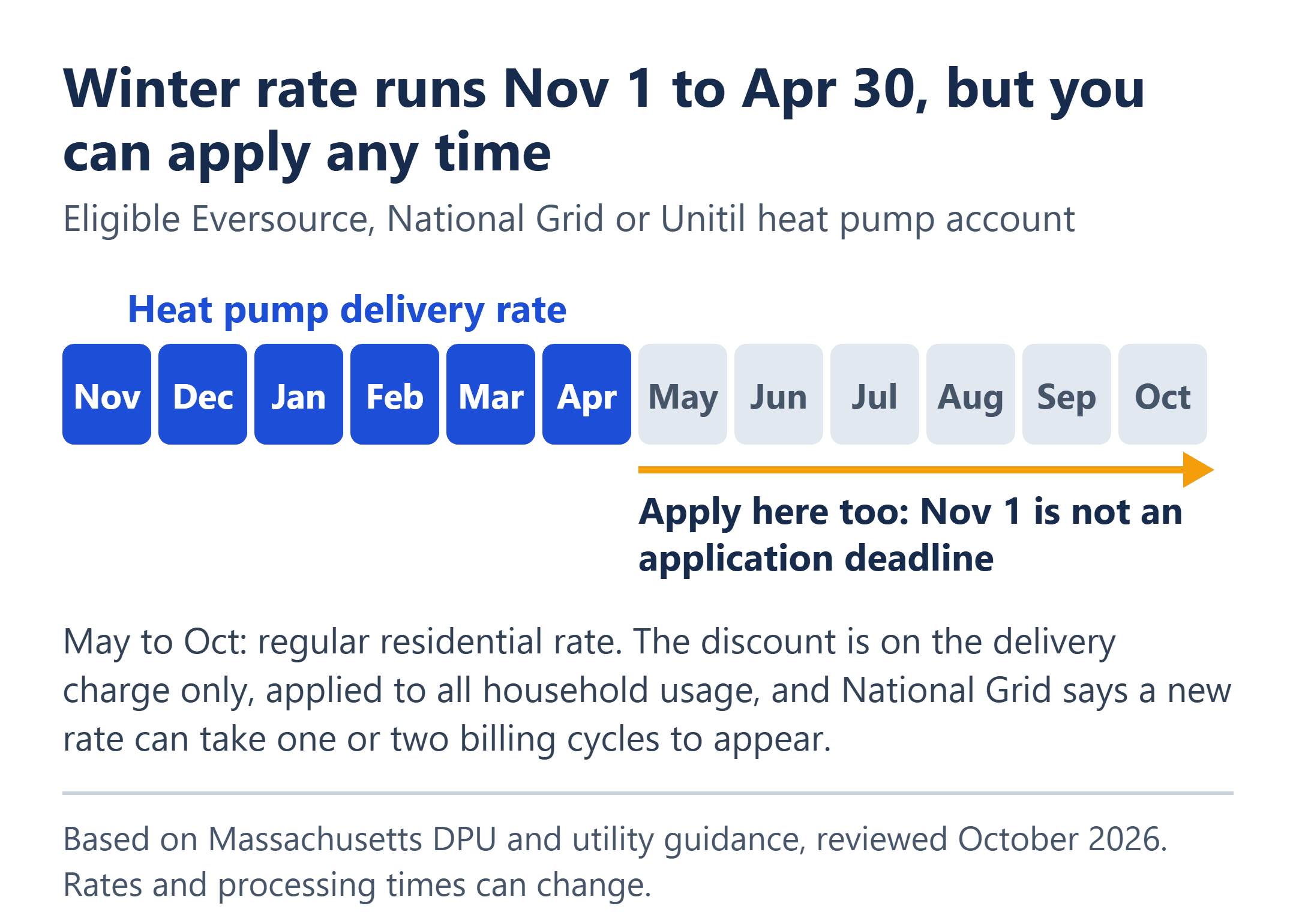
Massachusetts introduced a seasonal electricity delivery discount for eligible residential heat pump customers of Eversource, National Grid, and Unitil starting November 1, 2025. The lower rate applies during the winter heating season, November 1 through April 30.
Some households were enrolled automatically through Mass Save installation and rebate records. Others need to apply.
And if you moved into a home where someone else installed the heat pump years ago, you might not even know which category you’re in.
The good news is that you don’t have to start by hiring someone to inspect your heating system. Start with your electric bill.
Your Electric Bill May Already Have the Answer
The first thing to identify is which company delivers your electricity.
Not the company listed as your competitive electricity supplier, if you have one. The delivery utility.
For this Massachusetts program, the three participating companies are Eversource, National Grid, and Unitil.
Each has its own way of identifying a heat pump account.
| Electric utility | What to look for |
|---|---|
| Eversource | Rate code R1HP or R2HP |
| National Grid | A bill message indicating enrollment in the Heat Pump Rate |
| Unitil | HP in the Rate Code field |
These indicators come from the utilities’ published information and Mass Save guidance. Bill layouts can change, and National Grid says the savings are included in its distribution charge rather than shown as a separate discount line.
If you can’t find the indicator, don’t immediately conclude you’re ineligible.
Ask the utility which rate is currently assigned to your account.
This is particularly important before November, when the lower winter rate becomes active.
And don’t confuse the heat pump discount with a separate low-income electricity discount. Eligible households can potentially receive both, subject to their utility’s rules.
The House May Qualify Even If You Never Applied for a Rebate
Imagine two neighbors who both heat their homes with mini-splits.
One installed the system through Mass Save in 2023 and received a qualifying rebate.
The other bought a house last spring. The heat pump was already there, and the new owner has no idea when it was installed or whether the previous homeowner received an incentive.
Both households may be eligible for the seasonal rate.
But their enrollment situations could be very different.
Household A: The Mass Save installation
Utilities use Mass Save records to identify many eligible homes where qualifying heat pumps were installed or rebated since January 1, 2019.
That can lead to automatic enrollment.
But automatic enrollment isn’t the same as guaranteed enrollment.
National Grid explains that rebate processing can take several weeks and that some customers need to submit their own applications, including certain new-construction or renovation participants and customers who received its specified $250-per-ton rebate.
So even if you received a rebate, it’s worth checking your account.
Household B: The heat pump was already there
A home doesn’t necessarily lose its eligibility when someone moves out.
National Grid specifically addresses households where a previous resident installed the heat pump. The new account may be eligible for the rate, and the utility describes circumstances in which the enrollment can carry over.
But that doesn’t mean every new homeowner will automatically see the discount.
If the previous installation wasn’t identified through Mass Save records, or the new account isn’t showing the rate, the customer may need to apply.
Renters can also qualify when they hold the residential electric account and use a heat pump to heat their unit.
The important question isn’t who originally paid for the equipment. It’s whether the home has qualifying heat pump space heating and the electric account is enrolled.
A heat pump used only for air conditioning or water heating does not qualify for this particular rate.
What the Discount Actually Changes
It’s easy to misunderstand the phrase “heat pump electricity discount.”
It doesn’t mean the utility measures how many kilowatt-hours your heat pump consumes and discounts only those units.
The seasonal rate applies to all eligible household electricity usage during November through April.
That can include electricity used by the refrigerator, lights, cooking appliances, and everything else on the residential account.
The reduced rate is on the delivery side of the bill, rather than the electricity supply price.
That distinction matters because Massachusetts households may buy electricity supply through a competitive supplier or municipal aggregation program while still receiving delivery service from one of the three participating utilities.
The heat pump rate doesn’t require you to switch electricity suppliers.
And from May through October, the regular applicable residential rate returns.
So how much could you actually save?
There’s no reliable single dollar figure for every Massachusetts heat pump household.
Your savings depend on your utility, its current rates, and your electricity use.
A useful starting calculation is:
Estimated monthly delivery savings = Monthly kWh × (standard applicable delivery rate − heat pump delivery rate)
Use comparable rate components and account for any applicable differences beyond the base distribution charge.
Here’s an illustration using National Grid’s published residential rate table as checked in October 2026.
The table showed:
- Standard distribution charge: 10.924¢ per kWh
- Winter heat pump distribution charge: 6.623¢ per kWh
- Difference: 4.301¢ per kWh
Suppose a household uses 1,000 kWh in a winter month.
At those particular rates, the distribution-charge difference would be:
1,000 × $0.04301 = $43.01
That’s approximately $43 for that hypothetical month, not a promised saving or a statewide household average.
It also isn’t necessarily your total bill reduction. Other delivery components, existing discounts, and rate changes can affect the result.
The rates used in that illustration were published before the coming November 2026 winter season. Massachusetts regulators have been reviewing heat pump rate structures, including potential changes to winter transmission charges.
For your actual estimate, use the current rates in effect for your utility and billing period, not a savings figure from an older article.
The Massachusetts Department of Public Utilities heat pump rate page explains the program and links to utility rate information. Its displayed rate comparison includes values effective November 1, 2025, which should not automatically be treated as the final rates for winter 2026–27.
How to Enroll If the Rate Isn’t on Your Account
Once you’ve confirmed that your home uses a qualifying heat pump for space heating, the next step depends on your utility.
Eversource: Gather proof of the installation
Eversource provides a heat pump rate enrollment process for eligible residential customers.
Its published guidance describes submitting an application with supporting documentation, such as an installation invoice, qualifying rebate confirmation, or other accepted evidence of the heat pump.
The Massachusetts DPU’s guidance describes an online enrollment and verification process, including a 45-day verification timeframe.
Before submitting, check the current Eversource heat pump rate page for its accepted documentation and processing details.
The goal is to connect proof of qualifying space-heating equipment to the correct electric service account.
National Grid: One proof document may be enough
National Grid provides a dedicated Heat Pump Rate Enrollment Form.
It asks for your account information, service address, and confirmation that you use a heat pump to heat all or part of the home.
Its published examples of acceptable evidence include:
- A contractor installation invoice or receipt
- Proof of equipment purchase or payment
- Mass Save rebate confirmation
- An approved Massachusetts Clean Energy Center application
- A clear photo of the outdoor heat pump unit showing its model and serial number
National Grid says one accepted form of evidence is sufficient.
The electric account must be in your name.
If you have a clear photo of the outdoor unit but can’t find the old installation paperwork, that photo may be a particularly practical option—provided the required model and serial numbers are readable.
National Grid also offers a mail-in application option.
Unitil: Contact the utility to enroll
Unitil customers can start through the utility’s Massachusetts heat pump rate information.
The state’s published guidance identifies enrollment through Unitil customer service, including 1-888-301-7700, or its customer contact form.
The state guidance says Unitil customers do not need to provide additional supporting materials for the enrollment process, but should confirm that they use a heat pump for heating.
Ask Unitil to verify eligibility, the rate assigned to your account, and when the enrollment will take effect.
If you’re already enrolled, ask whether anything further is required before the coming winter season.
Don’t Mistake November 1 for an Application Deadline
November 1 is the start of the winter rate period.
It isn’t a universal last day to apply.
The participating utilities allow eligible customers to enroll outside the heating season.
National Grid, for example, explicitly says applications can be submitted from May through October and the winter rate will activate when the seasonal program resumes.
That doesn’t mean every application produces an immediate bill change.
National Grid says it may take one or two billing cycles for the rate to appear, and rebate-related automatic enrollment can take additional processing time.
Other utilities have their own verification procedures.
So if you’re reading this in October, the practical move is to check now rather than wait until the first cold-weather bill arrives.
And if you discover the issue in December or January, don’t assume you’ve missed the entire winter. Contact your utility and apply if you’re eligible.
Ask when the rate becomes effective and whether any earlier billing period can be adjusted. Don’t assume a retroactive credit is available simply because the heat pump was installed before you applied.
A Five-Minute Check Before Your Next Winter Bill
Here’s the approach I’d use for a Massachusetts home with a heat pump.
First, open the latest electric statement and identify the delivery utility.
Next, look for the heat pump rate indicator. If you don’t see it, ask the utility whether the account is enrolled.
Then consider how the heat pump got there. Was it installed through Mass Save? Was it installed before 2019? Did you move into a home where it was already present?
Those details help explain why automatic enrollment may or may not have happened.
If you aren’t enrolled, follow your utility’s application process. Have the account number and any required installation evidence ready.
Finally, take last winter’s electricity usage from your bills and compare the applicable standard and heat pump delivery rates for the coming season.
You don’t need to rely on a headline promising hundreds of dollars in savings. Your own kWh and your utility’s actual rates will give you a more useful answer.
The same habit of pricing a rate against your own usage instead of an advertised number is what we walk through in comparing Georgia natural gas marketer plans using your own usage.
A heat pump can be doing its job perfectly while the electric account is still on the wrong rate for that home.
Before spending money trying to make your heating system more efficient, make sure you’re receiving the rate you’re already eligible for.
Sources and scope: Massachusetts Department of Public Utilities seasonal heat pump rate guidance, National Grid’s heat pump rate and enrollment pages, and published Eversource, Unitil, and Mass Save guidance. Reviewed October 16, 2026. Eversource and Unitil enrollment details should be reconfirmed on their current pages because some underlying research relied on archived utility materials. This program concerns qualifying residential customers of the three participating Massachusetts electric utilities, not customers served by municipal light plants. Rates, processing times, and account eligibility can change.