GoHighLevel’s Starter plan is $97 a month, and the pricing page lists “Users: Unlimited.” Next to the AI and calling features there’s a short footnote: “Usage based charges apply.”
That footnote covers every text, every call minute, every phone number, every email send and the AI processing. The rates for all of it are published, just not on the pricing page. They’re spread across HighLevel’s help center, and they’re paid from a prepaid wallet that refills itself.
If you run your own service business and don’t resell to clients, Starter is the GoHighLevel plan to price. Most of what Unlimited adds for another $200 a month is built around client sub-accounts. Whether Starter beats the tools you pay for now comes down to two counts: how many subscriptions it would really replace, and how many people need a paid seat in them. Treat $97 as the floor, not the total.
It’s the wrong kind of tool if you’re shopping for field-service work like dispatching crews, costing jobs or tracking materials. Those aren’t in the feature list HighLevel publishes for these plans.
Prices, rate cards and terms here come from HighLevel’s pricing page, Terms of Service and help center, checked October 17, 2026. They’re US list prices; the pricing page doesn’t say whether tax is added. This is a reading of the official documentation, not a report from a HighLevel account, and every business in the examples is hypothetical.
Starter or Unlimited: what the extra $200 buys a single business
| Plan | Monthly billing | Annual, billed once | Sub-accounts |
|---|---|---|---|
| Starter | $97 | $970 | 3 |
| Unlimited | $297 | $2,970 | Unlimited |
| Agency Pro | $497 | $4,970 | Unlimited |
All three list unlimited users. Enterprise has no published price; its card sends you to sales.
The three plans also list the same core features: “Conversation AI, Voice AI, Content AI, Funnel AI, Reviews AI, Website & Funnel Builder, Domain Management, CRM & Pipelines, Custom Dashboards & Reporting, Email + SMS Marketing, Inbound & outbound calling, Unified Conversations, Social Media Management, Workflow Automation, Forms, Surveys & Quizzes, Booking Calendars, Ad Manager, Online Reputation Management, Prospecting tool, Payments & Invoicing, HighLevel mobile app, Courses, Communities, API Access.” The AI items are included as features, not as free usage.
So what does Unlimited add over Starter? The comparison table shows three rows: “Unlimited Sub-Accounts,” “Rebill Phone & Email (no markup)” and “Basic API Access.” HighLevel’s billing guide defines rebilling in one line: “Rebilling allows agencies to pass on-going costs to sub-accounts.” If you run one business, there’s no client sub-account to rebill, and Starter’s three sub-accounts already cover you. That leaves “Basic API Access,” and every plan already lists “API Access”; the pricing page doesn’t explain how the two relate.
Nothing on the page restricts who can buy which plan. The taglines describe who each one is aimed at: Starter is “Perfect for smaller businesses and solo marketers,” Unlimited is “Built for growing agencies.” Agency Pro ($497) adds “SaaS Mode,” “Automated Sub-Account Creation,” “Rebill Phone & Email with Markup,” “User/Agent Reporting” and “Advanced API Access,” most with no description in the table. My reading: unless you know what you’d build on the API, start the trial on Starter.
Expect the help center to talk to you as an agency. Pages are titled “Agency View” and “Billing Related Questions for Agencies,” and the wallet steps begin “Login to your Agency account.” HighLevel also states that “All sub-accounts still function as locations.” In your terms, you’re the agency and your business is one sub-account, or location. That matters for the AI add-on, which is billed per location.
On annual billing: twelve months at $97 is $1,164, against $970 paid up front, so annual saves two months of the monthly price. It’s billed in advance, and the Terms of Service make fees already assessed non-refundable, so that saving only arrives if you use all twelve months. Trying monthly first has its own price: each month on monthly billing is $97 that no clause credits against a later annual charge. One month first costs $97 more than annual from day one; three months costs $291 more.
The bill under the bill: usage charges and the wallet
These are the US rates in HighLevel’s help center as of October 17, 2026:
| Charge | Rate | Worth knowing |
|---|---|---|
| SMS, sent or received | $0.00747 per segment | A long text is more than one segment. Carrier fees are extra. |
| MMS | $0.0220 sent | Received: $0.0165 local, $0.0200 toll-free |
| Outbound calls | $0.0166 per minute ($0.0180 before discount) | Shown as a discounted rate, with no end date given |
| Inbound calls | $0.01165 per minute ($0.0129 before discount) | Toll-free inbound: $0.0198 per minute |
| Phone number | $1.15 a month local, $2.15 toll-free | A fixed cost once you text or call |
| $0.675 per 1,000 sent | Same rate on all plans | |
| A2P registration | $22.50 once (sole proprietor or low volume standard); $64.00 high volume | For texting US mobiles from a local number |
| A2P campaign | $1.50 to $10.00 a month | $2.00 sole proprietor, $10.00 standard |
| Carrier fee, per SMS segment sent | $0.0035 to $0.0050 | $0.0035 AT&T, $0.0045 T-Mobile, $0.0050 Verizon and US Cellular, $0.0042 other carriers (LC Phone guide) |
Texting has a registration step in front of it. HighLevel’s wording: “A2P 10DLC is the messaging standard required for sending SMS/MMS messages to U.S. mobile numbers using local business phone numbers.” So if you’ll text US mobile numbers from a local business number, register when the trial starts, not when you’re ready to judge it. Sole proprietor registration also carries a stated limit of “1 number, 3,000 segments/day.” If you’ll only make and take calls, or you’ll use a toll-free number, the documentation doesn’t say whether the requirement reaches you. Ask before you either budget for it or skip it.
A light texting month, worked out
Take a hypothetical shop that sends 1,000 text segments a month to US mobile numbers from one local number, with no texts coming back:
Segments: 1,000 × $0.00747 = $7.47
Carrier fees: 1,000 × $0.0035 to $0.0050 = $3.50 to $5.00
Local number: $1.15
A2P campaign: $2.00 (sole proprietor) to $10.00 (standard)
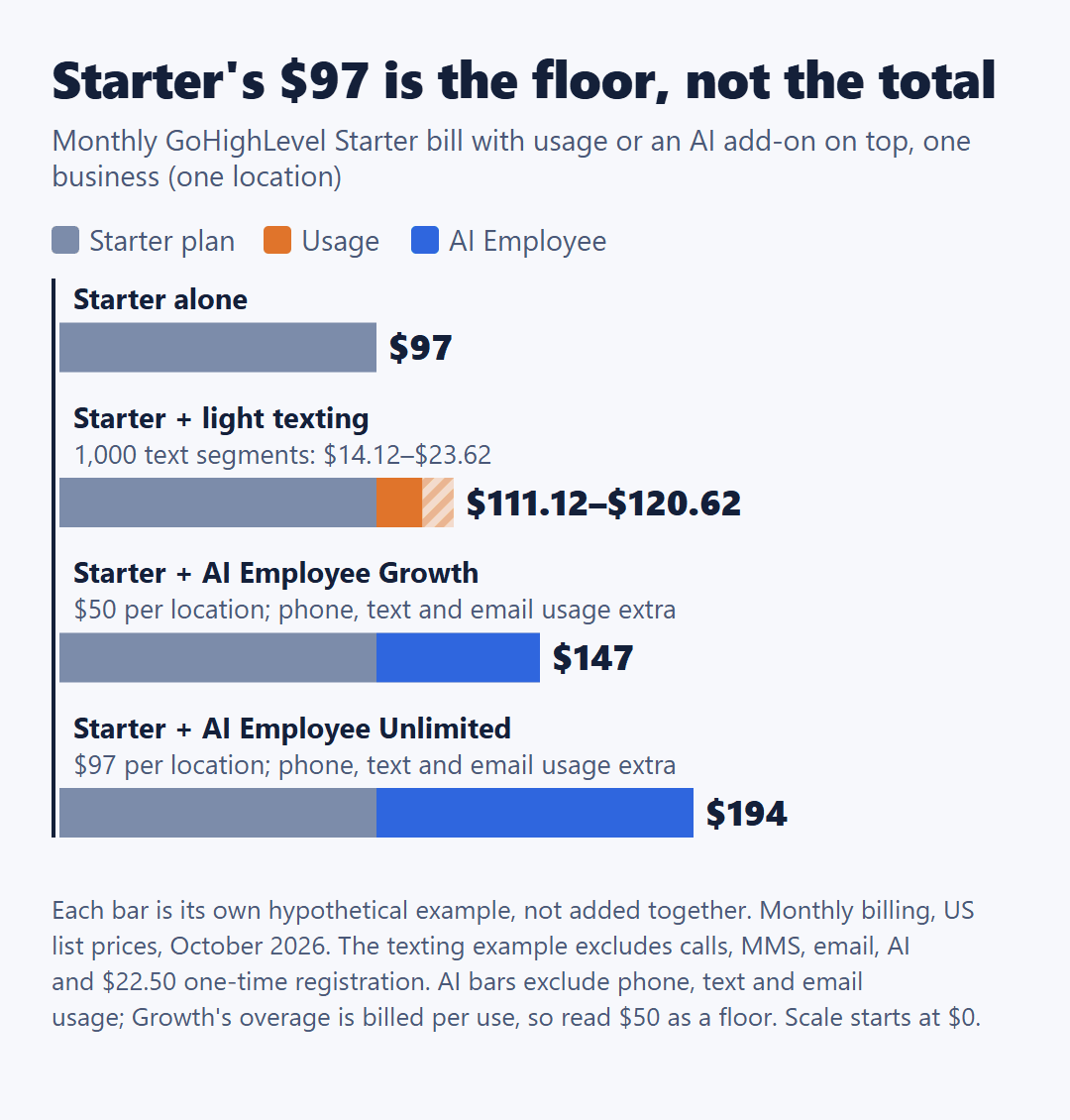
Total: $14.12 to $23.62 a month on top of the plan, plus $22.50 of one-time registration
Calls, MMS, email and AI aren’t in that figure, and received texts cost the same $0.00747 per segment plus a carrier fee of $0.0025 to $0.0100 per segment. Light texting turns out to be budgetable. HighLevel’s phone billing guide adds a 5% markup to pass-through charges such as A2P registration and carrier fees only when re-billing is enabled, which is how an agency passes costs on to client sub-accounts. A single business that doesn’t rebill is charged without it, so none is included above.
Usage comes out of a prepaid wallet, and the help center is explicit: “Wallet Auto Recharge cannot be disabled.” What you can turn off is Smart Adjustment, which raises the recharge amount to the next level when the same recharge triggers more than three times in seven days. If you watch every charge on the company card, set that up before your first campaign, not after.
AI: fixed unit prices, ranges and an optional add-on
HighLevel’s AI pricing article says it directly: “Some HighLevel AI features are included with AI Employee, some are free with fair-usage protections, and others are billed on a pay-per-use basis.”
- Pay-per-use with fixed unit prices. Content AI is $0.0945 per 1,000 words and $0.063 per image, Reviews AI is $0.01 per review, and Workflow AI premium actions are $0.01 per execution. The unit price is published; the total moves with how much you use.
- Pay-per-use with ranges. Conversation AI and Voice AI have no fixed rate. Conversation AI runs $0.25 to $2.00 per million input tokens and $1.60 to $10.00 per million output tokens, depending on the model. Voice AI is $0.10 to $0.20 a minute speech-to-speech, or a stack of voice engine, TTS provider and LLM token charges, with phone charges on top. No per-call price is published.
- AI Employee, an optional subscription per enabled location. Growth is $50 a month with 1,000 Conversation AI responses and 100 Voice AI minutes a month. Unlimited is $97 a month and lists Conversation and Voice AI as unlimited, subject to fair-use terms that allow HighLevel to “throttle, limit, require service upgrades, or terminate access with or without notice.”
For one business, that’s one location. Starter plus AI Employee Growth is $147 a month in subscriptions; Starter plus AI Employee Unlimited is $194. Neither includes phone, text or email usage. Growth’s 100 voice minutes average a little over three minutes a day, and past the allowance “additional usage will be billed at applicable pay-per-use rates.” For voice, those are the ranges above, so read $50 as a floor.
Does Starter beat the tools you pay for now?
The case for GoHighLevel is consolidation: one platform in place of several subscriptions. The feature list does cover CRM, email, texting, calendars, landing pages and reviews. The dollar side depends on what you’d cancel, and the comparison has to sit on one billing cycle.
Here’s a two-tool example built only from published prices. Calendly Standard is $10 per seat per month billed yearly ($12 billed monthly), and this comparison stays on an annual basis: GoHighLevel Starter at $970 a year is $80.83 a month. Mailchimp Standard “starts at $20/month” for up to 500 contacts, and its documentation describes monthly plans only. The comparison is $20 + ($10 × paid Calendly seats) against $80.83.
A paid seat isn’t every employee. In Calendly’s words, “Seats are required for users to connect calendars and host Calendly meetings – meeting invitees do not require a seat,” and you pay for every seat you hold, filled or not. A five-person shop where one person hands out the booking link is a one-seat business.
| Paid Calendly seats | Mailchimp + Calendly a month | Against Starter’s $80.83 |
|---|---|---|
| 1 | $30.00 | Separate tools $50.83 less |
| 3 | $50.00 | Separate tools $30.83 less |
| 5 | $70.00 | Separate tools $10.83 less |
| 6 | $80.00 | Separate tools $0.83 less |
| 7 | $90.00 | Starter $9.17 less |
In this example the separate tools stay cheaper through six paid seats, and Starter pulls ahead at the seventh. That line belongs to this pair of tools at these prices, not to every stack. Four things move it:
- Leadpages is left out. It shows monthly prices and no annual dollar figure, so it can’t join an annual comparison. Leaving it out makes the separate tools look cheaper than a real stack would be.
- No CRM or texting tool is in the stack, because their official prices weren’t checked. If you pay for five or six subscriptions today, your total is higher and the line comes earlier.
- Starter’s $80.83 has no usage in it. Texts, calls, numbers, email and AI come on top, which pushes the line later.
- Mailchimp’s $20 is a “starts at” price for up to 500 contacts and rises with your list.
This compares prices, not whether GoHighLevel’s calendar or email tool does the same job as the one it would replace. That part is what the trial is for. The billing model differs too: GoHighLevel charges email by the send, $0.675 per 1,000, while Mailchimp’s plans are priced by how many contacts you store. A big list you rarely email and a small list you email every week come out very differently under those two models.
If you decide to keep separate tools and link them with an automation platform, that link is one more bill to price: Zapier vs. Make pricing for a small service business: tasks, credits and seats.
Trial, refunds and the wallet balance when you leave
The pricing FAQ reads: “HighLevel operates on a month-to-month basis. There are no long-term contracts, and you can upgrade, downgrade, or cancel your account at any time directly from your dashboard.” That’s accurate, and the Terms of Service decide what happens to money you’ve already paid.
- The 14-day trial converts on its own. “Billing begins automatically at the end of any free trial unless canceled.” The documentation doesn’t say whether a card is needed to start. The terms also say trials are “not intended to be used consecutively,” and back-to-back trials can lead to suspension.
- Fees already billed don’t come back. “All Fees assessed by HighLevel are non-refundable, including subscription Fees, Communication Surcharges, and HighLevel’s resale of Third Party Services.” No separate refund exception for annual plans appears in the terms.
- Unused wallet money is a separate clause, with a clock. After you cancel, “it is Your sole obligation to request HighLevel to refund any amounts remaining in your account’s ‘wallet’,” and anything left more than 30 days later becomes HighLevel’s. Free promotional credits have no cash value and expire after 90 days. The terms don’t say how to make the request, how long it takes or whether there’s a fee.
- Renewal is automatic, at “the then-current rates.” Today’s $97 isn’t a locked price.
- Some services carry a minimum commitment. The terms mention “a non-cancellable minimum subscription commitment” for some subscriptions without listing which ones. Read your order screen before you agree.
- Upgrading mid-cycle is prorated. You’re charged for the new plan right away with a credit for unused time on the old one. Downgrading runs through the Billing settings, where you see the new price, the effective date and any prorated adjustment before you confirm. A downgrade doesn’t automatically cancel add-ons or phone numbers; those stay on the bill until you cancel them.
To cancel, the terms name three routes: your account, a support ticket, or (888) 732-4197. The in-app route asks for a reason, shows a data-loss warning and requires at least 30 words of feedback, so don’t leave it to the night before a renewal.
What to settle before day one of the trial
The 14 days go quickly, and part of the first week can disappear into texting registration. Before you start:
- List what you’d actually cancel. Price those tools on the same billing cycle, and count paid seats, not employees.
- If you’ll text from a local number, start A2P registration the day the trial opens, and budget usage on top: about $14 to $24 a month in the 1,000-segment example above.
- If you want AI answering calls on an AI Employee plan, add $50 or $97 per location, and treat it as a floor.
- Put day 13 on the calendar, and stay on monthly billing until the platform has earned a place in your week.
If dispatching crews and job costing are what you really need, this is the wrong category of software, and the better comparison is Jobber vs. Housecall Pro for a small HVAC team: which plan you need for QuickBooks Online.
If the documentation doesn’t answer these for your account, ask HighLevel support before the trial ends:
Do I need a card to start the 14-day trial? If I only take calls, or I use a toll-free number, do I still need A2P 10DLC registration? If I cancel, how do I request my unused wallet balance, how long does it take, and is there a fee? Does any service on my order carry a minimum commitment? Is a downgrade prorated?
The plan price was never the hard part of this decision. What it replaces, who needs a seat and how much you’ll text are.
Official pages to recheck: HighLevel pricing · LC Phone pricing and billing guide · A2P 10DLC messaging fees · AI product pricing · Wallet auto recharge · Terms of Service