You’re running a small roofing or exterior remodeling company. Your crew handles the jobs, you prepare estimates, and every measurement report you order is another business expense.
You’ve been using Hover to get measurements from property photos.
Then you see the upgrade offer.
Hover Pro costs $999 a year. Business costs $2,999 a year.
It’s tempting to assume that paying the annual fee means you can stop worrying about individual measurement charges.
But that’s not how Hover’s pricing works.
Neither Pro nor Business includes free scans as part of the annual subscription. You still pay for every project.
What you’re buying is a different per-project rate, along with additional software capabilities.
For a contractor ordering a handful of measurements each month, that distinction could determine whether the subscription saves money or simply adds another fixed expense.
Let’s work through the actual numbers.
This article uses Hover’s published US pricing and official terms checked October 17, 2026. The project scenarios are illustrative calculations, not records of actual customer use. Prices are in US dollars before applicable taxes.
The $999 question: what are you actually buying?
Hover currently lists three main plans for contractors.
| Plan | Annual subscription | How measurements are billed |
|---|---|---|
| Starter | $0 | Pay per project |
| Pro | $999 | Pay per project at a $20 discount |
| Business | $2,999 | Pay a flat rate by measurement type |
Starter also offers the first three projects free for eligible new users under Hover’s published offer. The official pricing information reviewed here doesn’t establish every restriction that may apply to those free projects.
There is no published monthly subscription price for Pro or Business on the pricing page.
And there’s no per-user subscription charge: Hover says its plans cover the entire team.
The distinction is straightforward.
Starter has no annual subscription commitment.
Pro requires $999 upfront for lower per-project prices.
Business requires $2,999 for a flat-rate structure that can benefit contractors ordering certain kinds of complex measurements.
Before deciding, you need to know what your company actually orders.
Source: Hover's official pricing.
A $59 measurement can become $39—or $79
Consider a straightforward exterior measurement.
Hover prices photo-based full exterior measurements according to roof complexity, which it defines using the number of roof facets.
Here’s what the same type of measurement costs on each plan.
| Full exterior complexity | Starter | Pro | Business |
|---|---|---|---|
| Simple, up to 4 facets | $59 | $39 | $79 |
| Average, 5–8 facets | $99 | $79 | $79 |
| Complex, 9+ facets | $139 | $119 | $79 |
Notice the unusual result.
For a simple structure, Business costs $40 more per measurement than Pro, despite having the larger annual subscription.
For a complex structure, Business costs $40 less than Pro.
For an average structure, the two plans charge the same $79.
That tells us something important about the Business plan.
It isn’t simply a volume discount.
Its financial value depends heavily on the complexity of the properties you measure.
A company doing mostly simple residential work and a company handling complex roofs can have completely different results, even if they order the same number of measurements.
What if you only need roof measurements?
The pricing changes again.
| Roof-only complexity | Starter | Pro | Business |
|---|---|---|---|
| Simple | $29 | $9 | $39 |
| Average | $49 | $29 | $39 |
| Complex | $69 | $49 | $39 |
For simple roof-only measurements, Pro costs just $9 per project.
Business charges $39.
That’s a $30 difference in Pro’s favor, before considering the annual subscription fees.
On complex roof-only measurements, Business is $10 less than Pro.
The savings are much smaller than the $40 difference on complex full exterior projects.
So even among roofing contractors, the answer depends on what kind of reports you order.
A roofer who frequently needs full exterior measurements isn’t buying the same mix of services as a roofer who orders roof-only measurements.
The number of projects matters, but the measurement type matters just as much.
When does Hover Pro actually pay for itself?
Let’s start with the simpler decision: Starter versus Pro.
Hover Pro saves $20 on each standard-delivery project compared with Starter.
The annual subscription costs $999.
That gives us a straightforward calculation:
$999 ÷ $20 = 49.95 projects
Since you can’t order a fraction of a project, the price-only break-even is 50 paid standard-delivery projects in a plan year.
At 49 projects, the discounts total $980.
At 50 projects, they total $1,000—just $1 more than the annual fee.
Hover describes Pro as paying for itself at roughly four projects a month. The exact calculation is slightly above four per month over a full year.
But this isn’t a universal recommendation to upgrade at 50 projects.
It assumes standard delivery, the published rates, and no additional value from Pro’s features or loyalty credits.
A small roofing contractor ordering 40 reports
Imagine a company ordering 40 average-complexity roof-only measurements over 12 months.
Every report uses standard delivery.
On Starter:
40 × $49 = $1,960
On Pro:
$999 + (40 × $29) = $2,159
Pro costs $199 more.
If all the business needs is those 40 reports at the published rates, the annual subscription doesn’t pay for itself through measurement discounts alone.
That doesn’t mean Pro has no other value. It means the fee savings alone don’t justify the subscription in this example.
What if you need reports urgently?
Hover also offers expedited delivery on eligible photo-based roof and exterior projects.
The published additional fees are:
- Starter: $39 per expedited project
- Pro: $19 per expedited project
- Business: $19 per expedited project
Hover describes typical expedited turnaround as within one hour for roof measurements and within 90 minutes for full exterior measurements. Actual delivery times may vary.
Because Pro saves $20 on the measurement and another $20 on expedited delivery, each expedited project saves $40 compared with Starter.
If every paid project is expedited:
$999 ÷ $40 = 24.975
That means 25 paid expedited projects over the plan year are enough for the discounts to cover Pro’s annual fee.
For a contractor regularly preparing time-sensitive estimates, that’s a very different calculation.
The useful formula is:
Annual Pro discount = ($20 × standard projects) + ($40 × expedited projects)
Compare that total with $999.
And count paid projects—not the three free Starter projects.
Be careful: one address isn’t always one billable project
Imagine you’re measuring a house with a detached garage.
You might think of it as one customer, one address, and one estimate.
Hover’s billing rules don’t necessarily treat it as one measurement project.
For exterior scans, each structure is billed separately.
The house and detached garage can therefore count as two projects.
That matters when estimating annual volume.
If you have 40 customer addresses but several properties include additional structures, the number of billable exterior measurements may be higher than 40.
Hover also says that saving photos without submitting an order doesn’t incur a measurement charge. Billing occurs when the model and measurements are delivered.
And if you upgrade a roof-only project to a full exterior measurement, Hover says it charges the difference in price rather than treating it as an entirely separate full-price order.
Before estimating your annual cost, look at your actual billable measurement orders rather than simply counting customers or estimates.
Business at $2,999: why more projects don’t automatically make it the better deal
This is where the decision gets more interesting.
Business costs $2,000 more per year than Pro.
Its flat-rate pricing can save money on complex measurements, but it can also cost more on simpler ones.
For standard-delivery full exterior projects:
- Simple: Business costs $40 more than Pro.
- Average: Business costs the same as Pro.
- Complex: Business saves $40 compared with Pro.
So the financial question becomes:
Do your savings on complex jobs exceed the additional costs on simple jobs by at least $2,000 a year?
For full exterior measurements alone, the formula is:
$40 × (complex projects − simple projects) ≥ $2,000
Average-complexity full exteriors don’t affect this difference.
That means you need at least 50 more complex full exterior projects than simple ones over the year for Business to match or beat Pro on price alone.
Let’s see what that looks like.
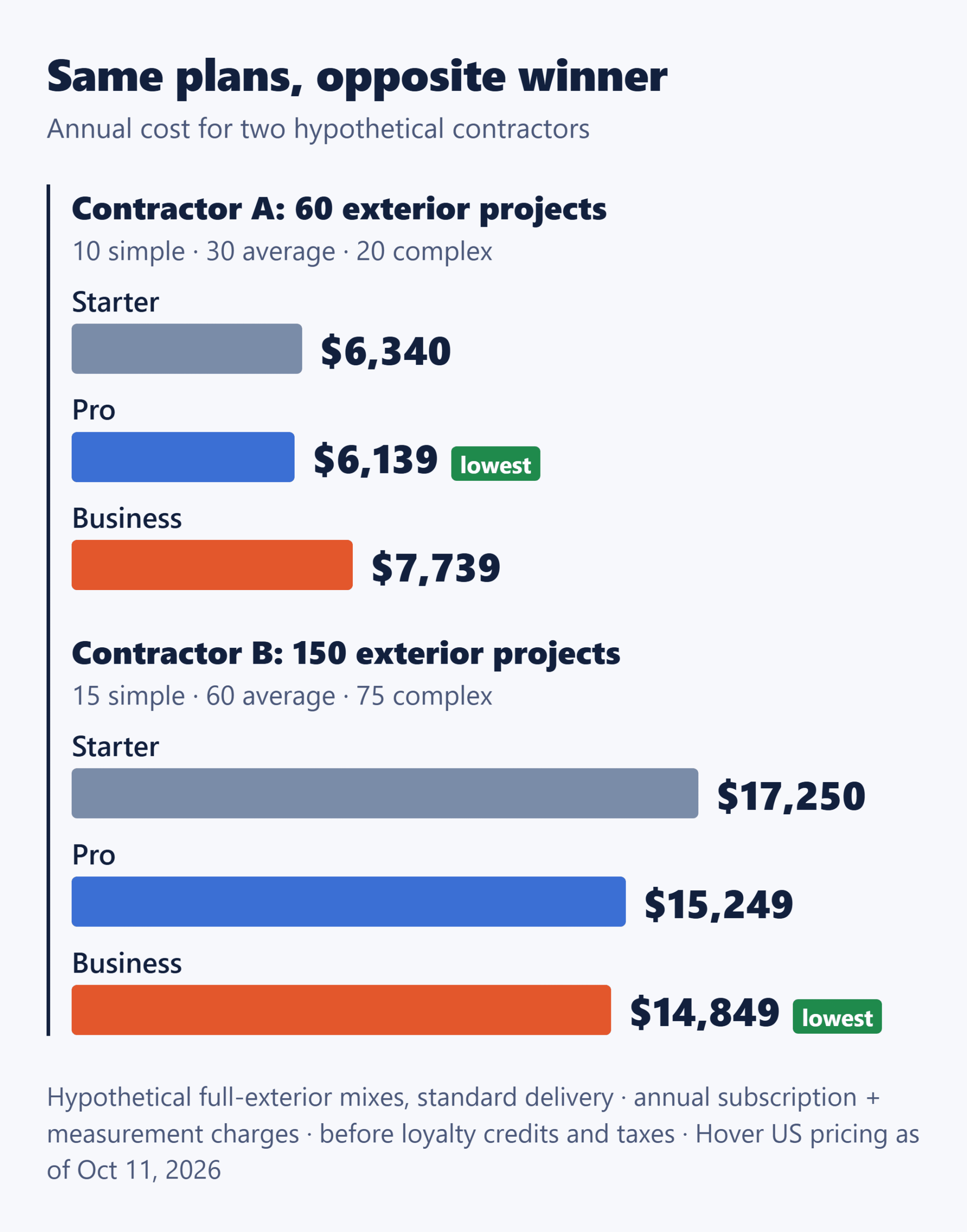
Contractor A: 60 exterior projects a year
Suppose a small remodeling contractor orders:
- 10 simple full exteriors
- 30 average full exteriors
- 20 complex full exteriors
All use standard delivery.
| Plan | Annual subscription + measurement charges |
|---|---|
| Starter | $6,340 |
| Pro | $6,139 |
| Business | $7,739 |
Pro is $201 less than Starter.
Business is $1,600 more than Pro.
In this scenario, the Business plan’s lower price on complex projects isn’t enough to recover its additional annual fee.
Contractor B: 150 exterior projects, mostly complex
Now consider a company ordering:
- 15 simple full exteriors
- 60 average full exteriors
- 75 complex full exteriors
Again, standard delivery only.
| Plan | Annual subscription + measurement charges |
|---|---|
| Starter | $17,250 |
| Pro | $15,249 |
| Business | $14,849 |
This time Business costs $400 less than Pro.
Why?
Because the company has 60 more complex projects than simple ones.
The $40 savings on each net complex project produces $2,400 in measurement-price advantage, enough to overcome Business’s additional $2,000 subscription fee.
Both examples exclude loyalty credits and taxes. The project mixes are hypothetical, not representative industry averages.
This is why a blanket statement such as “Business is better for high-volume contractors” is misleading.
The mix of simple and complex projects is what changes the calculation.
There’s another reason to consider Pro besides the $20 discount
So far, we’ve treated Hover as a measurement purchasing service.
But the annual plans also change which software features are available.
According to Hover’s published plan comparison:
- Typical standard processing time is 12 hours on Starter versus 4 hours on Pro and Business, although actual processing varies.
- Starter’s measurement exports are limited to PDF and ESX.
- Hover Design, branded estimates and agreements, and CRM integrations are available starting with Pro.
Those differences may matter to a contractor preparing several estimates a week.
For example, if branded estimates and integrations fit your existing workflow, the subscription could provide value beyond the per-project discount.
If branded estimates are the main draw, compare what a dedicated estimating app charges for them: Joist pricing for contractors, with no free plan and a 5-document limit on Basics.
But that value is business-specific.
There’s no credible way to assign a dollar saving to those features without knowing how your company works.
The better question is whether you would actually use them.
If you only need occasional measurements, paying $999 for features you won’t touch is difficult to justify.
If your estimating process depends on capabilities unavailable on Starter, the break-even calculation becomes only one part of the decision.
Business also extends its pricing and features to as many as 10 branches, while Starter and Pro cover one organization.
For a multi-location contractor, that may be relevant even when the pure measurement-cost calculation favors Pro.
What about Hover’s $1,000 credits?
Hover offers a loyalty credit program on Pro and Business.
Under the published terms, eligible customers earn $1,000 in Hover credits for every $10,000 spent on scans.
There are several conditions worth understanding.
The annual subscription fee doesn’t count toward that $10,000 threshold.
Expedited delivery charges do count.
Spending below a $10,000 increment carries forward while you remain eligible on Pro or Business, even across plan years.
Once issued, credits are applied to future scans. They cannot pay the subscription fee.
They expire 12 months after issuance, and unused credits are lost if you cancel or move down to Starter.
Source: Hover Loyalty Credit Program Terms.
These credits can change the effective cost for a business ordering enough measurements.
But they aren’t the same as receiving an immediate 10% discount on every project.
You must reach the spending threshold, receive the credits, and have eligible future purchases on which to use them.
That’s why the earlier comparisons use the published subscription and project prices without deducting assumed credits.
If your annual scan spending is substantial, model the credit program separately.
The annual commitment deserves as much attention as the discount
Suppose you expect a busy year and purchase Pro.
Three months later, project volume falls.
You may wish you’d stayed on Starter.
Hover’s published terms say plan fees and commitments are non-refundable and not prorated.
Plans renew automatically at the then-current rate unless you cancel renewal before the scheduled date.
If you cancel, your paid plan remains active through the end of its term. Afterward, the account moves to Starter and unused loyalty credits expire.
You can stop renewal through the plan page or by contacting Hover before the renewal date.
Source: Hover Terms of Use.
That means a $999 or $2,999 annual subscription should be evaluated against a realistic 12-month workload, not just your busiest recent month.
A contractor with seasonal demand should pay particular attention to that distinction.
The same 12-month test applies if you’re also weighing an annual project-management subscription billed per user rather than per project: Houzz Pro pricing per user, and the annual subscription after the free trial.
And if you’re considering Business, Hover says you can ask its team to compare your previous 12 months of usage against both paid plans before signing its agreement.
That’s a useful step when your project mix is complicated.
What I’d check before paying for any Hover plan
For a small roofing or exterior remodeling company, I’d start with last year’s measurement orders.
Not last year’s number of customers. Not total revenue. Actual measurement orders.
Separate them into full exterior, roof-only, interior, and blueprint projects, then by complexity.
Hover also prices interior and blueprint measurements differently. For example, on standard delivery, a complex interior scan is $89 on Starter, $69 on Pro, and $49 on Business. A complex blueprint exterior is $299, $279, and $189 respectively.
If those measurement types form a meaningful share of your workload, include their published rates rather than applying the full-exterior formula to everything.
Then ask:
- How many paid projects did we order over the last 12 months?
- How many required expedited delivery?
- What proportion were simple, average, or complex?
- Which Pro features would we actually use?
- Could our project volume change substantially next year?
- Are we prepared for a non-refundable annual subscription and automatic renewal?
With those answers, you can compare the three plans using your own workload.
A company ordering 40 standard roof measurements has a very different financial case from one ordering 150 full exterior measurements with a large proportion of complex structures.
Neither should make the decision based solely on the $999 or $2,999 headline.
You can check the current rates and plan features on Hover's official pricing page.
The real question isn’t whether Hover Pro is worth $999
It’s whether the way your company orders measurements makes the $999 useful.
If your annual volume is low and you don’t need the additional features, Starter’s pay-per-project model avoids an annual subscription commitment.
If you order enough paid measurements—or frequently need expedited delivery—Pro’s discounts may offset its annual fee.
And if your workload includes a substantial number of complex structures, Business deserves a closer calculation. But the $2,999 subscription doesn’t automatically become economical just because your company handles more jobs.
The smartest comparison is the one built from your own measurement history.
Before paying for a plan, take the time to run those numbers.
The answer may be less exciting than a software company’s upgrade pitch.
But for a contractor managing real expenses, it’s considerably more useful.