Smith.ai sells two plans called Pro. One is $150 a month. The other is $2,100.
They belong to different products. The $150 Pro is a tier of the AI Receptionist, where AI answers your calls. The $2,100 Pro is a plan of the Virtual Receptionist, where live receptionists answer 24/7. If you’ve read that Smith.ai “starts at $300 a month,” that’s the human Starter plan with 30 calls. The AI Receptionist starts at a Free plan: $0 for 25 calls a month.
The AI Receptionist has no single monthly price. You buy a call tier: Free at $0, Pro at $150, $270 or $500, Enterprise at $500 or $800. Calls past the tier are billed at that tier’s extra-call rate, from $2.10 to $3.00 (on Free, only once you switch overage on). Your monthly call count sets the bill, not the plan name. At 120 calls a month, for example, the lowest published option is Pro’s 75-call tier at $262.50. At 350 calls it’s a 300-call tier at $608.50.
One cost can’t be priced from public pages. If you switch on a live agent yourself, for verifying information or booking, that’s a per-call add-on with no published rate. Handoffs the AI starts on its own carry no fee.
Prices come from Smith.ai’s official pricing pages and help documentation, checked October 17, 2026: monthly billing, priced per account rather than per user, before tax. The call volumes below are illustrations, not figures from anyone’s account.
The extra-call rate is the one that decides a busy month
The AI Receptionist pricing page is built around call tiers, not feature tiers. You pick a plan, then a tier, and each tier has its own printed monthly price.
| Plan and tier | Per month | Calls included | Each extra call |
|---|---|---|---|
| Free | $0 | 25 | $3.00 |
| Pro, 75 calls | $150 | 75 | $2.50 |
| Pro, 150 calls | $270 | 150 | $2.30 |
| Pro, 300 calls | $500 | 300 | $2.17 |
| Enterprise, 300 calls | $500 | 300 | $2.17 |
| Enterprise, 500 calls | $800 | 500 | $2.10 |
| Enterprise, 1,000+ calls | Custom | 1,000+ | Custom |
Smith.ai’s own table has two rows that look alike. Per real call rate is what your included calls work out to: $150 across 75 calls is $2.00, $800 across 500 is $1.60. Extra per real call rate is what each call past the allotment costs. On every tier the extra-call rate is the higher one, and it’s the number that decides a busy month.
Look at the two 300-call rows. Pro’s top tier and Enterprise’s entry tier are both $500 a month for 300 calls with $2.17 per extra call. They cost exactly the same. The difference is what each plan includes, covered further down.
A few more terms that shape the bill:
- Billing is per call, not per minute. A ten-minute call from someone describing a leak costs the same as a one-minute call.
- Known spam doesn’t count. Calls from more than 20 million known spammers are filtered out before the AI answers. Everything else the AI picks up counts, with an allowance to remove up to 10% of your calls from the bill each billing cycle.
- No setup fee and no contract to sign. The published tiers are all month-to-month. The page also mentions a 6-month plan with rollover calls and a lower per-call rate, described in the Enterprise context, with “Talk to us” instead of a price.
Put your own call count through the tiers
Every month on any tier works out the same way:
Monthly cost = tier price + (calls over the tier’s allotment × that tier’s extra-call rate)
Here it is applied to five illustrative volumes. Each one assumes the same number of calls every month for 12 months, monthly billing, no spam allowance applied, no live-agent add-on and no tax. “Lowest” means lowest among the published monthly tiers; a quoted 6-month plan or Custom tier could come out lower.
| Calls a month | Lowest tier and math | Per month | 12 months |
|---|---|---|---|
| 40 | Free: 15 × $3.00 | $45.00 | $540 |
| 120 | Pro 75: $150 + 45 × $2.50 | $262.50 | $3,150 |
| 200 | Pro 150: $270 + 50 × $2.30 | $385.00 | $4,620 |
| 350 | Pro or Enterprise 300: $500 + 50 × $2.17 | $608.50 | $7,302 |
| 600 | Enterprise 500: $800 + 100 × $2.10 | $1,010 | $12,120 |
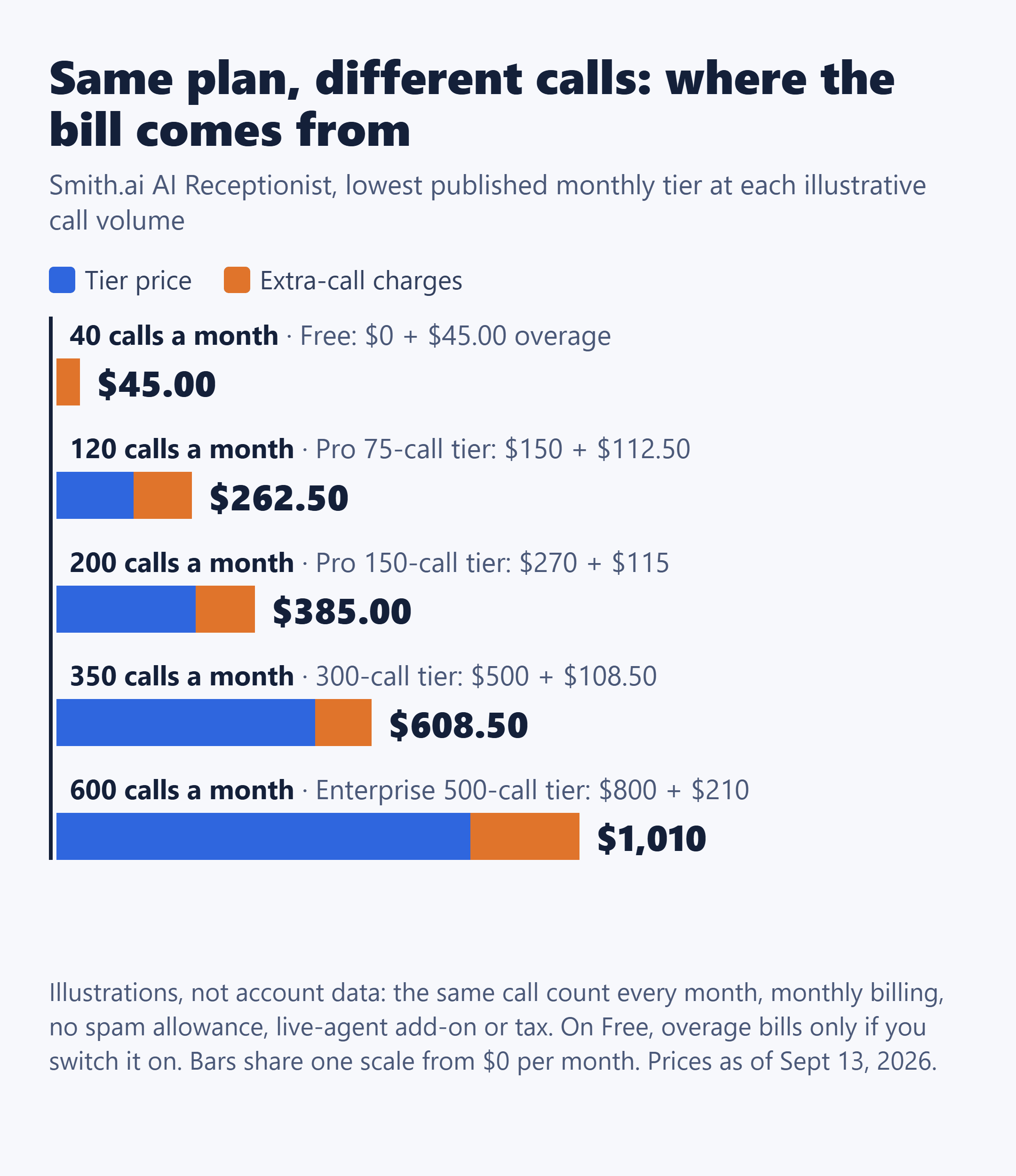
Two rows are worth a second look. At 120 calls, the 75-call tier with overage beats the 150-call tier by only $7.50 a month ($262.50 against $270), and staying on Free would cost $285. At 350 calls, the cheapest answer is a 300-call tier, and Pro and Enterprise charge the same for it.
The 40-call row has a condition attached: on the Free plan, overage is off by default, so those 15 extra calls are billed only if you switch overage on yourself. More on that below.
Where each tier starts beating the one below it
These crossovers use nothing but the published monthly prices, so they stay put until Smith.ai changes a tier:
- 75 calls: Free and Pro’s 75-call tier both cost $150. From 76 calls, Pro is cheaper.
- 123 calls: $150 + 48 × $2.50 = $270, the price of the 150-call tier. From 124 calls, the bigger tier is cheaper.
- 250 calls: $270 + 100 × $2.30 = $500, the price of a 300-call tier. From 251 calls, move up.
- 438 to 439 calls: a 300-call tier costs $799.46 at 438 calls and $801.63 at 439, against $800 for the 500-call tier.
Crossing one of these lines doesn’t move you. Plan changes are requested by email to [email protected], and billing for the new plan starts the following month. A spike is billed at your current tier’s extra-call rate, so if your phone gets busy in May, the plan change belongs in April.
The Free plan needs a card, and calls past 25 need your say-so
Smith.ai calls the Free plan “Not a trial”: 25 live calls a month, every month. It already lists 24/7 AI call answering, recording, transcription and summaries, lead qualification and routing, AI scheduling (Calendly and others), native integrations (Clio, Zapier and others) and call history. It also includes Quality Studio for testing before going live, with 50 simulated test calls a month that are separate from real calls.
Two conditions come with it. A credit card is required at signup, with no charge until you authorize one. And overage is off by default, so the $3.00 per extra call starts only when you turn it on.
What the documentation doesn’t say is what happens to call 26 while overage is off: whether the AI stops answering, sends the caller to voicemail or does something else. If you’d rather pay $3 than lose a job, that’s the first question I’d put to support. Setup is described as taking about 15 minutes, which is Smith.ai’s estimate rather than a measured figure.
The live-agent add-on is the one line you can’t price yet
Smith.ai’s product page treats two kinds of human involvement separately. When the AI escalates a call on its own, there’s no fee. When you choose to set up live agent involvement for verifying information or scheduling, it’s “available as a per-call add-on to any AI Receptionist plan.”
The rate for that add-on isn’t printed on the pricing page, the product page or the hybrid service page. So the tier math above covers the calls the AI hands off itself. What public information can’t settle is the cost of the paid transfer you switch on yourself. If that step is why you’re interested, get the per-call rate in writing before you set a budget.
The other way to get a person on every call is the human Virtual Receptionist, priced as its own product: Starter $300 for 30 calls ($11.50 per extra call), Basic $810 for 90 calls ($10.50) and Pro $2,100 for 300 calls ($8.50). Enterprise pricing isn’t published. At the same illustrative volumes and assumptions:
| Calls a month | AI Receptionist | Virtual Receptionist |
|---|---|---|
| 40 | $45.00 (Free) | $415.00 (Starter) |
| 120 | $262.50 (Pro 75) | $1,125.00 (Basic) |
| 200 | $385.00 (Pro 150) | $1,965.00 (Basic) |
| 350 | $608.50 (300-call tier) | $2,525.00 (Pro) |
| 600 | $1,010.00 (Enterprise 500) | $4,650.00 (Pro) |
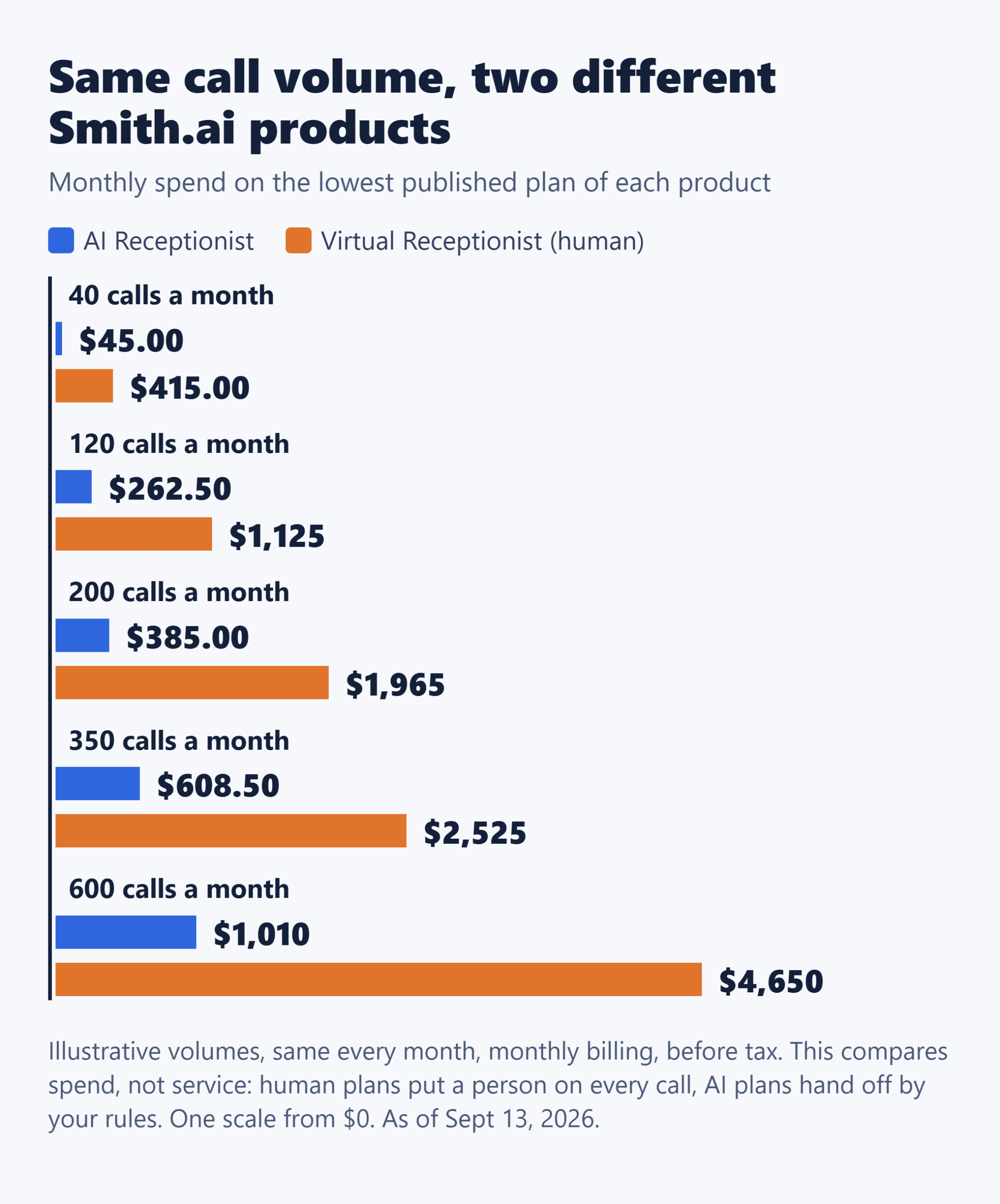
Over 12 months the gap runs from $4,440 at 40 calls to $43,680 at 600. That’s a spending comparison, not a service comparison: the human plans put a person on every call, the AI plans put AI on the call and hand it off when your rules say so. The human side also publishes a 10% discount for a 12-month subscription, left out here because Smith.ai doesn’t say whether it reaches overage charges.
If a person answering is what you actually want, the next question is how human services meter their time. That’s the subject of Ruby vs. Smith.ai pricing: per-minute vs. per-call costs for a small service business.
What Pro and Enterprise add (it isn’t call answering)
On most software, the cheap plan is where features go missing. Here, Free already answers, records, qualifies and books. Pro adds dedicated onboarding setup, live phone, email and chat support, and custom SMS branding. Enterprise adds full-service setup and ongoing optimization, custom AI prompting by a technical team, unlimited custom integrations and workflows, multi-location support and synchronization, and a dedicated success manager.
My practical reading: move to Pro when your volume makes a paid tier the cheaper side of the math, or when you want someone on the phone with you while you set routing up. Paying $150 a month for something Free already does is the mistake to avoid. Enterprise makes sense mainly for its extras, especially multi-location support, and at 300 calls it costs the same as Pro.
The AI is described as handling calls in English and Spanish. The pricing page doesn’t tie that to a tier, so confirm it on the plan you’re considering if many of your callers speak Spanish.
Cancelling, your number and your call records
Cancelling takes 30 days’ notice. The AI Receptionist is month-to-month with no long-term contract, but plan on one more billing cycle after you decide to stop.
Your number. You can forward your existing line or port it. Smith.ai’s porting guide describes 7 to 10 business days, no Smith.ai fee to bring a number in or take it out, and a few hours during the cutover when calls can’t come in. That guide is written for the Virtual Receptionist service and doesn’t mention the AI Receptionist, so ask whether it applies before you schedule a cutover.
Your recordings. The AI pricing page doesn’t state how long recordings and transcripts are kept. The help article that says 90 days covers the Virtual Receptionist and Outreach Campaign plans, not the AI Receptionist. If recordings feed your lead follow-up, ask for the retention period on your plan.
Your software. Smith.ai’s pages for Housecall Pro, Jobber, ServiceTitan and HubSpot all list AI Receptionist under “Works with,” as native integrations. None of the four states a plan requirement or extra charge, so “it connects” is confirmed and “it’s included on my plan” is a question.
Refunds. Smith.ai’s 30-day money-back guarantee names the Starter, Basic, Pro and Custom plans, up to $1,000, with overage excluded; the article lists those as its virtual receptionist and chat plans and does not name the AI Receptionist. Smith.ai’s AI Receptionist pages do reference a 30-day money-back guarantee for new clients, but that terms article still lists only Starter, Basic, Pro and Custom. Get it confirmed in writing at [email protected] before you count on it.
Before you pick a tier, count last month’s calls
Pull one or two months of inbound calls from your phone bill or current answering setup and take the average. Put it through the formula above and see which side of the nearest crossover it lands on. If your volume swings by season, price your busiest month too, because the plan won’t move up by itself.
If you can’t find the answers in your account, these are worth one email to [email protected] before you enter a card:
What is the per-call rate for live agent involvement on the tier I’m considering? On the Free plan with overage off, what happens to call 26? Does the 30-day money-back guarantee apply to my AI Receptionist plan, and is that in writing? How long are AI Receptionist recordings and transcripts kept? What does the 6-month (or any annual) plan cost, how many unused calls roll over, and do unused calls expire at renewal? How are very short calls and hang-ups counted?
With your call count and those answers, the tier choice stops being a guess. The plan name is the last thing to decide.
Official pages to recheck: AI Receptionist pricing · AI Receptionist product page · Virtual Receptionist pricing · Money-back guarantee FAQ