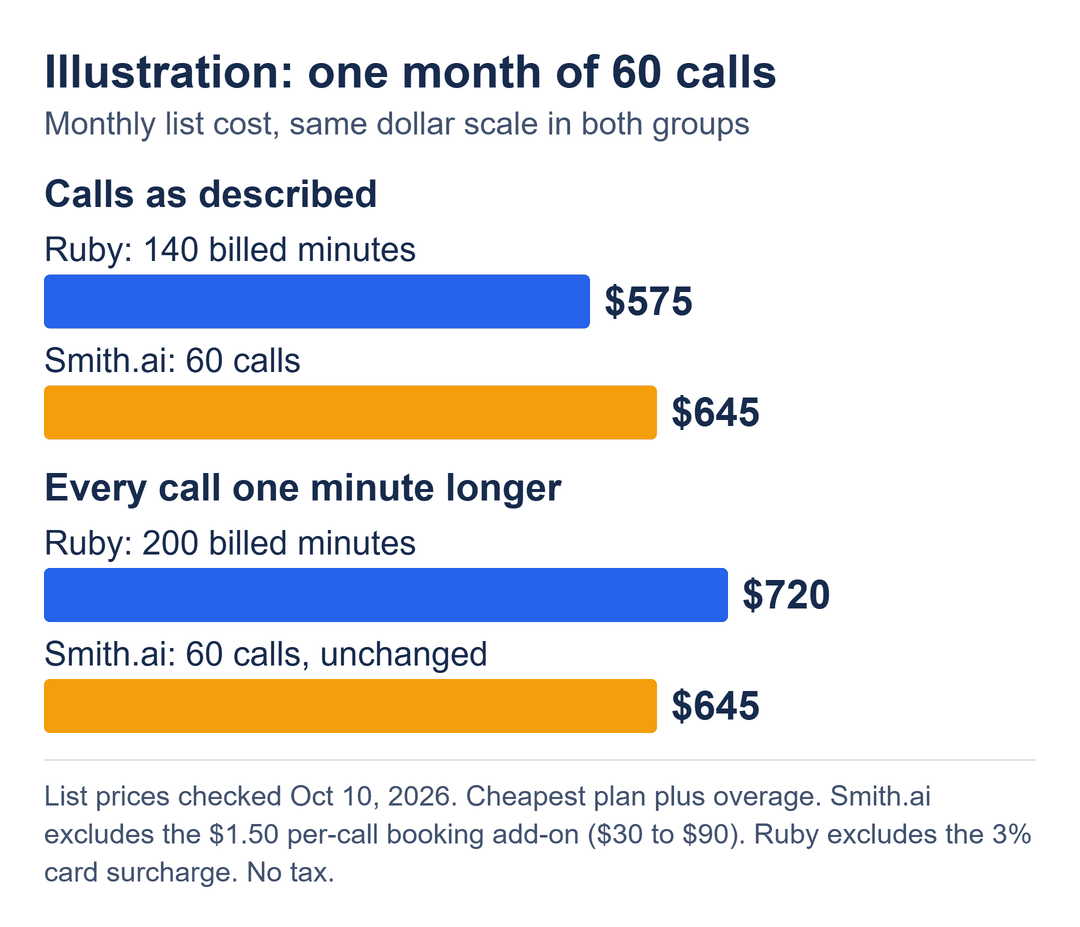
Take one month of calls worth answering: 60 of them, 40 from people leaving a message and 20 from people who want an appointment booked. It’s an illustration, not anyone’s phone bill. Ruby would run a clock on every one of those calls and round each up to the next full minute. Smith.ai would count 60 calls and never look at the clock.
Say each message call comes to 2 billed Ruby minutes and each booking call to 3. That’s 40 × 2 + 20 × 3 = 140 minutes, and Ruby’s cheapest way to cover it is the 100-minute plan plus 40 extra minutes: $395 + 40 × $4.50 = $575. Smith.ai’s cheapest way to cover 60 calls is Starter plus 30 extra calls: $300 + 30 × $11.50 = $645, before its $1.50 per-call booking add-on, which comes to $30 if it’s charged on the 20 booked calls and $90 if it’s charged on all 60. Now make every call one minute longer, 3 and 4 minutes. Ruby’s month becomes 200 minutes on the 200-minute plan, $720. Smith.ai’s number doesn’t move.
Ruby sells receptionist minutes: 50, 100, 200 or 500 a month for $250, $395, $720 or $1,725, and every call is rounded up to the next full minute. Smith.ai sells calls: 30, 90 or 300 a month for $300, $810 or $2,100, with no per-minute charge, and it doesn’t count telemarketers or misdialed numbers. Which one costs you less comes down to two numbers only you have: calls per month and billed minutes per call. On list prices, short calls favor Ruby’s per-minute billing and long calls favor Smith.ai’s per-call billing. Both are month-to-month.
Prices and terms come from the Ruby plans and pricing page, Ruby’s help center and Terms of Use, and the Smith.ai receptionist pricing page, Terms and Reasonable Use Policy, checked October 17, 2026. They’re US list prices in dollars, before tax, for the plans where a person answers the phone. None of it comes from an account with either service, and nothing here rates call quality.
If you’re also open to software picking up instead of a person, AI receptionist plans that bill by call count are a separate set of plans worth pricing against the same month of calls.
Two meters: receptionist minutes and counted calls
| Plan | Per month | Each extra minute |
|---|---|---|
| 50 minutes | $250 | $5.40 |
| 100 minutes | $395 | $4.50 |
| 200 minutes | $720 | $4.40 |
| 500 minutes | $1,725 | $4.00 |
| Plan | Per month | Each extra call |
|---|---|---|
| Starter, 30 calls | $300 | $11.50 |
| Basic, 90 calls | $810 | $10.50 |
| Pro, 300 calls | $2,100 | $8.50 |
All four Ruby plans carry the same features; only the minutes differ. Ruby’s overage rates aren’t on its pricing page; they’re listed in Ruby’s help center. Extra minutes are billed on the next invoice at your plan’s rate, Ruby doesn’t move you to a bigger plan automatically, and unused minutes don’t roll over. Ruby’s help center also lists in-between plan sizes, so ask if you land between two of the plans above.
What starts and stops Ruby’s clock
Ruby bills receptionist time, not call length. The clock starts when a receptionist picks up and stops when they transfer the call, send it to voicemail or hang up. It includes hold time and the time the receptionist spends writing up the call afterward. Once a call is transferred to you, your talk time isn’t billed.
Each call is rounded up to the next full minute, so a 10-second call is billed as one minute. And any call a receptionist handles uses minutes. Two kinds don’t: robocalls caught by Ruby’s free robocall filter, which Ruby switches on at your request and which sends flagged calls to voicemail, and calls that go to your after-hours voicemail. Outbound calls a receptionist makes for you use minutes as well.
What Smith.ai counts
Smith.ai counts calls you’d want answered, plus outbound calls it makes at your request. Its Terms say calls from telemarketers, misdialed numbers, promotional companies and callers who don’t want to leave a message aren’t counted, and its pricing page says you aren’t charged for spam or unsolicited sales calls as long as the line you forward passes caller ID. There’s no per-minute charge, though its Reasonable Use Policy says calls outside normal answering-service scope may incur additional fees.
So the call count isn’t the same number on both sides. For Ruby, count every call a receptionist would pick up. For Smith.ai, leave out the kinds of calls it doesn’t count.
Running your own month through both
Each side is one line of arithmetic once you have your numbers:
Ruby minutes = calls a receptionist handles × billed minutes per call
Ruby cost = plan price + (minutes over the plan × that plan’s overage rate)
Smith.ai cost = plan price + (counted calls over the plan × that plan’s overage rate) + per-call add-ons
The input that’s easy to get wrong is billed minutes per call. Round each call up to a full minute before you average; averaging raw call lengths understates your Ruby minutes. If you have no data at all, Ruby says a typical inbound call comes to about 2 receptionist minutes, with long-intake calls running longer and calls sent to voicemail running shorter.
Then price the next plan up on both sides, because overage can cost more than the bigger plan. At 120 Ruby minutes, the 50-minute plan plus 70 extra minutes is $628, while the 100-minute plan plus 20 extra minutes is $485. At 90 Smith.ai calls, Starter plus 60 extra calls is $990, while Basic is $810.
| Billed as | 30 calls | 60 calls | 90 calls |
|---|---|---|---|
| Ruby, 1 min a call | $250 | $304 | $395 |
| Ruby, 2 min a call | $304 | $485 | $720 |
| Ruby, 3 min a call | $395 | $720 | $1,028 |
| Smith.ai, any length | $300 | $645 | $810 |
These are examples, not a rule. They use list prices as of October 17, 2026, the cheapest plan plus overage on each side, and the same call count on both services. They leave out Smith.ai add-ons, Ruby’s 3% credit card surcharge and tax.
Within those nine cases, Ruby’s totals are lower at 1 minute a call and Smith.ai’s are lower at 3 minutes a call. At 2 minutes a call the two are $4 apart at 30 calls ($304 and $300), and Ruby’s total is lower at 60 and 90. The month from the top of this post, a mix of 2- and 3-minute calls, doesn’t sit on any single row. Your calls won’t all be the same length either, and Smith.ai’s counted calls can be fewer than the calls a Ruby receptionist handles, since Smith.ai leaves out the kinds of calls listed above. Run the formulas on your own log.
What lands on the invoice besides the plan
Smith.ai charges per call for some tasks. These are the listed add-ons a service business is most likely to switch on:
| Add-on | Per call |
|---|---|
| Appointment booking | $1.50 |
| Payment collection | $1.00 |
| Dedicated Spanish line | $1.00 |
| SMS or Slack transfer notification | $0.50 |
| Each extra CRM integration (first is free) | $0.50 |
| Call recording and transcription | $0.25 |
Lead qualification, intake of up to five questions, a dedicated phone number and 24/7 answering are included at no charge; longer intake is a paid add-on. What the pricing page doesn’t say is whether an add-on is charged on every counted call or only on calls where the task is done. That’s the $30-or-$90 gap in the booking example at the top, so get the answer before you sign up.
Smith.ai transfer destinations are limited by plan: 1 on Starter, 2 on Basic and 10 on Pro, and each additional one is $15 a month. That matters if answered calls go to more than one person. If those transfers ring a line your whole crew shares, what a small crew sharing one business number pays per user covers the phone-line side of the setup.
Ruby prices the same tasks into the plan. Scheduling, bilingual answering, intake and payment collection carry no per-feature fee, but the time they take is billed as receptionist minutes. On Ruby, a booking makes the call longer instead of adding a line item. The plan price isn’t necessarily the whole Ruby invoice either, so ask whether any other charges apply to your setup.
Ruby adds a 3% surcharge when you pay by credit card; debit card, ACH and check don’t carry it. On a $485 invoice, 3% is $14.55. Sales and telecom taxes are extra on both services and depend on your billing address.
Month-to-month on both, with different ways out
Both are month-to-month. Ruby’s contract runs 30 days and renews automatically, and a cancellation takes effect at the end of the current billing period. Smith.ai says it has no long-term contracts.
Smith.ai words its cancellation timing two ways. Its pricing FAQ says that if you cancel, you’re billed through the end of the current monthly billing cycle. Its Terms say cancellation must be made at least 30 days before the end of the current subscription cycle, and that if you cancel within 30 days of the end of the cycle, you’ll be billed for the following month. I’d plan on giving 30 days’ notice and get the final billing date from Smith.ai in writing.
Both offer a money-back window for first-time customers.
- Ruby: a full refund if you cancel within 21 days of sign-up or before you use 500 receptionist minutes, whichever comes first. Ruby’s Terms say the guarantee can vary and may not be available to every customer, so confirm yours at sign-up.
- Smith.ai: a refund of your first plan payment, up to $1,000, if you ask within 30 days. Overage charges aren’t covered.
Changing plans works differently on each.
- Ruby: you can upgrade at any time, and the upgrade applies to the current billing period; Ruby says that if your bill shows another plan would fit better, it can make the upgrade effective from the start of that period. A downgrade needs three consecutive billing periods on the same plan, except during a new customer’s first three billing cycles, when changes in either direction are allowed. Ruby also emails an alert at 85% and 100% of your plan minutes.
- Smith.ai: you can change plans at any time. The change takes effect on your next monthly payment date, and overage applies until then. Its Terms also say a plan change must be made at least 30 days before the end of the current subscription cycle, so ask Smith.ai when a change you request would start.
Smith.ai also offers 10% off for subscribing for 12 months. Its Terms describe long-term plans as prepaid and non-refundable, so that discount trades away the month-to-month exit.
What to have in hand before either sign-up call
Bring last month’s call log split into message calls and booking or intake calls, with each call rounded up to a full minute, and a count with the spam and wrong numbers taken out for the Smith.ai side. If you’d pay Ruby by credit card, add 3% to its total. Then put these to Smith.ai:
Is each add-on I’d switch on charged on every counted call, or only on calls where the task is done? If I cancel or change plans on a given date, what is my final billing date under the old plan?
The plan prices are the easy half of this comparison. The half that decides it is how long your calls really run once they’re rounded up, because that’s the only input one meter watches and the other ignores.
Sources: Ruby plans and pricing · Ruby Help: Am I on the right billing plan? · Ruby Billing Basics · Smith.ai receptionist pricing · Smith.ai Terms