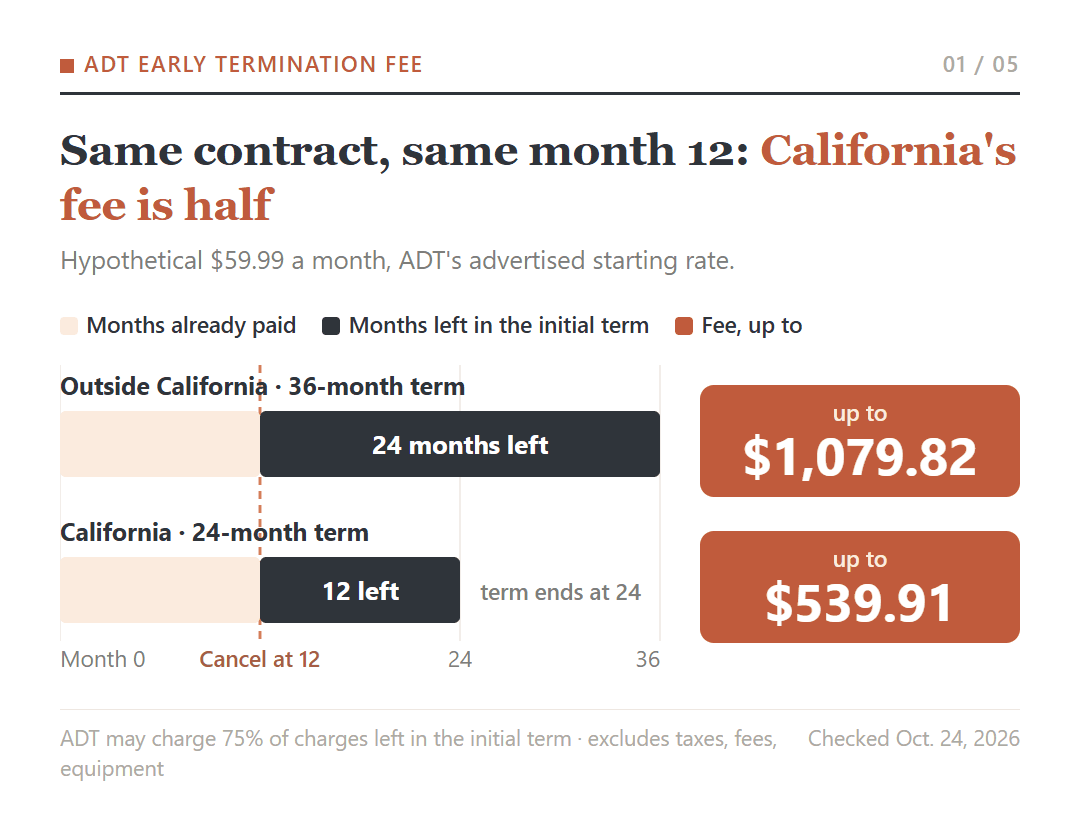
Picture two hypothetical households, not real customers. Both signed up for ADT’s professionally installed service on the same day at ADT’s advertised starting rate of $59.99 a month, and both are moving out at month 12 with no plan to keep ADT.
The household outside California could owe ADT up to $1,079.82 to cancel. The household in California could owe up to $539.91. Same rate, same month, half the fee.
One clause explains the gap. ADT’s published terms say: “Upon early termination by Customer, ADT may charge 75% of the monthly service charges due for the balance of the initial contract term.” Professionally installed service comes with a 36-month monitoring contract, or 24 months in California. At month 12, the first household has 24 months left and the second has 12.
So there’s no single ADT cancellation fee. Your number is 0.75 × your monthly service charge × the months left in your initial term, and only your own account holds both of those inputs.
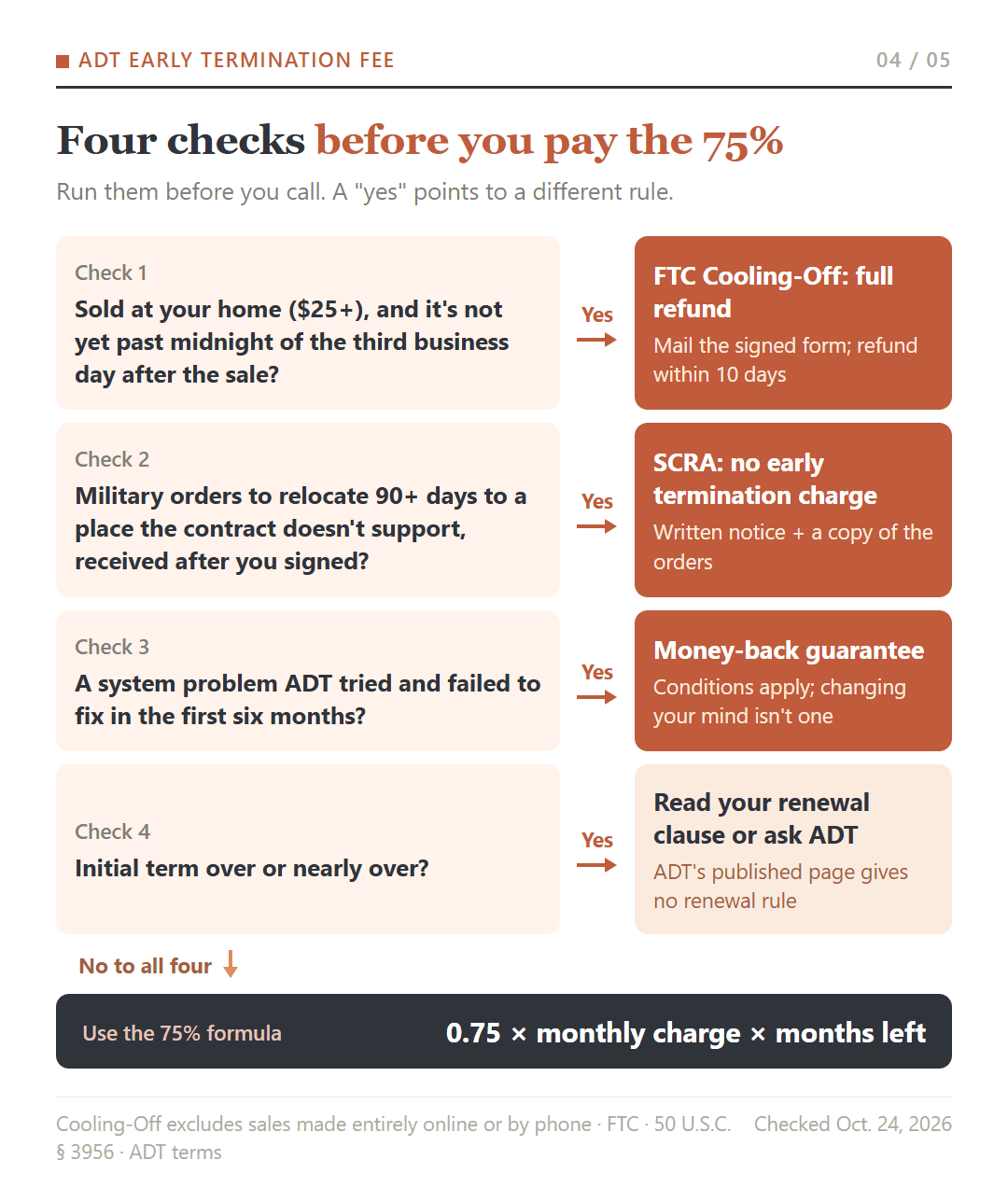
A few situations change that answer: a sale made in your home, if it’s not yet past midnight of the third business day after it, military relocation orders, a system problem ADT couldn’t fix in your first six months, or an initial term that’s already ending.
Pull Two Numbers From Your Own Contract Before Doing Any Math
First, check whose name is at the top of the contract. This page covers contracts signed directly with ADT. If an independent ADT authorized dealer’s name is on yours, that dealer’s own terms apply, and its contract length and fee can differ.
The first number is your monthly service charge, from your bill or your contract. ADT’s published page doesn’t spell out which line items count toward it, so confirm the monthly figure ADT will use.
The second is the number of months left in your initial term. Count from the date your contract term started, and ask ADT for the exact term end date rather than guessing from memory.
With both in hand, the arithmetic takes three steps:
- Multiply your monthly service charge by the months left. That’s what the rest of your initial term would cost.
- Multiply that total by 0.75. That’s the most ADT’s published terms let it charge you for leaving early.
- Compare your result with the payoff ADT quotes you.
For the hypothetical household outside California: $59.99 × 24 months left = $1,439.76, and 75% of that is $1,079.82. ADT’s own terms page uses the same multiplication from the other direction, listing California’s total fees “from $1,439.76,” which is 24 months at $59.99.
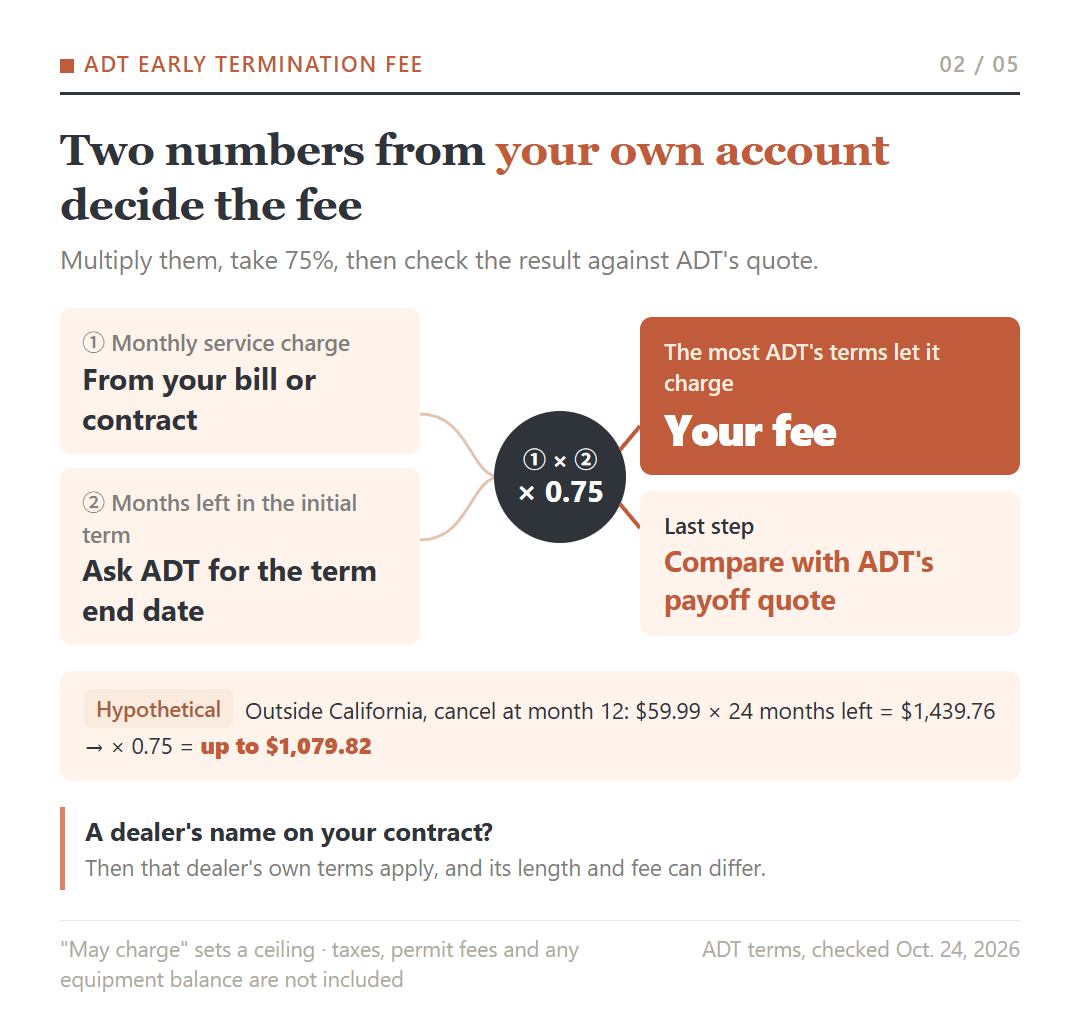
ADT’s wording is “may charge,” so 75% is the ceiling the published terms set, not a promise of the exact bill. Taxes, permit fees and any equipment balance sit outside this arithmetic, and the exact payoff comes from ADT.
Is Canceling Cheaper Than Riding Out the Contract?
If you won’t use ADT’s service at your next home, there are two ways out. Pay the early termination fee, which is 75% of the monthly charges left, or keep paying until the term ends, which is 100% of them.
The difference is always 25% of what’s left. That share doesn’t change, but the dollars behind it do, and they shrink every month the term runs down.
Take a hypothetical household paying $45.99 a month, ADT’s advertised starting rate for reactivated Secure Monitoring, on a 36-month term. With 30 months left, canceling costs $1,034.78 and paying to the end costs $1,379.70, a gap of about $345. With 6 months left, it’s $206.96 against $275.94, a gap of about $69.
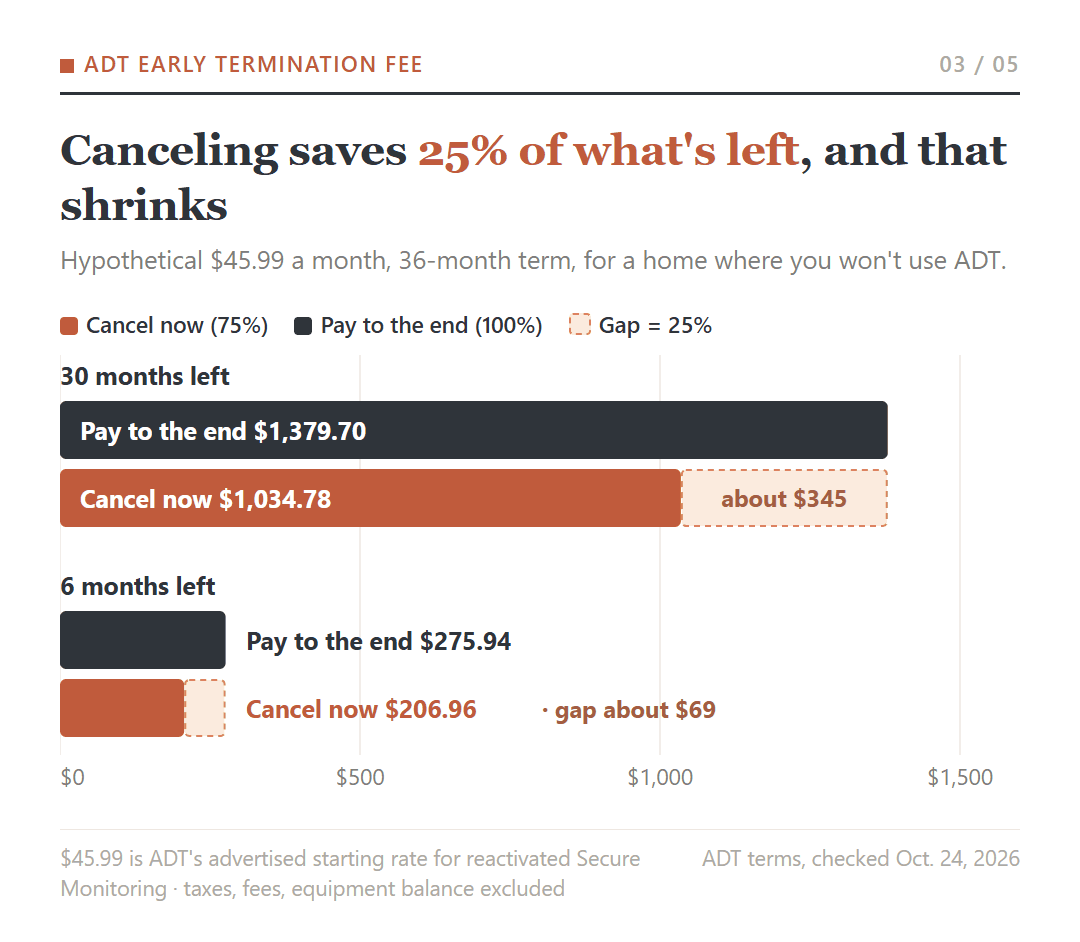
Near the very end, the gap is small. At $59.99 a month with 3 months left, the fee is $134.98 and paying out is $179.97, a $44.99 difference. Keep paying and you keep the monitoring for those months; cancel and that $44.99 is all you hold onto.
If you’re moving somewhere you’d want ADT anyway, ask ADT what it offers for a move before you cancel. That isn’t part of the published clause, so don’t count on it until ADT confirms it.
When the 75% Clause Isn’t the Whole Story
You may have read that ADT gives you 72 hours, or 30 days, to change your mind. Its published terms don’t say that. The rule with a published source is federal, and it’s narrower.
A sale made in your home, until midnight of the third business day after it
If an ADT salesperson sold you the system at your home and the sale was $25 or more, the FTC’s Cooling-Off Rule lets you cancel for a full refund until midnight of the third business day after the sale. Saturdays count as business days; Sundays and federal holidays don’t.
Sign and date the cancellation form the seller has to give you and mail it before that deadline; the FTC suggests certified mail. The seller then has 10 days to refund you. The rule doesn’t cover sales made entirely online or by phone. Details are on the FTC’s Cooling-Off Rule page.
Military relocation orders
A servicemember who signed before receiving orders to relocate for 90 days or more to a place the contract doesn’t support can end a home security contract, and the provider can’t impose an early termination charge. Send written or electronic notice with a copy of the orders, and return any provider-owned equipment within 10 days of disconnection. Prepaid amounts for time after the termination are refunded within 60 days. The rule is 50 U.S.C. § 3956.
On April 14, 2026, the Justice Department announced that ADT would pay over $1.3 million to resolve allegations that it imposed a 30-day notice requirement on at least 3,400 servicemembers who ended contracts after relocation orders. The DOJ’s release says companies can’t charge fees beyond the current billing period in that situation.
A system problem ADT couldn’t fix in six months
ADT’s money-back guarantee applies only after ADT has tried and failed to resolve a system-related issue within the first six months of your original activation. It requires continuous payment of both QSP and professional monitoring from activation, the equipment has to be returned before a refund, and it doesn’t cover problems the customer caused. Changing your mind isn’t one of the conditions.
An initial term that’s ending or already over
The word I keep coming back to in ADT’s clause is “initial.” The 75% applies to “the balance of the initial contract term,” and what happens after that term isn’t on ADT’s published page. If yours is over or nearly over, read the renewal clause in your own contract, or ask ADT, before assuming you can leave for free.
What Should You Have in Writing When the Call Ends?
Go into the call with three things written down: your monthly service charge, the term end date you worked from, and the name on your contract. Then ask for the numbers ADT is actually using.
“I’d like to cancel my monitoring contract effective [date]. What monthly charge and what initial-term end date are you using for my early termination fee, and what is the exact payoff? Is any equipment or financing balance due separately? Please send the cancellation and the payoff amount to me in writing.”
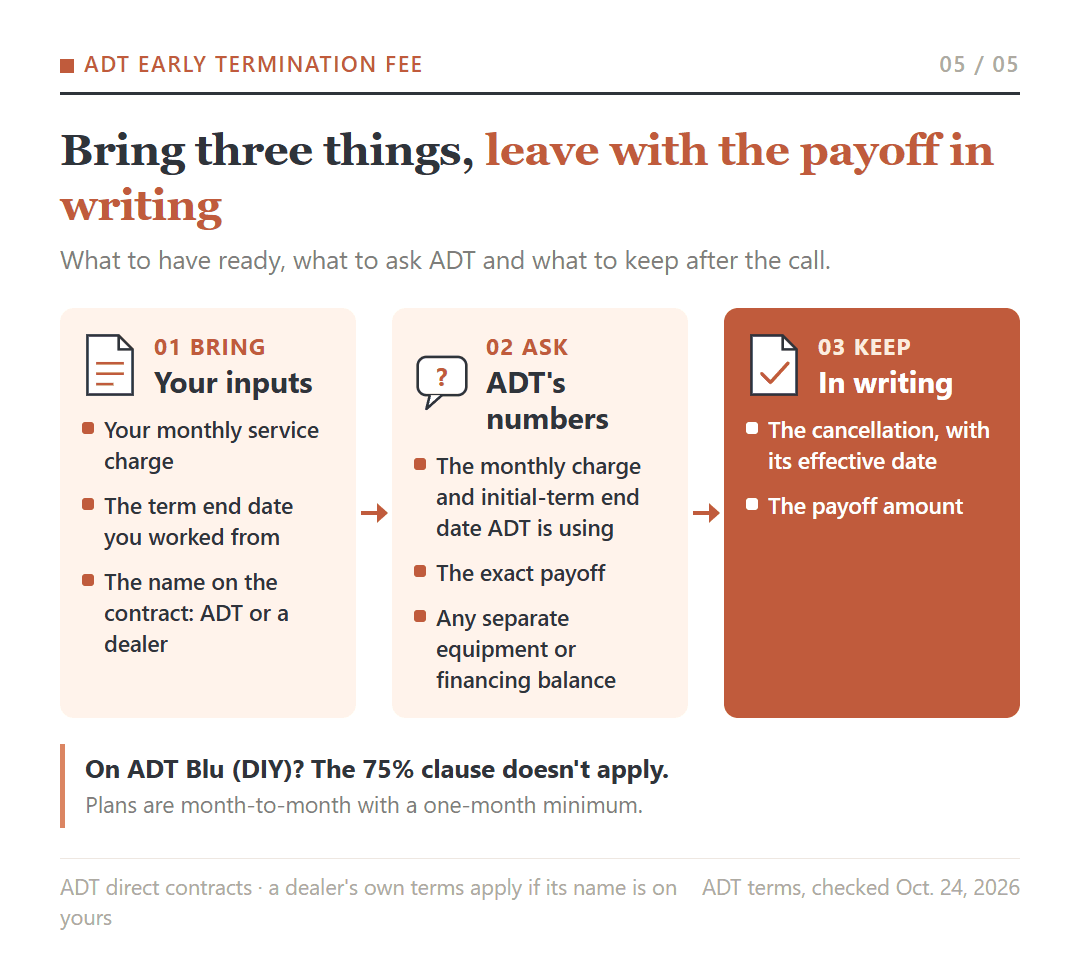
If you financed your equipment, the early termination fee and any remaining equipment balance are separate questions, so get an answer on each. On ADT Blu, the DIY line, plans are month-to-month with a one-month minimum, so the 75% clause doesn’t apply; cancel at (888) 392-2039 or through your order confirmation email.
Moving usually means closing more than one account. If internet is next on the list, it helps to know what Xfinity charges when you cancel early and how its equipment return works. And if the moving company’s final bill comes in above its quote, this walks through what you can do when movers charge more than the estimate.
Canceling early saves you a quarter of what’s left on the contract, but only if you weren’t going to use the service anyway. Only when you’re sure you won’t need ADT at the next address does that quarter become money you actually keep.
Sources: ADT, Residential Terms & Conditions (offer terms as published in October 2026); FTC, Buyer’s Remorse: The FTC’s Cooling-Off Rule May Help; 50 U.S.C. § 3956; U.S. Department of Justice, ADT to Pay $1.3M to Servicemembers for Illegal Charges (Apr. 14, 2026). Checked Oct. 24, 2026. The households in the examples are hypothetical, their monthly rates are ADT’s advertised starting prices, and the figures leave out taxes, fees and any equipment balance.