If you’ve lived in Austin for a few winters, you’ve probably heard some version of the rule of thumb: get the sprinklers off by mid-November, because that’s when your sewer bill gets decided.
Austin Water’s posted table for this winter reads a little differently. No billing cycle starts its window before December 1, 2026, and some keep measuring into late March. Cycle 2 runs until March 29, 2027.
Shutting the sprinklers off early does no harm. Turning them back on during the first warm week of March can cost you, if your cycle still has a few weeks to go.
Here’s the rule: Austin Water averages the water that runs through your meter during three consecutive winter billing months. Once your window closes, that average becomes the wastewater volume you’re billed each month for about the next year, or your actual water use that month if it’s lower.
Using more water in summer doesn’t push that number up. Using more during the window does. Sprinkler water, pool refills, car washing and leaks all count, even though none of it goes down the sewer.
Your three months depend on your billing cycle, and the cycle number is at the top left of your bill. This winter, the 20 cycles start between December 1 and December 27, 2026 and end between March 1 and March 29, 2027.
At the 2026–27 standard rates, each extra 1,000 gallons in your average adds $15.38 to the monthly wastewater charge once the average is above 2,000 gallons, and $7.58 below that line. That extra applies in every month your actual use reaches the average.
This covers Austin Water residential accounts. Other cities that bill sewer on a winter average use their own dates and rules.
Find Your Three Months: Start With the Cycle Number on Your Bill
Austin Water reads more than 250,000 meters in 20 groups, and each group’s billing cycle sets when its meter is read. That’s why there’s no single citywide window, and you can’t pick different months.
Pull up a recent bill and find the cycle number at the top left. Match it to the table below, or enter your address in Austin Water’s wastewater averaging page and calculator to see your dates.
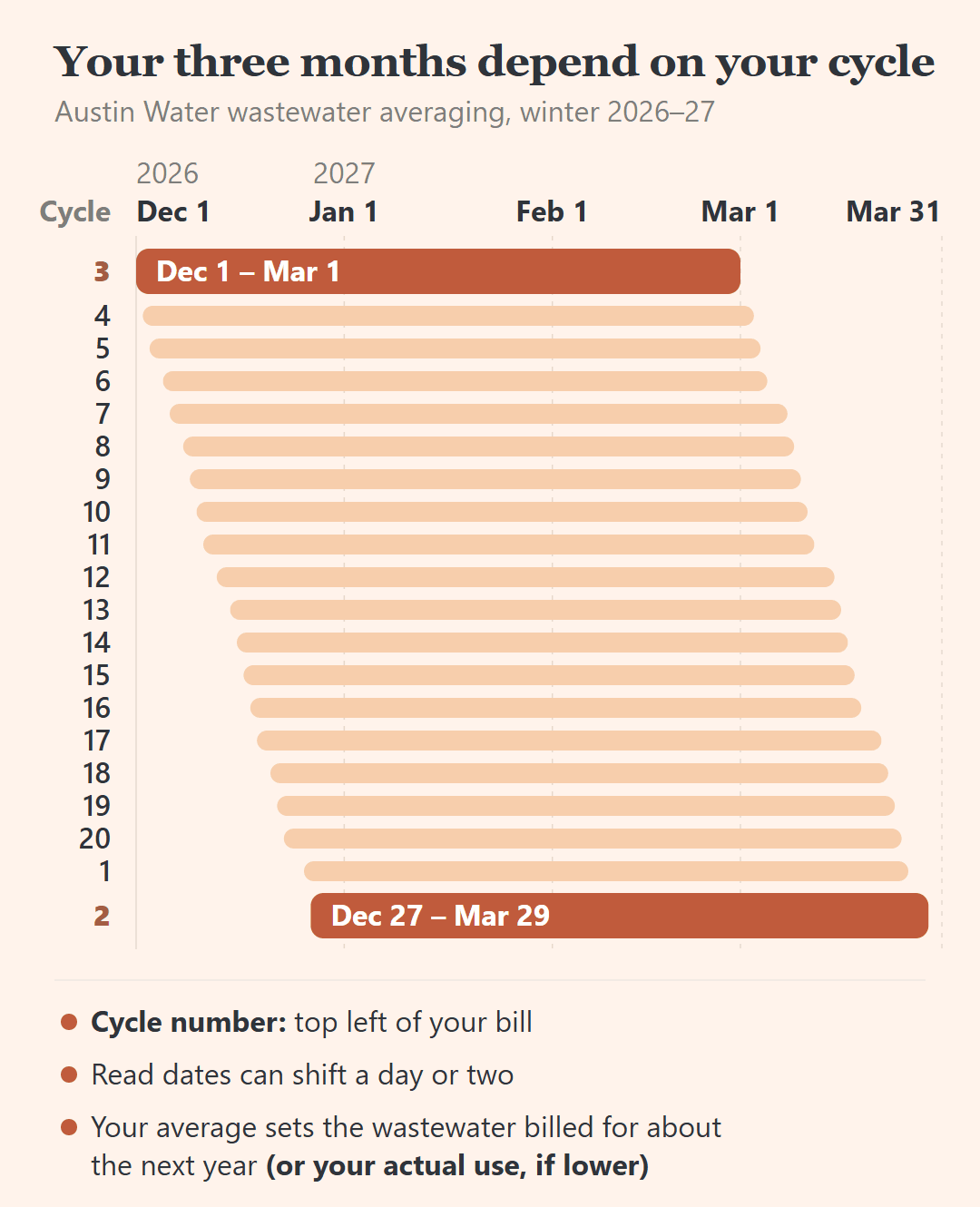
| Cycle | Window starts (2026) | Window ends (2027) | Active Date to Qualify (2027) |
|---|---|---|---|
| 1 | Dec 26 | Mar 26 | Jan 26 |
| 2 | Dec 27 | Mar 29 | Jan 27 |
| 3 | Dec 1 | Mar 1 | Jan 1 |
| 4 | Dec 2 | Mar 3 | Jan 2 |
| 5 | Dec 3 | Mar 4 | Jan 3 |
| 6 | Dec 5 | Mar 5 | Jan 5 |
| 7 | Dec 6 | Mar 8 | Jan 6 |
| 8 | Dec 8 | Mar 9 | Jan 8 |
| 9 | Dec 9 | Mar 10 | Jan 9 |
| 10 | Dec 10 | Mar 11 | Jan 10 |
| 11 | Dec 11 | Mar 12 | Jan 12 |
| 12 | Dec 13 | Mar 15 | Jan 13 |
| 13 | Dec 15 | Mar 16 | Jan 15 |
| 14 | Dec 16 | Mar 17 | Jan 16 |
| 15 | Dec 17 | Mar 18 | Jan 17 |
| 16 | Dec 18 | Mar 19 | Jan 19 |
| 17 | Dec 19 | Mar 22 | Jan 20 |
| 18 | Dec 21 | Mar 23 | Jan 21 |
| 19 | Dec 22 | Mar 24 | Jan 23 |
| 20 | Dec 23 | Mar 25 | Jan 24 |
Treat these as close, not exact. Austin Water says read dates can move a day or two, for example when weather changes the meter-reading schedule. A few days of margin on each end costs you nothing.
Every Gallon Through the Meter Counts. Here’s What Each 1,000 Costs
There’s no meter on your sewer line, so Austin Water uses your water meter during the window as a stand-in for what goes down the drain. The meter can’t tell a shower from a sprinkler zone, a pool top-off or a running toilet. All of it lands in the average.
That’s why the city’s own advice is simply to cut back outside water use during your three months. It’s the one lever you control.
The 2026–27 rates behind the math
For residential customers on standard (non-CAP) rates, effective October 1, 2026, the wastewater side of the bill has a $11.26 monthly customer charge. Volume costs $7.13 per 1,000 gallons for the first 2,000 gallons and $14.93 per 1,000 above that.
Two community benefit charges add $0.30 and $0.15 per 1,000 gallons of wastewater billed. Folded together, that gives you a simple formula:
Monthly wastewater charge = $11.26 + $7.58 for each 1,000 gallons up to 2,000 + $15.38 for each 1,000 gallons above 2,000.
Austin Water’s own example checks out against it: 4,000 gallons of wastewater comes to $57.18 a month. That’s the city’s example at 4,000 gallons, not a typical bill for your house.
Customers in Austin Water’s Customer Assistance Program pay lower volume rates, so their dollar figures will differ from the ones here. Rates are also set year by year, so these are the numbers in effect now, not a promise for the whole averaging year.
Your own numbers
To see roughly where your current average sits, look at a bill from a month when you used a lot of water, such as a hot summer month with the sprinklers running. Under the lower-of rule, the wastewater gallons billed that month should equal your average.
Austin Water’s bill guide says the service details section breaks down how your water and wastewater charges are calculated, so that’s the place to look. Then run the formula above with that number, and again with the number you’d expect if outdoor watering were off for the window.
Household A: sprinklers off for the window
Here’s a hypothetical example, built from Austin Water’s posted 2026–27 standard rates rather than a real customer’s bill. Household A uses about 3,000 gallons a month indoors and turns the irrigation controller off before its window starts. Its average comes out at 3,000 gallons.
That’s $11.26 + $15.16 + $15.38 = $41.80 a month for wastewater in any month A uses 3,000 gallons or more.
Household B: same house, schedule left running
Household B is the same hypothetical house with the same 3,000 gallons of indoor use, but the sprinkler schedule keeps running and adds about 4,000 gallons a month during the window. B’s average lands at 7,000 gallons.
That’s $103.32 a month in any month B uses 7,000 gallons or more, or $61.52 more than A. Those extra 4,000 gallons all sit above the 2,000-gallon line, so each one costs $15.38 a month.
Over 12 months that gap could reach about $738 in this example, but only if B uses at least 7,000 gallons every month and the 2026–27 rates hold all year. In months B uses less, the lower-of rule bills actual use and the gap shrinks.
Three Situations Where the Usual Advice Doesn’t Fit
You have a separate irrigation meter
If your sprinklers run on their own meter, most of this may not apply to you. Austin Water says most customers with an irrigation meter aren’t billed on a wastewater average at all; their wastewater is billed at the same volume as their house meter’s water use each month. Check your bill or ask Austin Water which way yours works.
You moved in this fall or winter
A new account needs at least 60 days of service to get its own average. If yours hasn’t been active long enough, Austin Water assigns the residential default of 5,000 gallons instead.
The table above lists an “Active Date to Qualify” for each cycle, from January 1 to January 27, 2027 this winter. If your service started close to your cycle’s date, ask Austin Water whether your account will get its own average.
A move usually means closing out other bills too. If you’re leaving a retail electricity plan elsewhere in Texas, read when a move gets you out of a Texas electricity early termination fee. If Spectrum was the internet provider at the old place, check whether Spectrum prorates your final bill before you pick a cancel date.
The house will sit empty most of the winter
This is where “use as little as possible” can backfire. If one of your three window months bills zero, Austin Water drops that month and averages the other two. If two or more months bill less than 100 gallons, you get the 5,000-gallon default instead of your own low number.
Take hypothetical Household C, which normally uses about 3,000 gallons a month but is away for most of its window, so two of the three months bill under 100 gallons. At 2026–27 standard rates, C’s default means $72.56 a month for wastewater in any month C uses 5,000 gallons or more, against $41.80 at a 3,000-gallon average.
That’s $30.76 more in those months. In months C stays near 3,000 gallons, the lower-of rule bills actual use and the difference is smaller or zero. If your house will be empty, weigh that before shutting the water off for the whole season.
Before Your Window Opens
- Find your cycle number at the top left of your bill, then write down your start and end dates from the table or the city’s calculator.
- Turn the irrigation controller off or to manual before your start date, and leave it there until your end date has passed. Hold off on pool refills and driveway car washes for the same stretch.
- Check for leaks in November. A running toilet or a dripping hose bib adds to the average the same way a sprinkler does.
- If you’ll be away, remember that two near-empty months bring the 5,000-gallon default.
If a leak does run during your window, Austin Water’s leak bill adjustment has to be requested within 90 days of the repair, with the repair receipt and the dates of the high bills. The steps are on its high water bill options page; ask Customer Care at 512-494-9400 whether the adjustment also changes your wastewater average.
If anything about your account is unclear, this is what I’d ask before December:
“My account is on billing cycle [number]. Can you confirm the read dates for my wastewater averaging period this winter? And is my wastewater billed on a winter average, or on my house meter because I have a separate irrigation meter?”
What stands out to me about this charge is that it’s one of the few lines on a utility bill a household sets for itself. About 90 days of winter water use decides the wastewater volume for the year that follows, and the meter counts the lawn the same as the laundry. Put your start date on the calendar now, while the sprinkler schedule is still easy to change.
Sources: Austin Water’s wastewater averaging page (2026–27 table, rules and FAQs), the 2026–27 residential rates linked from its rates and fees page, Austin Water’s 2027 rate adjustment fact sheet and bill guide, and its high water bill options page. Checked October 2026; rates effective October 1, 2026.